What is revenue cycle management?
Revenue cycle management is the chain of tasks, owners and payer deadlines that carries a patient visit from the appointment to a zero balance. The Healthcare Financial Management Association defines it as “the process used by healthcare systems to track the revenue from patients, from their initial appointment or encounter with the healthcare system to their final payment of balance.” HFMA writes for hospitals and health systems. In a private practice the same cycle is shorter, run by fewer people, and it starts earlier: a clinician who is not yet enrolled with a payer can see patients whose visits that payer may never pay.
Revenue cycle management vs medical billing
Medical billing covers the claim itself, from creating it to posting the payment. Revenue cycle management adds the stages on either side: enrollment, eligibility checks and authorizations before the visit, and denial analysis, A/R follow-up and patient balances after the payment posts. A practice can have a competent biller and still lose money in the stages nobody owns.
Why the cycle decides a private practice's cash
Each stage inherits the time the stage before it used. A claim filed after the payer's deadline is lost even when the care, the codes and the coverage were all correct. Cigna, for example, tells contracted providers that their contract does not allow billing the patient when a claim is denied for late filing, so the practice absorbs that loss. A hospital spreads such losses across a large volume of claims; a five-clinician practice feels each one in that month's payroll.
The medical revenue cycle in 9 stages for a private practice
The revenue cycle management process in a private practice runs in nine stages. Each stage below names who usually owns it in a small practice, how it fails, and the clock it runs against.
- Credentialing and enrollment. Each clinician is enrolled with each payer before billing that payer. Failure: sessions happen before the effective date. Clock: Medicare lets physicians, non-physician practitioners, physical therapists, occupational therapists and speech-language pathologists bill retrospectively for up to 30 days before their effective date when circumstances prevented enrolling in advance, or 90 days after a Presidentially-declared disaster. Other payers set retroactive billing in their own enrollment terms.
- Eligibility and benefits. The front desk confirms active coverage, the plan, the copay and the deductible before the visit. Failure: a changed plan surfaces weeks later as a denial.
- Prior authorization. Where the payer requires it, staff request approval before the service and track the units or visits approved. Failure: an authorization expires or runs out of units mid-treatment.
- Documentation and charge capture. The clinician documents and signs the visit, and the charge is entered. Failure: unsigned notes hold charges. Every day of charge lag comes out of the payer's filing window.
- Coding and claim submission. Codes are checked against the note, the claim is scrubbed and sent through a clearinghouse. Failure: a claim rejected at clearinghouse edits is assumed to be filed when it never reached the payer.
- Adjudication. The payer pays, denies or adjusts the claim. Owner: the payer. Clock: Medicare's 30-day payment ceiling for clean claims (below).
- Payment posting. Each remittance is posted line by line, adjustments included. Failure: a zero-paid line written off as a contractual adjustment hides a denial. The payer sets no clock here, so set your own.
- Denials and appeals. Each denial is corrected, reopened or appealed, and its cause is logged. Clock: the payer's corrected-claim and appeal windows. Denial management for private practices covers the log and the process.
- A/R follow-up and patient balances. Open claims are worked nearest deadline first. The patient's share is billed once the remittance assigns patient responsibility. Clock: the nearest filing or appeal deadline on each open claim.
A monthly review closes the loop: each recurring denial cause goes back to the stage, and the person, that created it.
| Stage | Usual owner in a small practice | First sign it is failing |
|---|---|---|
| Credentialing and enrollment | Owner or office manager | Sessions booked before a payer's effective date |
| Eligibility and benefits | Front desk | Eligibility and coverage denials |
| Prior authorization | Front desk or intake coordinator | Authorization denials; units used up before the plan of care ends |
| Documentation and charge capture | Clinicians | Unsigned notes; charge lag grows |
| Coding and claim submission | Biller | Clearinghouse rejections left unworked |
| Adjudication | Payer | Clean claims still unpaid past the payer's own clock |
| Payment posting | Biller or bookkeeper | Remittances waiting days to post |
| Denials and appeals | Biller, if anyone | The same denial cause repeats month after month |
| A/R follow-up and patient balances | Biller and front desk | The share of A/R older than 90 days grows |
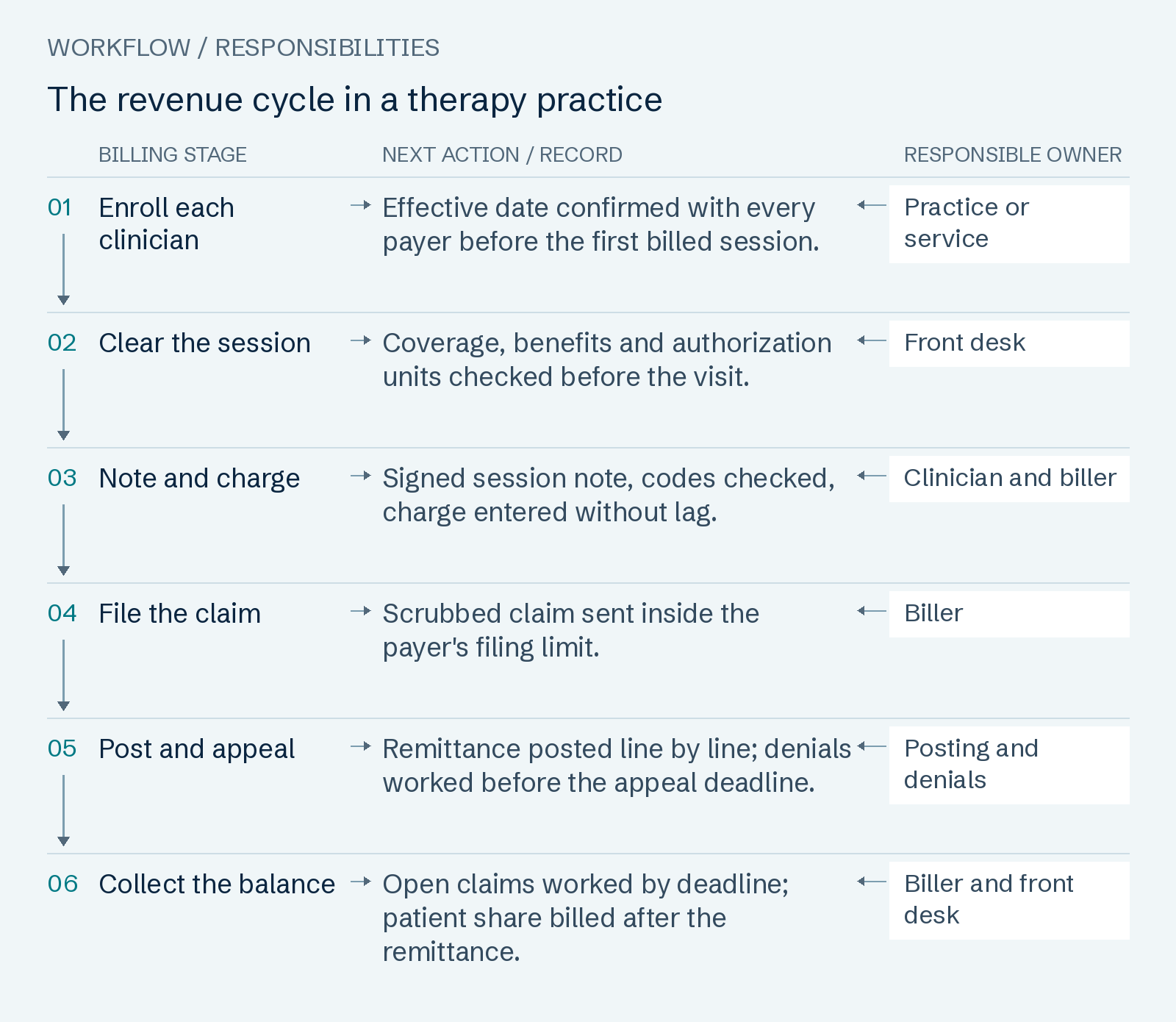
Read the workflow as text
- Enroll each clinician — Effective date confirmed with every payer before the first billed session. Owner: Practice or service.
- Clear the session — Coverage, benefits and authorization units checked before the visit. Owner: Front desk.
- Note and charge — Signed session note, codes checked, charge entered without lag. Owner: Clinician and biller.
- File the claim — Scrubbed claim sent inside the payer's filing limit. Owner: Biller.
- Post and appeal — Remittance posted line by line; denials worked before the appeal deadline. Owner: Posting and denials.
- Collect the balance — Open claims worked by deadline; patient share billed after the remittance. Owner: Biller and front desk.
The deadline layer: filing, corrected-claim and appeal clocks by payer
Every claim in your A/R carries up to three clocks: the limit for filing the first claim, the limit for sending a corrected claim, and the window for disputing the payer's decision. Each payer sets its own, so the same nine stages run on different clocks. The rows below come from our timely filing dataset, which quotes each payer's own manual or rule. Your contract or state law can set a different limit, so read your agreement for your own deadlines.
How the clocks count
Filing limits usually count from the date of service. Medicare's Claims Processing Manual says claims must be filed no later than 12 months, or 1 calendar year, after the date the services were furnished. Appeal windows usually count from the payer's notice instead. A Medicare redetermination must be filed within 120 days of receiving the initial determination, and the notice is presumed received 5 days after its date. Texas Medicaid gives practices 95 days from each date of service to file and 120 days from the disposition date on its R&S Report to appeal. New York Medicaid requires claims within 90 days of the date of service and a rejected or denied claim corrected and resubmitted within 60 days of the notification.
Medicare's own payment clock
Medicare also runs a clock on itself. Chapter 1 of the manual says clean claims must be paid or denied within 30 days of receipt, with interest owed on clean claims paid after that ceiling. A payment floor blocks early payment: a HIPAA-compliant electronic claim is not paid before the 14th day after receipt, and a paper claim not before the 29th day. A clean Medicare claim still unpaid after 30 days needs a status check, not more waiting.
| Payer and product line | File the first claim within | Corrected claims | Dispute or appeal window | Scope |
|---|---|---|---|---|
| Original Medicare (Part A and Part B) | 12 months (1 calendar year) after the date of service | Items not on the first claim cannot be added after the filing limit | Redetermination: 120 days from receipt of the notice | National |
| Cigna commercial | 90 days (participating); 180 days (out-of-network) after the date of service | Resubmissions Cigna did not request fall under the filing limit | Appeal within 180 calendar days of the initial payment or denial notice | National; state law or the agreement can allow longer |
| Cigna Healthcare / Evernorth Behavioral Health | 90 days from the date of service, or as your agreement defines | A timely claim returned for more information restarts the 90 days from Cigna's request | Payment appeals within 180 calendar days of the initial payment or denial decision | National |
| Blue Cross and Blue Shield of Texas, commercial PPO | 365 days of the date of service | Same filing deadline as the manual or subscriber contract | Claim dispute within 180 days of the check date or EOP date | Texas |
| Texas Medicaid (TMHP fee-for-service) | 95 days of each date of service | Not stated in our source | Appeal within 120 days of the disposition date on the R&S Report | Texas |
| New York State Medicaid (eMedNY fee-for-service) | 90 days of the date of service | Rejected or denied claims corrected and resubmitted within 60 days of notification | Not stated in our source | New York |
RCM metrics a private practice should track monthly
Revenue cycle management is measured stage by stage, because one practice-wide number tells you money is missing without telling you where. Track one formula per stage, recompute it each month from your practice-management reports, and split each one by payer. The monthly revenue cycle KPI report covers what a billing team's report should show and who should produce it.
Count rejections and denials apart
A rejection fails front-end or clearinghouse edits and never enters adjudication, so you fix and resubmit it. A denial is an adjudicated claim the payer will not pay as billed, so you correct it, ask for reconsideration or appeal. Counted together, they hide whether your claim data or the payer's decision caused the loss.
Worked example: A/R days, aged A/R and net collection rate
Illustrative example with round numbers, not client data and not a benchmark. A practice holds $120,000 in total A/R and entered $270,000 in charges over the last 90 days.
- Average daily charges: $270,000 ÷ 90 = $3,000.
- A/R days: $120,000 ÷ $3,000 = 40.
- If $30,000 of that A/R is older than 90 days, the aged A/R share is $30,000 ÷ $120,000 = 25%.
- If the month brought $60,000 of charges, $20,000 of contractual adjustments and $36,000 of payments, the net collection rate is $36,000 ÷ ($60,000 − $20,000) = 90%.
We print no target rates. Payer mix and specialty set what normal looks like, so compare each month with your own first month, payer by payer.
| Stage | Metric | Formula |
|---|---|---|
| Eligibility and authorization | Front-end denial share | Denials for coverage, eligibility or authorization ÷ all denials |
| Charge capture | Charge lag | Date the charge is complete − date of service, in days |
| Claim submission | Clean claim rate | Claims adjudicated on first submission without correction ÷ claims submitted |
| Claim submission | Rejection rate | Claims rejected at front-end or clearinghouse edits ÷ claims submitted |
| Adjudication | Denial rate | Claims denied ÷ claims adjudicated |
| Payment posting | Days to post | Posting date − remittance date, in business days |
| Denials and appeals | Overturn rate | Denials paid after correction or appeal ÷ denials worked |
| A/R follow-up | A/R days | Total accounts receivable ÷ average daily charges |
| A/R follow-up | Aged A/R share | A/R older than 90 days ÷ total A/R |
| Whole cycle | Net collection rate | Payments ÷ (charges − contractual adjustments) |
How to improve revenue cycle management: 12 fixes, deadline risk first
The order below puts money with a deadline ahead of money without one. The first fixes protect claims that are lost outright once a date passes; the later ones lower the cost and delay of every future claim. For each fix, the stage it repairs is in brackets.
- List every open claim with its deadline. Add the filing, corrected-claim and appeal date to each unpaid claim and sort by the nearest one. [A/R follow-up]
- Work everything within 30 days of a deadline this week. File, correct or appeal it, and keep the clearinghouse acceptance report as proof of timely filing. [A/R follow-up]
- Clear the rejection queue daily. A rejected claim was never received, so the filing clock keeps running. [Claim submission]
- Work denials within days of posting. The appeal window starts at the notice, not when someone opens it. [Denials and appeals]
- Check eligibility before every first visit and every plan change. Insurance eligibility verification before the visit prevents the coverage denials that otherwise surface weeks later. [Eligibility]
- Track authorizations by units remaining. Renew before the last approved visit, not after the denial. [Prior authorization]
- Close notes within a set number of days. Charge lag spends the filing window before a claim exists. [Charge capture]
- Confirm each new clinician's effective date with every payer before booking. Medicare's 30-day retrospective allowance does not reach other payers by default. [Enrollment]
- Post line by line, never in batches. A zero-paid line hidden inside a batch total is a denial nobody works. [Payment posting]
- Compare payments with your contracted rates. An underpaid line is not a denial, so it never reaches a denial queue. [Payment posting]
- Log the cause of every denial and fix the top three upstream. A front-desk or documentation fix stops the same denial on future visits. [Denials and appeals]
- Bill the patient's share as soon as the remittance sets it. Collect copays at check-in, and send statements on a fixed cycle. [Patient balances]
For a slower walk through diagnosing which stage leaks first, see how to improve your practice's revenue cycle. Our denial management steps cover fixes 4 and 11 in detail.
RCM for therapy, ABA and behavioral health: what is different
Therapy, ABA and behavioral health practices run the same nine stages, but the volume and the payers change which stage breaks first. A therapist seeing a client weekly creates many small claims for the same person, so a single eligibility or authorization miss repeats on every session until someone catches it.
Carved-out behavioral networks run their own clocks
When a plan sends behavioral health to a separate network, that network sets its own filing limit. Cigna's Evernorth Behavioral Health administrative guide considers only claims submitted within 90 days of the date of service, or as your provider agreement defines. That is a quarter of Original Medicare's 12 months, so a behavioral health practice that bills Medicare and a carved-out commercial network cannot run one follow-up rhythm for both.
Enrollment timing for therapists and new hires
Physical therapists, occupational therapists and speech-language pathologists are on the same Medicare list for 30-day retrospective billing as physicians. A new hire who starts seeing patients before each commercial and Medicaid effective date can build a caseload no payer will pay. In ABA, check which professional each payer enrolls and which credential the claim must name before scheduling sessions under a new clinician.
Authorization-heavy cycles
Where your payers authorize therapy or ABA by units or visits, the authorization log becomes part of the revenue cycle, not intake paperwork. Track units used against units approved each week and request renewals with the progress documentation the payer asks for. The behavioral health revenue cycle management guide covers clinician eligibility, rates and intensive outpatient programs in more depth.
In-house, software or outsourced RCM
Three models cover most private practices. Each still needs a named owner for every stage; what changes is who does the work and what you pay for it. The in-house vs outsourced cost model puts numbers on the comparison for your practice.
What stays with your practice under any model
Clinical documentation, signing notes, collecting copays at check-in, approving write-offs and the bank account that receives every payment stay with you. A billing company that runs your cycle works inside those limits.
| Model | Who does the work | What you pay | What can go wrong |
|---|---|---|---|
| In-house biller | Your employee runs submission, posting, denials and A/R | A salary plus benefits, software and clearinghouse fees; a billing and posting clerk's median wage is $48,500 a year (BLS) | One absence or resignation stops the cycle; deadlines go unwatched |
| Software you run yourself | Your staff, with automated claim edits and eligibility checks | A subscription priced by the vendor; ask for a written quote | The software flags problems but nobody is assigned to work them |
| Outsourced RCM | A billing company runs the stages you hand over | Usually a percentage of collections; ours is 5.0% to 8.5% of insurance payments | Unclear scope, or a contract without written turnarounds and exit terms |
Build your own A/R deadline map in a spreadsheet
An A/R deadline map lists every unpaid claim with the date it expires, so your team works the money that can still be lost before the money that cannot. You can build one from your practice-management system's aging report in about an hour.
- Export a claim-level aging report. One row per claim: patient account, payer, date of service, billed amount, balance, claim status and the last denial reason.
- Add the payer's limits. Use our timely filing dataset to look up each payer's filing, corrected-claim and appeal limit. Where your contract states a different number, use the contract.
- Calculate each claim's deadline. For an unfiled or rejected claim, the deadline is the date of service plus the filing limit, for example
=C2+365for a 365-day limit. For a denied claim, it is the notice date plus the appeal window. - Count the days left. Add a column with
=deadline-TODAY(). - Sort by days left, smallest first. Highlight every claim with 30 days or fewer.
- Assign each claim a next action and an owner. File, correct, appeal or write off, with the name of the person and the date.
How to read the map
Claims with a negative number of days left have passed a deadline; check them for a proof-of-timely-filing exception before writing them off. Claims under 30 days are this week's work. The total balance under 30 days is the money your practice can still lose this month. If the map is longer than your team can work, that is the point to hand it off: our revenue cycle management services put every claim on a deadline clock, and the billing rate card by specialty and practice size shows what that costs.
Or have us build it for your unpaid insurance claims over 90 days: Get my free A/R Deadline Map. A claim-by-claim list of every unpaid insurance claim over 90 days in the aging report you send: payer, amount, the deadline it faces, the denial reason and the next action, sorted by deadline. Clock starts with your claim-level aging export and signed BAA; above 10 requests in a week, we confirm your date within 1 business day.
Common questions
- What is revenue cycle management in simple terms?
- It is everything that happens between booking a patient and having the visit fully paid: enrolling clinicians with payers, checking coverage, coding and filing the claim, posting the payment, fixing denials and collecting the patient's share. The definition above shows how it differs from medical billing.
- What are the stages of the revenue cycle?
- This guide uses nine: credentialing and enrollment, eligibility and benefits, prior authorization, documentation and charge capture, coding and claim submission, adjudication, payment posting, denials and appeals, and A/R follow-up with patient balances. Lists with five or seven stages combine some of these; whatever the count, each stage needs an owner and a clock. The stage list gives both.
- How can a private practice improve its revenue cycle?
- Start with the claims that can still be lost: list every open claim with its filing or appeal deadline and work the nearest ones first. Then fix the stages upstream, such as eligibility checks before first visits, daily rejection work and authorization tracking. The 12 fixes are ordered that way.
- What is a good collection rate for a private practice?
- We print no target, because payer mix and specialty set what normal looks like. Use the net collection rate, payments ÷ (charges − contractual adjustments), split by payer, and compare each month with your own first month. A falling rate for one payer points to that payer's denials or underpayments; the metric table shows which stage to check next.
- How do filing deadlines affect revenue?
- A claim filed after the payer's limit is usually denied for good, even when the care and coding were correct, and a contract can stop you billing the patient for it. Original Medicare allows 12 months from the date of service; Cigna allows participating providers 90 days; Texas Medicaid allows 95 days. The payer table lists corrected-claim and appeal windows too.
- Is outsourcing revenue cycle management worth it for a small practice?
- It depends on whether anyone on your staff owns each stage and watches each deadline. If your aged A/R keeps growing or denials go unworked, compare the full cost of a biller with an outsourced fee using the cost model, and see what our billing service costs for your specialty and size.
Sources and review
Page revised November 4, 2026 · Review contact: Hyder Shah (inquiries@claimpillar.com). Every source below was retrieved on November 4, 2026. The payer table also draws on our timely filing dataset (payer manuals, retrieved October 2, 2026), including Cigna's appeals page and the Blue Cross and Blue Shield of Texas PPO manual; each limit applies to the payer and product named in its row.
- HFMA: Healthcare Revenue Cycle Management (RCM), What It Is and How It Works
- CMS Medicare Claims Processing Manual (Pub. 100-04), Chapter 1: General Billing Requirements
- CMS Medicare Claims Processing Manual (Pub. 100-04), Chapter 29: Appeals of Claims Decisions
- eCFR: 42 CFR 424.521, Request for payment by certain provider and supplier types
- Cigna Healthcare: Claims Submission, Payments, and Filing
- Cigna Healthcare / Evernorth Behavioral Health: Provider Administrative Guide
- TMHP: Texas Medicaid Provider Procedures Manual, Claims Filing
- eMedNY: Information for All Providers, General Billing