What behavioral health revenue cycle management covers, and where your practice loses money
Behavioral health revenue cycle management is every step between a scheduled therapy, testing, psychiatry or intensive outpatient (IOP) service and the last dollar posted for it: benefit checks, authorizations, clinician enrollment, coding, claims, payment posting, denials and appeals. Five behavioral rules inside those stages decide how much of what your clinicians earn reaches your account.
How is it different from a general medical revenue cycle?
The difference is who sets the rules. A behavioral health company such as Optum Behavioral Health or Evernorth Behavioral Health can manage the mental health benefit behind a medical plan, and then its filing window and authorization list apply. The clinician's license sets the Medicare rate. Federal parity law adds an appeal argument that exists only for mental health and substance use benefits.
| Where revenue leaks | What happens in your practice | The rule behind it (scope) |
|---|---|---|
| Carve-out filing windows | A claim sent on the medical plan's schedule reaches the behavioral company too late | Optum Behavioral Health: 90 calendar days from the date of service; most Magellan contracts: 60 days |
| Authorizations for testing and IOP | Test hours or program days delivered before approval go unpaid | Optum: routine outpatient therapy typically needs none; psychological testing and IOP typically do |
| Associate clinicians | Sessions by a pre-licensed clinician go to a payer that will not pay for them | Evernorth credentials only independently licensed clinicians; Optum's commercial supervision policy pays for them as state licensing rules allow |
| License-based Medicare rates | A correct payment is written off as an underpayment, or a real underpayment is missed | Medicare pays social workers, MFTs and counselors 75% of the clinical psychologist amount |
| Lapsed enrollment | Sessions seen during the lapse cannot be paid | Original Medicare pays nothing for a deactivated period; revalidation is generally every five years |
Which clinicians can your practice bill for, and at what rate?
The clinician's license sets three things on a Medicare claim: who may enroll, whether anyone else can bill under them, and the rate. CMS's Medicare mental health coverage booklet (MLN1986542) states that marriage and family therapists (MFTs) and mental health counselors may enroll and bill Medicare independently since January 1, 2024, and that Medicare pays clinical social workers, MFTs and counselors 75% of the physician fee schedule amount for clinical psychologists.
Can your group bill for associate clinicians?
Only where the payer and your state allow it, so get each payer's written rule before an associate's first session with its members. Medicare can cover behavioral health services that auxiliary personnel provide incident to a physician, clinical psychologist, NP, CNS, PA or CNM, under general supervision, when every incident-to requirement is met; a social worker, MFT or counselor cannot be that supervising biller. Medicare's MFT and counselor categories also require at least 2 years or 3,000 hours of post-master's supervised experience. Commercial networks split: Optum's network manual says it reimburses services by unlicensed practitioners working toward licensure under its commercial supervision reimbursement policy, as state licensing and scope-of-practice rules allow, while Evernorth requires a license to practice independently.
Worked example: what Medicare expects for 90837 by license
This is an example. It uses the 2026 national Medicare amount (unadjusted) for 90837, a 60-minute therapy session, in a non-facility setting: $167.00, from the CMS CY 2026 PFS relative value file (RVU26D). A clinical psychologist who accepts assignment expects $167.00. A social worker, MFT or counselor billing the same session expects $167.00 × 0.75 = $125.25. Actual payment varies by locality, setting and payer, and patient cost-sharing comes out of either amount. If your posting ignores the license, a correct $125.25 payment looks like a $41.75 underpayment.
| Clinician license | Medicare enrollment | Medicare rate basis | 90837, 2026 national Medicare amount (unadjusted), non-facility |
|---|---|---|---|
| Clinical psychologist | Enrolls and bills; auxiliary staff may provide services incident to them | 100% of the fee schedule, with assignment | $167.00 |
| Clinical social worker | Enrolls and bills; no services incident to them | 75% of the clinical psychologist amount | $125.25 (75% of $167.00) |
| Marriage and family therapist | Enrolls and bills since January 1, 2024 | 75% of the clinical psychologist amount | $125.25 (75% of $167.00) |
| Mental health counselor | Enrolls and bills since January 1, 2024 | 75% of the clinical psychologist amount | $125.25 (75% of $167.00) |
How do IOP programs get paid, and where do they lose revenue?
IOP reimbursement depends on who pays and where the program runs. Under Original Medicare, the CMS booklet lists the settings that provide IOP services: hospitals, critical access hospitals, community mental health centers, FQHCs, rural health clinics and opioid treatment programs. A physician must determine, at least every other month, that the patient needs a minimum of 9 hours of services per week, under a written treatment plan. A group therapy practice is not among those settings.
Commercial plans and Medicaid pay IOP under their own contracts and codes, and authorization comes first: Optum's manual lists intensive outpatient care among the non-routine services that typically require authorization before they are provided. Watch three things every week: the authorization's end date against the schedule, the hours each patient actually attended against the program's minimum, and the payer's filing window for each program day. Authorization tracking is a task you can delegate to a prior authorization service.
How can you tell where your practice's revenue cycle stands?
Your billing reports can answer this. Pull these numbers for the last full quarter, by payer and by clinician:
- A/R days: total accounts receivable divided by average daily charges.
- Aged A/R: balances older than 90 days, by payer. A behavioral carve-out balance at 90 days may already be past its filing window.
- Net collection rate: payments divided by charges minus contractual adjustments.
- Denials by reason: count authorization, enrollment and timely-filing denials separately; each points to a different leak in the table above.
- Claims within 30 days of a filing limit: the number that shows a carve-out deadline before it passes.
- Payments against the expected amount by license: so a 75% Medicare payment is not mistaken for an error.
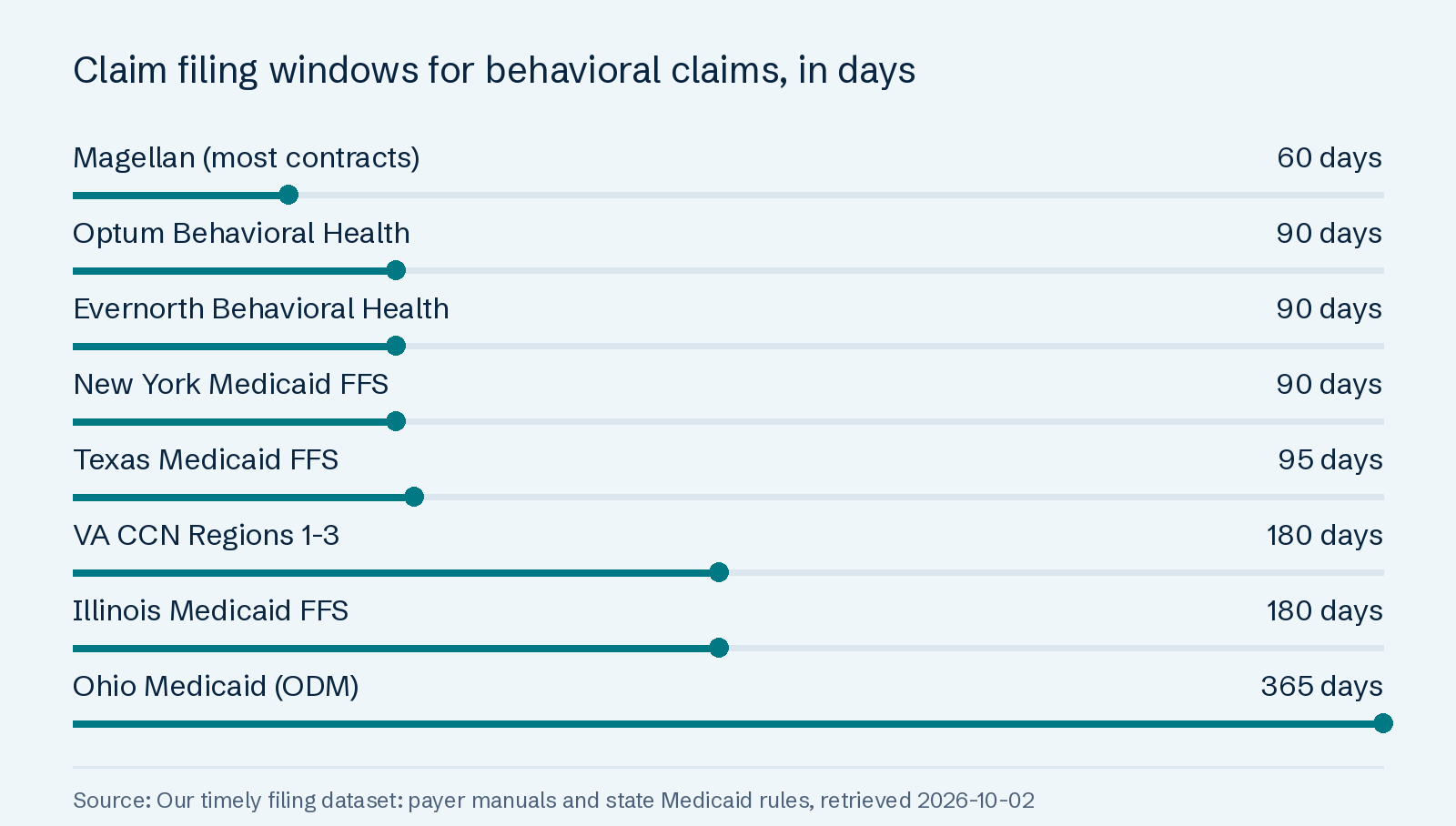
The chart shows why a single filing calendar fails: the windows in it run from 60 to 365 days, and Original Medicare allows 12 months. They come from our filing deadlines by payer dataset; a contract, plan or state law can set a different limit.
Worked example: one date of service, two deadlines
This is an example. A therapist sees two patients on March 2, 2026: one whose behavioral benefit Optum manages, one on Original Medicare. The Optum claim must arrive within 90 calendar days: 29 days remain in March, 30 in April and 31 in May (29 + 30 + 31 = 90), so the last day is May 31, 2026. The Medicare claim may be filed through March 2, 2027. The Optum deadline falls nine months earlier, so a work queue sorted only by date of service hides it.
Your options: run it in-house, add software or hand it off
The right owner for the cycle depends on how many payers, licenses and programs your practice bills, not on headcount. A practice with one or two payers, every clinician enrolled and a person who checks the filing calendar weekly can run it in-house. Software helps when the bottleneck is claim volume; someone still has to own associates, authorizations and appeals. A billing team fits a practice that mixes licenses or bills Medicare alongside carve-outs.
| Option | What it costs | Who does the work | What can go wrong |
|---|---|---|---|
| In-house biller | Salary: BLS median $51,140 a year for medical records specialists (May 2025), before benefits and software | Your employee, managed by you | One absence stops claims; carve-out windows close during turnover |
| EHR billing module or RCM software | The vendor's subscription, plus your staff time | Your staff, with automated scrubbing and eligibility checks | Software submits claims; nobody owns authorizations, associates or appeals |
| Billing company | A percentage of insurance payments (ours is in the cost section below) | The billing team, with your front desk and clinicians | Unclear scope: who tracks authorizations and enrollment must be in writing |
What to check before you decide who runs your revenue cycle
Whoever runs the cycle, in-house or outside, should be able to answer these for your practice:
- Which company manages each patient's behavioral benefit, and which filing window applies to it.
- Every open authorization with its end date, units or days left, and who requests the renewal.
- Each clinician's enrollment status with each payer, including the written rule for every associate.
- The expected amount for your top session codes by payer and license, so underpayments are appealed and correct payments are not.
- Re-enrollment dates: CMS says providers generally revalidate every five years, grants no extensions and pays nothing for a deactivated period; Optum recredentials clinicians every 36 months unless state law or client policy sets another cycle.
- Who works denials inside their windows: Optum allows 12 months in total for reconsideration plus appeal on commercial and Medicare Advantage claim and prior authorization decisions (not Medicaid plans), unless state law or the participation agreement sets another deadline.
When does a parity appeal apply?
A parity appeal applies when an employer or individual plan limits mental health care, for example through prior authorization or medical-necessity review, more strictly than it limits medical care in the same class of benefits. CMS states that the federal parity rule applies to private and non-federal governmental employer plans with more than 50 employees and to individual-market coverage, reaches small group plans only indirectly, and names prior authorization as an example of a nonquantitative treatment limitation. Medicare, Medicaid and CHIP are not group health plans, so parity is not an argument on an Original Medicare denial; managed care plans that contract with state Medicaid programs must meet certain parity requirements. Your clinician supplies the clinical justification; whether a plan breaks the law is a question for counsel.
What running the revenue cycle costs your practice
The in-house cost starts with a salary. The Bureau of Labor Statistics reports a median annual wage of $51,140 for medical records specialists, the occupation that includes medical coders, in May 2025; benefits, software, training and the hours you spend supervising come on top. The hidden cost is revenue that never arrives: a session billed after a 60- or 90-day window, or an IOP day delivered without authorization, is work your practice has already delivered.
Our Full-Service Billing for mental and behavioral health practices costs 8.0% of insurance payments for 1 clinician, 7.5% for 2–5 clinicians and 7.0% for 6–15 clinicians, with 0% of patient payments and $0 setup. Invoices 1–3: only percentage fees on that month's insurance payments, plus any statements or add-ons you order; the $400 minimum starts with invoice 4. Month to month. Leave with 30 days' written notice. No termination fee. The full rate card is on our pricing page.
When should your practice hand off the revenue cycle?
Practices hand off the revenue cycle when the rules outgrow the person running it: a second license type joins the group, associates start seeing insured patients, Medicare and carve-out claims share one queue, or claims start reaching their filing limits before anyone works them. Your clinicians keep clinical decisions, the schedule and the patient relationship either way.
If you would rather hand these leaks to a team, our mental health billing service is built for therapy, psychology and psychiatric practices: it takes each claim from the signed note to the posted payment, bills each clinician under their own enrollment, tracks authorization end dates and each payer's filing deadline, and works each denial. Questions first? Ask us about your payer mix.
An ABA agency has a separate service scope. If you are choosing support for autism treatment claims and authorization-unit tracking, review the ABA billing scope rather than assuming the mental-health package describes your agency’s work.
Common questions
- Where can behavioral health practices lose revenue?
- In five places: claims filed after a carve-out's window (60 days for most Magellan contracts, 90 for Optum Behavioral Health), testing or IOP days without authorization, associate sessions billed to payers that will not pay for them, Medicare payments misread because of the license rate, and lapsed enrollments.
- Can our group bill for associate clinicians?
- Only where the payer and your state allow it. Medicare covers no services incident to a social worker, MFT or counselor. Optum's commercial supervision policy pays for associates working toward licensure, as state licensing rules allow; Evernorth requires a license to practice independently.
- How do IOP programs get paid by insurers?
- Original Medicare pays IOP through hospitals, community mental health centers, FQHCs, rural health clinics, opioid treatment programs and critical access hospitals, for patients who need at least 9 hours a week. Commercial plans and Medicaid pay under their own contracts; Optum typically requires authorization first.
- What should revenue per clinician look like in a group practice?
- We have not found a published benchmark we can verify, so we do not quote one. Track net collections per rendering clinician per month against each clinician's license and payer mix: a counselor's Medicare session pays 75% of a psychologist's.
- Should a behavioral health group outsource billing?
- Consider it when the group mixes licenses, employs associates, bills Medicare alongside carve-outs or has claims nearing their filing limits. A practice with one or two payers and a weekly deadline check can keep it in-house. Compare costs on our pricing page.
- Does mental health parity help with Medicare denials?
- No. CMS states that Medicare, Medicaid and CHIP are not group health plans, so parity is not an argument on an Original Medicare denial. Medicaid managed care plans must meet certain parity requirements.
- How long does our practice have to file a therapy claim?
- It depends on who manages the benefit: 60 days for most Magellan contracts, 90 days for Optum and Evernorth behavioral plans, and 12 months for Original Medicare, from the date of service unless a contract or state law differs. See filing limits for each payer.
Sources and review
Page revised October 8, 2026 · Review contact: Hyder Shah (inquiries@claimpillar.com). Filing windows come from our timely filing dataset; the 90837 amount is the 2026 national Medicare amount (unadjusted) from the CMS CY 2026 PFS relative value file (RVU26D). Actual payment varies by locality, setting and payer.
- CMS MLN Booklet MLN1986542: Medicare & Mental Health Coverage (March 2026)
- Optum Behavioral Health National Provider Network Manual (effective Sept. 1, 2026)
- Evernorth Behavioral Health: Join the network
- CMS: The Mental Health Parity and Addiction Equity Act (MHPAEA)
- CMS: Revalidations (Renewing Your Enrollment)
- CMS CY 2026 PFS relative value file (RVU26D)
- BLS Occupational Outlook Handbook: Medical Records Specialists