What is revenue cycle management, and why does it decide your practice's cash?
Revenue cycle management is every step that turns a visit into money in your practice's bank account. HFMA defines it as “the process used by healthcare systems to track the revenue from patients, from their initial appointment or encounter with the healthcare system to their final payment of balance.” In a practice of 1 to 15 clinicians the cycle starts before the first appointment: a clinician who is not yet enrolled with a payer can see patients that payer may never pay for. Medicare lets physicians, non-physician practitioners, physical and occupational therapists and speech-language pathologists bill back up to 30 days before their enrollment effective date, and only when circumstances prevented enrolling sooner and the clinician already met every program requirement, state licensure included (90 days when a Presidentially-declared disaster prevented it). That window is a Medicare rule; each commercial payer sets its own effective date, which is why getting each clinician credentialed and enrolled is the first revenue stage, not paperwork.
Each stage spends time from a payer clock it does not control. A note left unsigned for three weeks leaves three weeks less to file the claim. If the payer denies it, a separate reconsideration or appeal clock runs from the date its rules specify. To size a leak, price one common visit. Example, not a benchmark: if 15 visits a month billed as 99214 (established-patient office visit, moderate complexity) go unpaid, that is 15 × $135.61 = $2,034.15 a month, or $24,409.80 a year, at the 2026 national Medicare amount (unadjusted), non-facility rate, from the CMS CY 2026 fee schedule file RVU26D. Actual payment varies by locality, setting and payer.
How is revenue cycle management different from billing?
Medical billing runs the claim from creation to posted payment. Revenue cycle management adds the stages on either side: enrollment, coverage checks and authorizations before the visit, and denial follow-up, aged A/R and patient balances after the payment posts. A billing service that only sends claims leaves those outer stages with your staff, so ask which stages a quote covers before you compare prices.
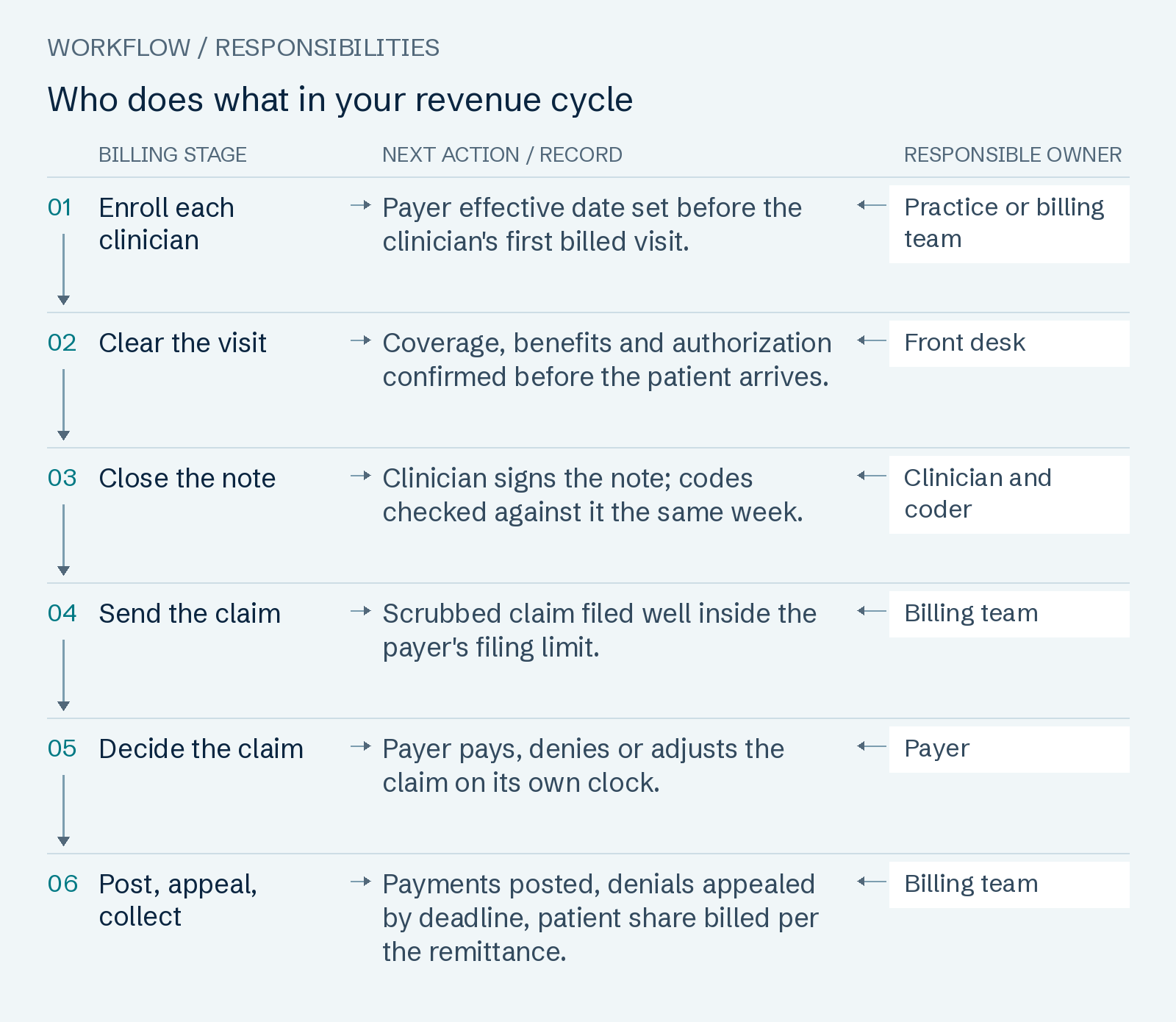
Read the workflow as text
- Enroll each clinician — Payer effective date set before the clinician's first billed visit. Owner: Practice or billing team.
- Clear the visit — Coverage, benefits and authorization confirmed before the patient arrives. Owner: Front desk.
- Close the note — Clinician signs the note; codes checked against it the same week. Owner: Clinician and coder.
- Send the claim — Scrubbed claim filed well inside the payer's filing limit. Owner: Billing team.
- Decide the claim — Payer pays, denies or adjusts the claim on its own clock. Owner: Payer.
- Post, appeal, collect — Payments posted, denials appealed by deadline, patient share billed per the remittance. Owner: Billing team.
Where is your practice losing money between the visit and the payment?
Each stage of the revenue cycle leaks money in its own way and runs on its own clock. The table names who usually owns each stage in a small practice, the payer clock it runs against with its scope, and the first sign that the stage is leaking. Your payer contracts and state law can change a default limit, so treat the clocks as examples and check your own agreements.
Where the clocks come from: Medicare enrollment from 42 CFR 424.521; Medicare filing and payment timing from the Medicare Claims Processing Manual, chapter 1; the redetermination window from chapter 29; prior-authorization decision times from the CMS-0057-F fact sheet; Cigna and Humana limits from each payer's provider pages, as recorded in our filing-limit dataset. For how practices keep claims inside every payer's window, see preventing timely filing denials.
Which numbers show where your practice stands?
Four numbers, each split by payer, show which stage leaks. Count rejections and denials apart: a rejection fails front-end or clearinghouse edits and never enters adjudication, so it points to claim data; a denial is an adjudicated claim the payer will not pay as billed, so it points to eligibility, authorization, coding or documentation. A/R days (total accounts receivable ÷ average daily charges) show how fast cash arrives, and you can work out your A/R days from two totals. The 90+ A/R bucket isolates older balances; check the remaining filing or appeal time on its insurance claims. Net collection rate, payments ÷ (charges − contractual adjustments), shows whether you collect what your contracts allow. Compare each with your own earlier months first; the monthly numbers and how to read them sets out the formulas and the report to ask for.
Which stage should you fix first?
Work the nearest filing and appeal deadlines first. A late denial may become unrecoverable, so check timely-submission proof and any applicable exception before writing it off.
- Claims nearest a filing or appeal deadline. Cigna tells contracted providers that their contract prohibits balance billing your patient when a claim is denied for late filing; confirm whether timely-submission proof or an exception can still support recovery. A Medicare redetermination request is due within 120 days of receiving the notice, which Medicare presumes arrives 5 days after its date.
- Denial causes that repeat at the front desk. Eligibility and authorization errors can recur until the underlying check-in process changes; fix the repeated cause and monitor later claims.
- Charge lag. Unsigned notes hold claims and spend the filing window. Medicare's limit is 12 months, or 1 calendar year, after the date of service; Cigna's is 90 days for participating providers on commercial claims sent to Cigna.
- Posting and patient balances. These stages have no payer deadline of their own, but a zero-paid line posted as an adjustment hides a denial that nobody works.
| Stage | Who usually owns it | Payer clock it runs against | First sign it is leaking |
|---|---|---|---|
| Credentialing and enrollment | Practice, or a credentialing service | Medicare: bill back up to 30 days before the effective date when circumstances prevented earlier enrollment (42 CFR 424.521); commercial payers set their own | Visits seen before a payer's effective date |
| Eligibility and benefits | Front desk | No payer clock; the plan in force on the date of service decides | Coverage or eligibility denials |
| Prior authorization | Front desk or clinical staff | Medicare Advantage plans and Medicaid and CHIP programs and plans: 72 hours expedited, 7 calendar days standard (CMS-0057-F, generally from January 1, 2026; not drugs) | Authorization denials; visits past the approved count |
| Charge capture and coding check | Clinician, then coder | Every day of charge lag comes out of the filing limit | Unsigned notes; charges entered days after the visit |
| Claim submission | Biller | Medicare: 12 months after the date of service; Cigna commercial: 90 days (participating); Humana commercial: 90 days unless state law or the contract sets another | Clearinghouse rejections left unworked |
| Adjudication | Payer | Medicare: clean claims paid within 30 days of receipt or interest is owed | Clean Medicare claims unpaid after 30 days |
| Payment posting | Biller or posting staff | No payer clock | Zero-paid lines written off as adjustments |
| Denials and appeals | Biller | Medicare redetermination: 120 days from receipt of the notice; Cigna commercial appeal: 180 calendar days from the payment or denial notice | The same denial reason repeating month after month |
| A/R follow-up and patient balances | Biller and front desk | The nearest filing or appeal deadline on each open claim | A growing share of A/R older than 90 days |
How to improve revenue cycle management: what are your options?
You have five ways to fix a leaking stage. They differ in who does the work and in what happens when that person is out. Compare them on one basis, staff and software in-house against a fee plus whatever you still pay, using what a biller costs next to an outsourced fee. Whichever you pick, every handoff needs a named owner on both sides, or claims age between them.
| Option | What it costs | Who does the work | What can go wrong |
|---|---|---|---|
| Fix it with your current staff | Staff hours you already pay for, plus any overtime | Your biller and front desk | The fix depends on one person; a vacancy stops it |
| Add tools in your practice-management system or clearinghouse | The vendor's subscription and per-claim fees | Your staff, with the vendor's setup help | Software flags errors; someone still has to work each one |
| A one-time billing audit or review | A fixed quote for the review | An outside reviewer; your staff make the fixes | Findings sit unused when nobody owns them |
| Hand off some stages, such as credentialing or aged A/R | A fee per stage, set in the quote | A billing company for those stages; your staff keep the rest | Claims fall between two teams without a named owner |
| Hand off the whole cycle | A fee set in the contract | A billing company, with your sign-off on codes and write-offs | A contract without written reporting hides the same leaks |
What should you check before you change anything?
Gather these seven items before you pick an option. Together they show whether the leak sits in one stage or several, and they let you judge any proposal against your own numbers.
- An A/R aging report by payer, at claim level, with the date of service on every line.
- A denial list for the last 90 days, grouped by reason and payer, with rejections listed separately.
- Charge lag: the days between each visit and its claim, and how many notes are unsigned today.
- The filing and appeal limits in your payer contracts, because a contract or state law can change the payer's default.
- Zero-paid and adjusted lines on recent remittances, to find denials that were posted as write-offs.
- A named owner for each stage in the table above; a stage without one is where claims age unnoticed.
- Bank deposits against posted payments for one month, with every gap explained.
Denials topping the list point to reducing claim denials; an aging report heavy past 90 days points to working A/R over 90 days.
What does improving your revenue cycle cost?
Improving the cycle costs staff time or a fee, and an in-house fix is not free because its cost sits in payroll. HFMA's MAP Keys, which apply to physician organizations and ambulatory providers as well as hospitals, compare the two with cost to collect: total revenue cycle cost ÷ total patient service cash collected. Its cost side counts salaries and fringe benefits, subscription fees and outsourced arrangements alike, so one ratio covers every option in the table above.
A billing and posting clerk's median wage is $48,500 a year (BLS, May 2025): about $4,042 a month before benefits, software and the clearinghouse, or about $5,774 at the private-industry benefit share (BLS, June 2026).
With us, Full-Service Billing runs from 5.0% to 8.5% of insurance payments, and Complete RCM at 9.0% adds credentialing, prior authorizations and aged A/R. Invoices 1–3: only percentage fees on that month's insurance payments, plus any statements or add-ons you order; the $400 minimum starts with invoice 4. Rates by specialty and practice size are on our pricing page.
When should you hand your revenue cycle to a billing team?
Hand it off when the same stage leaks month after month and nobody on staff owns it, when one biller holds the whole cycle in their head, or when aged A/R grows while the reports say all is well. Our revenue cycle management service is built for practices of 1 to 15 clinicians: we take the stages from coverage checks to patient balances, each with an owner and a clock, and your practice keeps clinical documentation, write-off approvals and the bank account that receives every payment. To see first which of your claims sit closest to a deadline, send a claim-level aging export for The Free A/R Deadline Map: A claim-by-claim list of every unpaid insurance claim over 90 days in the aging report you send: payer, amount, the deadline it faces, the denial reason and the next action, sorted by deadline. Clock starts with your claim-level aging export and signed BAA; above 10 requests in a week, we confirm your date within 1 business day.
Common questions
- What is revenue cycle management in a medical practice?
- It is everything between booking a visit and a zero balance: enrollment, coverage and authorization checks, coding, claims, payer decisions, posting, denials and patient balances. HFMA defines it as tracking revenue from the first appointment to the final payment of balance. The first section shows why each stage runs on its own payer clock.
- Where do small practices lose the most revenue?
- It differs by practice, so start with your own numbers rather than a national average. Missed filing or appeal deadlines can leave claims unrecoverable after available proof and exceptions are checked; front-end eligibility and authorization errors can create repeated denials. An aging report by payer and a 90-day denial list show which applies to your practice, and the stage table names the first sign of each leak.
- Which revenue cycle stages can our practice hand off?
- Almost all of them. Your clinicians document and sign notes, and your practice signs payer contracts, approves write-offs and receives payments in its own bank account. Claim submission, posting, denials, A/R follow-up, eligibility checks, authorization tracking and credentialing applications can go to a billing team, one at a time or together.
- How soon do fixes show up in collections?
- Front-desk and charge-capture fixes show on claims for future visits, so judge them on next month's numbers. For Medicare, the Claims Processing Manual says a HIPAA-compliant electronic claim is not paid before the 14th day after receipt, a paper claim not before the 29th day, and interest is owed on a clean claim not paid within 30 days. For commercial payers, check the payment terms in your contract.
- Should our practice fix the revenue cycle in-house or outsource it?
- Keep it in-house when one stage leaks and a staff member has time to own the fix. Outsource when several stages leak, when one person holds the whole cycle, or when a vacancy would stop claims going out. The in-house vs outsourced cost model shows the volume at which the answer flips.
- Can our front desk prevent denials?
- The front desk controls the two stages behind eligibility and authorization denials. Confirming coverage before each visit and tracking authorization counts and expiry dates reduces preventable eligibility and authorization errors; payer decisions and other claim requirements still apply. Under CMS-0057-F, Medicare Advantage plans and Medicaid and CHIP programs and plans must decide standard authorization requests within 7 calendar days and expedited ones within 72 hours, generally from January 1, 2026, so a request sent late can still push back the visit.
- Do we need new software to improve our revenue cycle?
- Not before you know which stage leaks. Start with the reports your practice-management system and clearinghouse can export: the aging report, the denial list and recent remittances from the seven checks. Software may flag or resolve some errors; assign a named owner to review the exceptions and get unresolved rejections, denials and aged claims worked before their deadlines.
Sources and review
Page revised October 7, 2026 · Review contact: Hyder Shah (inquiries@claimpillar.com). The worked example uses the CMS CY 2026 Physician Fee Schedule relative value file RVU26D (2026 national Medicare amount, unadjusted; actual payment varies by locality, setting and payer). The Cigna appeal window and Humana limit come from our timely-filing dataset, built from each payer's own provider pages (retrieved 2026-10-02); every source below was retrieved and checked on 2026-10-07.
- HFMA: Healthcare Revenue Cycle Management (RCM), What It Is and How It Works
- eCFR: 42 CFR 424.521, Request for payment by certain provider and supplier types
- CMS: Physician Fee Schedule relative value files (CY 2026, RVU26D)
- CMS Medicare Claims Processing Manual (Pub. 100-04), Chapter 1: General Billing Requirements
- CMS Medicare Claims Processing Manual (Pub. 100-04), Chapter 29: Appeals of Claims Decisions
- Cigna Healthcare: Claims Submission, Payments, and Filing
- CMS fact sheet: Interoperability and Prior Authorization Final Rule (CMS-0057-F)
- HFMA MAP Keys: Industry-standard revenue cycle KPIs