The mental health billing process in 8 steps
The mental health billing process has eight steps, and the first five happen before the claim ever leaves your practice, which is where the denial causes later on this page begin.
- Verify benefits before the first session. Confirm the plan is active, whether it routes behavioral health to a separate company, and what the client owes per visit.
- Get authorization where the plan requires it. Routine outpatient therapy often needs none; higher levels of care usually do.
- Register the client completely. Name, date of birth, address, member ID, group number and the insured's details exactly as the plan has them.
- Document the session. The note carries the start and stop times, the clinician's signature and credentials.
- Code the session. Pick the procedure code from the documented time and service, and the diagnosis code from the clinician's assessment.
- Submit the claim before the filing limit. Send an 837P through your clearinghouse, or a paper CMS-1500 where the payer still takes one.
- Post the payment and bill the client's share. Read the electronic remittance advice (the 835), post each line, and bill only what the plan assigns to the client.
- Work denials and follow up unpaid claims. Log each denial, set its appeal deadline, fix it, and fix the step that caused it.
Steps 1 to 5 are front-end work that your front desk and clinicians control. Steps 6 to 8 are the billing work you can do yourself, give to staff, or hand to a billing service. Weigh those three options in DIY billing, software or a billing service for therapists.
Verifying benefits and carve-outs
Benefits verification for a therapy practice answers one question before the first session: which company pays this claim, and what will the client owe? A plan can carve out its behavioral health benefit, meaning a separate company runs the network, authorizations and claims for mental health care. Cigna members, for example, can have their behavioral health benefit administered by Evernorth Behavioral Health, and Evernorth tells providers to verify eligibility beyond the ID card, through its provider website, a 270/271 inquiry, its phone system or customer service (Evernorth Behavioral Health provider administrative guide). Send a claim to the medical plan when a behavioral health company manages the benefit, and the claim goes to the wrong payer.
What to check on every new client
An electronic eligibility inquiry (the 270/271 transaction) through your clearinghouse returns eligibility status, coverage effective and end dates, the plan type and the remaining deductible and coinsurance, per Evernorth's guide. Fill the gaps with a call or the payer portal, using the full eligibility verification process in medical billing.
| What to confirm | Why it matters for your practice | Where you find it |
|---|---|---|
| Coverage is active on the date of service | No active coverage means the plan owes nothing for that session | 270/271 response or payer portal |
| Who manages the behavioral health benefit | Claims and authorizations go to that company, not the medical plan | Member ID card, then the benefit response |
| In-network or out-of-network for each clinician | Out-of-network can mean different cost share and a different filing limit | Payer directory and your own credentialing records |
| Copay, coinsurance and remaining deductible | Sets what you collect at the visit | 270/271 response or benefits call |
| Authorization and visit limits | Sessions past an approved count or level of care may not pay | Benefits call; plan's authorization rules |
| Telehealth coverage | Decides the place of service and modifiers on the claim | Plan's telehealth policy |
Choosing codes: 90791, 90834, 90837 and add-ons
Mental health procedure codes split into a first diagnostic evaluation, time-based psychotherapy, and add-ons. Three rules from the 2026 Medicare NCCI policy manual stop the most common coding denials (CMS NCCI Policy Manual, chapter XI):
- 90791 and 90792 are not reported with individual, group, family, crisis or other psychotherapy codes on the same date of service.
- Individual psychotherapy codes are time-based. 90832, 90834 and 90837 are psychotherapy without a medical E/M service; prescribers who also provide an E/M service report the E/M code plus add-on 90833, 90836 or 90838.
- Interactive complexity is reported with add-on 90785.
Payers check the time. Optum Behavioral Health lists 90834 as a 45-minute code and 90837 as 60 minutes or more, and tells clinicians to include their signature, credentials and start and stop times (Optum Provider Express, October 2025). The time thresholds and audit risk for the longest code are in the 90837 CPT code guide, and the full code set is in CPT codes for mental health.
What the codes pay under Medicare
The table shows 2026 national Medicare amounts (unadjusted, non-facility) from the CMS physician fee schedule files. Actual payment varies by locality, setting and payer. Medicare pays marriage and family therapists and mental health counselors 75% of the amount a clinical psychologist gets under the fee schedule, and both may enroll and bill Medicare independently since January 1, 2024 (CMS MLN1986542, March 2026). Commercial therapy insurance reimbursement is set by each payer's contract, so your own fee schedules decide what a session is worth to your practice.
| Code | In plain words | 2026 national Medicare amount (unadjusted, non-facility) |
|---|---|---|
| 90791 | Diagnostic evaluation, no medical services | $173.35 |
| 90832 | Psychotherapy, about 30 minutes | $85.84 |
| 90834 | Psychotherapy, about 45 minutes | $113.90 |
| 90837 | Psychotherapy, about 60 minutes | $167.00 |
| 90847 | Family psychotherapy, patient present | $109.55 |
| 90853 | Group psychotherapy | $30.39 |
| 90785 | Interactive complexity add-on | $14.70 |
Submitting claims: CMS-1500 fields therapists get wrong
A therapy claim goes out as an 837P electronic claim or its paper twin, the 1500 claim form, and both carry the same data. The National Uniform Claim Committee's instruction manual (version 13.0, July 2025) defines each box (NUCC 1500 Reference Instruction Manual); payers can add their own rules on top. The annotated claim below is an illustrative example, not client data: one 60-minute individual session, in the office, for a clinician who works in a group practice.
An annotated CMS-1500 for a therapy claim
The boxes that trip therapy practices are the rendering and billing provider pair (24J and 33), the place of service for telehealth (24B), and the diagnosis pointer (24E). NUCC says to report the rendering clinician in 24J only when that clinician differs from the billing provider in 33a, so a solo therapist billing under their own NPI leaves 24J blank, while a group practice puts the clinician's NPI in 24J and the group's in 33a. NUCC lets a solo clinician leave 24J blank, but Medicare requires the rendering provider's NPI in the lower unshaded part of 24J on every line (Medicare Claims Processing Manual, chapter 26, Item 24J), so fill it on Medicare claims. Every box in detail is in the CMS 1500 form guide for therapists.
| Box | What goes there (NUCC) | Illustrative therapy claim |
|---|---|---|
| 1a | Insured's ID number | Member ID exactly as on the card |
| 21 | ICD indicator 0 for ICD-10-CM; up to 12 diagnosis codes, no decimal point | The diagnosis from the clinician's assessment on line A |
| 22 | Only on a resubmission: code 7 replaces, code 8 voids the prior claim | Blank on a first claim |
| 24A | Date of service | The session date |
| 24B | Two-digit place of service code from the CMS list | 11 for office; 02 or 10 for telehealth, per the payer's rule |
| 24D | CPT or HCPCS code and up to four modifiers, no narrative | 90837, plus a telehealth modifier only if the payer requires one |
| 24E | Diagnosis pointer letter(s) from box 21, primary first, no commas | A |
| 24F | Charge for the line, no dollar sign or commas | Your practice's full fee for the session |
| 24G | Days or units; enter 1 when one service is performed | 1 |
| 24J | Rendering clinician's NPI, only when different from 33a (Medicare: always) | The therapist's individual NPI |
| 25 | Billing provider's federal tax ID (EIN or SSN) | The group's EIN |
| 33 / 33a | Billing provider name, street address, 9-digit ZIP and NPI | The group practice and its NPI |
Payment posting and client balances
Payment posting is where you learn whether each session paid as expected. The electronic remittance advice, the 835 file, shows the amount paid and when the check or electronic funds transfer was issued, and the payer's explanation of payment itemizes the services it processed (Evernorth guide). Post each line, not the total, so a single denied or underpaid session cannot hide inside a deposit.
What the client owes
- Compare the allowed amount on each line with your contracted rate for that code and payer.
- Move to the client only the amount the remittance assigns to them under the PR (patient responsibility) group code, or what the plan's rules allow you to bill.
- Collect copays at the visit, and send one statement for the rest with the session dates and the plan's payment shown.
- Open a denial for every line that paid $0, and an underpayment review for every line paid below contract.
Denials and appeals
Common therapy denial causes start at the front end: an inactive plan, the wrong payer when a behavioral health company manages the benefit, a missing authorization for a higher level of care, a clinician not yet credentialed with the plan (our therapist credentialing service files those enrollments), or a code the note does not support. Two coding denials are predictable from the NCCI rules above: 90791 billed with psychotherapy on the same date, and an E/M code billed with 90791 or 90792.
Appeal windows are short and set by each payer. In our timely-filing dataset, Evernorth Behavioral Health allows payment appeals within 180 calendar days of the payment or denial decision, Optum Behavioral Health allows 12 months for reconsideration and appeal together, and Original Medicare allows 120 days from receipt of the initial determination to request a redetermination (see our timely filing limits by payer). The full process, from logging the denial to fixing its cause, is in our denial management guide.
Filing limits come first
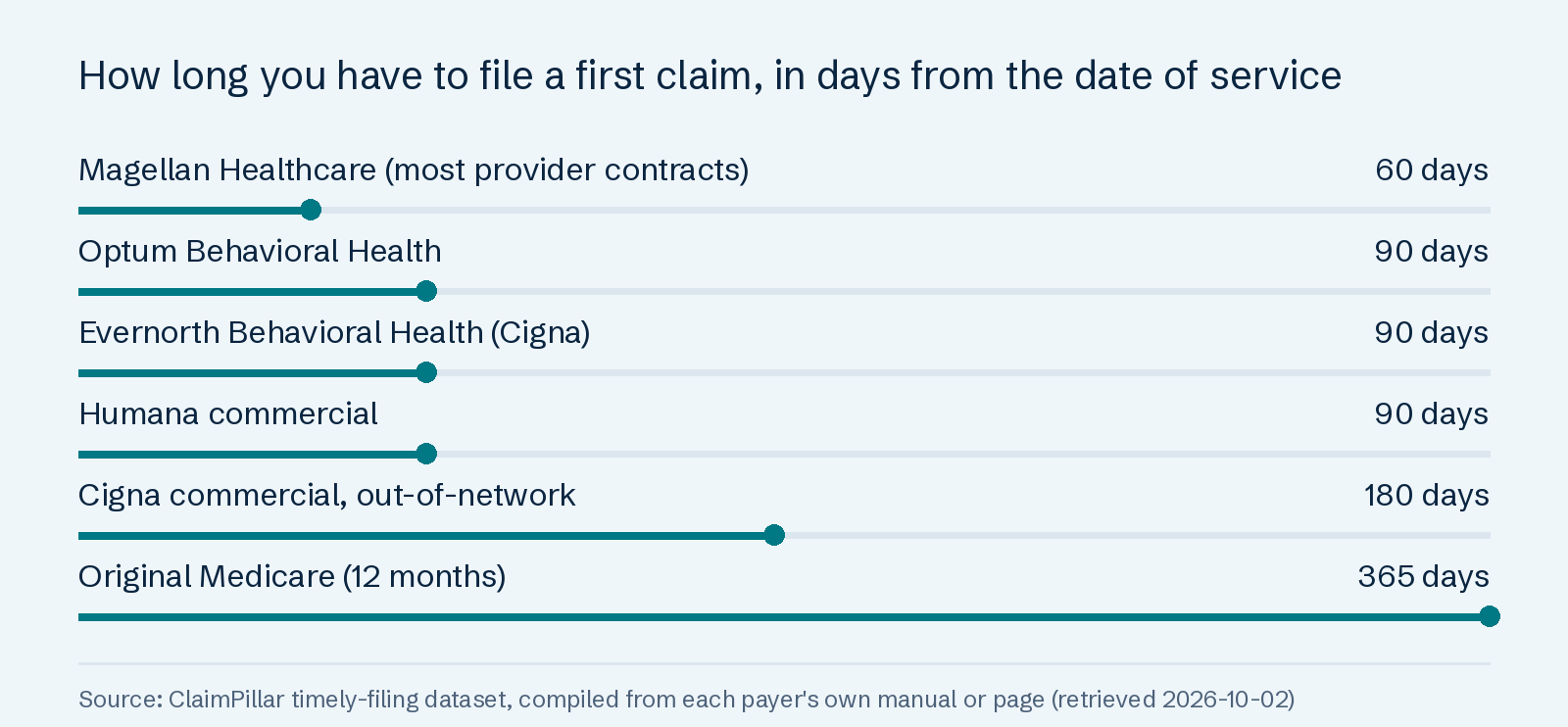
The first deadline to watch is the initial filing limit in the chart: Original Medicare, for example, accepts a late claim only under the narrow exceptions in 42 CFR 424.44(b). Behavioral health plans sit at the short end: 60 days under most Magellan Healthcare contracts and 90 days at Optum Behavioral Health and Evernorth Behavioral Health, against 12 months for Original Medicare.
Superbills and out-of-network billing
A therapist who is out of network with a client's plan can still help the client get reimbursed. Either your practice files an out-of-network claim on the client's behalf, or the client pays you and files a superbill with their plan. Evernorth notes that members whose plans include out-of-network benefits are free to use them, and that care from a non-participating provider may leave the member with unexpected costs (Evernorth guide). Cigna lists 180 days to file an out-of-network commercial claim, against 90 days in network.
A superbill template for therapy sessions
A superbill is an itemized receipt carrying the same data a payer reads from a claim. Build yours with these fields, each mapped to the 1500 box the plan will look for, and ask the client to check their plan's member claim form for anything extra it requires. A fuller layout is in the superbill for therapy resource.
| Superbill field | What to enter | Matching 1500 box |
|---|---|---|
| Practice name, street address and phone | The billing provider's details | 33 |
| Billing NPI and tax ID | The practice's NPI and EIN | 33a, 25 |
| Clinician name, credential and NPI | The therapist who saw the client | 24J, 31 |
| Client name, date of birth and address | As on the client's plan | 2, 3, 5 |
| Member ID and plan name | From the client's insurance card | 1a, 11c |
| Date of service and place of service | Session date; 11 for office, 02 or 10 for telehealth | 24A, 24B |
| Procedure code and modifiers | One line per service, for example 90834 | 24D |
| Diagnosis code(s) | ICD-10-CM codes from the clinician's diagnosis | 21, 24E |
| Fee and units | Your fee per line; 1 unit per session | 24F, 24G |
| Amount paid and date | What the client paid you, and when | Receipt only |
Good faith estimates, Medicare, and when to hand billing off
Self-pay and superbill clients bring a federal rule with them. Usually, a provider must give a good faith estimate of expected charges to a person who is not using health insurance to pay for care, if they ask for one or schedule at least 3 business days ahead (CMS: What is a good faith estimate?). Treat a client who pays you directly and files their own superbill as covered by that rule unless your counsel tells you otherwise.
Medicare works differently from commercial plans. CMS states that marriage and family therapists and mental health counselors must accept assignment, so the superbill route above is for commercial plans, not for your Medicare clients.
When billing is worth handing off
If billing breaks in your practice at steps 6 to 8, with claims waiting while sessions run back to back, denials sitting unworked and 60- or 90-day filing limits drawing close, our mental health billing services take over submission, posting, denials and follow-up while you keep the clinical work, with rates by practice size on the pricing page. Before you decide, see where your unpaid claims stand: Get my free A/R Deadline Map. Clock starts with your claim-level aging export and signed BAA; above 10 requests in a week, we confirm your date within 1 business day.
Common questions
- How do therapists bill insurance?
- Therapists bill insurance by verifying the client's benefits, getting any required authorization, documenting the session with start and stop times, coding it, and sending an 837P electronic claim or a paper 1500 claim form to the payer that manages the behavioral health benefit. Then they post the payment from the remittance, bill the client's share and work any denial.
- What is the mental health billing process?
- The mental health billing process has eight steps: verify benefits, get authorizations, register the client, document the session, code it, submit the claim before the filing limit, post the payment and bill the client's share, and work denials and unpaid claims. The first five steps happen before the claim leaves your practice, so that is where most denial prevention sits.
- What form do therapists use to bill insurance?
- Therapists use the 1500 Health Insurance Claim Form (the CMS-1500) on paper, or its electronic equivalent, the 837P, sent through a clearinghouse. The NUCC instruction manual defines each box, and each payer can add its own rules.
- Can therapists bill insurance without being in network?
- Yes, for clients whose plans have out-of-network benefits. The practice can file an out-of-network claim, or the client pays and submits a superbill to their plan. The client usually pays more out of network, and filing limits differ: Cigna lists 180 days out of network against 90 in network. Medicare is different, because CMS requires marriage and family therapists and mental health counselors to accept assignment.
- What is an ERA in mental health billing?
- An ERA, or electronic remittance advice, is the 835 file a payer sends with each payment. It shows what was paid on each claim line, any adjustments, and when the check or electronic funds transfer was issued. Your practice posts payments and spots denials from it.
- What is incident-to billing in mental health?
- Incident-to billing lets a practitioner bill Medicare for services that auxiliary staff provide as part of the practitioner's own professional services. CMS says marriage and family therapists may provide services incident to a physician, clinical psychologist, clinical nurse specialist, nurse practitioner, physician assistant or certified nurse-midwife, but Medicare does not cover services billed incident to the therapist's own services (CMS MLN1986542).
- How can a therapy practice improve its insurance collections?
- Verify benefits before the first session, track authorized session counts at scheduling, document start and stop times, submit claims within days of the session rather than near the filing limit, post every remittance line by line, and work each denial before its appeal window closes. If billing keeps falling behind, compare doing it yourself with outsourced behavioral health billing.
Sources and review
Page revised November 5, 2026 · Review contact: Hyder Shah (inquiries@claimpillar.com). Every source below was retrieved on November 5, 2026. Payer rules apply to the payer and product named; your contract, the client's plan or state law can set different rules. Medicare amounts are 2026 national, unadjusted figures from the CMS fee schedule files.
- NUCC: 1500 Health Insurance Claim Form Reference Instruction Manual, version 13.0 (July 2025)
- CMS: Medicare NCCI Policy Manual, Chapter XI (revised 1/1/2026)
- CMS MLN1986542: Medicare & Mental Health Coverage (March 2026)
- CMS MCD: Billing and Coding: Psychiatry and Psychology Services (A57480, revision effective 01/01/2026)
- Evernorth Behavioral Health: Provider administrative guidelines (PCOMM-2021-1080, 8/21)
- Optum Provider Express: psychotherapy and E/M billing errors (October 2025)
- CMS: What is a good faith estimate?
- CMS: Place of Service Code Set
- CMS: PFS Relative Value Files (CY 2026, RVU26D)