Eligibility verification in medical billing: what it is and what it costs you to skip
Eligibility verification is the check, before the visit, that a patient's plan covers them on the date of service and what the plan pays for. Federal rules define the electronic version: the HIPAA eligibility transaction is an inquiry from a provider to a health plan about the patient's eligibility, coverage and benefits, and the plan's response. The adopted standard is the X12 270 inquiry and 271 response (version 005010X279), with CAQH CORE operating rules adopted alongside it. Medicare runs the same exchange through HETS, which accepts 270 requests and returns 271 responses in real time only; it does not accept batch requests.
Skipping it costs your practice in three places. UnitedHealthcare's 2026 administrative guide names the first: one of the primary reasons claims are rejected is incomplete or inaccurate eligibility information. The second is the copay or deductible you did not collect at the session, which becomes a statement and a follow-up call. The third is the referral, authorization or network problem you learn about from the denial, weeks after the sessions were delivered.
Eligibility versus benefits
Eligibility answers one question: is this person covered by this plan on this date? Benefits answer what the plan pays for that service: the copay or coinsurance, the deductible left, any visit limit, and whether a referral or authorization is needed. A patient can be eligible and still have no benefit for outpatient therapy, or a benefit that is used up. Your front desk needs both answers before the first session.
The 8-step insurance eligibility verification process
Run these eight steps before every new patient's first session, and again whenever a re-verification trigger below applies. Steps 1 to 4 confirm coverage; steps 5 to 8 confirm the benefits and the money.
- Collect the card, the ID and the subscriber details. Scan both sides of every insurance card and record the subscriber's name and date of birth when the patient is a dependent. UnitedHealthcare states that possessing an ID card is not proof of eligibility, so the scan starts the check; it does not finish it.
- Ask about every other coverage. For Medicare patients, CMS tells providers to ask about other coverage that could be primary to Medicare at each visit before providing services. For everyone, ask whether a spouse's or parent's plan also covers them.
- Run the eligibility check for the session date. Send the 270 inquiry through your clearinghouse, or use the payer's portal. Check the coverage start and end dates against the appointment date, not today's date.
- Confirm your network status separately. UnitedHealthcare says plainly that your network status is not returned on 270/271 eligibility transactions; check it in the payer's portal. Out of network, the patient may face higher costs or no coverage.
- Find out who manages the mental health benefit. Look for a behavioral health phone number or company name on the card, and verify with that company if it differs from the medical plan (next section).
- Record the outpatient therapy benefit. Copay or coinsurance, deductible met and remaining, out-of-pocket maximum, and any visit limit with the visits already used this plan year.
- Check the authorization, referral and telehealth rules. Ask whether the plan requires authorization or a referral for therapy, from which session, for how many visits, and whether telehealth sessions are covered for this patient.
- Write it on the appointment and tell the patient. Note the date checked, the source (271 response, portal or call reference number) and the patient's expected cost, and give the patient that cost before the first session.
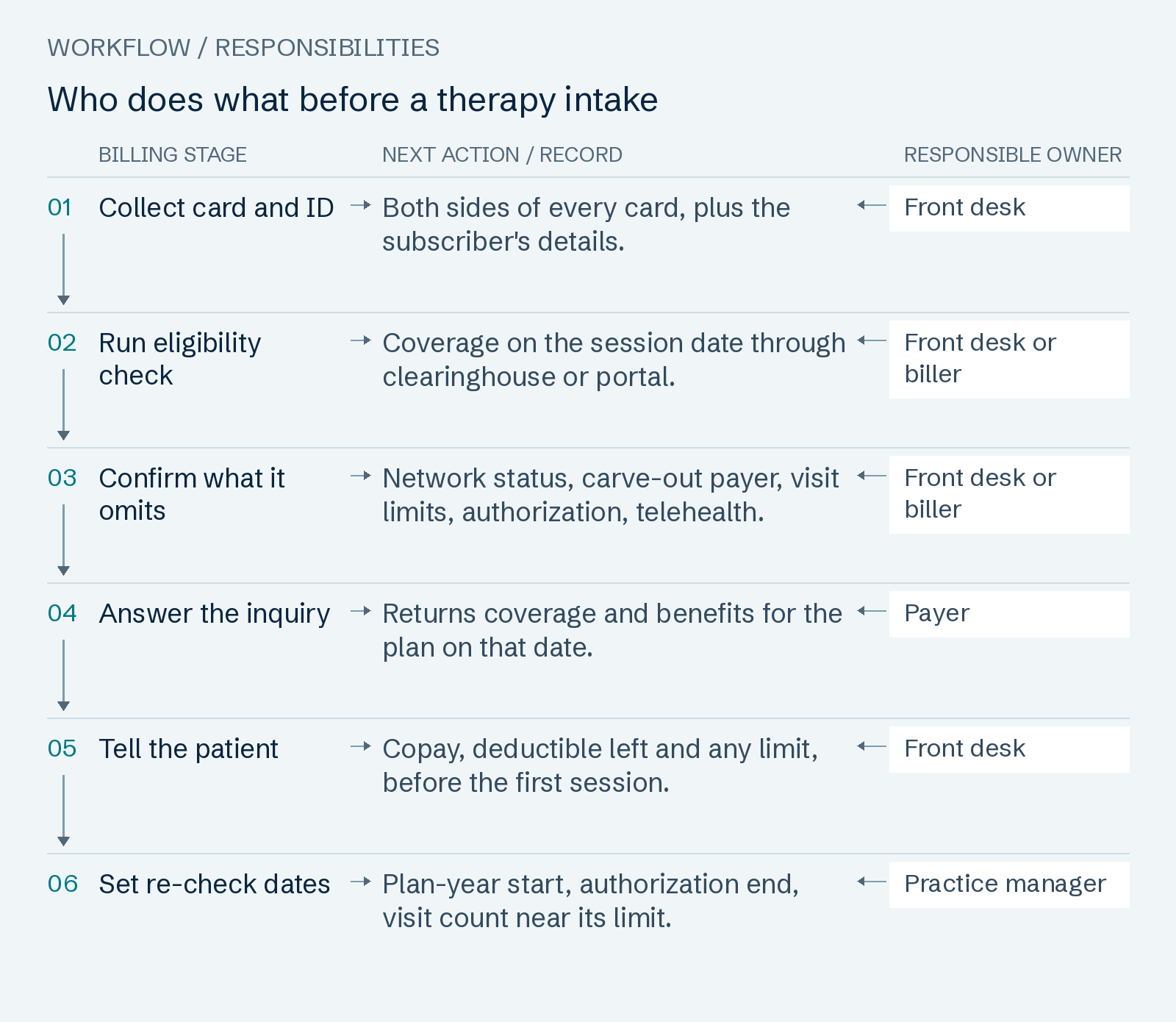
Read the workflow as text
- Collect card and ID — Both sides of every card, plus the subscriber's details. Owner: Front desk.
- Run eligibility check — Coverage on the session date through clearinghouse or portal. Owner: Front desk or biller.
- Confirm what it omits — Network status, carve-out payer, visit limits, authorization, telehealth. Owner: Front desk or biller.
- Answer the inquiry — Returns coverage and benefits for the plan on that date. Owner: Payer.
- Tell the patient — Copay, deductible left and any limit, before the first session. Owner: Front desk.
- Set re-check dates — Plan-year start, authorization end, visit count near its limit. Owner: Practice manager.
Eligibility and benefits verification for recurring sessions
Therapy differs from a one-off visit: a patient may come weekly for months, and the coverage behind session 20 is not always the coverage you verified at intake. UnitedHealthcare warns that health plans and coverage can change within a single enrollment year, and tells providers to verify eligibility at the point of service for Individual Exchange members, whose subsidy and Medicaid eligibility can change mid-year.
Two coverage types need extra care. Marketplace plans must give members who receive advance premium tax credits and have paid at least one full month's premium a three-month grace period before ending coverage, and UnitedHealthcare says its eligibility check shows whether a member is inside it. If the premium is not paid by the end of the grace period, UnitedHealthcare ends coverage at the end of the first month and denies claims for the second and third months. Medicaid eligibility is renewed on a cycle: the federal rule at 42 CFR 435.916 sets renewal once every 12 months for most income-based groups, so a long-running Medicaid patient needs a check around their renewal date.
Therapy verification checklist
Use the table as the checklist your front desk fills in for each patient at intake. Every row must have an answer, or the reason it is still open, before the first session.
| Check | What to record | Where the answer comes from |
|---|---|---|
| Coverage on the session date | Plan name, member ID, start and end dates | 271 response or payer portal |
| Payer order | Primary and secondary plans; Medicare other-coverage answers | Patient answers, compared with the 271 response |
| Network status | In or out of network for this plan and product | Payer portal or provider services line (not in the 271) |
| Who manages behavioral health | Company name and phone number if separate from the medical plan | Back of the ID card, then that company |
| Outpatient therapy benefit | Copay or coinsurance, deductible left, out-of-pocket maximum | 271 response or the managing company |
| Visit limit | Visits allowed this plan year and visits already used | Payer portal or a call, with its reference number |
| Authorization or referral | Required or not, from which session, how many visits approved | Payer's authorization rules for therapy |
| Telehealth | Whether video or audio-only sessions are covered for this patient | Payer's telehealth policy |
| Re-check date | Next date or trigger to verify again | Your practice's re-verification rules (below) |
Mental health carve-outs: checking the right payer
A carve-out is a plan design where the medical insurer hands the mental health and substance use benefit to a separate company. For a therapy practice, that company decides eligibility for your sessions, holds the authorizations and often processes the claims, so verifying with the medical plan alone can return the wrong answer.
UnitedHealthcare's guide shows how it works in practice: its commercial plans offer mental health and substance use disorder benefits delivered by its affiliate United Behavioral Health, operating as Optum, depending on the member's plan, and members reach those programs through the phone number on the back of the ID card. For Individual Exchange members, the same guide points behavioral health providers to the Optum Telemental Health policy for virtual care rules.
How to spot a carve-out at intake
- Read the back of the card for a separate behavioral health or mental health phone number, or a second company's name.
- If the 271 response lists a different payer or contact for mental health, verify with that payer.
- Confirm your network status with the company that manages the benefit; being in network with the medical plan does not settle it.
- Record which company holds the authorization, and send claims where that company directs.
Visit limits, auth requirements and telehealth benefits
Visit limits, authorization rules and telehealth coverage are the three benefit details that most often change what a therapy practice can bill, and each is set by the plan, so ask the payer every time instead of assuming.
Visit limits and thresholds
For mental health, federal parity law limits how tight a cap can be: the Department of Labor explains that, for most health plans, visit limits on mental health benefits cannot be more restrictive than those on medical or surgical visits. A limit can still exist, so record it with the visits used. Medicare outpatient therapy has no hard cap but a dollar threshold: for 2026, CMS sets the KX modifier threshold at $2,480 for PT and speech-language pathology combined, and $2,480 for OT, and claims above it without the KX modifier are denied. CMS also names a $3,000 targeted medical review threshold for each. A rehab practice therefore tracks each Medicare patient's year-to-date therapy amount.
Authorization requirements
Ask whether authorization is required, from which session, for how many visits and for what date range. When the plan approves a number of sessions, the authorization end date and the session count become re-verification triggers. Our prior authorization services take on that tracking when practices hand it off.
Telehealth benefits
Medicare first. CMS's telehealth FAQ says the Consolidated Appropriations Act, 2021 permanently removed geographic and place-of-service limits for behavioral health telehealth, so patients can receive it at home. After December 31, 2027, a mental health patient who starts telehealth at home needs an in-person visit within 6 months before the first telehealth session; patients who started before January 1, 2028 instead need an in-person visit at least every 12 months. The same FAQ says that, starting January 1, 2028, physical therapists, occupational therapists and speech-language pathologists can no longer furnish Medicare telehealth services. Commercial plans write their own rules: UnitedHealthcare's Individual Exchange chapter, for example, covers eligible virtual care given by audio and video, and allows additional modalities for virtual behavioral health under the Optum policy. Check the telehealth benefit for each patient's plan before moving sessions online.
When to re-verify mid-treatment
Re-verify when something changes the answer, not on a feeling. The table lists the triggers your front desk can watch for and what to check at each. Practices that bill weekly sessions often add a standing check before the first session of each month as a backstop; set that rule to fit your caseload and payer mix.
| Trigger | Why it matters | What to re-check |
|---|---|---|
| New plan year (often January 1) | Deductibles reset and the employer may have changed plans | Coverage, deductible, copay, visit limit, network status |
| Patient reports a new job, card or plan | The plan on file may no longer be active | Full eight-step check on the new plan |
| Patient turns 65 or reports Medicare | Payer order can change | Other-coverage questions and payer order |
| Authorization end date or approved visits nearly used | Sessions after it may not be paid | Authorization status and the renewal request |
| Visit count near the plan's limit | Sessions over the limit may be the patient's to pay | Visits used to date and any extension process |
| Medicaid renewal month | Renewal can end or change coverage | Coverage dates and the managed care plan |
| Marketplace patient misses a premium | A grace period may end in termination | Grace-period status on the eligibility response |
| Move from in-person to telehealth | Telehealth may be covered differently | The plan's telehealth benefit and any in-person rule |
| Eligibility rejection or denial posts | Coverage changed after your last check | Coverage on each affected date before resubmitting |
Mistakes that cause eligibility denials
Most eligibility denials trace back to a check that was skipped, run for the wrong date or run with the wrong company. These are the patterns to train out of your front desk:
- Treating the card as proof. A card on file can show a plan the patient has left.
- Checking today instead of the session date. A plan ending at month's end passes today's check and fails next week's session.
- Verifying with the medical plan when a carve-out runs mental health. The eligibility answer, the authorization and the claim address can all sit with the other company.
- Assuming network status from the 271. It is not in that response.
- Skipping the other-coverage questions. CMS tells providers to keep an intake process that identifies primary payers other than Medicare to prevent incorrect billing; a wrong payer order sends the claim to the wrong plan.
- Verifying once at intake for a months-long treatment. Session 20 runs on whatever coverage exists that day.
- Not writing down the source. Without the date checked and a call reference number, your practice has nothing to point to if the payer's answer changes.
When an eligibility denial does post, check coverage for every affected date before resubmitting; the same lapse usually covers several sessions.
Free verification script for your front desk
Copy this script into your intake procedure. Your front desk reads the patient questions when booking, and the payer questions on a call when the portal or the 271 response leaves a gap.
Questions for the patient when booking
- "Please send a photo of the front and back of each insurance card you have."
- "Is the plan in your name, or someone else's? If someone else's, what are their name and date of birth?"
- "Do you have any other coverage, through a spouse, a parent, Medicare or Medicaid?"
- "Has your plan changed this year, or do you expect it to change while you are in treatment?"
- "Would you like to use telehealth for any of your sessions?"
Questions for the payer or behavioral health company
- "Is the member active on [date of first session], and what are the coverage start and end dates?"
- "Is outpatient mental health (or outpatient PT, OT or speech) managed by you or by another company?"
- "Is our practice in network for this member's plan?"
- "What are the copay or coinsurance, deductible remaining and out-of-pocket maximum for this service?"
- "Is there a visit limit, and how many visits have been used this plan year?"
- "Is authorization or a referral required, from which session, and for how many visits?"
- "Are telehealth sessions covered, and by video only or also by audio?"
- "Can I have a reference number for this call?"
When to hand eligibility verification off
Every step on this page can stay in-house. The cost is front-desk time on portals and hold lines, plus the discipline to re-check on every trigger for every patient in treatment. Practices hand it off when eligibility denials keep reaching the remittance, when nobody tracks authorization counts, or when the person who knew each payer's rules has left.
Our insurance eligibility verification work covers new patients and changed coverage. It checks coverage on the date of service, payer order, network status and referrals, writes the result on the appointment and sends any failure back to your front desk with the fix. It is included in Full-Service Billing, from 5.0% to 8.5% of insurance payments, with 0% of patient payments and $0 setup. Invoices 1–3: only percentage fees on that month's insurance payments, plus any statements or add-ons you order. Percentage fees and mailed statements are capped at 9.0% of that month's insurance payments; from invoice 4, the $400 minimum applies even in a month when the cap comes to less. Month to month. Leave with 30 days' written notice. No termination fee. Therapists, counselors and psychologists can see how we bill sessions on our mental health billing services page; rehab practices, on our physical therapy billing services page. Compare our published rates by specialty or tell us about your schedule and payer mix.
Common questions
- What is the eligibility verification process in medical billing?
- It is the check, before a visit, that the patient's plan covers them on the date of service and what it pays for that service. Your front desk collects the card, asks about other coverage, runs an eligibility check (the X12 270 inquiry and 271 response, or the payer's portal) for the session date, then confirms network status, who manages the benefit, the cost to the patient, visit limits, authorization and telehealth rules.
- How often should insurance be verified for therapy patients?
- Verify before the first session, then on each trigger: a new plan year, a new card or job, a Medicare or Medicaid change, an authorization nearing its end or its approved visits, a visit count near the plan's limit, a move to telehealth, or an eligibility denial. Many practices also add a monthly check for patients seen weekly; set the rule that fits your caseload.
- What is the difference between eligibility and benefits?
- Eligibility says whether the person is covered by the plan on a given date. Benefits say what the plan pays for a specific service: copay or coinsurance, deductible remaining, visit limits, and whether authorization or a referral is required. A patient can be eligible and still have no outpatient therapy benefit left.
- What happens if eligibility is not verified?
- The claim can be rejected or denied for coverage, sent to the wrong payer, or paid at out-of-network rates, and the patient's share goes uncollected at the session. UnitedHealthcare names incomplete or inaccurate eligibility information as one of the primary reasons for claim rejections. Whether you can bill the patient for an uncovered session depends on the payer's rules and your agreement with the patient.
- Does the 271 eligibility response show whether we are in network?
- Not reliably. UnitedHealthcare states that network status is not returned on 270/271 eligibility transactions and asks providers to confirm it in its portal. Check network status separately for each plan, and with the behavioral health company when a carve-out manages the benefit.
- Can we hand eligibility verification to a billing company?
- Yes. Our eligibility verification work is part of Full-Service Billing: we check new patients and changed coverage, record the result on the appointment and route failures to your front desk with the fix. Your team still collects the cards, asks the other-coverage questions and decides whether to see a patient whose coverage fails.
Sources and review
Page revised November 5, 2026 · Review contact: Hyder Shah (inquiries@claimpillar.com). Every source below was retrieved on November 5, 2026. Payer statements apply to the plans named; check each patient's own plan.
- 45 CFR Part 162, Subpart L: Eligibility for a health plan (eCFR)
- CMS: About HETS 270/271
- UnitedHealthcare: 2026 Care Provider Administrative Guide
- CMS MLN006903: Medicare Secondary Payer (July 2025)
- CMS: Telehealth FAQ (updated October 8, 2026)
- CMS: Therapy services (KX modifier threshold)
- U.S. Department of Labor: Mental Health and Substance Use Disorder Parity
- 42 CFR 435.916: Periodic renewal of Medicaid eligibility (eCFR)