What a therapy superbill is, and why your practice hands one out
A therapy superbill is an itemized statement of the sessions a client has already paid your practice for. It is not a claim: your practice files nothing with the plan. The client sends the superbill to their own plan and asks it to reimburse them under their out-of-network benefits.
For a private-pay or out-of-network practice, the superbill is what lets an insured client afford your fee. You are paid in full at the session, at your own rate, and the client recovers part of the cost from the plan later. Whether that model fits your practice better than joining panels is a separate decision, set out in private pay vs insurance for therapy practices.
Two conditions bound the route. The client needs a plan that pays for out-of-network care, and the client cannot be on Original Medicare with a Medicare-enrolled clinician (both are covered under rejections below). When a plan refuses out-of-network care for a client it cannot serve in-network, a single case agreement is the other route to coverage.
What a superbill must include: NPI, CPT, ICD-10, dates, fees
A superbill has to give the plan everything it would get from a claim, because the plan cannot ask your practice to fill gaps. Medicare's own patient claim form is a useful public standard: Form CMS-1490S asks the patient to attach an itemized bill showing the date of service, the place of service, a description of the illness or injury, a description of each service, the charge for each service, the provider's name and address, and the provider's National Provider Identifier (NPI) if known.
Free therapy superbill template: the fields to copy
Use the table below as your template. Build it once in your EHR or as a document, and fill one line per session.
| Field | What to enter | Why the plan needs it |
|---|---|---|
| Practice and clinician | Clinician's name and credentials, practice name, address, phone and email | Identifies who provided the care; CMS-1490S asks for the provider's name and address |
| NPI | The treating clinician's individual NPI; add your group NPI if you bill as a group | CMS-1490S lists the provider's NPI on the itemized bill |
| Tax ID | Your practice's Tax Identification Number (usually its EIN) | Ties payment records to your practice; your good faith estimates must already show it |
| Client | Client's full name, date of birth and address, plus the plan member ID from their card | Matches the bill to the member's coverage |
| Date of service | One line per session date; never a date range for several sessions | Each session is priced and counted separately |
| Place of service | Office address, or telehealth with the place-of-service code you use on claims | CMS-1490S asks for the place of service |
| Diagnosis | The ICD-10-CM code from your record, with its plain-language name | Describes the condition treated; CMS-1490S asks for it |
| Service | The CPT code and a short plain description, e.g. 90837, psychotherapy, 53 minutes or more | Tells the plan which service to price |
| Fee and payment | Your fee per session, the amount paid and the date paid | Shows the client already paid you, so the plan reimburses the client |
| Signature | Clinician signature and date | Confirms the statement came from your practice |
How clients submit a superbill: portals, forms, mail
Your client, not your practice, sends the superbill to the plan. The route depends on the plan, and the plan's member website and the member services number on the client's ID card give the current one. Tell new clients the steps at intake, because a client who never files never gets reimbursed and may stop seeing you over the cost.
- Check out-of-network benefits first. The client asks the plan whether outpatient mental health care is covered out-of-network, the out-of-network deductible left, the coinsurance percentage and any session limit.
- Get the superbill. Your practice issues it after each session or once a month, with one line per date of service.
- Find the member claim route. The client logs in to the plan's member portal or downloads the plan's member medical claim form.
- Submit it. Upload the superbill in the portal, or attach it to the signed claim form and mail it to the address on the form. Keep a copy.
- Read the explanation of benefits. The plan sends an explanation of benefits (EOB) showing the allowed amount, what went to the deductible and what it paid the client.
Payer submission routes, checked 2026-11-05
Plans change their portals and forms, so give clients the route and the date you checked it.
| Plan | Member route (as published) | Checked |
|---|---|---|
| Blue Cross and Blue Shield of Illinois | Its Connect team tells members to mail the bill with the Medical Claim Form (Domestic), or send it through the Blue Access for Members Message Center if the plan allows | 2026-11-05 |
| Original Medicare | Form CMS-1490S with the itemized bill, mailed to the Medicare contractor; only when the provider refused or was unable to file, or is not enrolled; the form warns that a claim for a non-enrolled provider's services may be denied | 2026-11-05 |
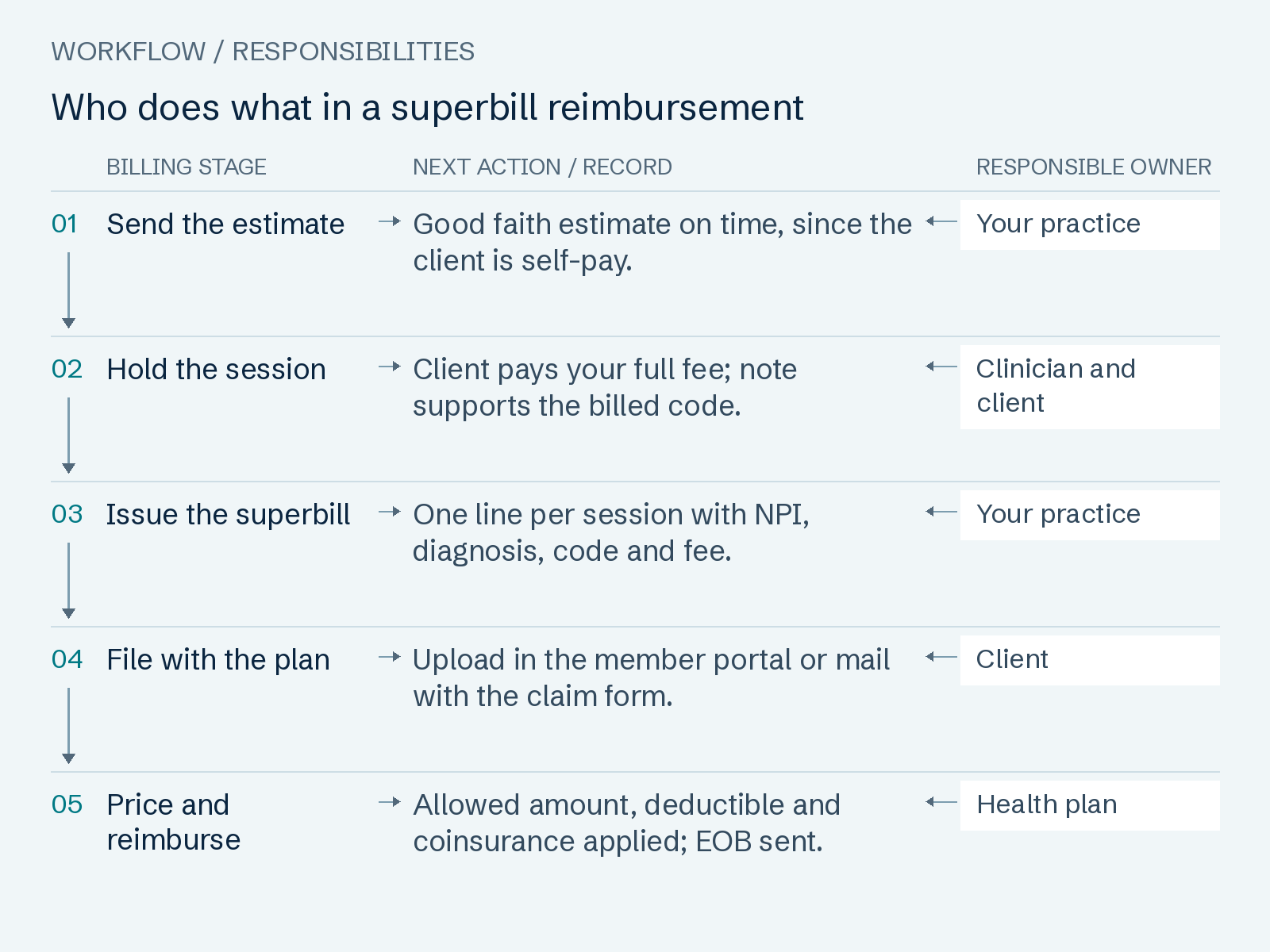
Read the workflow as text
- Send the estimate — Good faith estimate on time, since the client is self-pay. Owner: Your practice.
- Hold the session — Client pays your full fee; note supports the billed code. Owner: Clinician and client.
- Issue the superbill — One line per session with NPI, diagnosis, code and fee. Owner: Your practice.
- File with the plan — Upload in the member portal or mail with the claim form. Owner: Client.
- Price and reimburse — Allowed amount, deductible and coinsurance applied; EOB sent. Owner: Health plan.
Out-of-network benefits: deductible and allowed amount
A superbill does not decide what the client gets back; the plan's out-of-network terms do. Three terms set the number. The allowed amount is the maximum the plan will pay for a covered service, and if the provider charges more, the patient may have to pay the difference. The deductible is what the client pays for covered services before the plan starts to pay. Out-of-network coinsurance is the client's percentage of the allowed amount for providers outside the plan's network; HealthCare.gov uses 40% as its example and notes it usually costs more than in-network coinsurance.
So the client's reimbursement is worked out on the plan's allowed amount, not on your fee. If your fee is above it, the gap stays with the client on every session. Explaining this up front protects the relationship more than any discount.
Reimbursement worked example with deductible and coinsurance
Illustrative example, not client data: your fee is $180 per session, the plan's out-of-network allowed amount is $120, the client has $500 of out-of-network deductible left, and coinsurance is 40%, so the plan pays 60% of the allowed amount once the deductible is met.
| Session (illustrative) | Client paid you | Allowed amount | Applied to deductible | Plan reimburses client | Client's net cost |
|---|---|---|---|---|---|
| Sessions 1-4 (each) | $180 | $120 | $120 | $0 | $180 |
| Session 5 | $180 | $120 | $20 (deductible met) | $60 (60% of $100) | $120 |
| Session 6 onward (each) | $180 | $120 | $0 | $72 (60% of $120) | $108 |
Superbill vs filing claims for clients
Handing out superbills keeps billing work off your desk, but it moves the work, the wait and the denials onto your clients. Filing the out-of-network claim for them is the other model: your practice, or a billing service, submits the claim to the client's plan and follows it to payment. The choice changes your obligations too, because a client whose claim you file is no longer self-pay under the good faith estimate rule below.
| Question | Superbill (client files) | Your practice files the claim |
|---|---|---|
| Who submits to the plan | The client, by portal or member claim form | Your practice or your billing service |
| When you are paid | In full at the session | Depends on the plan and on what you collect at the session |
| Who works a denial | The client | Your practice or your billing service |
| Admin on your side | One statement per session or month | Claims, posting and follow-up on each session |
| Good faith estimate | Required: the client counts as self-pay | Not under the self-pay rule: the client is seeking a claim |
| Client experience | Pays your full fee, waits for reimbursement | No paperwork; may pay less up front |
No Surprises Act good-faith estimates for superbill clients
A client who has a group or individual health plan but does not seek to have a claim submitted to it is an "uninsured (or self-pay) individual" under 45 CFR 149.610. That definition covers every commercially insured client who pays you and files a superbill, so each one is owed a good faith estimate. CMS's good faith estimate guide for patients tells them to expect one when they are not using insurance to pay for care.
When the estimate is due and what it must show
- Timing. Care scheduled at least 3 business days ahead: no later than 1 business day after scheduling. At least 10 business days ahead: no later than 3 business days after scheduling. On request: no later than 3 business days after the request.
- Contents. Among other items: the client's name and date of birth, the service in plain language, the expected diagnosis codes, service codes and charges, and your name, NPI and tax ID, with the state and location where care is given.
- Recurring sessions. One estimate may cover a recurring course of therapy if it states the expected frequency and number of sessions, and its scope may not exceed 12 months.
- Disputes. A client billed at least $400 more than the estimate's expected charges can start the patient-provider dispute process under 45 CFR 149.620, within 120 calendar days of receiving the initial bill.
Your superbill fee should match the expected charge on the client's estimate. A mismatch is the first thing a dispute looks at.
Common superbill rejections
When a plan returns a superbill unpaid, the cause is usually on the statement or in the client's coverage. Most of these are preventable at intake.
Problems on the statement
- Missing identifiers. No NPI, no diagnosis code or no service code, so the plan cannot price the session.
- Sessions lumped together. A monthly total without a line per date of service.
- Fee and payment not shown. The plan cannot see that the client paid you, so it has nothing to reimburse.
- A code your record does not support. The superbill must match your session note; bill CPT 90837 only when the note supports a session of that length.
Problems with the client's coverage
- No out-of-network benefits. An HMO generally won't cover out-of-network care except in an emergency, and an EPO covers services only in its network, emergencies aside.
- Original Medicare. The law requires the doctor, provider or supplier to file Medicare claims for covered services, Medicare.gov explains, so an enrolled clinician files rather than handing over a superbill. Clients file their own Medicare claim only in limited cases, within 12 months of the date of service.
- Filed too late. Commercial plans set their own deadline for member-submitted claims; ask clients to check it in their plan documents and to file monthly, not at year end.
When your practice should file claims instead
Superbills work while your caseload is small and your clients are willing to file. They stop working when clients drop out over reimbursement paperwork, when plans keep returning statements, or when you want to accept clients who will only come if the claim is handled for them. At that point filing out-of-network claims for clients, and tracking each one, is billing work like any other.
For practices that bill insurance plans, the whole cycle runs under our mental health billing services. The wider rules for in-network and out-of-network therapy claims are set out in mental health insurance billing for practices. If claims you already filed are sitting unpaid, start with The Free A/R Deadline Map: Clock starts with your claim-level aging export and signed BAA; above 10 requests in a week, we confirm your date within 1 business day. Request the free review.
Copy the field table above into your EHR's statement settings today.
Common questions
- How do I submit a superbill to insurance?
- Your client submits it, not your practice. The client uploads the superbill in the plan's member portal where the plan accepts uploads, or attaches it to the plan's member medical claim form and mails it to the address on the form. Blue Cross and Blue Shield of Illinois, for example, tells members to mail the bill with its claim form or send it through its member Message Center if the plan allows. Original Medicare works differently: an enrolled clinician must file the claim.
- What should a therapy superbill include?
- The clinician's name, address and NPI, your practice's tax ID, the client's name, date of birth and member ID, one line per date of service, the place of service, the ICD-10-CM diagnosis code, the CPT code with a plain description, the fee, the amount paid and the date paid, and a signature. Medicare's Form CMS-1490S lists the same core facts for an itemized bill.
- How much will insurance reimburse from a superbill?
- It depends on the client's out-of-network benefits, not on your fee. The plan prices each session at its allowed amount, counts it toward the out-of-network deductible until that is met, then pays its share after the client's coinsurance. In the illustrative example above, a $180 session with a $120 allowed amount and 40% coinsurance returns $72 to the client once the deductible is met.
- Can my therapist submit the superbill for me?
- A practice that files for the client is filing a claim, not handing over a superbill. Your practice can do it, or hand it to a billing service: the claim goes to the client's plan in your name, and you follow it to payment. That client then is no longer self-pay under the good faith estimate rule, because they are seeking to have a claim submitted.
- Do I need a diagnosis on a superbill?
- Yes. Plans pay for treatment of a covered condition, and the diagnosis tells them what was treated; Medicare's patient claim form asks for a description of the illness or injury on the itemized bill. Use the ICD-10-CM code from your clinical record. Clients who do not want a diagnosis shared with their plan can pay privately and not file.
- Do superbill clients need a good faith estimate?
- Yes. Under 45 CFR 149.610, an insured client who does not seek to have a claim submitted to their plan counts as self-pay, so your practice gives them a good faith estimate: within 1 business day of scheduling care booked at least 3 business days out, or within 3 business days for care booked 10 or more business days out or on request.
Sources and review
Page revised November 5, 2026 · Review contact: Hyder Shah (inquiries@claimpillar.com). Every regulation, government page and plan page below was retrieved on November 5, 2026. Plan routes apply only to the plan named; the worked example is illustrative, not client data.
- eCFR: 45 CFR 149.610, Good faith estimates for uninsured (or self-pay) individuals
- eCFR: 45 CFR 149.620, Patient-provider dispute resolution
- CMS: Good faith estimate (Medical bill rights guide)
- CMS: Form CMS-1490S, Patient's Request for Medical Payment (version 01/18)
- Medicare.gov: Claims
- HealthCare.gov glossary: Allowed amount
- HealthCare.gov glossary: Deductible
- HealthCare.gov glossary: Out-of-network coinsurance
- HealthCare.gov glossary: Health Maintenance Organization (HMO)
- HealthCare.gov glossary: Exclusive Provider Organization (EPO) plan
- Blue Cross and Blue Shield of Illinois, Connect: How do I submit a super bill from my therapist for reimbursement?