What is a single case agreement?
A single case agreement (SCA) is a one-client contract between a health plan and a provider who is not in the plan's network. It sets what the plan will pay you, for which services, for how long, and what the client owes. It does not make your practice a network provider: the next client on the same plan starts from zero.
For a therapy or ABA practice, an SCA matters in two moments. A client you already treat changes to a plan you are not contracted with, or a plan refers a client to you because nobody in its network can take them. In both, the alternative is billing the client out-of-network or as private pay, and many clients cannot keep coming on those terms.
The names vary by payer. One Oregon Medicaid plan, Umpqua Health Alliance, uses two separate tools in its behavioral health prior authorization FAQ: an SCA, which it describes as typically for inpatient or residential treatment lasting the whole episode of care, and a special financial arrangement (SFA) attached to a single authorization request, typically for shorter outpatient care at a higher rate than its fee schedule. North Carolina's Alliance Health calls its version an out-of-network single client application and agreement. Ask each plan what its version is called before you send anything.
This page explains how the process works; it is not legal advice, and no plan is obliged to accept the rate you ask for.
When a payer will agree: network adequacy and continuity of care
Plans agree to an SCA when their own network cannot do the job. That is your case to make, and several rules give it weight depending on the client's coverage.
Network adequacy: the plan has no one suitable
Medicaid managed care plans have a federal duty. Under 42 CFR 438.206(b)(4), if the network cannot provide necessary covered services to a particular enrollee, the plan must cover them out of network, adequately and timely, for as long as the network cannot provide them, and the enrollee's cost may be no greater than in-network. Marketplace plans must keep networks sufficient in number and types of providers, including mental health and substance use disorder specialists, so services are accessible without unreasonable delay. Some states go further: New York Insurance Law section 4804 requires a managed care insurer with no in-network provider of appropriate training and experience to refer the insured to an appropriate provider at no additional cost beyond in-network cost sharing.
Continuity of care: your contract ended mid-treatment
When a provider's network contract is terminated (including when it expires or is not renewed, but not when it ends for quality or fraud reasons), federal law gives certain patients a transition period. Under 42 U.S.C. 300gg-113, a continuing care patient (for example, one undergoing a course of treatment for a serious and complex condition) can elect to keep receiving covered care from that provider on the same terms for up to 90 days from the plan's notice. After that, an SCA is how you ask to finish the course of treatment.
State laws written for specific clients
A few states require SCAs for named groups. Utah's Code section 31A-22-658 requires, from January 1, 2024, a health benefit plan covering mental health treatment to offer an SCA on request to an enrollee who works as a health care provider, so they can see an out-of-network mental health provider they choose; the enrollee must ask before treatment starts, and the statute lists exceptions. Check your own state's insurance code or Medicaid plan contract before assuming a right exists.
| Client's coverage | Rule that supports an out-of-network agreement | What it means for your request |
|---|---|---|
| Medicaid managed care plan | 42 CFR 438.206(b)(4) and (b)(5): out-of-network coverage while the network cannot provide the service | Show the plan has no network provider able to treat this client in a timely way |
| ACA marketplace plan | 45 CFR 156.230: networks sufficient in mental health and substance use providers | Document the in-network clinicians you or the client contacted and their wait times |
| New York managed care plan | Insurance Law 4804(a): referral to an appropriate out-of-network provider at in-network cost | Explain the client's specific needs that no network provider has the training to meet |
| Any group or individual plan whose contract with you ended | 42 U.S.C. 300gg-113: up to 90 days of continued care for continuing care patients | Ask for an SCA before the transition period ends, not after |
| Utah plan, enrollee who works as a health care provider | Utah Code 31A-22-658: plan must offer an SCA on request, before treatment | The client makes the request, with details of where they work |
Who asks: provider, client or case manager
Either side can start it, and the strongest requests come from both. The client calls member services and asks for an in-network provider who can treat their condition; when the plan cannot name one who is accepting clients, the client asks for a single case agreement with your practice. You then send the clinical and practice details. New York's rule describes the referral as made under a treatment plan approved by the insurer in consultation with the client's primary care provider, the out-of-network provider and the client. Plans route these requests to different teams, such as utilization management, provider contracting or a care manager, so ask member services which team handles out-of-network requests and get a reference number for the call.
Some plans want the request on their own form. Alliance Health in North Carolina asks the provider to be enrolled in the state Medicaid system (NCTracks) for the service and to submit a provider application request, which it reviews for network need. If that is approved, it sends an out-of-network prior authorization form to return with clinical documentation within five business days; if utilization management approves the service, the plan emails the agreement, which must be completed and returned within 14 calendar days.
A request script you can adapt
"I am calling about [client name, member ID, date of birth]. I am a licensed [credential] and out-of-network with your plan. The client needs [service and frequency] for [condition, in clinical terms]. The plan's directory shows no in-network clinician with [the specific expertise] accepting new clients within [distance or time]; the client contacted [names and dates]. I am requesting a single case agreement covering [service codes], [number of sessions], from [start date] to [end date], at [your proposed rate]. Who should I send the clinical documentation to, and what is the reference number for this request?"
Document checklist for the payer
- Client details: name, member ID, date of birth, plan and group number.
- Your practice details: legal name, tax ID, NPI (individual and group if you have one), license number and state, W-9 if the plan asks.
- Clinical summary: diagnosis, assessment, treatment plan and recent progress notes. Umpqua Health Alliance, for example, asks providers requesting prior authorization for a returning client's outpatient behavioral health services for the initial assessment, the treatment plan and the three most recent progress notes.
- Why the network cannot serve this client: in-network clinicians contacted, their answers and dates, distance or wait times, and any specialty training this client needs.
- The terms you propose: services and codes, number of sessions, dates and rate.
- The call log: dates, names and reference numbers from every conversation.
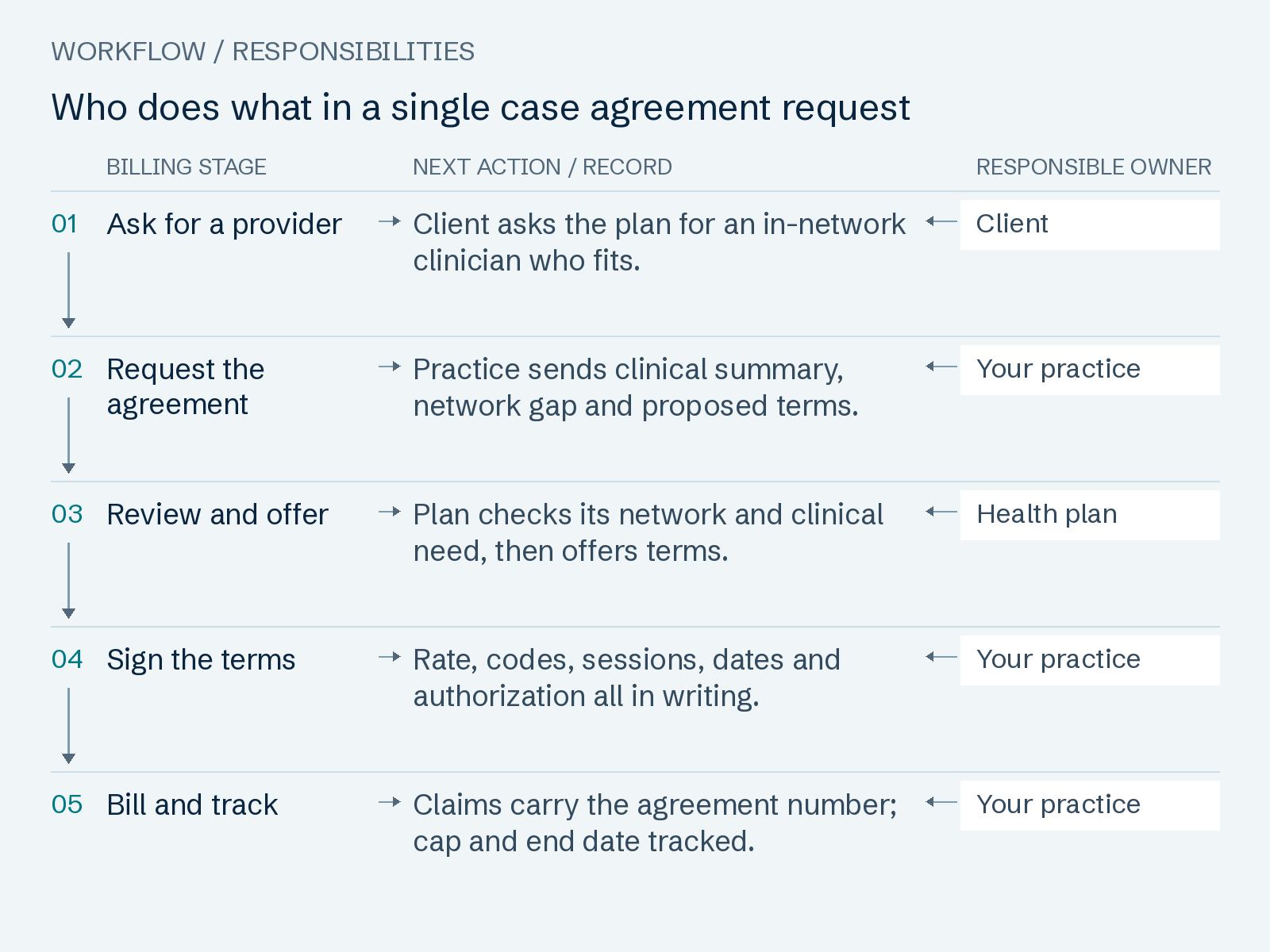
Read the workflow as text
- Ask for a provider — Client asks the plan for an in-network clinician who fits. Owner: Client.
- Request the agreement — Practice sends clinical summary, network gap and proposed terms. Owner: Your practice.
- Review and offer — Plan checks its network and clinical need, then offers terms. Owner: Health plan.
- Sign the terms — Rate, codes, sessions, dates and authorization all in writing. Owner: Your practice.
- Bill and track — Claims carry the agreement number; cap and end date tracked. Owner: Your practice.
What to negotiate: rate, sessions, dates, authorizations
An SCA is a negotiated contract, so every term is open until it is signed. Utah's statute, for example, requires its SCAs to define the length and scope of the agreement; treat those as the minimum on any agreement you sign.
Name your rate in the request. Umpqua Health Alliance says that if a request does not include the rate of payment, it is reviewed at its standard Medicaid rates, and asking for more later means a new authorization request. Decide your number before you call: your usual private-pay fee, the rate you would need to keep this client on your caseload, or a figure tied to the plan's own fee schedule. The plan may counter. Whatever you agree, the written agreement is the only version that counts.
Read the signed copy against this table before the first session under it.
| Term | What to pin down in writing | What goes wrong if it is vague |
|---|---|---|
| Rate basis | A fixed amount per service code and unit, or a stated percentage of a named fee schedule | The plan pays its default out-of-network or fee-schedule amount and you have nothing to appeal with |
| Services and codes | Every code you will bill, including assessments, family sessions and add-ons | A service missing from the list is paid out-of-network or denied |
| Session or unit cap | Number of sessions or units, and whether a cap can be extended | Visits past the cap go unpaid until a new agreement is signed |
| Start and end dates | Effective date, end date, and whether sessions before signing are covered | Sessions outside the dates are billed at out-of-network terms |
| Authorization | Whether prior authorization is still required, its number and its own dates | An agreement without a matching authorization can still be denied |
| Client cost sharing | Copay, coinsurance and deductible at in-network levels, and no balance billing | The client receives a bill they did not expect and stops coming |
| Claims and reference number | Claims address or payer ID, the agreement or authorization number, and the filing deadline | Claims process as ordinary out-of-network claims |
Single case agreements for ABA and specialty therapy
ABA and other specialty therapy requests rest on the same argument, with more paperwork. Treatment plans run for months and need regular reauthorization, so the agreement and the authorization each have their own dates. Umpqua Health Alliance, for instance, lists a six-month authorization period for ABA and three months for outpatient behavioral health services. An SCA that outlasts its authorization, or the reverse, leaves sessions unpaid in the gap.
For an ABA agency, also ask who the plan will treat as the provider on the agreement: the agency, the supervising behavior analyst, or both.
Specialty therapy is where network adequacy arguments are strongest. A plan may list many therapists but few who treat eating disorders, provide a specific trauma therapy, or see young children. Name the specialty and the evidence that no in-network clinician offers it to this client within a reasonable time.
Billing under an SCA
Claims under an SCA go out like any other claim, with the agreement's details on them. The NUCC 1500 claim form instructions define item 23 as the payer-assigned number authorizing the services; enter the prior authorization or referral number the plan assigns for the agreement's services there (or in its electronic equivalent), with no hyphens or spaces, unless the plan tells you to use another field. Use the codes, NPI and tax ID named in the agreement, and bill your agreed rate as the plan instructs.
Approval is not payment. Alliance Health states that authorization of services does not guarantee payment, so check the first claim's remittance against the agreed rate before you bill a full month. If it paid at an out-of-network or fee-schedule amount, call with the agreement number and ask for reprocessing while the paperwork is fresh.
If the client used to pay you directly and submit claims themselves, the SCA usually replaces that: the plan pays you and the client pays only their cost sharing. Our guide on how to submit a superbill to insurance covers the self-pay route for clients who do not get an agreement.
Track the limits every month
- Sessions used against the cap.
- Days left before the end date and the authorization end date.
- Paid amounts against the agreed rate.
- The renewal request date, set well before the end date.
SCA vs going in-network
An SCA solves one client's problem; going in-network changes the economics for every client on that plan. If you are asking the same plan for agreements again and again, that plan is telling you its network needs you, and an application may be worth more than another negotiation. Credentialing verifies a provider's qualifications; enrollment registers the provider with a payer so claims can be paid; contracting sets the rates and terms. See insurance credentialing for therapists for how that process runs.
When the paperwork is the bottleneck, our insurance credentialing service files applications for $149 per payer: Billed only after the payer confirms your effective date; $0 if denied or panel closed; filed within 5 business days of your complete packet. For practices that want claims and authorizations tracked as well, see our mental health billing services.
If out-of-network claims are already sitting unpaid, start with The Free A/R Deadline Map: send your aging export and we sort every unpaid claim over 90 days by the deadline it faces. Clock starts with your claim-level aging export and signed BAA; above 10 requests in a week, we confirm your date within 1 business day. Get my free A/R Deadline Map.
| Your situation | Better fit | Why |
|---|---|---|
| One client with a specialty need the plan cannot meet | Single case agreement | Fast to request, tied to this client's care, no network obligations |
| A current client whose plan changed mid-treatment | Single case agreement | Keeps treatment going while the client stays on the new plan |
| Several clients on the same plan asking to use insurance | Apply to join the network | One application replaces repeated negotiations and reauthorizations |
| The plan's panel is closed to new providers | Single case agreement, and reapply later | Agreements remain possible even when applications are not accepted |
| The plan's in-network rate is below what you can accept | Single case agreement or private pay | An agreement can set a per-client rate; joining locks in the network rate |
Common questions
- What is a single case agreement?
- A single case agreement is a contract between a health plan and an out-of-network provider that covers one client's care on agreed terms: rate, services, number of sessions and dates. It usually lets the client pay in-network cost sharing. It does not make your practice an in-network provider for other clients.
- How do I get a single case agreement?
- Have the client ask the plan for an in-network clinician who can treat them, then send the plan your request: the client's details, your NPI and tax ID, a clinical summary, evidence that no in-network provider can take the client, and the terms you propose. Ask member services which team handles out-of-network requests, and keep reference numbers for every call. See the document checklist above.
- What rate should I ask for in a single case agreement?
- Ask for a specific figure in writing, such as your usual fee per session or a stated percentage of a named fee schedule. No rate is guaranteed and the plan may counter. Do not leave the rate blank: one Oregon Medicaid plan reviews requests without a rate at its standard fee schedule, and raising it later needs a new request.
- How long does a single case agreement last?
- As long as the agreement says. Terms are negotiated per client, so the end date, the session cap and any separate authorization period are set in each agreement. Utah's law, for example, requires its agreements to define their length and scope. Ask for renewal terms before the end date, not after.
- Can a client request a single case agreement?
- Yes, and the request is often stronger when the client starts it, because the plan's duty runs to its member. The client asks member services for an in-network provider who can meet their needs; when none is available, they ask for an agreement with you. In Utah, an enrollee who works as a health care provider has a statutory right to request one before treatment starts.
- What if the plan says no?
- Ask for the reason in writing. If the plan names in-network clinicians, check whether they actually take this client's condition and are accepting new clients, and send that evidence back. Medicaid managed care plans must cover services out of network when their network cannot provide them, under 42 CFR 438.206. Otherwise the client can use out-of-network benefits or pay privately.
Sources and review
Page revised November 5, 2026 · Review contact: Hyder Shah (inquiries@claimpillar.com). Every law, regulation and plan source below was retrieved on November 5, 2026; plan rules apply only to the plan and state named.
- eCFR: 42 CFR 438.206, Availability of services (Medicaid managed care)
- eCFR: 45 CFR 156.230, Provider access standards for network plans
- New York State Senate: Insurance Law section 4804, Access to specialty care
- Cornell LII: 42 U.S.C. 300gg-113, Continuity of care
- FindLaw: Utah Code 31A-22-658, Single case agreement for mental health treatment
- Umpqua Health Alliance: Prior Authorizations, Behavioral Health FAQ
- Alliance Health (North Carolina): Out-of-network authorizations
- NUCC: 1500 Health Insurance Claim Form Reference Instruction Manual, version 13.0 (7/25)