Allowed amount definition
The allowed amount is the maximum a plan will pay for a covered service. HealthCare.gov's glossary entry defines it that way and lists other names you will see on contracts and remittances: "eligible expense", "payment allowance" or "negotiated rate". Medicare calls it the Medicare-approved amount. Whatever the label, the figure includes two shares: what the plan pays you and what the client pays you.
The allowed amount comes from one of three places:
- Your contract, when you are in network: the rate the plan agreed to pay for that code.
- A public fee schedule, for Medicare: it comes from the physician fee schedule, adjusted for your locality.
- The plan's own method, when you are out of network (covered below).
The rule that ties them together: Medicare payment is based on "the lesser of the actual charge or the applicable fee schedule amount", in the words of 42 CFR 414.21. Your charge caps what you can be allowed; the fee schedule or contract caps it from the other side.
Allowed vs billed vs paid amounts
Three numbers on every explanation of benefits look alike and mean different things. Mixing them up is how practices bill clients the wrong balance or post underpayments as routine write-offs.
| Amount | What it is | Who sets it | What happens to it |
|---|---|---|---|
| Billed amount (charge) | Your full fee for the service as sent on the claim | Your practice | Caps the allowed amount; the excess over the allowed amount is adjusted off or, out of network, may be owed by the client |
| Allowed amount | The most the plan recognizes for the service | Your contract, Medicare's fee schedule or the plan's out-of-network method | Split between the client's share and the plan's payment |
| Paid amount | What the plan actually sent you | The plan, after applying the client's benefits | Posted as the insurance payment |
| Client's share | Deductible, copay and coinsurance on the allowed amount | The client's plan design | Billed to the client or their guarantor |
How the allowed amount sets the client's share
Every cost-share calculation starts from the allowed amount. Medicare.gov's page on outpatient mental health care states that after the Part B deductible, the client pays "20% of the Medicare-approved amount" for visits, and it lists clinical social workers, marriage and family therapists and mental health counselors among the covered providers. Twenty percent of the allowed amount, not of your charge.
Worked 90837 example: an LCSW session under Original Medicare
The 2026 national Medicare amount (unadjusted) for 90837, the psychotherapy code for sessions of 53 minutes or more, in a non-facility setting is $167.00, from the CMS physician fee schedule relative value files (RVU26D); actual payment varies by locality, setting and payer. Chapter 12 of the Medicare Claims Processing Manual sets payment for clinical social workers at 75 percent of the physician fee schedule, and for marriage and family therapists and mental health counselors at 75 percent of what a clinical psychologist is paid, with assignment required for all three.
Illustrative example, not client data. The charge and the unmet deductible are round numbers chosen to show the arithmetic.
| Line | Amount | How it is worked out |
|---|---|---|
| Billed (your charge) | $180.00 | Illustrative practice fee |
| Allowed | $125.25 | 75% × $167.00 national amount for an LCSW |
| Contractual adjustment (CO) | $54.75 | $180.00 − $125.25, written off: the client never owes it |
| Deductible | $50.00 | Illustrative unmet Part B deductible, taken from the allowed amount first |
| Coinsurance | $15.05 | 20% of the $75.25 left after the deductible |
| Paid by Medicare | $60.20 | $75.25 − $15.05 |
| Client owes | $65.05 | $50.00 deductible + $15.05 coinsurance |
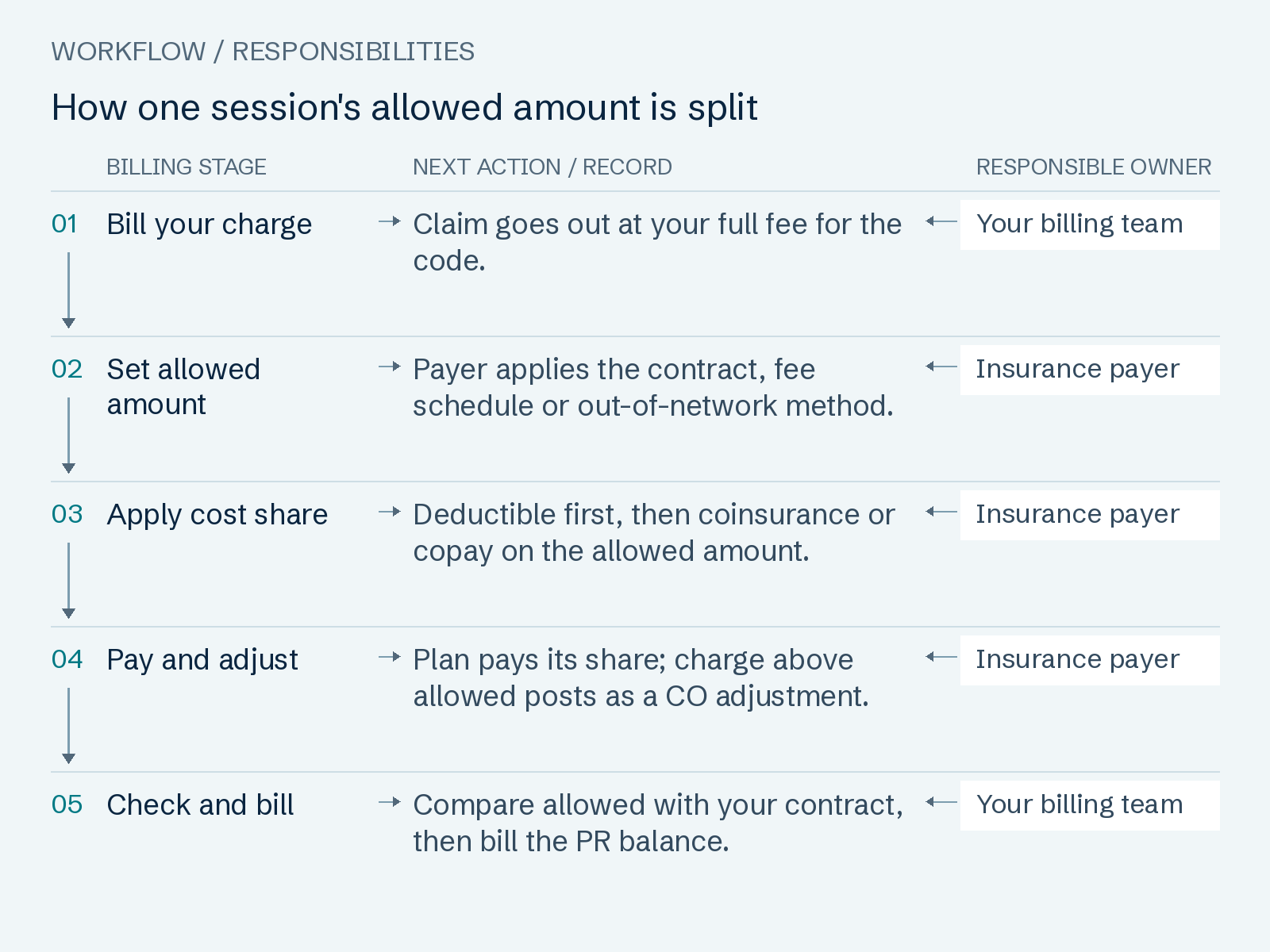
Read the workflow as text
- Bill your charge — Claim goes out at your full fee for the code. Owner: Your billing team.
- Set allowed amount — Payer applies the contract, fee schedule or out-of-network method. Owner: Insurance payer.
- Apply cost share — Deductible first, then coinsurance or copay on the allowed amount. Owner: Insurance payer.
- Pay and adjust — Plan pays its share; charge above allowed posts as a CO adjustment. Owner: Insurance payer.
- Check and bill — Compare allowed with your contract, then bill the PR balance. Owner: Your billing team.
In-network contracts vs out-of-network allowed amounts
In network, the allowed amount is the rate you signed for, and the client never owes more than their cost share on it. Federal price-transparency rules call that figure the negotiated rate: the amount a plan "has contractually agreed to pay an in-network provider" (45 CFR 147.210). HealthCare.gov's glossary adds that a preferred (in-network) provider may not bill the client for the difference between the charge and the allowed amount.
Out of network, the plan decides the allowed amount by its own method. The same regulation defines the out-of-network allowed amount as "the maximum amount a group health plan or health insurance issuer will pay" for a service from an out-of-network provider. Some plans base it on usual, customary and reasonable (UCR) charges, which HealthCare.gov describes as an amount based on what providers in the area usually charge, adding that UCR is "sometimes" used to set the allowed amount. The plan document, not the claim, tells you which.
Out-of-network example for a therapy client
Illustrative example, not client data: you charge $180.00, the client's plan allows $110.00 out of network, the out-of-network deductible is met, and coinsurance is 40%. The plan pays $66.00, the client owes $44.00 in coinsurance, and the $70.00 gap between charge and allowed amount may also fall to the client, because HealthCare.gov notes the client "may have to pay the difference" when the charge exceeds the allowed amount. A state law or a single-case agreement can change that, so check before you bill it. When an out-of-network client pays you directly and claims reimbursement, a therapy superbill submitted to their insurer is how the plan applies its allowed amount to that visit.
Medicare has its own version. A provider who does not participate is paid 5% less than the fee schedule allowed amount and, according to CMS's participation page, cannot charge the patient more than the limiting charge, 115% of the fee schedule amount for non-participating providers (itself 5% below the participating amount). That route is closed to social workers, marriage and family therapists and mental health counselors, who must accept assignment.
Contractual adjustments on the EOB (CO-45)
A contractual adjustment is the part of your charge above the allowed amount that the payer assigns to you. On your remittance it appears as an adjustment line with a group code and a claim adjustment reason code. The CMS booklet Remittance Advice Resources and FAQs explains that group codes assign financial responsibility for the unpaid part of a line: Contractual Obligation (CO) puts it on the provider, Patient Responsibility (PR) puts it on the patient, and providers may bill Medicare beneficiaries for an unpaid portion only when the adjustment shows group code PR.
Billers call the routine charge-over-allowed write-off "CO-45" after the reason code payers commonly attach to it. The official wording of every reason code is published by X12 at x12.org/codes; read the code your payer actually used rather than assuming.
Posting the adjustment correctly
- Post the payment, the CO adjustment and the PR amounts exactly as the remittance shows them.
- Bill the client, or the guarantor on the account, only for the PR amounts, or where the payer's rule allows it.
- Before posting a CO adjustment, check that the allowed amount behind it matches your contract. A CO line built on a wrong allowed amount is still an underpayment.
Spotting underpayments
An underpayment is an allowed amount below what your contract or the fee schedule says it should be. It hides inside an otherwise normal payment, so nobody notices unless someone compares each line with the rate. Check these when an allowed amount looks low:
- Compare with the right fee schedule. Match the payer, plan, code and year.
- Check the rendering provider. Medicare pays an LCSW, LMFT or LPC 75% of the amount a psychologist gets for the same code. Check whether your commercial contracts tier rates by license. A claim processed under the wrong clinician pays the wrong rate.
- Check the place of service code. Medicare publishes separate facility and non-facility amounts (for 90837 in 2026, $135.27 facility vs $167.00 non-facility, national and unadjusted), so the wrong place of service changes the allowed amount.
- Check units and modifiers against what you billed.
- Look for offsets. A short payment can be a deduction for a different claim; see recoupment.
- Dispute it in writing with the claim number, the contracted rate and the remittance line, inside the payer's appeal window.
On Full-Service Billing, our 60-Day Underpayment Check does this work for you: In month 3 we compare every payment from your first 60 days against your contracted rates and appeal each underpaid line. Needs your fee schedules. (Sold separately at $495.) If you would rather keep posting in house but want the checks done, see our payment posting service.
Using allowed amounts to set fees
Set each charge at or above the highest allowed amount you are paid for that code. Medicare pays on the lesser of your actual charge or the fee schedule amount (42 CFR 414.21), so a charge below the fee schedule amount quietly lowers what you are paid. Check your commercial contracts for the same lesser-of clause.
Three places to find the numbers:
- Your remittances. The allowed amount for each payer and code is already on every remittance you post.
- Medicare's fee schedule. The national amounts in the CMS relative value files, adjusted for your locality, give a public floor to compare against.
- Plans' price-transparency files. Under 45 CFR 147.212, group health plans and health insurers must publish an in-network rate file and an out-of-network allowed amount file, update them monthly and make them free to access. The out-of-network file reports allowed amounts paid in a 90-day period beginning 180 days before publication, and leaves out any service and provider with fewer than 20 claims.
One charge per code for every payer keeps the comparison honest: when each payer's allowed amount comes back below the same charge, the gaps show you which contracts to renegotiate. To see where your fees sit, compare them with our billing service pricing, which is a share of insurance payments (5.0% to 8.5% of insurance payments). Invoices 1–3: only percentage fees on that month's insurance payments, plus any statements or add-ons you order. Percentage fees and mailed statements are capped at 9.0% of that month's insurance payments; from invoice 4, the $400 minimum applies even in a month when the cap comes to less.
Underpaid lines and unworked denials both run against payer deadlines. To see which unpaid claims are closest to theirs, get my free A/R Deadline Map; Clock starts with your claim-level aging export and signed BAA; above 10 requests in a week, we confirm your date within 1 business day.
Common questions
- What is the allowed amount in medical billing?
- It is the maximum a health plan will pay for a covered service, including the patient's share. It comes from your contract when you are in network, from Medicare's fee schedule for Medicare claims, or from the plan's own method out of network.
- Is the allowed amount what I pay?
- Not all of it. The allowed amount is split between the plan's payment and the client's deductible, copay or coinsurance. Under Original Medicare, after the Part B deductible, the client pays 20% of the Medicare-approved amount for outpatient mental health visits.
- Why is the allowed amount lower than the billed amount?
- Your charge is your own price; the allowed amount is what the payer has agreed or decided to recognize. Medicare pays on the lesser of the two, so set charges at or above their highest allowed amount, and in network the difference is written off as a contractual adjustment.
- How is the out-of-network allowed amount set?
- Each plan sets it by its own method, sometimes based on usual, customary and reasonable charges in the area; the plan document says which. Group health plans and insurers must publish the out-of-network allowed amounts they have paid in a monthly price-transparency file.
- What is a contractual adjustment?
- It is the part of your charge above the allowed amount that the payer assigns to you with group code CO. CMS explains that CO puts the amount on the provider, so the patient is not billed for it; only PR amounts go to the patient.
- How do I know if a payer underpaid a claim?
- Compare the allowed amount on the remittance with your contracted rate for that payer, code and year. Then check the rendering provider, place of service, units and modifiers, and look for an offset from another claim before you dispute it in writing.
Sources and review
Page revised November 5, 2026 · Review contact: Hyder Shah (inquiries@claimpillar.com). The workflow checklists are editorial recommendations; payer requirements depend on the program and current policy.
- HealthCare.gov glossary: Allowed amount
- HealthCare.gov glossary: UCR (usual, customary and reasonable)
- eCFR: 42 CFR 414.21, Medicare payment basis
- eCFR: 45 CFR 147.210, transparency in coverage definitions
- eCFR: 45 CFR 147.212, transparency in coverage machine-readable files
- Medicare Claims Processing Manual, chapter 12: physicians and nonphysician practitioners (Rev. 13753)
- Medicare.gov: Mental health care (outpatient)
- CMS: Medicare participation
- CMS MLN booklet: Remittance Advice Resources and FAQs
- CMS: PFS Relative Value Files (CY 2026, RVU26D)