What a place of service code tells the payer
A place of service code tells the payer the setting where the patient received the service. CMS maintains the national list, the Place of Service Code Set, and the CMS-1500 and its electronic equivalent carry the same two-digit values for every payer. The Medicare Claims Processing Manual, chapter 26, tells you to enter the code in item 24B, one per service line.
The code does three jobs on a therapy claim:
- It picks the payment rate. Medicare pays many codes at two amounts, facility and non-facility, and the POS decides which one applies.
- It drives setting edits. Payers write setting rules into their policies, and a code that does not match them can deny or delay the claim.
- It flags telehealth. POS 02 and POS 10 tell Medicare and the plans that follow its codes that the visit happened by telecommunication, and where the patient was.
The table below lists the codes therapy, ABA and behavioral health practices use most, with CMS's names and the rate Medicare applies under chapter 12, section 20.4.2 of the same manual. Commercial and Medicaid plans may set their own rate logic, so treat the last column as Medicare's rule.
POS quick reference for therapy claims (CMS code set, page last modified February 17, 2026)
Retrieved November 4, 2026. Codes outside this list exist; the CMS page holds the full set.
| POS | CMS name | Medicare rate | Typical therapy use |
|---|---|---|---|
| 02 | Telehealth Provided Other than in Patient's Home | Facility | Video session while the patient sits in a clinic, school office or other non-home site |
| 03 | School | Non-facility | ABA or speech sessions delivered at the child's school |
| 10 | Telehealth Provided in Patient's Home | Non-facility | Teletherapy with the patient at home |
| 11 | Office | Non-facility | Sessions in your own practice office |
| 12 | Home | Non-facility | In-person ABA, OT or counseling in the patient's private residence |
| 19 | Off Campus-Outpatient Hospital | Facility | A registered hospital outpatient seen in an off-campus provider-based department |
| 21 | Inpatient Hospital | Facility | A registered inpatient on a general hospital unit |
| 22 | On Campus-Outpatient Hospital | Facility | A registered hospital outpatient seen on the main campus |
| 51 | Inpatient Psychiatric Facility | Facility | Services to a patient registered in an inpatient psychiatric facility |
| 52 | Psychiatric Facility-Partial Hospitalization | Facility | Partial hospitalization program services |
| 53 | Community Mental Health Center | Facility | Services at a community mental health center |
| 55 | Residential Substance Abuse Treatment Facility | Non-facility | Residential addiction treatment |
| 56 | Psychiatric Residential Treatment Center | Facility | Residential psychiatric treatment |
| 57 | Non-residential Substance Abuse Treatment Facility | Non-facility | Outpatient addiction treatment |
| 58 | Non-residential Opioid Treatment Facility | Non-facility | Opioid treatment program services |
| 99 | Other Place of Service | Non-facility | Settings no other code describes; some plans use it for community ABA |
POS 11 (office) vs POS 22 and 19 (outpatient hospital)
POS 11, Office, is a location other than a hospital, skilled nursing facility, community health center or similar facility where you routinely examine and treat patients on an ambulatory basis. Most private therapy and counseling practices bill POS 11 for every in-person session. Medicare pays it at the non-facility rate.
POS 22, On Campus-Outpatient Hospital, is the part of a hospital's main campus that treats patients who do not need admission. POS 19, Off Campus-Outpatient Hospital, is an off-campus hospital provider-based department, a code CMS made effective January 1, 2016, when it split the old single outpatient hospital code in two. Both take the facility rate under Medicare.
Hospital registration overrides the room
Chapter 26 sets the rule that catches clinicians who also hold hospital privileges: when you treat a registered hospital outpatient, you report at least POS 19 or POS 22 wherever the face-to-face visit happened, and chapter 12 pays the facility rate for those patients. A psychologist who sees a hospital-registered patient in their own suite still reports 19 or 22, not 11. Ask the hospital's registration desk when you are unsure.
How to choose between POS 22 and POS 19
The test is the department's location relative to the hospital's main campus, not the distance you drove. If the hospital calls the clinic an off-campus provider-based department, report POS 19; if the clinic sits on the main campus, report POS 22. A practice you own that is not part of the hospital fits CMS's office definition, POS 11, unless the patient is a registered hospital patient. Get the hospital's written answer on department status and keep it in your payer file.
POS 21 (inpatient) and consults
POS 21, Inpatient Hospital, is a facility, other than psychiatric, that treats admitted patients. Chapter 26 requires you to report at least POS 21 for a registered inpatient, whatever room the encounter happened in, and allows a more exact inpatient code when you know it, such as POS 51 for a patient registered in an inpatient psychiatric facility. Medicare then pays your services at the facility rate.
Medicare does not pay consultation codes
Psychiatrists and nurse practitioners asked to see a hospital patient often reach for a consultation code. Chapter 12, section 30.6.10 says Medicare stopped recognizing consultation codes for Part B payment on January 1, 2010. Bill the initial hospital care code (99221-99223) or a subsequent hospital care code that reflects the work you documented, with POS 21. Commercial plans write their own consult policies, so check each plan before you bill a consult code to it.
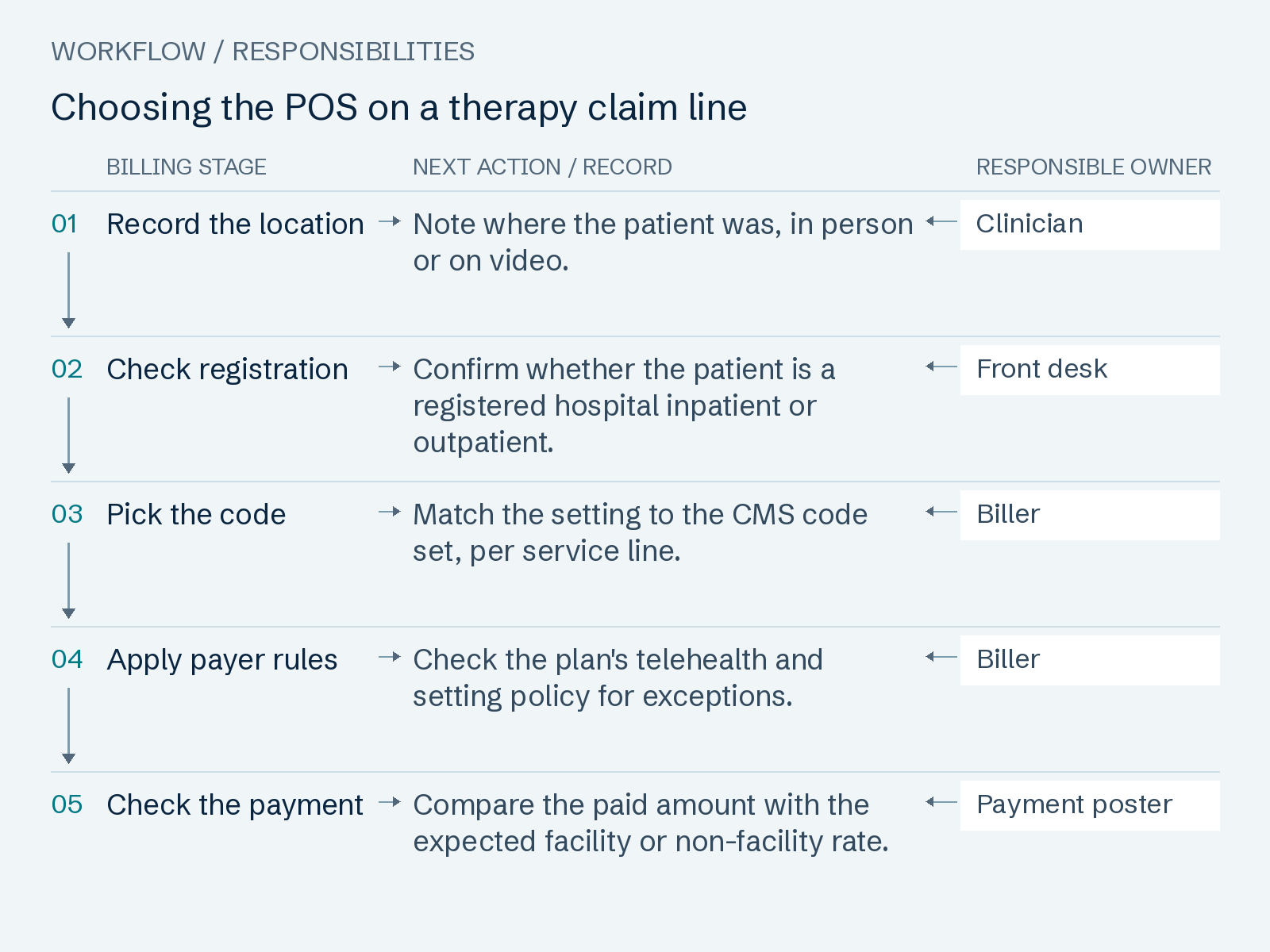
Read the workflow as text
- Record the location — Note where the patient was, in person or on video. Owner: Clinician.
- Check registration — Confirm whether the patient is a registered hospital inpatient or outpatient. Owner: Front desk.
- Pick the code — Match the setting to the CMS code set, per service line. Owner: Biller.
- Apply payer rules — Check the plan's telehealth and setting policy for exceptions. Owner: Biller.
- Check the payment — Compare the paid amount with the expected facility or non-facility rate. Owner: Payment poster.
Telehealth: POS 02 vs POS 10 for teletherapy
POS 02 and POS 10 both report a service delivered through telecommunication. The difference is where the patient was. POS 10, Telehealth Provided in Patient's Home, applies when the patient is in their private residence; POS 02, Telehealth Provided Other than in Patient's Home, applies when they are anywhere else. Where you sat does not change the code. CMS made POS 10 effective January 1, 2022 and available to Medicare April 1, 2022.
For Medicare, the CMS telehealth FAQ says to use POS 02 or 10 and confirms that since January 1, 2024, telehealth to patients in their homes is paid at the non-facility rate; POS 02 stays on the facility list in chapter 12. Commercial and Medicaid payers do not agree: some want POS 02 only, some want your usual in-person POS plus a modifier. The payer-by-payer POS and modifier grid is in our telehealth modifier guide (GT, 95 and 93).
ABA and home or school sessions: POS 12, 03 and 99
ABA programs move with the child, so a single authorization can produce lines with three or four different place of service codes. The CMS definitions are short:
- POS 12, Home: a location other than a hospital or other facility where the patient receives care in a private residence. It means an in-person session; a video session to the same home is POS 10.
- POS 03, School: a facility whose primary purpose is education.
- POS 99, Other Place of Service: a setting no other code describes.
Plans then write their own ABA instructions. Blue Cross and Blue Shield of Illinois, in an April 10, 2024 provider notice, lists POS 03 for school, 11 for the office, 12 for the patient's home and 99 for every other setting, including community and daycare locations, and warns that the wrong code can deny or delay the claim. Setting rules differ by plan and by state Medicaid program, so confirm each payer's ABA policy before scheduling school or community hours.
One session, one line, one setting
Set the POS per service line, not per claim. If a technician runs two hours at home in the morning and one hour at school after lunch, bill them as separate lines with POS 12 and POS 03, each with its own units. Session notes should name the location, because an auditor matches the note to the POS.
Behavioral health facilities: POS 53, 55, 57 and 58
Behavioral health has its own block of facility codes, and they do not all pay the same way under Medicare. CMS defines them as follows:
- POS 53, Community Mental Health Center: a facility that offers outpatient services, including specialized services for children, the elderly and the chronically ill, 24-hour emergency care, day treatment and partial hospitalization, among others. Medicare pays your professional services there at the facility rate.
- POS 55, Residential Substance Abuse Treatment Facility: treatment for substance use to live-in residents who do not need acute medical care. Non-facility rate.
- POS 57, Non-residential Substance Abuse Treatment Facility: substance use treatment on an ambulatory basis, including individual, group and family counseling and psychological testing. Non-facility rate.
- POS 58, Non-residential Opioid Treatment Facility: ambulatory treatment of opioid use disorder, including methadone and other medication-assisted treatment. Non-facility rate.
The related inpatient and residential codes, POS 51 (inpatient psychiatric), 52 (partial hospitalization) and 56 (psychiatric residential treatment center), are all on Medicare's facility list. A group practice that contracts to staff a community mental health center should bill POS 53, not POS 11, even when the clinician thinks of the CMHC room as their office.
Facility vs non-facility payment: why the wrong POS costs money
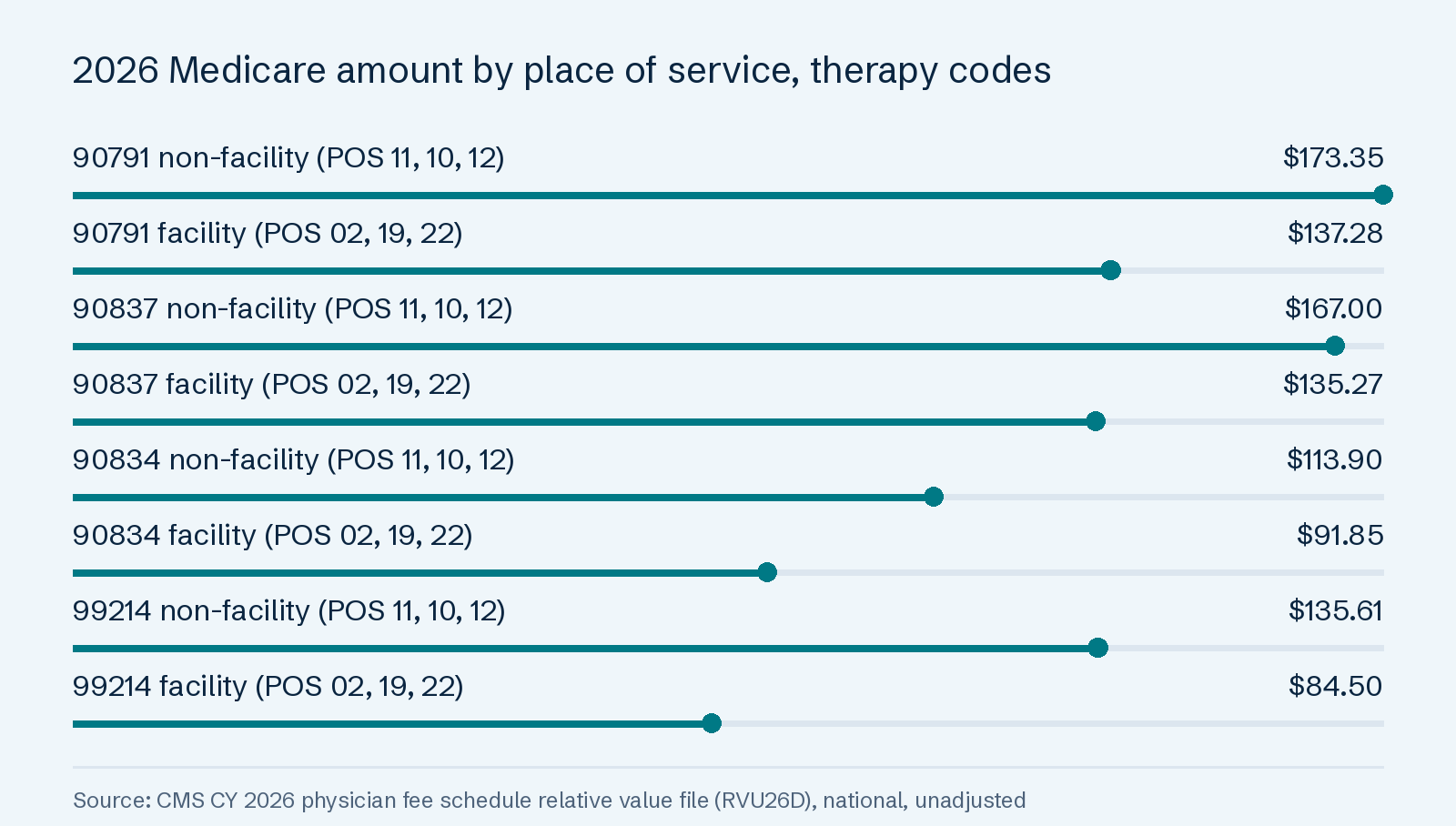
Medicare's physician fee schedule gives many codes two amounts, and chapter 12, section 20.4.2 says the POS on the claim decides which one is paid. The gap comes from the practice expense relative value units: in the 2026 file, 90837 carries 1.20 non-facility practice expense units against 0.25 facility. The 2026 national Medicare amounts (unadjusted) below show what that means per session. Actual payment varies by locality, setting and payer.
The exception for PT, OT and speech therapy
The same section says outpatient rehabilitative therapy procedures, including physical therapy, occupational therapy and speech-language pathology, are paid at the non-facility rate whether they are furnished in a facility or non-facility setting. For those services the POS still has to be correct, but it does not move the Medicare amount.
The error runs both ways. Reporting POS 11 for a patient who was a registered hospital outpatient overstates the payment and creates an overpayment. An HHS-OIG audit (A-01-13-00506, May 6, 2015) found Medicare contractors potentially overpaid physicians about $33.4 million for services from January 2010 through September 2012 that were coded with the wrong place of service. Reporting POS 02 for a patient who was at home understates it: on a 90837 line that is $31.73 less under Medicare's 2026 national amounts.
| Code (our plain description) | Non-facility: POS 11, 10, 12 | Facility: POS 02, 19, 21, 22, 53 | Difference |
|---|---|---|---|
| 90791 psychiatric diagnostic evaluation | $173.35 | $137.28 | $36.07 |
| 90832 psychotherapy, about 30 minutes | $85.84 | $69.47 | $16.37 |
| 90834 psychotherapy, about 45 minutes | $113.90 | $91.85 | $22.05 |
| 90837 psychotherapy, about 60 minutes | $167.00 | $135.27 | $31.73 |
| 90847 family psychotherapy with patient | $109.55 | $102.87 | $6.68 |
| 99214 established patient visit, moderate | $135.61 | $84.50 | $51.11 |
POS denial fixes and payer quirks
Most place of service denials and underpayments trace back to one of a few causes. Check them in this order before you correct and resubmit:
- Patient location not documented. The note should say where the patient was for telehealth (home or elsewhere) and where an in-person session happened. Without it you cannot defend POS 10 against POS 02, or POS 12 against POS 11.
- Hospital registration missed. Ask whether the patient was a registered inpatient or outpatient on that date. If so, CMS requires at least POS 21, 19 or 22.
- Payer telehealth rule ignored. Cigna's policy says not to bill POS 10. State Medicaid rules differ too; as examples of one state's rule each, NC Medicaid wants your usual POS with GT instead of POS 02, and Washington Apple Health's lower-acuity behavioral health rules need modifier 95 for non-facility pay.
- Setting not covered for the service. Plans write their own setting rules for ABA and other therapy services. Check the plan's policy before the session, not after the denial.
- Claim template default. If your claim template sets a default POS, audit it after any move to teletherapy or home sessions, not just the denied claim.
When the record shows the correct setting, fix the POS through the payer's corrected-claim process, and watch the payer's filing window while you do.
Claim-form and glossary pages for POS work
- The CMS 1500 form, where item 24B holds the POS on every line
- The UB-04 institutional claim, which hospitals and facilities file for their side of a visit
- Modifier 95 vs the GT modifier for telehealth lines
- Telehealth billing for therapists
- Glossary entries for the allowed amount, the rendering provider and recoupment after an overpayment
When to hand off POS coding
If your team is correcting the same POS errors every month, the fix is a claim scrub, not more resubmissions. Medical coding services check the codes, modifiers and units on every line against the signed note before the claim goes out, and practices that want the whole cycle covered can look at medical billing services for small practices. Therapy groups can compare mental health billing services and ABA therapy billing. To see which unpaid claims are closest to their deadline, request The Free A/R Deadline Map through the free billing audit page. Clock starts with your claim-level aging export and signed BAA; above 10 requests in a week, we confirm your date within 1 business day.
Common questions
- What is POS 11 in medical billing?
- POS 11 is CMS's code for Office: a location other than a hospital or other listed facility where a health professional routinely sees patients on an ambulatory basis. Medicare pays POS 11 lines at the non-facility rate. Do not use it for a patient who is a registered hospital inpatient or outpatient; chapter 26 requires at least POS 21, 19 or 22 for them.
- What is the difference between POS 22 and POS 19?
- Both report a registered hospital outpatient and both take Medicare's facility rate. POS 22 is On Campus-Outpatient Hospital, a department on the hospital's main campus. POS 19 is Off Campus-Outpatient Hospital, a provider-based department off the main campus, effective January 1, 2016. Ask the hospital which applies to the department where you see patients.
- What is place of service 02?
- POS 02 is Telehealth Provided Other than in Patient's Home: the patient joined the visit from somewhere other than their home, such as a clinic or a school office. Medicare lists POS 02 among the settings paid at the facility rate. If the patient was at home, report POS 10 instead, unless the payer's policy says otherwise.
- Which POS code do I use for teletherapy at home?
- For Medicare and UnitedHealthcare commercial plans, POS 10, which Medicare pays at the non-facility rate. Cigna's virtual care policy says to report POS 02 with a virtual care modifier and not to bill POS 10, and NC Medicaid (one state's rule) wants your usual POS with modifier GT. Check each plan's telehealth policy and your telehealth modifier rules before you set the claim template.
- What POS code is used for ABA in the home?
- POS 12 (Home) for in-person ABA in the patient's private residence; a video session to the same home is POS 10. Blue Cross and Blue Shield of Illinois, for example, lists POS 12 for the home, 03 for school, 11 for the office and 99 for community and daycare settings. Confirm your own payer's ABA policy, since setting rules differ by plan and state.
- Can I bill POS 11 when I see a hospital patient in my own office?
- Not under Medicare's rules if that patient is a registered hospital inpatient or outpatient on that date. Chapter 26 says to report at least POS 21 for an inpatient and POS 19 or 22 for an outpatient, irrespective of where the face-to-face visit happened, and chapter 12 pays the facility rate. Billing POS 11 instead overstates the payment.
Sources and review
Page revised November 4, 2026 · Review contact: Hyder Shah (inquiries@claimpillar.com). Every source below was retrieved on November 4, 2026; payer rules are scoped to the plan named. Medicare amounts are 2026 national amounts (unadjusted) from our copy of the CMS RVU26D file.
- CMS, Place of Service Code Set (page last modified February 17, 2026; retrieved November 4, 2026)
- CMS, Medicare Claims Processing Manual, Chapter 12, sections 20.4.2 and 30.6.10 (retrieved November 4, 2026)
- CMS, Medicare Claims Processing Manual, Chapter 26, Completing and Processing Form CMS-1500 (retrieved November 4, 2026)
- CMS, Telehealth FAQ (updated October 8, 2026; retrieved November 4, 2026)
- CMS, MLN901705 Telehealth & Remote Monitoring (December 2025; retrieved November 4, 2026)
- UnitedHealthcare Commercial Reimbursement Policy 2026R0046A, Telehealth/Virtual Health, Professional (retrieved November 4, 2026)
- Cigna Reimbursement Policy R31, Virtual Care (last updated February 17, 2026; retrieved November 4, 2026)
- Washington HCA, Behavioral health telemedicine policy and billing FAQ (effective January 1, 2025; retrieved November 4, 2026)
- NC Medicaid Clinical Coverage Policy 1H, Telehealth, Virtual Communications and Remote Patient Monitoring (amended February 15, 2025; retrieved November 4, 2026)
- Blue Cross and Blue Shield of Illinois, Filing Claims for ABA Services: Use the Correct Place of Service Code (April 10, 2024; retrieved November 4, 2026)
- HHS-OIG, Incorrect Place-of-Service Coding Resulted in Potential Medicare Overpayments Costing Millions (A-01-13-00506, May 6, 2015; retrieved November 4, 2026)