Rendering provider definition
The rendering provider is the person or company who rendered or supervised the care on a claim line. That is the wording of the NUCC 1500 claim form instruction manual (version 13.0, July 2025), the national standard for paper professional claims. The NUCC adds that a substitute provider (locum tenens) who covered the visit is reported as the rendering provider, and that a laboratory or other facility can be one.
In practice, the rendering provider is the clinician whose license and payer enrollment make the service billable: the therapist who ran the session, the physician who saw the patient, the behavior analyst responsible for the treatment line. The rendering provider is identified by a Type 1 (individual) NPI. The CMS NPI fact sheet (December 2024) says individuals are only eligible for one NPI, so the same 10-digit number follows that clinician to every employer and every claim.
The rendering provider is not always the person who was in the room. Payers decide whose NPI represents a service delivered by a technician, an assistant or a pre-licensed clinician, which is why the ABA and supervision sections below matter more than the definition itself.
Rendering vs billing vs supervising vs referring provider
Four provider roles can appear on one professional claim, and each has its own field. Box 33 identifies the provider that is requesting to be paid, per the NUCC; box 24J identifies who rendered each line. Box 17 holds one name for a referring, ordering or supervising provider, marked with a qualifier to the left of the dotted line: DN for referring, DK for ordering, DQ for supervising. When more than one applies, the NUCC priority order is referring first, then ordering, then supervising.
Medicare follows the same layout. Chapter 26 of the Medicare Claims Processing Manual (Rev. 14466, May 27, 2026) asks for a supervising physician in item 17 when Medicare policy requires one, and a separate CMS-1500 for each ordering, referring or supervising physician when a claim involves several.
| Role | Who it is | CMS-1500 field | What goes wrong when it is wrong |
|---|---|---|---|
| Rendering provider | The individual who performed or supervised the service line | Box 24J, lower unshaded half (NPI); 24I qualifier plus shaded 24J for a non-NPI ID | Missing or unenrolled NPI: claim returned or denied |
| Billing provider | The group, organization or individual asking to be paid | Box 33 (name, street address, phone) and 33a (NPI) | Payment goes to the wrong entity, or the claim is rejected |
| Supervising provider | The clinician supervising a service when payer policy requires one to be named | Box 17 with qualifier DQ, NPI in 17b | Missing when the payer requires it for technician or supervisee services |
| Referring or ordering provider | The clinician who referred the patient or ordered the service | Box 17 with qualifier DN (referring) or DK (ordering), NPI in 17b | Missing on services that need a referral or order |
Where the rendering NPI goes: CMS-1500 box 24J and the 837P
The rendering NPI goes in the lower, unshaded half of box 24J on each service line. The shaded upper half, with a qualifier in 24I, carries a payer-assigned non-NPI number only when a payer still uses one. On the electronic 837P, the CMS CMS-1500 and 837P code sources job aid maps item 24J to the rendering provider identifier in loop 2310B (claim level) or 2420A (line level), and item 33a to the billing provider identifier in loop 2010AA. Medicare marks both as required.
When 24J can be left blank
The NUCC says to report 24I and 24J only when the rendering provider differs from the billing provider in 33a and 33b. A solo clinician billing under their own individual NPI is both, so the NUCC instruction lets 24J stay blank; confirm your payer agrees. Medicare is stricter: chapter 1 of the Claims Processing Manual (Rev. 13725, April 10, 2026) lists a missing 24J NPI from a rendering practitioner who is a sole practitioner or a member of a group practice among the errors that make a claim unprocessable, so Medicare claims carry the rendering NPI in 24J either way.
Incident-to services
For Medicare services billed incident to a physician or non-physician practitioner, chapter 26 says that when the person who ordered the service is not supervising, the supervisor's NPI goes in 24J. The NPI in 24J follows the supervision, not the order.
Box 24J sits next to the other line-level fields on the CMS-1500 claim form, including box 24B, where the POS code such as 22 or 11 tells the payer where the rendering provider delivered the service.
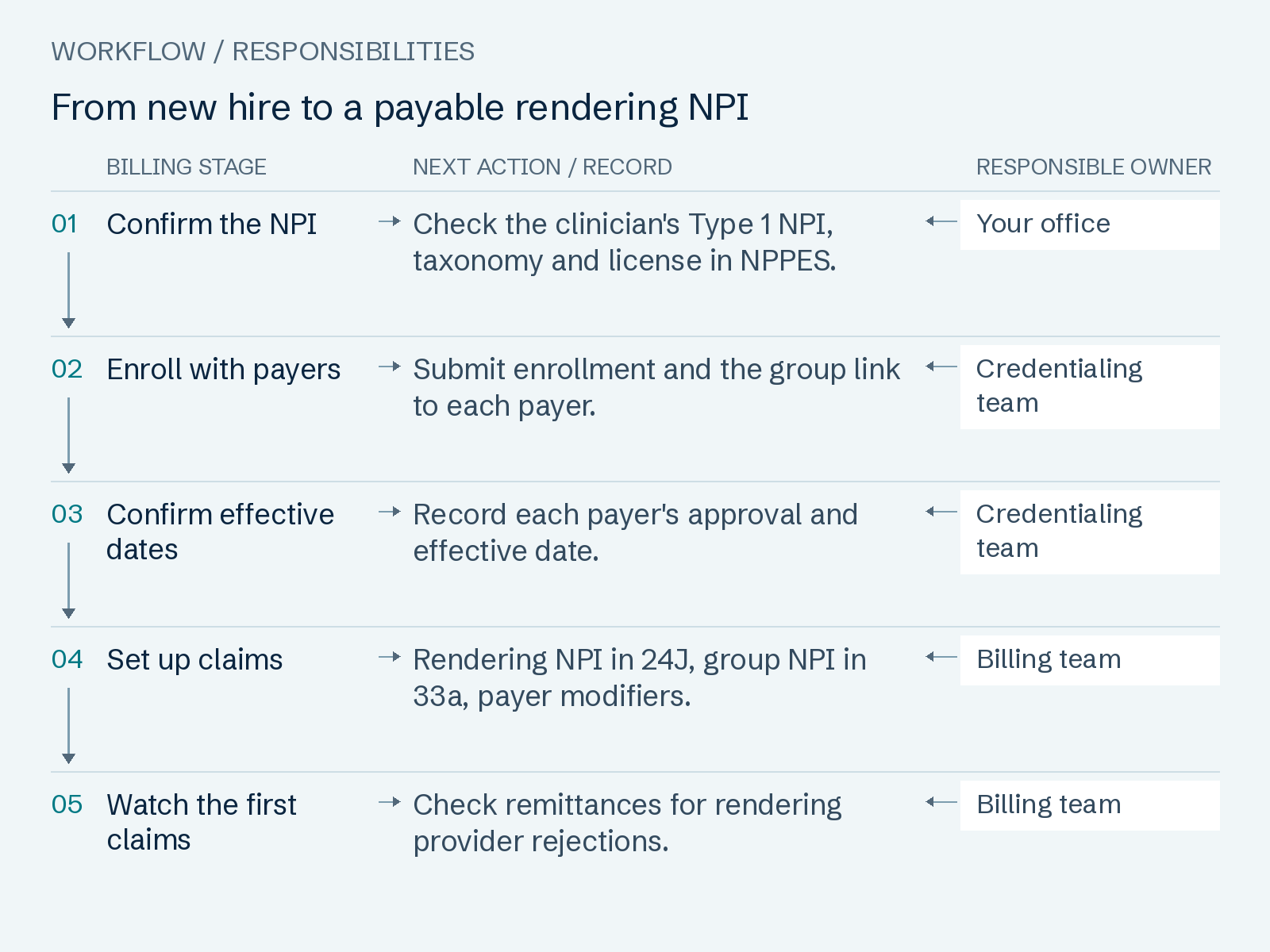
Read the workflow as text
- Confirm the NPI — Check the clinician's Type 1 NPI, taxonomy and license in NPPES. Owner: Your office.
- Enroll with payers — Submit enrollment and the group link to each payer. Owner: Credentialing team.
- Confirm effective dates — Record each payer's approval and effective date. Owner: Credentialing team.
- Set up claims — Rendering NPI in 24J, group NPI in 33a, payer modifiers. Owner: Billing team.
- Watch the first claims — Check remittances for rendering provider rejections. Owner: Billing team.
Group practices: individual NPI vs group NPI
A group practice claim carries two kinds of NPI. The CMS NPI fact sheet defines Type 1 NPIs for individual providers, including sole proprietors, and Type 2 NPIs for organizations such as physician groups; an organization can hold more than one. A clinician who incorporates can hold both a Type 1 for themselves and a Type 2 for their corporation or LLC.
- Group claim: the group's Type 2 NPI in 33a, each clinician's Type 1 NPI in 24J.
- Solo sole proprietor: the clinician's Type 1 NPI in 33a; under the NUCC instruction 24J can stay blank because it would repeat 33a, but Medicare still expects the NPI in 24J.
- Incorporated solo clinician: the corporation's Type 2 NPI in 33a and the clinician's Type 1 NPI in 24J, because they are now two entities.
For Medicare, the link between the two is the reassignment of benefits. The CMS-855I application says reassigning lets an organization or group submit claims and receive payment for Part B services the clinician provided as a member of the group, that the separate CMS-855R form has been discontinued, and that both the individual and the group must be enrolled (or enrolling at the same time) before the reassignment can take effect. Commercial plans and Medicaid programs have their own enrollment and group-linking steps; ask each one how a new clinician is added under your group before their NPI appears in 24J.
ABA: when the BCBA, not the RBT, is the rendering provider
ABA has no single national rule for whose NPI goes in 24J when a registered behavior technician (RBT) delivers the hours. Payers fall into three patterns. The rules below were retrieved on 2026-11-05; check each payer's current manual before you change claim setup.
- Everything under the BCBA. Montana Medicaid's ABA fee schedule (effective July 1, 2025) says the BCBA assumes full professional responsibility for services by an intermediate professional or RBT, and all services are billed under the BCBA's provider NPI.
- The licensed analyst is both rendering and billing. The Texas Medicaid LBA enrollment guide says a licensed behavior analyst enrolls only as an individual, uses their individual NPI as both rendering and billing provider, may not use the employer's NPI, and adds a modifier to show services delivered by assistants and behavior technicians.
- The technician is the rendering provider. Indiana Medicaid requires the rendering NPI to match the modifier for the level of provider who delivered the service: U1 for a credentialed RBT, U2 for a BCaBA, U3 for a doctoral-level BCBA-D (IHCP bulletin BT202539). Bulletin BT202596 moved enforcement to August 1, 2025.
Commercial plans add their own layer. Blue Cross and Blue Shield of Oklahoma's ABA payment policy CPCP011 (effective March 20, 2026) asks for one modifier (HM, HN or HO) showing the rendering provider's level of training on technician-delivered treatment code 97153, treats the provider who renders treatment week to week as the rendering provider, and says an unlicensed or non-network-credentialed provider cannot bill through another person's NPI and be reimbursed.
| Payer (type) | Rendering NPI on RBT-delivered hours | Rule date and source |
|---|---|---|
| Montana Medicaid (state Medicaid) | The supervising BCBA's NPI for all services | Fee schedule effective July 1, 2025 |
| Texas Medicaid (state Medicaid) | The licensed behavior analyst's individual NPI, as rendering and billing, with a modifier for BT services | TMHP LBA enrollment guide, retrieved 2026-11-05 |
| Indiana Medicaid (state Medicaid) | The enrolled RBT's own NPI, matched to modifier U1 | BT202539 (March 13, 2025); enforced from August 1, 2025 per BT202596 |
| BCBS of Oklahoma (commercial) | The provider who renders the treatment, with an HM, HN or HO level modifier on 97153 | CPCP011, effective March 20, 2026 |
Pre-licensed therapists and supervisor billing rules
A pre-licensed therapist (an associate counselor, social worker or marriage and family therapist working toward licensure) may or may not be able to enroll with a payer in their own name; that depends on the payer and the state. Where they cannot, their sessions are billed under a supervising licensed clinician or not at all.
Medicare: incident-to, under the supervisor
Medicare's incident-to rule, 42 CFR 410.26(b)(5), allows behavioral health services by auxiliary personnel under the general supervision of a physician or other practitioner, and adds that only the supervising practitioner may bill Medicare for incident-to services. Paragraph (b)(7) requires the services to follow state law. On the claim, the supervisor's NPI is the one in 24J, as chapter 26 describes.
Commercial plans and Medicaid
Commercial and Medicaid rules vary more. The BCBS of Oklahoma ABA policy is a useful example of the wording to look for: services by a supervisee billed through a supervisor must follow state law, board requirements and CMS conventions within a formal supervisor-supervisee relationship. Before you bill a pre-licensed clinician's sessions under a supervisor, get the payer's rule in writing, and confirm the supervisor's own credentialing covers the service and location.
Rendering provider denials and credentialing gaps
A rendering provider denial is often an enrollment problem, not a coding problem: the claim names the right clinician, but the payer does not recognize that NPI as an enrolled rendering provider under your group. Texas Medicaid states the result plainly in its LBA guide: claims submitted with a billing or rendering NPI that is not enrolled will not be reimbursed. Two details catch practices out. The CMS fact sheet notes that updating an NPI record in NPPES does not update Medicare enrollment. And Indiana's BT202596 shows that a payer can pay an enrolled rendering provider out of network while managed care network participation is still pending, which is not the rate you contracted for.
Credentialing-gap checklist: every rendering NPI linked to the group
- List every clinician who appears in 24J, with their Type 1 NPI and start date.
- For each payer, confirm the clinician is enrolled and linked to your group's Type 2 NPI and tax ID (for Medicare, the reassignment on the CMS-855I).
- Confirm the taxonomy and service locations on file match what the claim will show.
- For ABA, confirm each payer's rendering pattern from the section above, and that technicians are enrolled where the payer requires it.
- Hold claims for a new clinician until the effective date is confirmed, and track that date against each payer's filing limit.
- Re-check after any NPPES change, address move, license renewal or new location.
Our insurance credentialing service files each clinician who joins your group as their own line with each commercial payer, and our provider enrollment service files the Medicare CMS-855I with reassignment to your group and the state Medicaid application. Our ABA therapy billing service checks overlapping sessions by rendering provider and adds the credential modifiers each payer's manual asks for. If unlinked NPIs have already left claims unpaid, the free A/R Deadline Map lists every unpaid claim over 90 days by deadline. Clock starts with your claim-level aging export and signed BAA; above 10 requests in a week, we confirm your date within 1 business day. Get your free A/R Deadline Map.
Common questions
- What does rendering provider mean?
- The rendering provider is the individual who performed or supervised the service on a claim line. Their own NPI goes in box 24J of the CMS-1500, or loop 2310B or 2420A on the 837P. The NUCC manual defines it as the person or company who rendered or supervised the care.
- What is the difference between a rendering and billing provider?
- The rendering provider performed the service (box 24J); the billing provider is asking to be paid (box 33 and 33a). In a group, the clinician renders and the group bills under its Type 2 NPI. For a solo clinician billing under their own NPI, they are the same, and the NUCC instruction lets 24J stay blank, though Medicare still expects the NPI in 24J.
- Can an RBT be a rendering provider?
- It depends on the payer. Indiana Medicaid requires the enrolled RBT's NPI with modifier U1. Montana Medicaid bills all ABA services under the BCBA's NPI, and Texas Medicaid uses the licensed behavior analyst's NPI as both rendering and billing provider. Check each payer's current ABA policy.
- Can a pre-licensed therapist be the rendering provider?
- Not under Medicare's incident-to rule. Medicare lets auxiliary personnel provide behavioral health services under general supervision, but only the supervising practitioner may bill, so the supervisor's NPI goes in 24J (42 CFR 410.26). Commercial and Medicaid rules vary; get the payer's rule in writing.
- Does the rendering provider need to be credentialed with the payer?
- Yes, where the payer enrolls individual clinicians. Texas Medicaid will not reimburse claims with a rendering NPI that is not enrolled, and Medicare needs both the clinician and the group enrolled before a reassignment takes effect. Our credentialing and provider enrollment services file each new clinician with each payer.
Sources and review
Page revised November 5, 2026 · Review contact: Hyder Shah (inquiries@claimpillar.com). The workflow checklists are editorial recommendations; payer requirements depend on the program and current policy.
- NUCC 1500 Health Insurance Claim Form Reference Instruction Manual, version 13.0 (July 2025), items 17, 24J and 33 (retrieved 2026-11-05)
- Medicare Claims Processing Manual, chapter 26, items 17, 24J and 33a (CMS, Rev. 14466, retrieved 2026-11-05)
- Medicare Claims Processing Manual, chapter 1, unprocessable claims (CMS, Rev. 13725, retrieved 2026-11-05)
- Medicare Billing: CMS-1500 and 837P code sources job aid (CMS MLN, retrieved 2026-11-05)
- NPI fact sheet, December 2024 (CMS, retrieved 2026-11-05)
- CMS-855I Medicare enrollment application, reassignment of benefits (CMS, retrieved 2026-11-05)
- 42 CFR 410.26: incident-to services, supervision and billing (eCFR, retrieved 2026-11-05)
- Montana Medicaid ABA services fee schedule, effective July 1, 2025 (retrieved 2026-11-05)
- Texas Medicaid licensed behavior analyst enrollment (TMHP, retrieved 2026-11-05)
- IHCP bulletin BT202539: ABA rendering provider requirement (Indiana Medicaid, March 13, 2025, retrieved 2026-11-05)
- IHCP bulletin BT202596: ABA out-of-network claims and enforcement date (Indiana Medicaid, June 26, 2025, retrieved 2026-11-05)
- BCBS of Oklahoma clinical payment and coding policy CPCP011: applied behavior analysis (effective March 20, 2026, retrieved 2026-11-05)