What is the CMS 1500 claim form?
The CMS-1500 is the standard paper claim form that non-institutional providers and suppliers use to bill Medicare Administrative Contractors (MACs) (CMS booklet MLN006976, December 2025), and the NUCC manual says most insurers accept it nationwide. Psychologists, clinical social workers, physical and occupational therapists and physicians are all on the CMS list of professionals who bill this way. A hospital, nursing facility or other institution bills on a different form, the UB-04.
The National Uniform Claim Committee (NUCC) designs and maintains the form. The version in use is 02/12, OMB control number 0938-1197, approved June 10, 2013, and Medicare accepts paper claims only on that version (Medicare Claims Processing Manual, ch. 26).
Two layers of instructions for every box
Every box follows two layers of rules. The NUCC 1500 Reference Instruction Manual (version 13.0, July 2025) is payer-neutral, is updated each July, and tells you to check the instructions your payer, clearinghouse or vendor issues. Chapter 26 is Medicare's layer; Medicaid agencies and commercial plans publish their own. When the two disagree, the payer's instruction wins for that payer's claims.
HCFA vs CMS-1500 vs 837P: same claim, different formats
HCFA, CMS-1500 and 837P name the same professional claim. The NUCC manual explains that the Centers for Medicare & Medicaid Services was formerly known as HCFA (the Health Care Financing Administration), which is why billers still say "HCFA form" or "HCFA 1500". The 837P is the electronic version: the ASC X12 837 professional transaction, version 5010A1, which CMS calls the standard electronic format for professionals and suppliers. CMS keeps the paper data set consistent with the electronic one so one processing system can handle both.
In practice your billing software builds the 837P from the same fields you would type on the paper form, and the clearinghouse sends it. The box numbers stay useful because payer manuals, rejection reports and front-desk training all refer to them.
| Name | What it is | Who uses it | Source |
|---|---|---|---|
| HCFA 1500 | The form's older name, from when CMS was called HCFA | Same users as the CMS-1500 | NUCC manual, history section |
| CMS-1500 (02/12) | Paper professional claim, red-ink original | Physicians, therapists, psychologists, social workers, suppliers | CMS ch. 26; MLN006976 |
| 837P (5010A1) | Electronic professional claim | The same providers, sent through a clearinghouse | MLN006976 |
| UB-04 (CMS-1450) | Paper institutional claim, designed by the NUBC | Hospitals and other institutional providers | CMS CMS-1450 page |
Patient and insured boxes (1-13)
Boxes 1 to 13 identify who was treated and who holds the coverage. Copy them from the insurance card and the intake form, never from memory. The NUCC manual adds one rule that trips up dependants: if the patient has their own unique member ID, the patient is reported as the insured, in the insured fields, not in the patient fields.
Box 11 on Medicare claims
Chapter 26 makes box 11 a required field on every Medicare claim. Completing it confirms you made a good-faith effort to find out whether Medicare pays first. Enter NONE when no insurance is primary to Medicare. When another plan is primary, enter its policy or group number, complete 11a to 11c, and complete boxes 4, 6 and 7 as well (ch. 26).
Medicare also wants 8-digit birth dates in boxes 3 and 11a (on version 02/12 it leaves 9b blank), and chapter 1 of the claims manual accepts "Signature on File" in boxes 12 and 13 when the signature requirements have been met.
| Box | What goes in it | Where to get it | What to check |
|---|---|---|---|
| 1 | One payer type checked (Medicare, Medicaid, TRICARE, group plan, other) | Insurance card | Only one box may be marked |
| 1a | Insured's ID exactly as on the card | Insurance card | Matches the card for the payer you are billing |
| 2, 3 | Patient name, birth date, sex | Intake form | Medicare wants an 8-digit birth date |
| 4, 7 | Insured's name and address | Intake form | Medicare: required when another plan is primary |
| 5, 6 | Patient address; relationship to insured | Intake form | Relationship matches who holds the policy |
| 9, 9a, 9d | Other insured's name, policy or group number, plan name | Secondary card | Complete only when 11d is marked yes |
| 10a-10c | Whether the condition relates to work, an auto accident or another accident | Intake questions | One box marked on each line |
| 11, 11a-11d | Insured's group number and plan; Medicare: NONE or the primary plan | Card and eligibility check | Medicare: never blank |
| 12, 13 | Patient and insured signatures, or Signature on File | Signed consent on file | Signature on File is accepted |
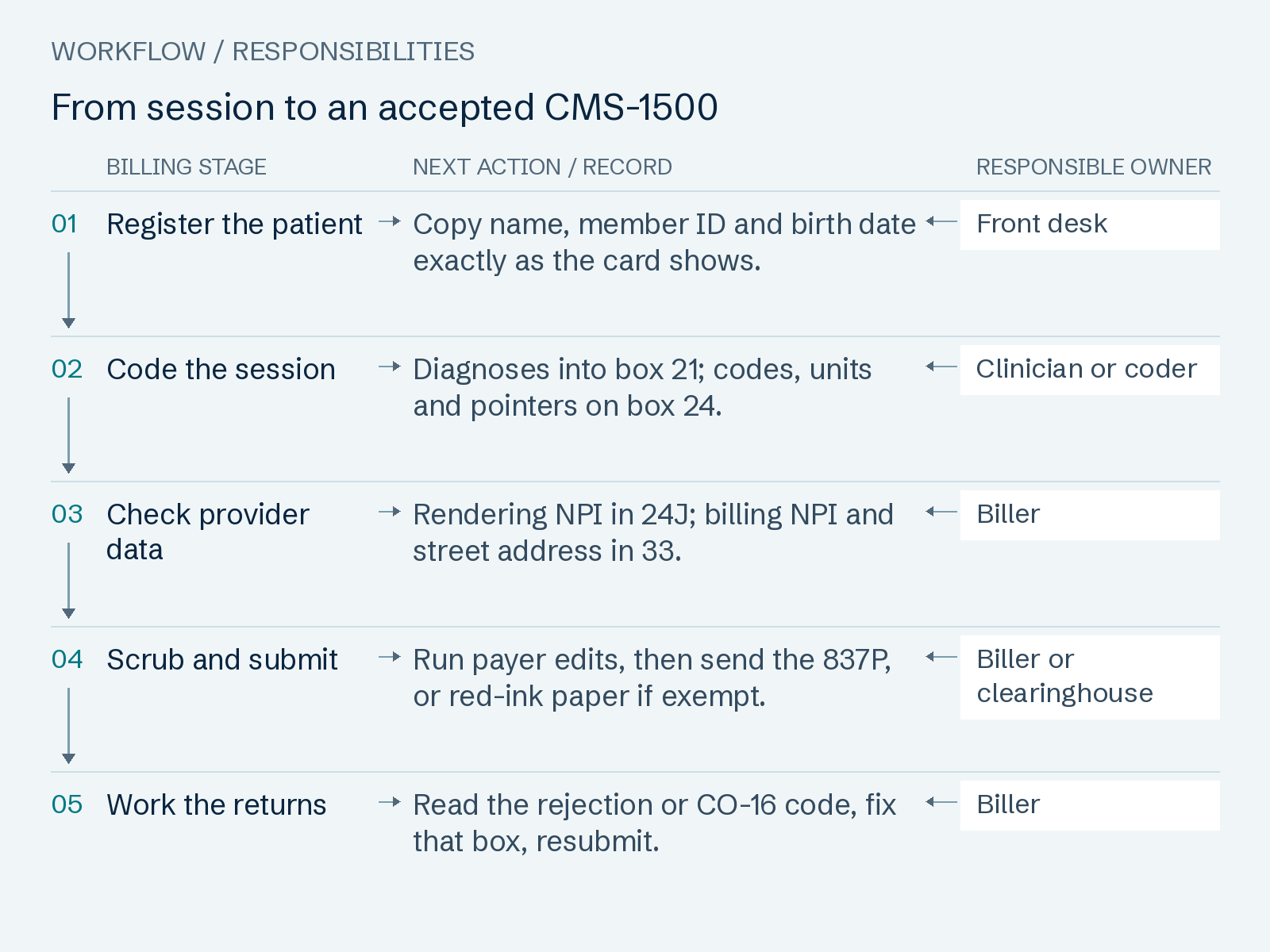
Read the workflow as text
- Register the patient — Copy name, member ID and birth date exactly as the card shows. Owner: Front desk.
- Code the session — Diagnoses into box 21; codes, units and pointers on box 24. Owner: Clinician or coder.
- Check provider data — Rendering NPI in 24J; billing NPI and street address in 33. Owner: Biller.
- Scrub and submit — Run payer edits, then send the 837P, or red-ink paper if exempt. Owner: Biller or clearinghouse.
- Work the returns — Read the rejection or CO-16 code, fix that box, resubmit. Owner: Biller.
Provider boxes: referring (17), diagnosis (21), service lines (24)
Boxes 14 to 23 carry dates, the referring provider, diagnoses and authorizations; box 24 carries up to six service lines. Fill them in this order:
- Box 17 and 17b: referring, ordering or supervising provider. Enter the qualifier to the left of the dotted line (DN referring, DK ordering, DQ supervising), then the name, with the NPI in 17b. For Medicare physical, occupational and speech therapy claims, chapter 26 requires the physician or practitioner who certified the plan of care to be entered as the referring provider in 17 and 17b.
- Box 19: additional claim information. Payer-specific notes, such as the narrative for an unlisted code.
- Box 21: diagnoses. Enter ICD indicator 0 for ICD-10-CM between the dotted lines, then up to 12 codes on lines A to L, without the decimal point and without narrative.
- Box 22: resubmission. Only for a corrected claim: frequency code 7 (replacement) or 8 (void), plus the payer's original reference number. Never on an original claim. Medicare's chapter 26 says to leave box 22 blank.
- Box 23: prior authorization. One payer-assigned number, such as the authorization for an ABA treatment period, with no hyphens or spaces.
- Box 24, lines 1 to 6. 24A dates of service, 24B place of service, 24D the CPT or HCPCS code with up to four modifiers, 24E the diagnosis pointer letter, 24F the charge, 24G days or units (enter 1 for a single service), and 24J the rendering NPI. The shaded top half of each line holds supplemental data such as an NDC, not another service.
Box 24E: pointer letters, not codes
Box 24E points each line to a letter from box 21; the diagnosis code itself never goes in 24E. The NUCC manual allows several letters per line, primary first, with no commas. Medicare allows one: chapter 26 says to enter only one reference letter per line item. A claim needing more than 12 diagnoses must be split, and the NUCC caps a multi-page claim at 50 service lines.
Box 24B takes the two-digit place of service code for each line. The full code set with therapy and telehealth examples is on the place of service codes page.
| Box | What goes in it | Medicare note (ch. 26) |
|---|---|---|
| 14 | Date of current illness, injury or pregnancy, with qualifier 431 or 484 | Date only: Medicare does not use the qualifier |
| 17 / 17b | Qualifier DN, DK or DQ, name; NPI in 17b | Therapy: the plan-of-care certifier as referring |
| 17a | Other ID with qualifier (shaded) | Leave blank |
| 21 | ICD indicator 0; up to 12 codes, lines A-L | Required when a diagnosis is required |
| 23 | Prior authorization, referral or CLIA number | One number only |
| 24B | Place of service code per line | Required |
| 24D | CPT/HCPCS code plus up to four modifiers | Required |
| 24E | Pointer letter(s) to box 21 | One letter per line |
| 24G | Days or units; 1 for a single service | Anesthesia in minutes |
Rendering vs billing provider: boxes 24J and 33
Box 24J names the clinician who rendered or supervised the line; box 33 names the provider asking to be paid. The rendering provider meaning has its own glossary entry. In short, a therapist employed by a group renders, and the group bills.
Box 24J: the rendering NPI
The NPI goes in the lower, unshaded half of 24J. The shaded half, with its qualifier in 24I, takes a non-NPI identifier only when a payer uses one. The NUCC says to report 24I and 24J only when they differ from 33a and 33b. Medicare is stricter: chapter 1, section 80.3.2.1.2 returns a claim as unprocessable when a rendering practitioner who is a sole practitioner or a member of a group practice leaves their NPI out of 24J. For incident-to services where the ordering practitioner is not supervising, chapter 26 puts the supervisor's NPI in 24J.
Box 33 and 33a: the billing provider
Box 33 always gets the billing name, address, 9-digit ZIP code and phone number, with the billing NPI in 33a. The NUCC recommends a street address or physical location, not a PO box, because the 837P requires one for the billing provider. Medicare treats 33 and 33a as required fields. Box 32 is the separate service-location box: Medicare has required it for every place of service since January 1, 2011, and only one location fits per claim.
| Practice set-up | Box 24J | Box 33a | Source |
|---|---|---|---|
| Solo clinician billing under their own NPI (NUCC default) | Blank, because it would repeat 33a | Clinician's individual NPI | NUCC 24I/24J |
| Solo clinician or group member billing Medicare | Clinician's individual NPI | Clinician's or group's NPI | CMS ch. 1 and ch. 26 |
| Therapist employed by a group practice | Therapist's individual NPI | Group's organizational NPI | NUCC; CMS ch. 26 |
| Texas Medicaid ABA, licensed behavior analyst | LBA's individual NPI | LBA's individual NPI; the employer's NPI may not be used | TMHP LBA enrollment guide |
Therapy and ABA examples: units, modifiers, POS
The table shows two sample claims side by side. Both are illustrative examples, not client data: the patient, clinician and charge fields describe what goes in each box, not real values. Check each payer's own manual before you copy a pattern.
Sample 1: a 90837 telehealth session billed to Medicare
A licensed clinical social worker in a group practice sees a Medicare patient at home by live video for a 60-minute psychotherapy session (CPT 90837); the 90837 code page covers its time rules. Medicare lets behavioral health telehealth reach patients in their homes, with no geographic restriction (CMS telehealth FAQ, updated October 8, 2026). Chapter 26 section 10.5 says POS 02 or 10 must be paired with the telehealth modifier: 95 for audio and video, 93 for audio only. POS 10 pays at the non-facility rate and POS 02 at the facility rate; the modifier does not change the rate. Chapter 26 also asks for a service location in box 32 for all POS codes, so ask your MAC which address it expects for a home telehealth visit. More on payer rules for therapists is in the mental health insurance billing guide.
Sample 2: a day of 97153 for a Texas Medicaid ABA client
A behavior technician delivers three hours of protocol-based treatment at the client's home under a licensed behavior analyst (CPT 97153, counted in 15-minute units, so 180 minutes is 12 units). Texas Medicaid enrolls only the licensed behavior analyst, as an individual: the LBA's own NPI goes in both the rendering and billing fields, the employer's NPI may not be used, and the LBA adds the modifier Texas Medicaid requires to show who delivered the service (TMHP enrollment guide). Texas also requires professional claims for ABA; institutional forms are rejected. Other payers differ: Indiana Medicaid bulletin BT202662 (April 28, 2026) requires the UA modifier on fee-for-service comprehensive ABA claims when the prior authorization was submitted on or after April 1, 2026. How a partial unit counts is the payer's rule.
| Box | Sample 1: 90837 by video (Medicare) | Sample 2: 97153 day (Texas Medicaid) |
|---|---|---|
| 1 / 1a | Medicare; the Medicare beneficiary identifier | Medicaid; the client's Medicaid ID |
| 11 | NONE, if no plan is primary to Medicare | Per the Texas Medicaid instructions |
| 21 | ICD indicator 0; diagnosis from the note on line A | ICD indicator 0; diagnosis from the treatment plan on line A |
| 23 | Blank unless the payer issued a number | The prior authorization number |
| 24A | Date of the session | Date of the session |
| 24B | 10 (patient at home) | 12 (home), or the code for where the session happened |
| 24D | 90837 with modifier 95 | 97153 with the modifier TMHP requires for the technician level |
| 24E | A (one pointer for Medicare) | A |
| 24F | Your usual charge for the session | Your usual charge for 12 units |
| 24G | 1 | 12 (180 minutes in 15-minute units) |
| 24J | The social worker's individual NPI | The LBA's individual NPI |
| 32 | The location your MAC asks for | Where the session took place, per payer rules |
| 33 / 33a | Group name, street address; group NPI | LBA's name and address; LBA's individual NPI |
Paper claims: when you still need the red form
Medicare wants initial claims sent electronically unless an exception under the Administrative Simplification Compliance Act (ASCA) applies. MLN006976 lists the exceptions for professionals and suppliers:
- Fewer than 10 full-time equivalent employees, billing your MAC.
- Roster billing for mass immunizers (COVID-19, flu or pneumonia shots).
- Paper claims under a Medicare demonstration project.
- Medicare Secondary Payer claims with more than one primary payer and more than one allowed amount.
An unusual circumstance waiver also covers a large group practice or supplier that submits fewer than 10 claims a month and not more than 120 a year. If a MAC asks for your exception justification and you do not answer, it denies your paper claims from 91 calendar days after its first letter, and you cannot appeal that decision.
Paper means an original form printed in Flint OCR Red, J6983, or an exact match. Scanners read the entries while the red lines drop out, so photocopies and downloaded copies cannot be used to submit claims, and CMS does not supply the form (CMS CMS-1500 page). CMS points providers to the U.S. Government Printing Office, local printers and office supply stores. Commercial plans and Medicaid agencies set their own paper rules.
Hospital, nursing facility and other institutional charges go on the UB-04 (CMS-1450) instead, which the NUBC designs (CMS CMS-1450 page). The ub04 form guide covers that claim.
Top HCFA 1500 rejection reasons
A rejection fails front-end or clearinghouse edits and never enters adjudication: fix it and resubmit. A denial is an adjudicated claim the payer will not pay as billed. Medicare adds a third outcome for paper and electronic claims with incomplete or invalid data: it returns them as unprocessable with group code CO and reason code 16. Chapter 1 says such a claim does not meet the criteria to be considered a claim, is not denied, and so carries no appeal rights.
The table lists the box conditions chapter 1 names, with the remark code number Medicare sends alongside CO-16. Official remark code wording is published at x12.org/codes. The CO-16 denial code page walks through the fix for each.
Fix the box at its source record
A box that fails on many claims points to a shared record: the registration screen, a charge template or the provider file. Correct it there, then resubmit before the filing limit runs out. Medicare's limit is 12 months, or 1 calendar year, after the date of service; other payers' limits are listed in the timely filing limits by payer.
If boxes 17b, 24J or 32 keep coming back and nobody has time to trace them, our full-service billing covers claim creation and scrubbing, submission, and denial work; smaller groups can see how it runs on our medical billing services for small practices page. To see which unpaid claims are closest to their deadline first, request The Free A/R Deadline Map on the free A/R Deadline Map page. Clock starts with your claim-level aging export and signed BAA; above 10 requests in a week, we confirm your date within 1 business day.
| Box | Medicare returns the claim when | Remark code with CO-16 | Fix |
|---|---|---|---|
| 1a | The Medicare beneficiary identifier is missing or invalid | N382 | Re-copy the ID from the card; run an eligibility check |
| 11 with 4, 6, 7 | Box 11 names a primary insurer but 4, 6 or 7 is incomplete | MA92, MA89, MA88 | Complete the insured's name, relationship and address |
| 17 / 17b | An ordered or referred service has no provider name or no NPI | N285 or N286 | Add the referring name and NPI from the order |
| 21 | A required diagnosis is missing, incorrect or truncated | M76 | Code to full specificity from the note |
| 24A | A service spans more than one day with no valid to date | M59 | Add the to date, or bill each day on its own line |
| 24D | A required modifier is missing, or a modifier is invalid or obsolete | M20 | Check the modifier against the payer's policy |
| 24D with 19 | An unlisted or NOC code has no narrative in box 19 or attached | M51 | Add the narrative to box 19 |
| 24J | A sole practitioner or group member left out their rendering NPI | N290 | Fix the provider file that feeds 24J |
| 32 | The service location name, address or ZIP code is missing | MA114 | Add the location; one per claim |
Common questions
- What is a CMS 1500 form?
- It is the standard paper claim form non-institutional providers and suppliers use to bill professional services, such as therapy, psychology and physician visits. The NUCC maintains it, and Medicare accepts paper only on version 02/12. The same data travels electronically as the 837P (CMS MLN006976).
- Is HCFA the same as CMS-1500?
- Yes. The NUCC manual notes that CMS was formerly known as HCFA, the Health Care Financing Administration, which is where the HCFA 1500 name comes from. HCFA form, HCFA 1500 and CMS-1500 all mean the same professional claim form.
- Where do I put the rendering provider NPI on the CMS 1500?
- In box 24J, lower unshaded half, on each service line. The billing provider's NPI goes in 33a. The NUCC says to leave 24J blank when it would repeat 33a, but Medicare returns the claim as unprocessable when a sole practitioner or group member leaves 24J empty, so follow your payer.
- Can I submit a CMS 1500 electronically?
- Yes: the electronic version is the 837P, sent from your billing software through a clearinghouse. Medicare requires initial claims to be electronic unless an ASCA exception applies, such as having fewer than 10 full-time equivalent employees. Paper must be the original red-ink form, never a photocopy.
- Who uses the CMS 1500 vs the UB-04?
- Professionals and suppliers bill on the CMS-1500: therapists, psychologists, social workers, physicians and similar practitioners. Hospitals and other institutional providers bill facility charges on the UB-04, also called the CMS-1450, which the NUBC designs (CMS).
- How many service lines and diagnoses fit on one CMS 1500?
- Six service lines per page and up to 12 diagnosis codes in box 21. The NUCC manual says a claim needing more than 12 diagnoses must be split, and a claim with more than 50 service lines must be split too. On later pages, repeat the diagnoses from page one.
Sources and review
Page revised November 4, 2026 · Review contact: Hyder Shah (inquiries@claimpillar.com). Every source below was retrieved and checked on November 4, 2026. Payer rules apply only to the payer named; the sample claims are illustrative, not client data.
- NUCC: 1500 Health Insurance Claim Form Reference Instruction Manual, version 13.0 (July 2025)
- CMS: Medicare Claims Processing Manual, Chapter 26, Completing and Processing Form CMS-1500 (Rev. 14466, May 27, 2026)
- CMS: Medicare Claims Processing Manual, Chapter 1, sections 70 and 80.3 (Rev. 13725, April 10, 2026)
- CMS MLN006976: Medicare Billing: CMS-1500 & 837P (December 2025)
- CMS: Professional Paper Claim Form (CMS-1500)
- CMS: Institutional Paper Claim Form (CMS-1450)
- CMS: Telehealth FAQ (updated October 8, 2026)
- TMHP: Licensed Behavior Analyst Enrollment in Texas Medicaid
- Indiana Health Coverage Programs: Bulletin BT202662, additional ABA guidance (April 28, 2026)