What is the UB04 form (CMS-1450)?
The UB-04 is Form CMS-1450, which CMS describes as a uniform institutional provider bill suitable for billing multiple third-party payers (Medicare Claims Processing Manual, ch. 25, §70.1). Because one form serves many payers, a particular payer may not need every data element. The National Uniform Billing Committee (NUBC) maintains the approved codes and licenses the Official UB-04 Data Specifications Manual, so this guide describes codes in our own words from CMS and payer instructions.
CMS lists the institutional providers that bill on the CMS-1450 and the 837I (CMS booklet MLN006926, December 2025). For behavioral health the list matters because it names community mental health centers and opioid treatment programs alongside hospitals, critical access hospitals, home health agencies, hospices, skilled nursing facilities, rural health clinics and Federally Qualified Health Centers.
Residential programs and commercial plans
Medicaid and commercial plans set their own form rules for residential and day programs. Blue Cross and Blue Shield of Minnesota bills residential services on type of bill 86X on an 837I, with room and board on its own line (Blue Cross MN policy Behavioral Health-023). Blue Cross Blue Shield of Wyoming wants partial hospitalization, residential care, acute care and detox on a UB-04 or 837I with type of bill 086x (BCBSWY behavioral health billing guidelines). Your program's form follows the payer, so check each plan before the first claim.
UB04 vs CMS-1500: facility vs professional claims
The billing entity decides the form, not the service. CMS describes the CMS-1500 as the paper claim that non-institutional providers or suppliers use (MLN006976), while the UB-04 carries the facility's charges. A partial hospitalization day in a hospital outpatient department can therefore produce two claims: the hospital's UB-04 for the program and the psychiatrist's own professional claim. Our guide to the CMS 1500 form covers that professional claim box by box, and the clinician's claim shows the setting with a place of service code such as POS 22 rather than a type of bill.
Use the table to decide which claim a service belongs on. Each row names its source; a payer row applies only to that payer.
When the same service changes form by payer
Intensive outpatient care shows how far payers diverge. Medicare bills hospital IOP on type of bill 013X with condition code 92 (ch. 4, §261.1). Blue Cross Blue Shield of Wyoming instead asks for IOP on a CMS-1500 or 837P with HCPCS S9480 on the psychiatric side and H0015 on the substance use side (BCBSWY). A program that sends every IOP claim the same way will get some of them back.
Opioid treatment programs are a second split. Medicare takes OTP claims on the 837P or CMS-1500, but an OTP that enrolled as an institutional provider bills on the CMS-1450, and a freestanding OTP facility uses type of bill 087x (CMS ch. 39).
| Setting and payer | Claim form | Bill type or flag | Source |
|---|---|---|---|
| Hospital outpatient partial hospitalization, Medicare | UB-04 / 837I | TOB 013X (CAH 085X), condition code 41 | CMS ch. 4, §260.1 |
| Community mental health center PHP, Medicare | UB-04 / 837I | TOB 076X, condition code 41 | CMS ch. 4, §260.1.1 |
| Hospital intensive outpatient program, Medicare | UB-04 / 837I | TOB 013X (CAH 085X), condition code 92 | CMS ch. 4, §261.1 |
| FQHC or RHC intensive outpatient program, Medicare | UB-04 / 837I | Revenue code 0905 with condition code 92 | MLN Matters MM13264 |
| Freestanding opioid treatment program enrolled as an institutional provider, Medicare | UB-04 / 837I | TOB 087x | CMS ch. 39 |
| Residential treatment, Blue Cross MN | 837I | TOB 86X, room and board on its own line | Blue Cross MN policy BH-023 |
| Intensive outpatient program, BCBS Wyoming | CMS-1500 / 837P | HCPCS S9480 or H0015 | BCBSWY guidelines |
| Therapist, psychologist or psychiatrist's own services | CMS-1500 / 837P | Place of service code | CMS MLN006976 |
| Medicare-certified ambulatory surgical center | 837P (rarely CMS-1500) | Place of service code | CMS ch. 14 |
Key form locators: type of bill, revenue codes, occurrence codes
The UB-04 calls each field a form locator (FL). Chapter 25 sets Medicare's requirement for every one (CMS ch. 25, §75). These are the locators behavioral health programs most often get wrong:
- FL 4, type of bill. Four characters: after a leading zero that CMS ignores, the second digit names the type of facility, the third classifies the type of care and the fourth is the frequency code, the bill's sequence in the episode. A hospital program bills 013X, a CMHC 076X and a residential program, where the payer allows it, 086X.
- FL 6, statement covers period. The From and Through dates of the services on the bill. Medicare starts its 12-month filing clock at the Through date on span claims.
- FLs 18 to 28, condition codes. Medicare requires condition code 41 on every partial hospitalization claim and 92 on every intensive outpatient claim.
- FLs 31 to 34, occurrence codes and dates. Two-character event codes, each with a date, that explain something that happened during the billing period. Chapter 25 marks them situational.
- FL 42 and FL 44, revenue code and HCPCS. A revenue code explains each charge; outpatient lines also carry a HCPCS or CPT code, up to four modifiers.
- FL 63, treatment authorization code. Required when the payer assigned an authorization or referral number for the services.
- FL 64, document control number. On a corrected claim, the payer's control number for the original bill.
- FL 67, principal diagnosis. The full ICD-10-CM code with all seven characters where they apply; the decimal point is implied.
Revenue code 0001 and one line per date
The UB-04 has no printed total line. Revenue code 0001 carries the sum of charges, and the other revenue codes run in ascending order. On outpatient bills, including 013X, 032X, 034X, 076X and 085X, Medicare wants a line item date of service for every repetition of a revenue code: a group therapy service given five times in the billing period takes five lines (ch. 25, FL 45). A Medicare claim holds up to 450 lines, or 9 paper pages.
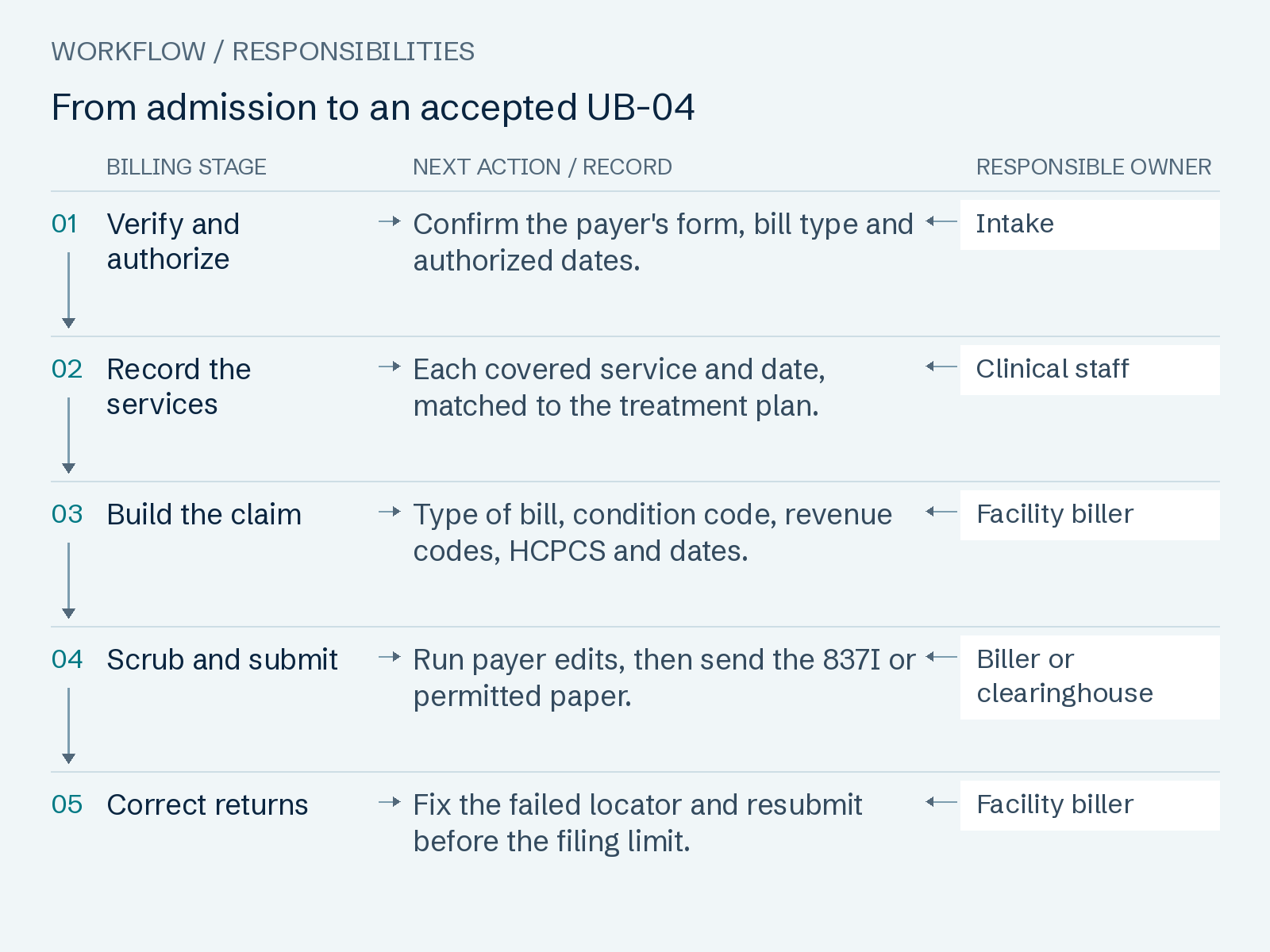
Read the workflow as text
- Verify and authorize — Confirm the payer's form, bill type and authorized dates. Owner: Intake.
- Record the services — Each covered service and date, matched to the treatment plan. Owner: Clinical staff.
- Build the claim — Type of bill, condition code, revenue codes, HCPCS and dates. Owner: Facility biller.
- Scrub and submit — Run payer edits, then send the 837I or permitted paper. Owner: Biller or clearinghouse.
- Correct returns — Fix the failed locator and resubmit before the filing limit. Owner: Facility biller.
Behavioral health revenue codes: 0905, 0906, 0912, 0913, 1001, 1002
The six revenue codes most programs ask about are NUBC codes, and the NUBC manual is licensed. The table states how each public payer document cited below uses them, in our own words, not the NUBC definitions.
Medicare bills PHP and IOP by component
Medicare does not take a single program-day revenue code from hospitals and CMHCs. Under component billing, the facility reports a revenue code and charge for each covered service, from a list that includes 0900, 0904, 0914, 0915, 0916, 0918 and 0942, plus HCPCS codes from hospital outpatient departments and CMHCs; critical access hospitals are exempt from the HCPCS rule (CMS ch. 4, §260.1 and §261.1). Of the program-level codes, 0905 appears in Medicare's FQHC and RHC IOP rule; the others come from the Medicaid and commercial documents in the table.
Payer examples come from Iowa Total Care behavioral health type of bill scenarios, Blue Cross MN policy BH-023 and BCBS Wyoming guidelines; each applies only to that payer's members.
| Revenue code | How the cited payers use it | Where it is documented |
|---|---|---|
| 0905 | Intensive outpatient program; Medicare requires it, with condition code 92, on FQHC and RHC IOP claims | MLN Matters MM13264; Iowa Total Care lists it for 13X and 76X PHP/IOP |
| 0906 | Listed with 0905, 0912 and 0913 among the revenue codes for hospital-based (13X) and CMHC (76X) PHP/IOP claims | Iowa Total Care TOB scenarios |
| 0912 | Partial hospitalization; paired with H0035 on TOB 013X for non-Medicare members | Blue Cross MN BH-023; BCBSWY |
| 0913 | Partial hospitalization; listed with 0912 as the second PHP revenue code | Blue Cross MN BH-023; BCBSWY |
| 1001 | Residential treatment, psychiatric; room and board line on TOB 86X | BCBSWY; Blue Cross MN BH-023 |
| 1002 | Residential treatment, substance abuse | BCBSWY; Iowa Total Care RTC scenario |
Home health and ASC claims on the UB04
Home health. A Medicare home health agency opens each admission with a Notice of Admission on type of bill 032A, and the MAC must accept it within five calendar days after the admission date (CMS ch. 10). A late NOA reduces the period payment by the days from admission to acceptance, divided by 30, and that reduction is the agency's liability, not the patient's. Each 30-day period of care then bills on type of bill 0329 with line item detail for the services given. Our home health billing service handles that calendar for agencies.
Ambulatory surgical centers. A Medicare-certified ASC does not bill Medicare on the UB-04. It bills the Medicare contractor on the ASC X12 837 professional claim format or, in rare cases, the CMS-1500 (CMS ch. 14). A hospital outpatient surgery department is different: it is part of the hospital and bills on the UB-04 under type of bill 013X with a dated line for each service. Commercial and Medicaid plans publish their own form rule for ASCs, so read the plan's manual before the first case.
One episode, many bills
Home health shows the frequency code at work: one admission produces a notice, a run of period claims and sometimes corrections, each with its own type of bill. Behavioral health programs see the same pattern when a payer wants interim bills for a long residential stay.
Electronic 837I vs paper UB04
The 837I is the standard electronic format institutional providers use, and version 5010A2 is current (MLN006926). CMS keeps the paper and electronic data sets consistent so one processing system can handle both, and MAC websites may publish a crosswalk from each form locator to its 837I location.
When Medicare still takes a paper UB-04
Medicare wants initial claims electronic unless the provider qualifies for an Administrative Simplification Compliance Act exception or waiver. For institutional providers, CMS lists these exceptions:
- Fewer than 25 full-time equivalent employees, billing your MAC.
- Roster billing by mass immunizers for COVID-19, flu or pneumonia shots.
- Paper claims under a Medicare demonstration project.
- Medicare Secondary Payer claims with more than one primary payer and more than one allowed amount.
CMS does not supply the form and warns against submitting a downloaded copy, because the scanners need the printed form's colors. Blank copies may be available from office supply stores. The professional claim's threshold is lower: fewer than 10 full-time equivalent employees for the CMS-1500.
UB04 rejection reasons and fixes
Medicare MACs edit every required UB-04 field and return a bill that fails to the provider for correction (CMS ch. 1, §80.3.2.2). A claim returned as unprocessable does not count as a claim, is not denied, and has no appeal rights, so the only remedy is to correct it and send it again before the filing limit runs out (ch. 1, §80.3.1). These are the edits facility programs hit, with the fix for each:
- Invalid or blank type of bill (FL 4). Fix the facility and care digits in the billing system's setup for that program, not claim by claim.
- Statement period errors (FL 6). The From date may not be later than the Through date, the Through date may not be later than today, and outside home health the period may not span two accounting years. Split the bill at the year end.
- Revenue code lines out of order (FL 42). Four digits each, ascending, with 0001 last on paper. Lines missing their dates break the line-item date rule above.
- Missing program flag. A PHP claim without condition code 41, or an IOP claim without 92, will not process as the program. Build the code into the program's claim template.
- Authorization mismatch (FL 63). The authorization number or its covered dates do not match the bill. Check the authorization log before release.
- Billing NPI (FL 56). Required on every Medicare claim. Use the NPI enrolled for the facility or program, not a clinician's individual NPI.
The filing clock starts at the Through date
Medicare's timely filing limit is 12 months, or 1 calendar year, after the date of service, and for institutional claims with span dates the Through date counts as the date of service (CMS ch. 1, §70.1). Other payers set their own limits; see each payer's timely filing limit.
When to hand off facility billing
If your program bills IOP, PHP or residential days to several payers that each want a different form, revenue code and authorization trail, our behavioral health billing services can take on the clinicians' professional claims. Start with the Get my free A/R Deadline Map.
Common questions
- What is a UB04 form?
- It is Form CMS-1450, the uniform claim form institutional providers such as hospitals, community mental health centers, opioid treatment programs and home health agencies use to bill facility charges. Its electronic format is the 837I (CMS MLN006926).
- What is the difference between a UB04 and a CMS 1500?
- The UB-04 carries a facility's charges, coded with a type of bill and revenue codes; the CMS-1500 carries a non-institutional provider's or supplier's professional services, coded with a place of service (CMS MLN006976). One program day can produce both: the facility's UB-04 and the clinician's CMS-1500.
- Who uses the UB04?
- CMS lists hospitals, critical access hospitals, community mental health centers, opioid treatment programs, home health agencies, hospices, skilled nursing facilities, rural health clinics, FQHCs and other institutional providers (MLN006926). Commercial plans may also want residential and partial hospitalization programs on it.
- What revenue code is used for IOP?
- It depends on the payer. Medicare requires revenue code 0905 with condition code 92 on FQHC and RHC IOP claims (MM13264), while hospitals and CMHCs bill Medicare IOP by component revenue codes with condition code 92 (CMS ch. 4, §261.1). Some Medicaid and commercial plans, such as Iowa Total Care, list 0905 or 0906 with HCPCS codes such as H0015 or S9480, and others, such as BCBS Wyoming, want IOP on a CMS-1500 instead.
- Can ASCs bill on a UB04?
- Not to Medicare. A Medicare-certified ASC bills its contractor on the 837P professional format or, rarely, the CMS-1500 (CMS ch. 14). A hospital outpatient surgery department bills the UB-04. For commercial and Medicaid plans, follow the form the plan's provider manual names.
- Can I download and print a blank UB-04 for Medicare?
- CMS advises against it: it does not supply the form, and a downloaded copy may not reproduce the colors its scanners read. Most facilities must bill Medicare on the 837I anyway unless an exception applies, such as having fewer than 25 full-time equivalent employees (MLN006926).
Sources and review
Page revised November 5, 2026 · Review contact: Hyder Shah (inquiries@claimpillar.com). Every source below was retrieved and checked on November 5, 2026. Payer rows apply only to the payer named; NUBC code definitions are licensed and are not reproduced here.
- CMS: Medicare Claims Processing Manual, Chapter 25, Completing and Processing the Form CMS-1450 Data Set
- CMS MLN006926: Medicare Billing: CMS-1450 & 837I (December 2025)
- CMS MLN006976: Medicare Billing: CMS-1500 & 837P (December 2025)
- CMS: Medicare Claims Processing Manual, Chapter 4, sections 260 and 261 (Rev. 13799, May 28, 2026)
- CMS: Medicare Claims Processing Manual, Chapter 1, sections 70.1 and 80.3.2.2 (Rev. 13725, April 10, 2026)
- CMS: Medicare Claims Processing Manual, Chapter 10, Home Health Agency Billing
- CMS: Medicare Claims Processing Manual, Chapter 14, Ambulatory Surgical Centers
- CMS: Medicare Claims Processing Manual, Chapter 39, Opioid Treatment Programs
- CMS MLN Matters MM13264: Billing Requirements for IOP Services for FQHCs and RHCs
- Blue Cross Blue Shield of Wyoming: Behavioral Health Billing Guidelines
- Blue Cross and Blue Shield of Minnesota: Reimbursement Policy Behavioral Health-023, Facility Based Mental Health Services
- Iowa Total Care: Behavioral Health Type of Bill Scenarios