CO-16 denial code description
CO-16 is claim adjustment reason code (CARC) 16 under the CO group code. CMS explains how the three parts of a remittance message work together: the group code assigns financial responsibility to the provider or the beneficiary, the CARC gives the general reason the payment differs from the billed amount, and a remittance advice remark code (RARC) adds the specific detail. CMS adds that a RARC is optional unless the CARC's definition requires one (Medicare Claims Processing Manual, chapter 1, §01.1). CARC 16 is one that does: X12's usage note for it says at least one remark code must be provided (X12 CARC list). The same manual says contractors use group code PR when the beneficiary is liable and CO when the provider is liable, so a CO-16 balance does not go on the patient statement.
Reason 16 on its own tells you the payer could not use the claim as sent. CMS's term for this is an unprocessable claim, and chapter 1, §80.3.2 tells Medicare contractors to return a claim when a required or conditional data element is missing or not accurately entered in its field. The official wording of every CARC and RARC is published by X12 at x12.org/codes; this page describes each pairing only as CMS or the payer explains it.
Is CO-16 a rejection or a denial?
We use two terms site-wide. A rejection fails front-end or clearinghouse edits and never enters adjudication; a denial is an adjudicated claim the payer will not pay as billed. Medicare's CO-16 sits between them. Chapter 1, §80.3.1 says a claim returned as unprocessable for incomplete or invalid information "does not meet the criteria to be considered as a claim, is not denied" and has no appeal rights, yet it can arrive on your remittance advice. Commercial payers often adjudicate the claim and send CO-16 as a denial that you correct, as the Blue Cross Blue Shield of North Dakota example below shows.
Read the RARC: it tells you what's missing
The remark code turns a vague reason into one field. Chapter 1, §80.3.2.1 of the CMS manual lists the conditions under which a Medicare Part B contractor returns a CMS-1500 claim with group CO and CARC 16, and it names the remark code for each. The rows below come from that list, plus one commercial example from BCBSND's CO16 denial resolution page. The middle column restates the condition CMS or the payer describes, not the X12 code text. For where each item sits on the form, see our CMS 1500 form guide.
Read every remark code on the line, not only the first. One CO-16 line can carry two or three, and each one names a separate field to fix.
| Remark code with CO-16 | Condition the source describes | Fix before you resubmit |
|---|---|---|
| N382 | No valid Medicare beneficiary identifier (MBI) in item 1a (CMS) | Copy the MBI from the current card or eligibility response |
| N329 | Birth date in item 3, 9b or 11a not in 8-digit format (CMS) | Correct the date format in the registration record |
| N290 | Rendering practitioner in a group or solo practice left their NPI out of item 24J (CMS) | Add the rendering NPI, and confirm it is linked to the billing NPI |
| N285, N286 | Ordering or referring physician's name missing from item 17 or NPI missing from 17b (CMS) | Add the name and NPI exactly as the ordering or referring provider is enrolled |
| M76 | Required diagnosis in item 21 missing, incorrect or truncated (CMS) | Code the diagnosis to full specificity from the note |
| M20 | A HCPCS modifier that must go with the code is missing, invalid or obsolete (CMS) | Add or replace the modifier when the documentation supports it |
| M59 | Service spans more than one day with no valid "to" date in item 24A (CMS) | Enter the to date, or split the span into single-date lines |
| M51 | Unlisted or not-otherwise-classified code in 24D with no narrative in item 19 or an attachment (CMS) | Describe the service in item 19 or attach the narrative |
| MA114 | Service location name, address and ZIP missing from item 32 where CMS requires it (CMS) | Enter the location where the service was furnished |
| MA92, MA89, MA88 | Primary insurer shown in item 11, but items 4, 6 or 7 incomplete (CMS) | Complete the insured's name, relationship and address |
| MA63 | BCBSND diagnosis edits: laterality against modifier, an unspecified code beside a specified one, Excludes1 pairs, a secondary diagnosis billed alone | Correct the diagnosis or modifier and send a claim correction |
Top CO-16 causes on therapy and ABA claims
Therapy and ABA claims fail on the same few fields because one setup error repeats on every session billed from it. These are the fields to check first on a CO-16 for a psychotherapy, physical therapy or ABA claim.
Missing or wrong rendering NPI
Box 24J carries the clinician who rendered the session; box 33a carries the provider asking to be paid. Medicare returns the claim with N290 when a rendering practitioner who is a sole practitioner or a member of a group leaves their NPI out of 24J (CMS chapter 1, §80.3.2.1.2). Medicaid rules can go further. Texas Medicaid's licensed behavior analyst enrollment guide says an enrolled LBA uses their own NPI as both the rendering and the billing provider, that the employer's NPI may not be designated as either, and that claims with a billing or rendering NPI that is not enrolled will not be reimbursed. Our rendering provider definition explains the difference between the two roles.
Missing prior authorization number
The NUCC 1500 instruction manual puts the payer-assigned prior authorization number in item 23, with no hyphens or spaces. Before you treat a CO-16 as a data fix, confirm the authorization exists and covers the date of service and the code. If it does, add the number and resubmit. If it does not, a corrected field will not help: the next step is the payer's retro-authorization or appeal route, and the remittance will usually show a different reason code.
Units and session dates
NUCC says item 24G holds the days or units as defined by the code set, that the numeral 1 must be entered when only one service was performed, and that a fraction of a unit uses a decimal point. A blank 24G, or units that do not match the session note, is a common data gap on timed therapy and ABA codes. For a span of sessions on one line, Medicare returns the claim with M59 when the "to" date in 24A is missing.
| Field on the claim | What goes wrong on therapy and ABA claims | Where to check it |
|---|---|---|
| 24J rendering NPI | Left blank, or the clinician's NPI is not linked to the group with that payer | NPPES and the payer's enrollment roster |
| 33a billing NPI | Agency NPI used where the payer requires the clinician's own NPI (Texas Medicaid ABA) | The payer's or state Medicaid enrollment rules |
| 23 prior authorization | Number missing, typed with hyphens or spaces, or belongs to another date span | The authorization letter or portal record |
| 24G units | Blank, or units that do not match the timed minutes in the note | The session note and the code's unit definition |
| 1a member ID | Old card number after a plan change | The eligibility response for the date of service |
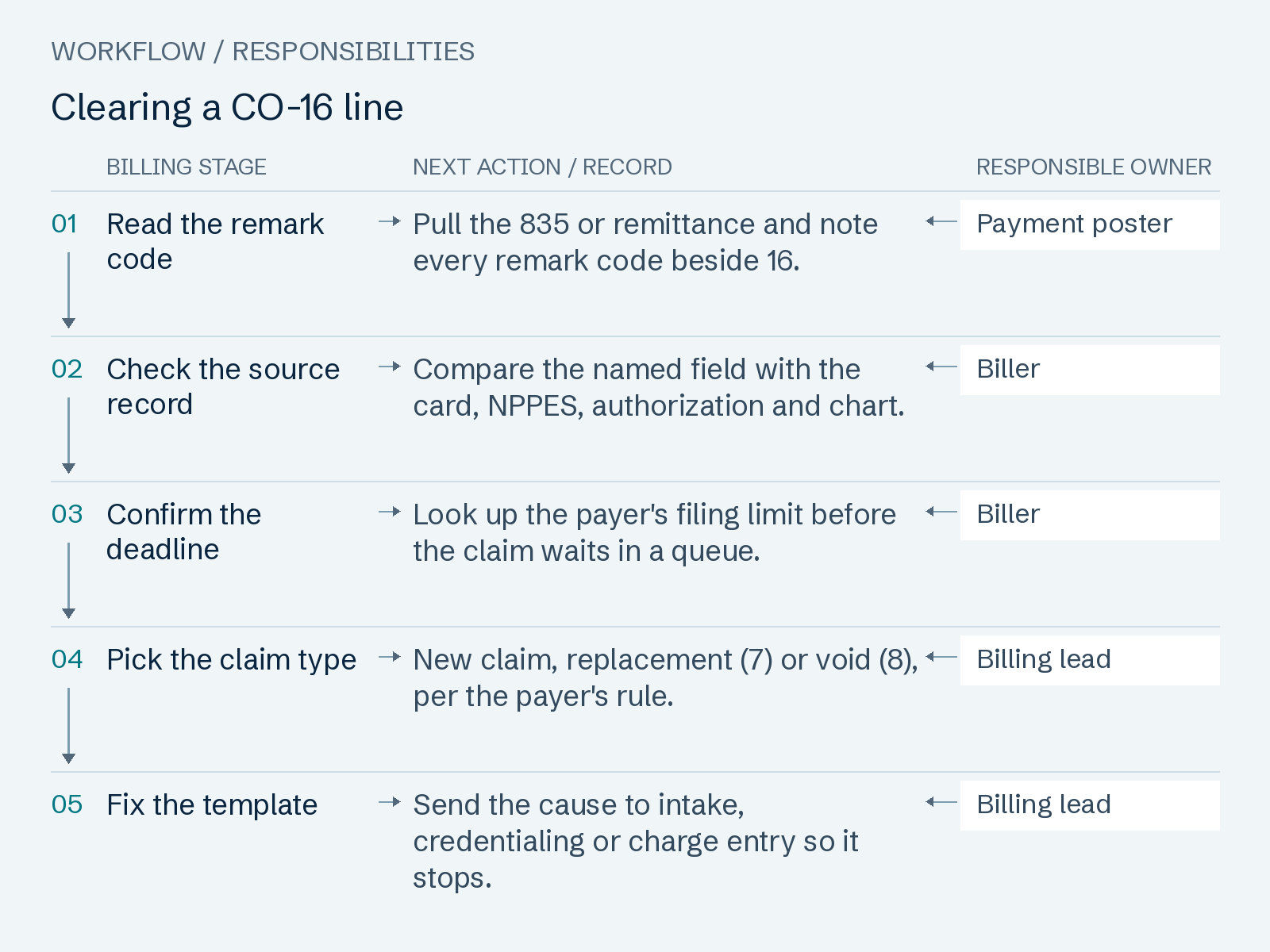
Read the workflow as text
- Read the remark code — Pull the 835 or remittance and note every remark code beside 16. Owner: Payment poster.
- Check the source record — Compare the named field with the card, NPPES, authorization and chart. Owner: Biller.
- Confirm the deadline — Look up the payer's filing limit before the claim waits in a queue. Owner: Biller.
- Pick the claim type — New claim, replacement (7) or void (8), per the payer's rule. Owner: Billing lead.
- Fix the template — Send the cause to intake, credentialing or charge entry so it stops. Owner: Billing lead.
Fix, then resubmit or correct: frequency codes 7 and 8
The claim type depends on what the payer did with the first claim. NUCC's item 22 instruction says to enter a bill frequency code when resubmitting, 7 for replacement of a prior claim and 8 for void or cancel of a prior claim, with the payer's original reference number beside it, and says the item is not for original claim submissions. Payers set their own rules on top of that, so check the payer's instructions before you send anything.
Medicare is the clearest case. Chapter 1, §80.3.2 says that when a remittance advice was used to return the claim, you may submit a corrected claim or an entirely new claim; it also says denied claims can never be resubmitted, only appealed, while returned claims can be corrected and resubmitted (§60.1). When some lines are clean and others are not, Medicare Part B contractors split the claim, pay the clean lines and return the others as unprocessable, so resubmit only the returned lines.
Commercial payers usually want a replacement claim. Blue Cross and Blue Shield of Oklahoma's corrected claim policy (CPCP025) asks for frequency code 7 or 8 with the original claim number or DCN, sent electronically in loop 2300 CLM05-3 with the number in REF02 under qualifier F8. It says a replacement missing that number is rejected, a professional correction without the right frequency code will deny, and every correctly billed line from the original must appear on the replacement. Our DCN and ICN claim number guide shows where to find that number.
| What happened to the first claim | What to send | Box 22 / 837 frequency |
|---|---|---|
| Rejected at the clearinghouse; never reached adjudication | Fix the field and send it again as an original claim | Blank (original submission) |
| Medicare returned the claim or lines as unprocessable (CO-16) | A new claim with the corrected data; no appeal | Per your Medicare contractor's instructions |
| Commercial payer processed it and sent CO-16 | A replacement claim with every line, corrected | 7 plus the original claim number |
| Billed to the wrong patient, provider or payer entirely | Void the original, then send a new original claim | 8 plus the original claim number, then blank |
Timely filing risk on CO-16 resubmissions
A CO-16 does not stop the filing clock. Medicare's limit is 12 months, or 1 calendar year, after the date of service, and because CMS says an unprocessable claim is not considered a claim, the corrected one still has to arrive inside that window. CGS, a Medicare Part A contractor, says claims returned to the provider for correction and then resubmitted are also subject to the one calendar year limit.
Behavioral health and commercial payers often run much shorter clocks, and some give a returned claim its own window. The rows below come from our timely filing dataset, each taken from the payer's or agency's own manual or provider page and retrieved on October 2, 2026. Your contract can set a different limit; the full list is in our timely filing limits by payer.
| Payer (line of business) | Initial claim limit | Corrected or returned claim, as the payer states it |
|---|---|---|
| Medicare fee-for-service | 12 months (1 calendar year) after the date of service | Items left off the first claim cannot be added after the limit; corrections to a timely claim follow reopening rules |
| Optum Behavioral Health | 90 calendar days | Corrections or additions within 90 days of initial claim receipt |
| Cigna Healthcare / Evernorth Behavioral Health | 90 days | A timely claim returned for new or additional information: the 90 days reset to the date of Cigna's request |
| Magellan Healthcare (behavioral health) | 60 days for most provider contracts | Not stated in the source excerpt |
| Blue Cross and Blue Shield of Texas (PPO) | 365 days | Claims returned for more information: resubmit within 90 days of the date BCBSTX mails the request |
| Texas Medicaid (TMHP fee-for-service) | 95 days | Not stated in the source excerpt |
| Highmark (DE, PA, WV, NY) | Per contract; 365 days if the contract is silent | 15 months (455 days) from the original claim's finalization, effective Sept. 1, 2026 |
Preventing CO-16 with front-end edits
Every CO-16 is a data gap that existed before the claim left your system, so prevention means checking the fields the remark codes name at intake, credentialing and charge entry. These edits catch the therapy and ABA causes above:
- Eligibility on the date of service: copy the member ID, name and birth date exactly from the current card and eligibility response, for new patients and every plan change.
- Provider roster: keep each clinician's NPI, its link to the group NPI and its enrollment status per payer in one place, and update it before a new clinician's first billed session.
- Authorization tracking: store each authorization's number, date span, codes and units, and block charge entry when a session falls outside them.
- Unit checks: compare 24G with the timed minutes in the session note before submission.
- Scrubber rules: flag a blank 24J on group claims, a blank item 23 for payers that require authorization, a missing "to" date on span lines, and unlisted codes without an item 19 narrative.
Track CO-16 by remark code every month. A cluster of one remark code points to one broken template or intake step, and fixing that source stops the repeats. Our denial management guide shows how to log denials by root cause and decide which to work first.
When CO-16 needs an appeal instead
Most CO-16 lines are fixed, not appealed. Two cases are different.
Medicare's ordering and referring exception
A note in chapter 1, §80.3.2 says Part B clinical lab, imaging technical or global component, DMEPOS and home health claims are denied, not returned, when the ordering or referring provider's information is invalid or the provider's specialty cannot order or refer. A denial carries appeal rights: Medicare's redetermination request is due within 120 days of receiving the notice of initial determination.
Commercial reconsideration when a correction is not the next step
BCBSND routes its CO16 diagnosis edits to a claim correction. It offers a reconsideration, which it says is a payment dispute and not an appeal, when the provider disagrees with the determination and a correction is not the next step, and it sends a reconsideration notification within 45 days of the request. Other payers write their own routes, so read the payer's dispute page before you choose.
If CO-16 keeps returning on your therapy or ABA claims and nobody has time to trace it to the roster, authorization log or template, our denial management services correct, reopen or appeal each denial, or return it to you with the fix, and send its cause to the person who can stop it, and our revenue cycle management services cover the intake and charge-entry steps where these gaps start. To see which unpaid claims are closest to their filing deadline, request The Free A/R Deadline Map on the Get my free A/R Deadline Map page. Clock starts with your claim-level aging export and signed BAA; above 10 requests in a week, we confirm your date within 1 business day.
Common questions
- What does denial code CO-16 mean?
- CO-16 means the payer could not process the claim because required information was missing, incomplete or invalid, and the CO group code makes the balance the provider's responsibility. The remark code on the same line names the field. Medicare calls these claims unprocessable and returns them without appeal rights.
- How do I fix a CO-16 denial?
- Read every remark code on the line, find the field each one names, and correct it from the source record: the card, NPPES, the authorization or the chart. Then confirm the filing deadline and send the right claim type: a new claim for a Medicare return, or a replacement claim with frequency code 7 and the original claim number for most commercial payers.
- Is CO-16 a rejection or a denial?
- For Medicare it is neither, strictly. CMS says a claim returned as unprocessable is not considered a claim and is not denied, so it has no appeal rights, even though it can appear on your remittance. Many commercial payers adjudicate the claim and send CO-16 as a denial that you correct.
- What RARC codes come with CO-16?
- Medicare's manual pairs CARC 16 with remark codes such as N382 (MBI in item 1a), N290 (rendering NPI in 24J), N285 and N286 (ordering or referring provider in 17 and 17b), M76 (diagnosis in item 21), M20 (modifier), M59 (span to date), M51 (unlisted code narrative) and MA114 (service location in item 32). Commercial payers add their own; BCBSND uses MA63 for diagnosis edits. Official wording is at x12.org/codes.
- How long do I have to resubmit a CO-16 claim?
- Usually the payer's original filing limit. Medicare's is 12 months after the date of service, and an unprocessable claim does not stop that clock. Some payers give returned claims their own window: Evernorth Behavioral Health resets its 90 days to the date of its request, and Blue Cross and Blue Shield of Texas allows 90 days from its mailed request. See filing limits by payer.
- Can we bill the patient for a CO-16 amount?
- No. The CO group code puts the balance on the provider, and CMS says beneficiaries cannot be held liable for items and services never properly billed to Medicare. Bill the patient only under the PR group code, a valid ABN or a payer rule that allows it; for CO-16, correct the field and resubmit.
Sources and review
Page revised November 5, 2026 · Review contact: Hyder Shah (inquiries@claimpillar.com). Every source below was retrieved and checked on November 5, 2026. The filing-limit table comes from our timely filing dataset, built from payer and state sources retrieved on October 2, 2026. Remark code pairings are described as CMS or the payer explains them; X12 publishes the official code wording.
- CMS: Medicare Claims Processing Manual, Chapter 1, §01.1, §60.1, §80.3 (Rev. 13725, April 10, 2026)
- NUCC: 1500 Health Insurance Claim Form Reference Instruction Manual, version 13.0 (July 2025), items 22, 23 and 24G
- X12: Claim Adjustment Reason Codes (CARC 16 and its usage note)
- Blue Cross Blue Shield of North Dakota: CO16 denial resolution
- Blue Cross and Blue Shield of Oklahoma: Corrected Claim Submissions (CPCP025)
- CGS Medicare Part A: Timely Filing Requirements
- TMHP: Licensed Behavior Analyst (LBA) Enrollment in Texas Medicaid