DCN meaning
DCN stands for document control number: the number a payer or its fiscal agent assigns to a claim when the claim enters its system. CMS describes it in its instructions for form locator 64 of the UB-04 institutional claim, the field named Document Control Number, as the control number assigned to the original bill by the health plan or the health plan's fiscal agent as part of their internal control
(Medicare Claims Processing Manual, chapter 25).
Commercial plans use the same term. Blue Cross and Blue Shield of Oklahoma's corrected claim policy (CPCP025) asks that every corrected claim carry the original claim number or the Document Control Number (DCN)
. Treat the two phrases as one thing: the number the payer created, not the one your practice created.
Four claim numbers compared
Billers mix up four numbers that look alike on paper. The table shows which side creates each one and where it belongs.
| Term | Who assigns it | Where you see it | What you use it for |
|---|---|---|---|
| DCN (document control number) | The payer or its fiscal agent | UB-04 form locator 64; payer remits and portals | Identifying the original claim on a replacement or void |
| ICN (internal control number) | The payer, when it receives the claim | Claim acknowledgments, remits and claim status screens | The same job as the DCN; some payers use this name |
| Payer claim control number | The payer | 835 remittance, element CLP07 | The X12 name for the DCN or ICN in electronic files |
| Patient account number | Your practice management system | CMS-1500 box 26; returned in 835 element CLP01 | Matching the payment to your own patient record |
ICN number: internal control number
An ICN is the internal control number a payer stamps on each claim it receives. Blue Cross and Blue Shield of Kansas defines it as the unique sequence of numeric characters that BCBSKS assigns to each claim as it is imaged and before it is processed
(BCBSKS glossary). Medicare contractors use the ICN and DCN labels together. CGS, a Medicare Administrative Contractor, tells providers that its claim acknowledgment report (the 277CA) will return the ICN/DCN number
in a reference segment with qualifier 1K. Its example is REF*1K*21215712345678, a 14-digit number (CGS 5010 tip of the day, June 2012).
The length and layout differ from payer to payer, so never retype an ICN from memory or rebuild it from a pattern. Copy it exactly from the payer's own acknowledgment, remit or portal. NUCC allows 18 characters for it in box 22.
Where to find them on ERAs, EOBs and payer portals
The payer's number reaches you in four places, roughly in the order the claim moves:
- Claim acknowledgment (277CA). This arrives after the clearinghouse passes the claim to the payer. CGS returns the ICN/DCN in a REF segment with qualifier 1K.
- Electronic remittance advice (835). CMS's 835 flat-file map names element CLP07 Payer Claim Control # and element CLP01 Patient Control # (CMS 835 flat file, 5010A1, updated January 2023).
- Paper remit or EOB. The same number is printed on each claim's line, under whatever label the payer uses: ICN, DCN, claim number or claim ID. Our explanation of benefits guide walks through the rest of that page.
- Payer portal claim status. Most portals let you search by member and date of service and show the payer's claim number in the result.
Annotated ERA snippet
Illustrative example, not client data. The ICN is CGS's published sample number, and the other values are made up:
CLP*ACCT10422*[status]*250*180*20*MB*21215712345678~
- ACCT10422 (CLP01): your patient control number, the value you sent in box 26.
- 250, 180, 20 (CLP03 to CLP05): total charge, claim payment and patient responsibility.
- MB (CLP06): the claim filing indicator. CGS's 835 companion guide says Medicare sends MB for Part B and MA for Part A.
- 21215712345678 (CLP07): the payer claim control number, the DCN or ICN. On a commercial remit this is the number a replacement or void must quote. This sample is a Medicare Part B remit, and Part B fixes errors through a reopening instead (see below).
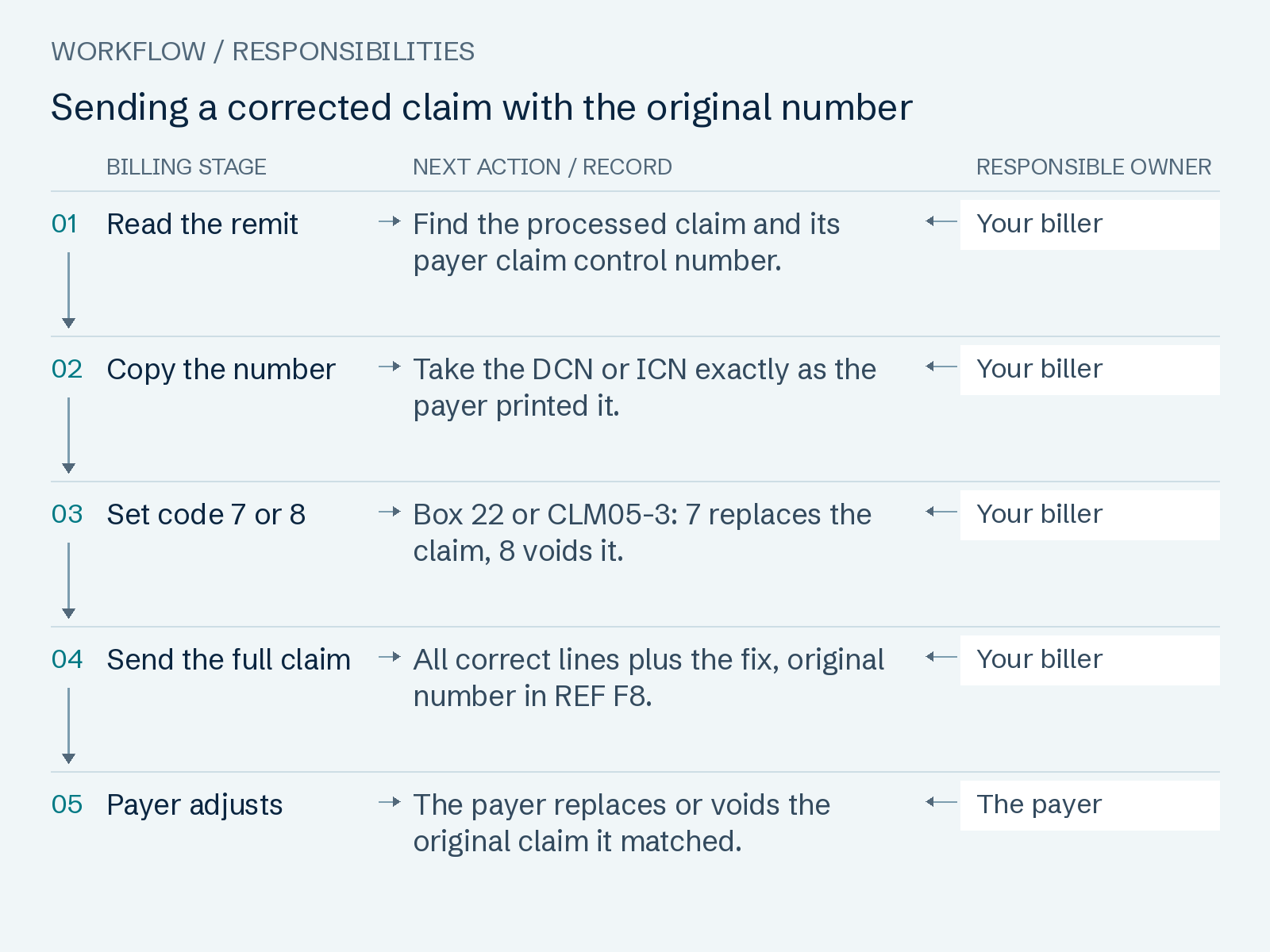
Read the workflow as text
- Read the remit — Find the processed claim and its payer claim control number. Owner: Your biller.
- Copy the number — Take the DCN or ICN exactly as the payer printed it. Owner: Your biller.
- Set code 7 or 8 — Box 22 or CLM05-3: 7 replaces the claim, 8 voids it. Owner: Your biller.
- Send the full claim — All correct lines plus the fix, original number in REF F8. Owner: Your biller.
- Payer adjusts — The payer replaces or voids the original claim it matched. Owner: The payer.
Using the original claim number on corrected claims
A corrected claim changes a claim the payer has already processed. BCBSOK's policy calls it a way to update a previously processed claim with new or additional information
. The original number is how the payer finds the claim it should replace. Under the same policy, a replacement sent with frequency code 7 or 8 must carry the original claim number or DCN in loop 2300, REF02, with qualifier F8 in REF01. Leaving it out will generate a compliance error and the claim will be rejected
.
The replacement replaces the whole claim. BCBSOK requires every line that was correct the first time to appear again with the corrected lines. Lines left off the replacement may be subject to recoupment
, so read our recoupment explainer before you send a partial claim.
The Medicare Part B exception
Medicare Part B does not take replacement claims. For item 22, CMS's CMS-1500 instructions say Leave blank. Not required by Medicare
(Medicare Claims Processing Manual, chapter 26). For the 837P, Part B contractor CGS's 837P companion guide (version 10.0, August 2026) says CLM05-3, the claim frequency code, Must be equal to “1”
(original). Medicare fixes clerical errors, such as a wrong date of service, modifier or transposed code, through a reopening rather than an appeal. Part A providers may still send adjusted claims (chapter 34, sections 10.4 and 10.4.1).
| Payer | Box 22 on paper | Electronic claim | How an error is fixed |
|---|---|---|---|
| Blue Cross and Blue Shield of Oklahoma (CPCP025) | 7 or 8 plus the original claim number or DCN | CLM05-3 set to 7 or 8; original number in REF02 with qualifier F8 | Full replacement claim (7) or void (8) |
| Medicare Part B (CMS chapter 26; CGS 837P guide) | Leave blank | CLM05-3 must equal 1 (original) | Reopening for clerical errors |
| Medicare Part A (CMS chapter 34, 10.4.1) | Not used (UB-04 claim) | Adjusted or corrected claim | Adjusted claim, or a reopening |
Frequency codes 7 and 8 and CMS-1500 box 22
The NUCC 1500 instruction manual (version 13.0, July 2025) names item 22 Resubmission and/or Original Reference Number. Its rules:
- Enter the bill frequency code, left-justified, in the left-hand Code area: 7 replaces a prior claim and 8 voids or cancels one.
- Enter the original reference number, the payer-assigned number for the previously submitted claim, in the Original Ref. No. area. The code area holds 11 characters and the reference area 18.
- Leave item 22 empty on original claims. NUCC says it
is not intended for use for original claim submissions
, and tells you to check the payer's current instructions for the field.
Our CMS 1500 form guide covers the other 32 boxes. Box 22 has nothing to do with place of service 22, which CMS defines as an on-campus outpatient hospital (CMS POS code set). That code belongs in box 24B.
Corrected-claim example with box 22 filled in
Illustrative example, not client data. A commercial claim paid with the wrong modifier on line 2 gets a replacement:
- Box 22, Code area:
7 - Box 22, Original Ref. No.:
[CLP07 value], the payer claim control number copied exactly from CLP07 on that payer's remit - Box 24: every original line again, with line 2's modifier corrected (when the documentation supports it)
- Box 26: the same patient account number as the first claim
Electronically, the same claim carries 7 in CLM05-3 and the number in REF02 after qualifier F8. On a UB-04, BCBSOK puts the 7 or 8 in box 4, the type of bill.
Common errors and rejections
Most claim-number failures come from one of six mistakes:
- Your number in the payer's field. Box 26 holds your patient account number. Box 22 needs the number the payer assigned (NUCC). Mixing them up leaves the payer with nothing to match.
- No original number. At BCBSOK, a 7 or 8 without the DCN in REF*F8 is a compliance error and the claim is rejected.
- No frequency code. Without one, BCBSOK denies a professional correction and denies an institutional one as a duplicate. Either way the original claim is not adjusted.
- A partial replacement. Lines missing from the replacement can be recouped.
- Correcting a claim that was never processed. BCBSOK describes a corrected claim as an update to a previously processed claim. A claim rejected at the front end was never processed, so there is no original to replace. Fix it and send it as an original instead of a 7.
- Sending a 7 to Medicare Part B. CGS expects CLM05-3 to be 1. Ask for a reopening instead.
If a claim comes back denied for missing or incomplete information, our CO-16 denial code guide lists the fields to check before you send the correction.
Tracking claim numbers in your A/R
Store the payer claim control number against each claim in your practice management system as soon as the 277CA or the 835 posts it. When the number lives next to your patient account number, anyone working the claim can pull it straight from the record without searching the portal. It also lets you follow a replaced claim from the original to the correction.
- Post CLP07 from every 835 to the matching account, using CLP01 as the key.
- On a follow-up call, give the payer's number first. It is the number the payer assigned for its own internal control.
- Before you send a 7 or 8, check the payer's correction deadline as well as its timely filing limits. Deadlines differ by payer.
Our denial management services work corrections and appeals on these numbers, and our A/R recovery service follows up on open claims. To see which unpaid claims are closest to a payer deadline, Get my free A/R Deadline Map; Clock starts with your claim-level aging export and signed BAA; above 10 requests in a week, we confirm your date within 1 business day.
Common questions
- What does DCN mean in medical billing?
- DCN means document control number: the number the payer or its fiscal agent assigns to your claim. CMS calls it the control number assigned to the original bill, and payers ask for it whenever you replace or void a claim.
- What is an ICN number?
- An ICN, or internal control number, is the number a payer gives each claim when it receives it. Medicare contractors return it as the ICN/DCN on the claim acknowledgment, and it appears as the payer claim control number on the 835 remit.
- Where do I find the original claim number?
- On the 835 remittance in element CLP07, on the paper remit or EOB line for that claim, on the 277CA acknowledgment, or in the payer portal's claim status search. Copy it exactly. Formats differ between payers.
- Do I need the ICN for a corrected claim?
- Yes, for payers that accept replacements. With frequency code 7 or 8, the original number goes in box 22 or in REF02 with qualifier F8, and BCBSOK rejects a replacement without it. Medicare Part B is different: send corrections as reopenings and leave box 22 blank.
- Is the DCN the same as the claim number?
- Usually, yes. Payers print the same payer-assigned number as the DCN, ICN, claim number or claim ID. It is not your patient account number, which is the one you enter in box 26.
- Can I use frequency code 7 on a Medicare Part B claim?
- Not at CGS: its 837P companion guide requires CLM05-3 to equal 1 (original), and CMS says to leave item 22 blank. Check your own Medicare contractor's companion guide. Medicare corrects clerical errors such as a wrong modifier or date through a reopening.
Sources and review
Page revised November 5, 2026 · Review contact: Hyder Shah (inquiries@claimpillar.com). The workflow checklists are editorial recommendations; payer requirements depend on the program and current policy.
- NUCC: 1500 Health Insurance Claim Form Reference Instruction Manual, version 13.0 (July 2025), items 22 and 26
- CMS: Medicare Claims Processing Manual, Chapter 25, form locator 64 Document Control Number (Rev. 12423)
- CMS: Medicare Claims Processing Manual, Chapter 26, item 22 (Rev. 14466, May 27, 2026)
- CMS: Medicare Claims Processing Manual, Chapter 34, sections 10.4 and 10.4.1, reopenings
- CMS: 835 Flat File, 5010A1 (updated January 10, 2023), CLP01 and CLP07
- CGS: CMS 837P 5010 Companion Guide, version 10.0 (August 2026)
- CGS: CMS 835 5010 Companion Guide, version 8.0 (August 2026)
- CGS: 5010 tip of the day, identifying your ICN on the 277CA (June 2012)
- Blue Cross and Blue Shield of Oklahoma: Corrected Claim Submissions (CPCP025)
- Blue Cross and Blue Shield of Kansas: Internal Control Number (ICN) glossary entry
- CMS: Place of Service Code Set