EOB medical abbreviation: Explanation of Benefits
In medical billing, EOB means Explanation of Benefits. It is the payer's written account of one claim after it has been processed: who was seen, by whom, on what date, what was billed, what the plan allowed and paid, and what the member owes. CMS's consumer guide, How to read an explanation of benefits, puts it plainly: an EOB shows the total charges for the visit and "isn't a bill". It tells the client what the plan covers and what they will pay when your practice bills them.
The EOB goes to the plan member. Your practice sees the same decision on the provider side, as a remittance advice on paper or as an electronic remittance advice (ERA). Billers often call that provider copy an EOB too, so when a client says "my EOB says I owe nothing", the fastest check is to open your remittance for the same claim number and compare the two.
Why it matters to a therapy practice
Therapy is billed in recurring sessions, so one misread EOB repeats every week. A deductible that resets at the start of the plan year, a copay that changed when the client's plan renewed, or a service the plan denied as out of network all show up first on the EOB and remittance. Read the first few EOBs for every new client and every new plan year closely, before the balance builds. For the wider workflow, see our mental health insurance billing guide.
How to read an EOB for a therapy session, line by line
Every plan prints its EOB in its own layout, but the fields CMS lists in its guide appear on almost all of them: the patient, the plan, the provider and date of care, a claim number, the payee, the service, the provider charges, the allowed charges, the amount paid by the insurer, what the patient owes, and remark codes explained at the bottom of the page. The table walks through one de-identified sample for an hour-long individual psychotherapy session billed as 90837.
Illustrative sample, not a real client or claim. The dollar amounts are round numbers chosen to show the arithmetic; they are not any payer's rates.
- Confirm the client, member ID, plan and claim number match your records.
- Check the date of service, the code, the rendering provider and the place of service code the plan processed, because the plan pays what it processed, not what you meant to send.
- Read the money columns left to right: charge, allowed, adjustments, deductible, coinsurance or copay, paid.
- Read every remark code before you post the payment.
| EOB field | Sample value (illustrative) | What it tells you |
|---|---|---|
| Patient / member | Client A., member ID ending 0000 | Who received care and whose policy paid; for a minor the member is often a parent |
| Claim number | Sample 000000000 | The reference to quote on calls, corrected claims and appeals |
| Provider and date of service | Your therapist, 03/02/2026 | Who the plan believes saw the client, and when |
| Service | 90837, one session | The code and units the plan processed |
| Provider charges | $200.00 | Your full fee as billed |
| Allowed charges | $150.00 | The most the plan recognizes for this service under your contract or its fee schedule |
| Not allowed / contractual adjustment | $50.00 | Charge minus allowed; an in-network practice writes it off |
| Deductible | $100.00 | Part of the allowed amount the client pays before the plan shares cost |
| Coinsurance | $10.00 | The client's percentage share (20% here) of the allowed amount left after the deductible |
| Paid by insurer | $40.00 | What the plan paid on this line |
| What you owe / patient balance | $110.00 | Deductible plus coinsurance; the most the client should be billed for this line |
| Remark code | A short code with its note | The plan's explanation of an adjustment; its meaning is printed on the EOB |
Medicare EOB vs Medicare Summary Notice vs remittance advice
Original Medicare does not send an EOB. A client with Original Medicare gets a Medicare Summary Notice (MSN), which Medicare.gov says is not a bill and arrives every 6 months when the client had services in that period. It lists what providers billed to Medicare, what Medicare paid and the maximum the client may owe the provider.
A client in a Medicare Advantage plan does get an EOB. Federal rules at 42 CFR 422.111(k) require Medicare Advantage organizations to send enrollees a written explanation of benefits showing, for each service, the billing code and amount billed, the total cost the plan approved, the plan's share and the enrollee's share, plus year-to-date totals. Part D drug plans send a separate monthly EOB for prescriptions, which never covers a therapy session.
Your practice receives neither of those. According to the CMS booklet Remittance Advice Resources and FAQs, Medicare Administrative Contractors send providers an electronic remittance advice (the ASC X12 835) or a standard paper remittance with each payment, while beneficiaries get the MSN.
| Document | Who sends it | Who receives it | When | Use it to |
|---|---|---|---|---|
| EOB (commercial plan) | The health plan | The plan member (subscriber) | After the plan processes a claim | Explain coverage and the patient balance to the client |
| EOB (Medicare Advantage) | The Medicare Advantage plan | The enrollee | When benefits are provided (42 CFR 422.111(k)) | Show approved cost, plan share and enrollee share |
| Medicare Summary Notice (MSN) | Medicare | The Original Medicare beneficiary | Every 6 months, if services were received | Compare against your statement; start a Medicare appeal |
| Remittance advice (ERA 835 or paper) | The payer or Medicare contractor | Your practice (the payee) | With each payment or denial | Post payments, adjustments and denials to each claim |
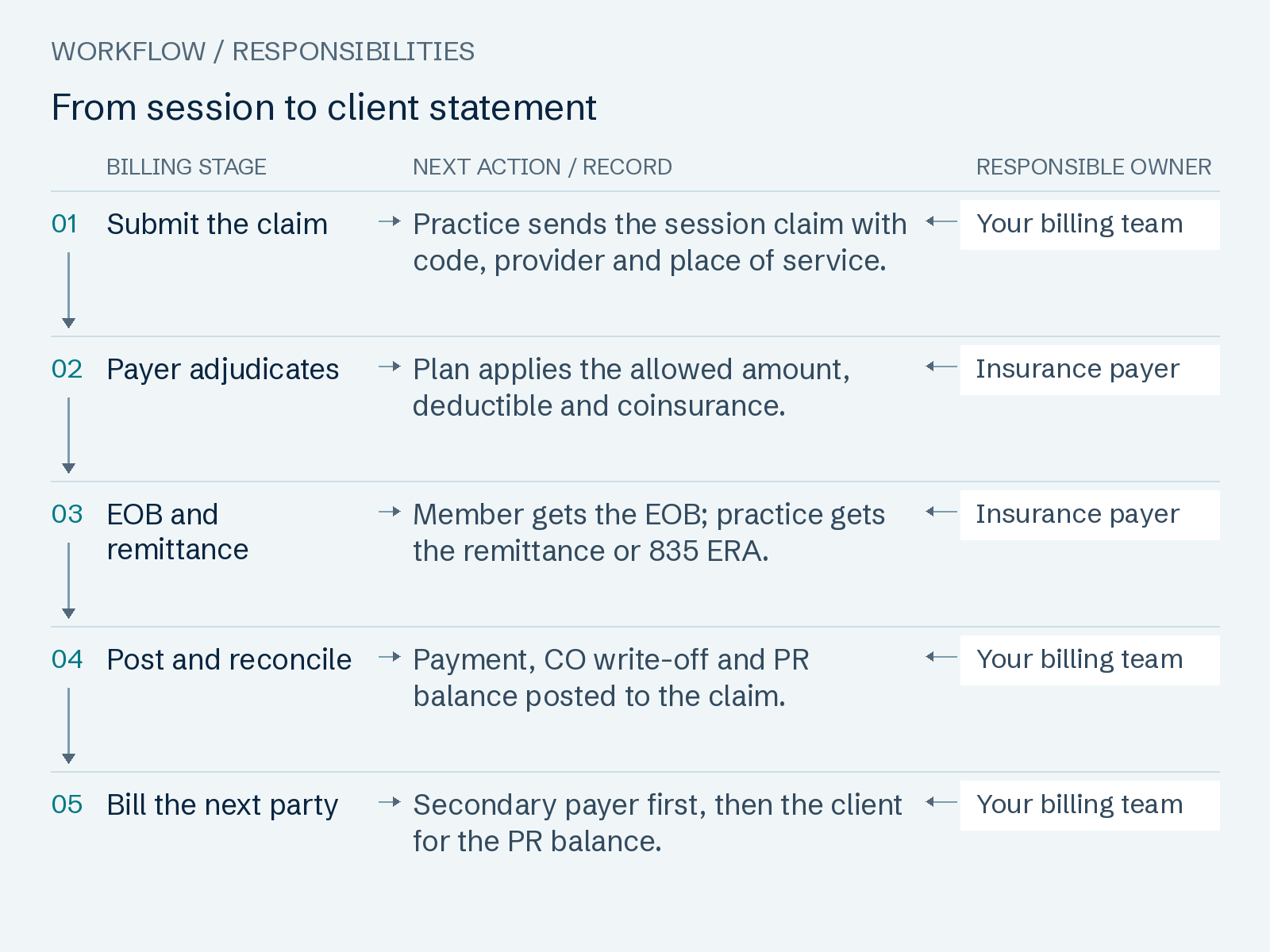
Read the workflow as text
- Submit the claim — Practice sends the session claim with code, provider and place of service. Owner: Your billing team.
- Payer adjudicates — Plan applies the allowed amount, deductible and coinsurance. Owner: Insurance payer.
- EOB and remittance — Member gets the EOB; practice gets the remittance or 835 ERA. Owner: Insurance payer.
- Post and reconcile — Payment, CO write-off and PR balance posted to the claim. Owner: Your billing team.
- Bill the next party — Secondary payer first, then the client for the PR balance. Owner: Your billing team.
Allowed amount, deductible, coinsurance and client balance
Everything on the patient side of an EOB is worked out from the allowed amount, not from your charge. The allowed amount is split between the client's deductible, then the client's coinsurance or copay, then the plan's payment. The gap between your charge and the allowed amount is a contractual adjustment when you are in network.
Worked example: a commercial plan
Illustrative example, not client data, using the sample EOB above: charge $200.00, allowed $150.00, $100.00 of the client's deductible still unmet, 20% coinsurance.
- Contractual adjustment: $200.00 − $150.00 = $50.00, written off.
- Deductible: the first $100.00 of the allowed amount is the client's.
- Coinsurance: 20% of the remaining $50.00 = $10.00, also the client's.
- Plan payment: $150.00 − $100.00 − $10.00 = $40.00.
- Client balance: $100.00 + $10.00 = $110.00.
Worked example: Original Medicare in 2026
CMS's CY 2026 deductible and coinsurance update (MM14279) sets the Part B deductible at $283 a year and Part B coinsurance at 20%. The 2026 national Medicare amount (unadjusted) for 90837 in a non-facility setting is $167.00, from the CMS physician fee schedule relative value files; actual payment varies by locality, setting and payer. Illustrative calculation, not client data:
- First session of the year, deductible unmet: the whole $167.00 goes to the deductible. Medicare pays $0, the MSN shows the client may owe $167.00, and $116.00 of the deductible remains.
- Deductible already met: the client's 20% coinsurance is $33.40 and Medicare's 80% share is $133.60, before any other adjustment shown on your remittance.
Who receives the client's statement is a separate question: for a minor, it is usually the parent named as guarantor on the account.
Denial and adjustment codes on an EOB
Every reduction on the remittance carries codes that say why it happened and who carries it. The CMS remittance advice booklet describes three sets: a claim adjustment group code, a claim adjustment reason code (CARC) and a remittance advice remark code (RARC). CMS explains that the group code assigns financial responsibility for the unpaid part of the line. Contractual Obligation (CO) puts it on the provider; Patient Responsibility (PR) puts it on the patient. CMS adds that providers may bill Medicare beneficiaries for an unpaid portion only when the adjustment shows group code PR.
The reason code explains the adjustment overall, and the remark code adds a more specific note. The official wording of each code is published by X12 at x12.org/codes; the client's EOB prints the plan's own plain-language version at the bottom.
What to do with a denied line
- Separate rejections from denials: a rejection never entered adjudication and is fixed and resubmitted; a denial is an adjudicated claim the payer will not pay as billed.
- Read the group code first. A CO denial stays with the practice until it is corrected or appealed; bill the client only for amounts the payer assigns to PR, or where the payer's rule allows it.
- Fix the cause (eligibility, authorization, code, modifier, rendering provider or place of service), then send a corrected claim or a reconsideration request inside the payer's deadline.
- Log the remark code so the same denial does not recur on next week's session.
When the same denials keep coming back, our denial management services work and appeal them.
Secondary claims and crossover
The primary payer's EOB or remittance is the evidence a secondary payer needs. Chapter 28 of the Medicare Claims Processing Manual states that a secondary claim is valid only when the primary payer's paid amount plus its adjusted amounts equal the billed amount, with standard reason codes explaining each adjustment. Send the secondary claim with the primary payer's payment and adjustment lines exactly as the remittance shows them.
Medicare crossover
For Medicare, much of this happens automatically. Under the same chapter, Medigap plans and other supplemental payers sign Coordination of Benefits Agreements (COBAs), and Medicare forwards the processed claim to them after adjudication. The manual notes that the remittance carries remark code MA18, and the MSN its own message, to show the claim was crossed over. When you see that flag, wait for the supplemental payer's response before billing the client for the coinsurance. Our page on Medicare crossover claims covers what to do when a claim does not cross.
When the EOB doesn't match your contract
An allowed amount below your contracted rate is an underpayment until proven otherwise. The CMS booklet notes that remittance information also tells you whether you can resubmit a corrected claim or appeal the payment. Check these before you call the payer:
- Compare the allowed amount with your fee schedule for that payer, code and year.
- Confirm the plan processed the claim as in network, under the right rendering provider and place of service.
- Look for a provider-level adjustment. The CMS booklet lists a deduction for a prior overpayment as one example, so a short payment can be an offset for a different claim; see recoupment.
- Call with the claim number, ask for reprocessing, and record the reference number; appeal in writing if the plan will not correct it.
Keep the EOB with the claim
Store every EOB and remittance with the claim it explains. If you are in network with a Medicare Advantage plan, 42 CFR 422.504(i) requires the plan to have its contracted entities agree to HHS audit rights over their records through 10 years from the end of the contract period or the completion of any audit, whichever is later; state law and other payer contracts can add their own periods.
Underpayments and unworked denials age quietly. To see which unpaid claims are closest to a payer deadline, get my free A/R Deadline Map; Clock starts with your claim-level aging export and signed BAA; above 10 requests in a week, we confirm your date within 1 business day. If you would rather hand off posting and follow-up, see payment posting services.
Common questions
- What does EOB stand for in medical billing?
- EOB stands for Explanation of Benefits. It is the health plan's statement of how it processed a claim: the charge, the allowed amount, what the plan paid and what the member owes.
- Is an EOB a bill?
- No. CMS states that an explanation of benefits isn't a bill. It shows what the plan covered and the patient balance; the bill comes from your practice, and when you are in network it should not be higher than the patient balance on the EOB.
- What is a Medicare EOB called?
- For Original Medicare it is the Medicare Summary Notice (MSN), which Medicare.gov says is sent every 6 months when the person had services. Medicare Advantage plans send their own EOB, and providers get a remittance advice or 835 ERA instead.
- Who gets the EOB, the client or the practice?
- The plan member gets the EOB. Your practice gets the remittance advice for the same claim, on paper or as an 835 ERA, with the group, reason and remark codes for each adjustment.
- Why does my EOB show a different amount than I charged?
- Plans pay from the allowed amount, not your charge. The difference is a contractual adjustment when you are in network, and the allowed amount is then split between the client's deductible, coinsurance or copay, and the plan's payment.
- How long should a practice keep EOBs?
- No single federal rule sets a period for EOBs. Keep them with the claim for at least as long as your longest obligation: Medicare Advantage contracts carry HHS audit rights through 10 years from the end of the contract period or of any audit, whichever is later, under 42 CFR 422.504(i), and state law or other payer contracts may set their own periods.
Sources and review
Page revised November 5, 2026 · Review contact: Hyder Shah (inquiries@claimpillar.com). The workflow checklists are editorial recommendations; payer requirements depend on the program and current policy.
- How to read a health insurance explanation of benefits (CMS)
- Medicare Summary Notice (MSN) (Medicare.gov)
- Explanation of Benefits for Medicare drug plans (Medicare.gov)
- CMS MLN booklet: Remittance Advice Resources and FAQs
- eCFR: 42 CFR 422.111(k), Medicare Advantage explanation of benefits
- eCFR: 42 CFR 422.504, Medicare Advantage contract provisions (records and audit rights)
- CMS MLN Matters MM14279: CY 2026 Medicare deductible, coinsurance and premium rates
- Medicare Claims Processing Manual, chapter 28: coordination with Medigap and other complementary insurers (Rev. 13314)
- CMS: PFS Relative Value Files (CY 2026, RVU26D)