Guarantor definition (medical)
A guarantor is the person or organization who has agreed to pay a patient's account with your practice. The guarantor owes the balance insurance does not pay, such as copays, deductibles, coinsurance and charges for uncovered or self-pay visits, and the guarantor is the person your statements go to.
The definition used by practice management and hospital systems comes from the HL7 version 2 data standard. Its GT1 guarantor segment describes the guarantor as the person or the organization with financial responsibility for payment of a patient account, and it carries fields for the guarantor's name, address, relationship to the patient, employer and priority. That is why a guarantor can be a parent, a spouse, an adult child, another relative or an organization, not only the patient.
Where the guarantor lives in your billing system
The guarantor sits on the patient account, not on the insurance claim. Medicare's instructions for the CMS-1500, in chapter 26 of the Medicare Claims Processing Manual, ask for the patient's name, the insured's name, the patient's relationship to the insured and the insured's address (items 2, 4, 6 and 7), along with service details such as the place of service code. No item asks who the guarantor is. The payer pays or denies the claim; your billing system then bills whatever is left to the guarantor.
Guarantor vs subscriber vs patient
Four parties touch every insured visit, and mixing them up is where most guarantor problems start. The subscriber (also called the insured or policyholder) is the person whose name the insurance policy is in. The guarantor is the person who pays what the policy does not. They are often the same adult, but the roles are separate fields in your system and can point to different people.
One person, three roles, or three people
An adult client with their own employer plan is patient, subscriber and guarantor at once. A 15-year-old covered on a father's plan who lives with her mother can have three different people in the three roles: herself as patient, her father as subscriber and her mother as guarantor, if that is what the parents agreed and signed at intake.
| Role | Who it is | Where it appears | What they receive |
|---|---|---|---|
| Patient | The person who received the care | Patient record and the claim (CMS-1500 item 2) | The care; access to their own records |
| Guarantor | The person or organization responsible for the account balance | Patient account in your billing system; patient statements | Patient statements and collection notices |
| Subscriber (insured) | The person who holds the insurance policy | The claim (CMS-1500 items 4, 7 and 11) and the payer's member file | The payer's explanation of benefits (EOB), unless a confidentiality rule redirects it |
| Payer | The insurance plan, Medicare or Medicaid program | The claim's payer fields; eligibility responses | The claim; it returns payment and the remittance |
Guarantors for minors and dependents
For a minor, the guarantor is normally a parent or legal guardian, because the adult who consents to a child's care usually also accepts the bill. HIPAA treats that adult as the child's personal representative: under 45 CFR 164.502(g)(3), a parent, guardian or other person acting in loco parentis who can make health care decisions for an unemancipated minor under applicable law is treated as the minor's personal representative, with the exceptions covered in the teen section below.
The guarantor does not have to be a parent. A grandparent raising a child, a stepparent, an adult sibling or an organization can be the guarantor if they agree to it in writing. For adult dependents, such as a 24-year-old still on a parent's plan, the adult client is usually their own guarantor even though the parent remains the subscriber.
Set the guarantor at intake, in writing
- Record the patient, then each insurance policy with its subscriber's name, date of birth and member ID exactly as the card shows.
- Ask who will pay the balance and record that person as guarantor, with their own address, phone and email.
- Have the guarantor sign your financial responsibility agreement.
- For children of separated parents, ask for the custody or support order section that covers medical costs, and keep a copy.
- Re-check all of it when the client turns 18, a custody order changes or coverage changes.
Who can legally be held to a debt is a state-law question, so have your financial policy reviewed by a lawyer licensed in your state; this page is not legal advice.
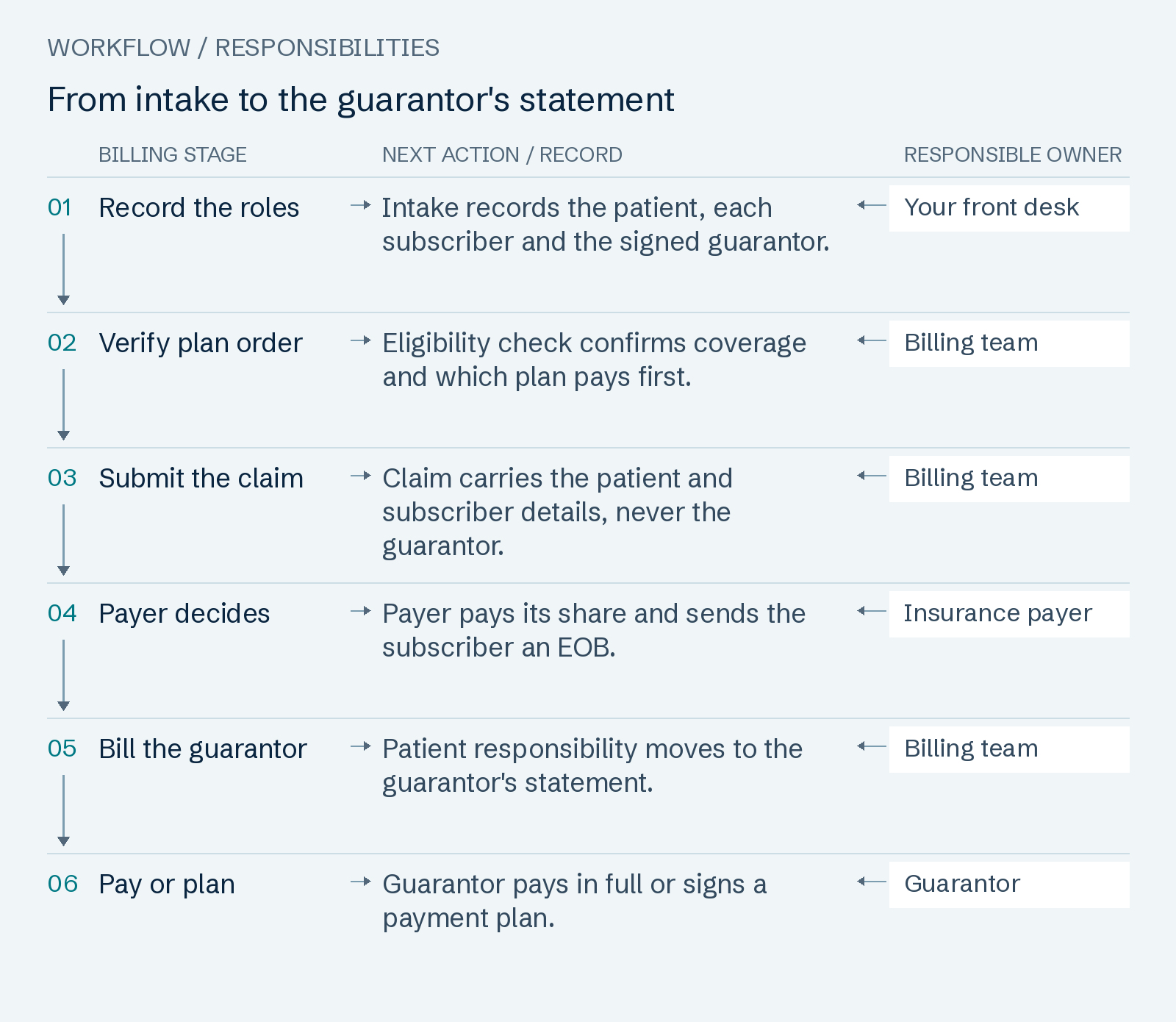
Read the workflow as text
- Record the roles — Intake records the patient, each subscriber and the signed guarantor. Owner: Your front desk.
- Verify plan order — Eligibility check confirms coverage and which plan pays first. Owner: Billing team.
- Submit the claim — Claim carries the patient and subscriber details, never the guarantor. Owner: Billing team.
- Payer decides — Payer pays its share and sends the subscriber an EOB. Owner: Insurance payer.
- Bill the guarantor — Patient responsibility moves to the guarantor's statement. Owner: Billing team.
- Pay or plan — Guarantor pays in full or signs a payment plan. Owner: Guarantor.
Divorced or separated parents: court orders and the birthday rule
When both parents insure a child, the plans follow coordination of benefits rules to decide which pays first. The standard rules are set out in the NAIC's Coordination of Benefits Model Regulation. For parents who are married or living together, the plan of the parent whose birthday falls earlier in the calendar year is primary (month and day only; the year does not count). If both share a birthday, the plan that has covered its parent longer is primary.
For parents who are divorced, separated or not living together, the model puts a court decree first. If a decree makes one parent responsible for the child's health care expenses or coverage and that parent's plan knows of it, that plan is primary. If the decree makes both parents responsible, or gives joint custody without naming who covers health care, the birthday rule applies. With no decree, the order is the custodial parent's plan, then the custodial parent's spouse's plan, then the non-custodial parent's plan, then that parent's spouse's plan.
What the birthday rule decides, and what it does not
The birthday rule and custody rules decide the order of insurance plans. They do not decide who your statement goes to. A father can hold the primary plan while the mother signed as guarantor. A support order may split out-of-pocket costs between the parents, but your practice collects from the guarantor who signed with you; the parents settle the split between themselves. Your state's version of the rule can differ from the model, so confirm it with the plan.
| Minor-client scenario | Which plan is billed first | Who is usually the guarantor | What to collect at intake |
|---|---|---|---|
| Two insured parents, married or living together | The plan of the parent with the earlier birthday in the year | The parent who signs your financial agreement | Both cards, both subscribers' dates of birth, the signed agreement |
| Separated parents; a court decree makes one parent responsible for health care | That parent's plan, once it knows of the decree | Often the responsible parent; set by who signs with you | The decree's medical-costs section, both cards, the signed agreement |
| Joint custody decree that does not say who covers health care | Birthday rule, as for married parents | The parent who signs; both may sign if your policy allows | The decree, both cards, each parent's contact details |
| No decree; the child lives mostly with one parent | Custodial parent's plan, then the custodial parent's spouse's, then the other parent's | Usually the custodial parent who brings the child | Both cards if both insure the child, the signed agreement |
| Teen of 12 or older consents to outpatient therapy alone in California | The teen's coverage as usual; the plan must send sensitive-service notices to the teen | Not a parent who did not take part: California says parents are not liable for this care unless they participate | The teen's own contact details, any confidential-communication request, a plan for payment |
Teen therapy clients: confidentiality and statements
Teen therapy is where the guarantor, the subscriber and confidentiality collide. HIPAA's personal-representative rule in 45 CFR 164.502(g)(3) has three exceptions: the parent is not the minor's personal representative for a service when the minor consents to it and no other consent is required by law, when the minor may lawfully get it without parental consent and the minor, a court or another person authorized by law consents, or when the parent agrees to a confidentiality arrangement between the provider and the minor. For everything else, the rule defers to state or other applicable law on what a parent may see.
State law sets the consent age and the payment rule, and it varies. In California, Family Code section 6924 lets a minor of 12 or older consent to outpatient mental health treatment or counseling when the attending professional judges the minor mature enough to participate intelligently. The same section says the parents are not liable for payment for that treatment unless they participate in it, and then only for the services rendered with their participation. A parent who never took part is not the right guarantor for those sessions.
Statements and EOBs can reveal the visit
A statement mailed to a parent, or an EOB mailed to the subscriber, can disclose a confidential visit. Two rules limit that:
- Your practice. Under 45 CFR 164.522(b), a covered provider must accommodate reasonable requests to receive communications at an alternative address or by alternative means, may not ask why, and may condition the accommodation on how payment, if any, will be handled.
- The health plan. California's Civil Code section 56.107 requires health care service plans to send bills, EOBs and other communications about a protected individual's sensitive services directly to that individual: to an alternative mailing address, email or phone number if they designate one, otherwise in their own name at the address on file. A teen who shares the policyholder's address should designate an alternative one. Section 56.05 defines sensitive services to include all mental and behavioral health care and counts a minor who can consent without a parent as a protected individual.
A client who pays in full out of pocket can also require you not to disclose that service to their health plan for payment purposes, under 45 CFR 164.522(a)(1)(vi). Other states set different ages and payment rules, so check your state's minor-consent statute and have a lawyer confirm your policy.
Guarantor errors that delay payment
Most guarantor errors come from one shortcut: copying one person's details into another person's role. The claim needs the subscriber's details exactly as the payer holds them, and the statement needs the guarantor's. These are the mistakes that hold up money:
- Guarantor details sent as the subscriber. The mother is entered as guarantor and her name and date of birth flow into the insured fields, but the policy is the father's. The payer cannot match the member and the claim rejects.
- Wrong primary plan. The plan that should pay second is billed first, ignoring the birthday rule or a custody decree, and the claim is denied for coordination of benefits until it is re-billed in the right order.
- The minor set as their own guarantor. Statements go to a child no one has agreed to pay for, and the account ages with no one paying it.
- Statements to the wrong household. After a separation, the statement still goes to the parent who left or to an old address, and nobody pays.
- A confidential-communication request ignored. A teen's statement goes to the parent's address in breach of an accepted request, which is a privacy problem as well as a collection one.
- No update at 18. A client turns 18 and the parent remains guarantor without agreeing to stay one.
Most of these are fixed at intake and checked again at eligibility verification, before the first claim goes out.
How statements and payment plans work
The guarantor's bill starts only after the payer decides the claim. The payer applies the allowed amount for each service, pays its share, and explains the result to the subscriber in an explanation of benefits (EOB). Whatever the payer assigns to patient responsibility moves to the guarantor's account, and your practice sends the guarantor a statement for it.
Payment plans
A payment plan is a written agreement between your practice and the guarantor to pay a balance in installments. Its terms (amount, due date, what happens after a missed payment) come from your own financial policy, so put them in writing and have the guarantor sign them. State law can limit fees, interest and collection steps, so have the policy reviewed before you use it.
If the guarantor does not pay
The balance stays the guarantor's debt, and your options are reminders, a payment plan, or referral to a collection agency under your policy. Once a third-party collector is involved, federal law adds rules. The FTC's debt collection FAQs say the Fair Debt Collection Practices Act covers medical bills; the collector must give validation information when it first contacts the person or within five days, and a person who disputes the debt in writing within 30 days stops collection until the collector sends verification. When the guarantor is the wrong person, such as a parent California says is not liable, the fix is to correct the account, not to collect harder.
Sending guarantor statements and answering routine billing questions are part of our patient statement services; payment plans, write-offs and any referral to a collection agency stay your practice's decisions. The steps a practice can take before an account reaches collections are set out in patient collection strategies. To compare what handing billing off would cost a therapy or behavioral health practice, see the full rate card.
Common questions
- What is a guarantor in medical billing?
- The guarantor is the person or organization financially responsible for a patient's account. They receive the patient statements and pay what insurance does not, such as copays, deductibles, coinsurance and self-pay charges. An adult patient is usually their own guarantor.
- Is the guarantor the same as the insured?
- Not necessarily. The insured (subscriber) holds the insurance policy and appears on the claim; the guarantor pays the balance and appears on the statement. One adult is often both, but a child's insured parent and guarantor parent can be different people.
- Who is the guarantor for a child?
- Usually the parent or legal guardian who consents to care and signs the practice's financial agreement. When parents are separated, which parent's plan is billed first follows a court decree or the birthday and custody rules, but the guarantor is whoever signed with the practice. Some states, such as California, limit when a parent can be billed for a teen's confidential therapy.
- Can a guarantor be someone other than a parent?
- Yes. The HL7 data standard defines the guarantor as a person or organization with financial responsibility for the account, so a grandparent, stepparent, adult sibling, spouse or organization can be guarantor if they agree to it in writing.
- What happens if the guarantor won't pay?
- The balance stays on the guarantor's account. A practice can send reminders, offer a written payment plan or refer the account to a collection agency under its financial policy. A third-party collector must follow the Fair Debt Collection Practices Act, which the FTC says covers medical bills.
- Can a teenager be their own guarantor for therapy?
- It depends on state law. In California a minor of 12 or older may consent to outpatient mental health treatment, and parents are not liable for it unless they take part. Practices then set up payment with the teen, often through insurance with confidential communications, and should confirm the arrangement with a lawyer.
Sources and review
Page revised November 4, 2026 · Review contact: Hyder Shah (inquiries@claimpillar.com). The workflow checklists are editorial recommendations; payer requirements depend on the program and current policy.
- HL7 v2: GT1 guarantor segment definition (HL7 Europe, retrieved 2026-11-04)
- Medicare Claims Processing Manual, chapter 26: completing the CMS-1500 (CMS, Rev. 14466, retrieved 2026-11-04)
- NAIC Coordination of Benefits Model Regulation (MDL-120, retrieved 2026-11-04)
- 45 CFR 164.502(g): personal representatives and unemancipated minors (eCFR, retrieved 2026-11-04)
- 45 CFR 164.522: restrictions and confidential communications (eCFR, retrieved 2026-11-04)
- California Family Code section 6924: minor consent to outpatient mental health care (retrieved 2026-11-04)
- California Civil Code section 56.107: health plan communications about sensitive services (retrieved 2026-11-04)
- California Civil Code section 56.05: definitions of sensitive services and protected individual (retrieved 2026-11-04)
- Debt collection FAQs (Federal Trade Commission, retrieved 2026-11-04)