Recoupment definition
Recoupment is how a payer collects an overpayment it says it made to your practice: it keeps money from claims it owes you now until the old debt is paid. The claim you were paid for months ago is reversed or adjusted, and the amount shows up as a deduction on a later remittance, often on a check for unrelated patients. That is why recoupment usually surprises practices: the deposit is smaller than the claims it covers.
Medicare's own fact sheet, Medicare Overpayments (MLN006379, July 2025), defines an overpayment as a payment above the amount due under existing laws and regulations, and treats an identified overpayment as a debt owed to the federal government. When a provider receives an overpayment of $25 or more, the Medicare Administrative Contractor (MAC) starts recovery by sending a demand letter. If the debt is not paid, the MAC recovers it by offsetting your future payments.
Where a recoupment shows up
You see a recoupment on the electronic remittance or the paper remit for the payment it reduced, not on the claim it relates to. Match each deduction to the original claim, patient and date of service before you accept it; reading the adjustment lines on an explanation of benefits (EOB) is the fastest way to tell a recoupment from an ordinary contractual adjustment.
Recoupment vs refund vs offset
The three words describe who moves the money and when. A refund is money you return. An offset is the mechanism: the payer subtracts what you owe from what it owes you. A recoupment is the overpayment recovery that the payer carries out, almost always by offset.
A refund is not optional once you find the error yourself. Under 42 CFR 401.305, a provider that has identified a Medicare overpayment must report and return it by the later of 60 days after identifying it or the date any corresponding cost report is due, and CMS's fact sheet describes a 6-year look-back for self-identified overpayments. The deadline can be suspended for up to 180 days while you run a timely, good-faith investigation into related overpayments from the same cause.
| Term | What happens to the money | Who starts it | Where you see it |
|---|---|---|---|
| Recoupment | Payer keeps part of later payments until the overpayment is covered | The payer, after its own review or audit | Deductions on a later remittance |
| Refund | Your practice sends the overpaid amount back | Your practice, after finding the error | Your refund letter or payer refund form |
| Offset | Amount owed is subtracted from amount payable | The payer, as the way it collects | Adjustment lines on the remittance |
| Overpayment | The debt itself: paid more than was due | Either side can identify it | Demand letter or your own audit |
Why payers recoup: audits, eligibility, credentialing gaps
CMS lists four causes of Medicare overpayments in its overpayment fact sheet: incorrect coding, insufficient documentation, medical necessity errors, and processing and administrative errors. Commercial payers recover for the same reasons, and most recoupment letters a practice receives trace back to one of three findings.
Audit and review findings
A post-payment review compares the claim with the clinical record. When the note does not support the code, the time or the units billed, the payer treats the difference as an overpayment and recovers it, sometimes across every claim in the sample period.
Eligibility findings
Coverage that ended before the date of service, a patient with another primary payer, or a duplicate payment from two plans all turn a paid claim into an overpayment. These are checkable before the visit, which is why eligibility verification at every new authorization period matters as much as coding.
Credentialing and enrollment gaps
A claim billed under a rendering clinician who was not yet enrolled with that payer, or under the wrong NPI or tax ID, can be paid first and reversed later when the payer reconciles its provider file. The gap usually affects every claim for that clinician in the same period, so the dollar amount grows fast.
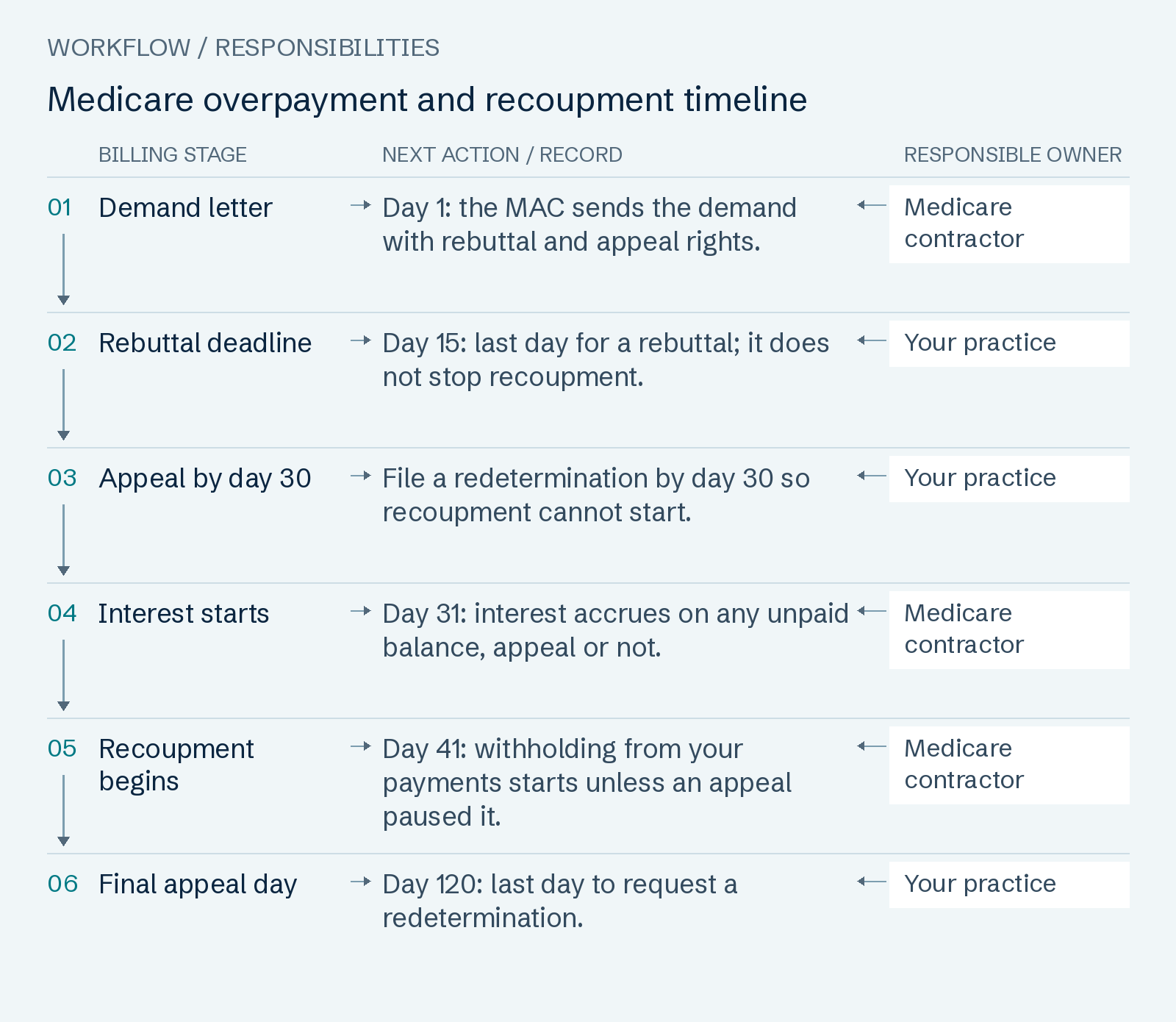
Read the workflow as text
- Demand letter — Day 1: the MAC sends the demand with rebuttal and appeal rights. Owner: Medicare contractor.
- Rebuttal deadline — Day 15: last day for a rebuttal; it does not stop recoupment. Owner: Your practice.
- Appeal by day 30 — File a redetermination by day 30 so recoupment cannot start. Owner: Your practice.
- Interest starts — Day 31: interest accrues on any unpaid balance, appeal or not. Owner: Medicare contractor.
- Recoupment begins — Day 41: withholding from your payments starts unless an appeal paused it. Owner: Medicare contractor.
- Final appeal day — Day 120: last day to request a redetermination. Owner: Your practice.
Therapy and ABA triggers: 90837 audits, unit caps, supervision
Behavioral health is a frequent audit target because its codes are billed by time and its payments add up session by session. In report A-09-21-03021 (May 2023), the HHS Office of Inspector General estimated that $580 million of the $1 billion Medicare Part B paid for psychotherapy from March 2020 through February 2021 was improper. Of 216 sampled enrollee days, providers did not meet Medicare requirements on 128 (for example, psychotherapy time was not documented) and did not meet Medicare guidance on 54 (for example, the provider's signature was missing).
The 90837 psychotherapy code (53+ minutes)
90837 is the longest individual psychotherapy session code, and it pays more than the shorter session codes (2026 national Medicare amount, unadjusted, non-facility: $167.00 for 90837 against $113.90 for 90834; actual payment varies by locality, setting and payer), so reviewers check that the note records the actual time spent. A note with no start and stop time or total minutes leaves nothing to defend. Our 90837 billing guide sets out what the note needs. Check every other claim detail the reviewer will compare with the record as well, including the place of service code for telehealth sessions.
ABA units, authorizations and supervision
In report A-09-22-02002 (December 2024), OIG found that Indiana made at least $56 million in improper fee-for-service Medicaid payments for applied behavior analysis, and every one of the 100 sampled enrollee-months included at least one improper or potentially improper claim line. OIG recommended that the state refund $39,432,556 in federal share, give ABA providers more guidance on 97155 and 97156, signatures, billable time and session-note detail, and run periodic statewide post-payment reviews to recover noncompliant payments. For an ABA practice, that means three checks before billing: units within the authorization, supervision and protocol-modification sessions documented by the right credential, and session notes that show what was done in each billed unit. Our ABA therapy billing service keeps a unit ledger against each client's authorization, so sessions past the authorized units are caught before they are billed.
Medicare recoupment timeline and how to pause it
Medicare's schedule runs from the date of the demand letter, and the day count decides your options. The dates below come from CMS fact sheet MLN006379 (July 2025) and 42 CFR 405.379, the rule that limits recoupment while an appeal is pending.
How to pause Medicare recoupment
- Request a redetermination by day 30. Under 42 CFR 405.379(d)(1), the contractor may not begin recoupment before day 41 and must stop once it receives a timely, valid redetermination request.
- If the redetermination affirms the overpayment, recoupment may start or resume on the 60th calendar day after the decision notice, unless the qualified independent contractor (QIC) receives a timely, valid reconsideration request first; that request stops recoupment again.
- An appeal filed after day 30 but by day 120 still stops recoupment once the MAC validates it, but money already withheld is not refunded until the redetermination is decided.
- Above the second level (an administrative law judge and beyond), recoupment stays in effect while you appeal.
Two traps catch practices. A rebuttal, due by day 15, lets you explain why the MAC should not recoup, but it does not stop recoupment. And interest starts on day 31 on any unpaid balance whether or not you appealed; if you win, the overpayment and the interest are adjusted. If you agree with the debt but cannot pay it at once, the demand letter explains how to request an extended repayment schedule.
| Day after the demand letter | What happens |
|---|---|
| Day 1 | The MAC sends the overpayment demand letter |
| Day 15 | Last day to submit a rebuttal (does not stop recoupment) |
| Day 16 | Immediate recoupment begins if you asked for it |
| Day 30 | Last day to pay in full before interest; file a redetermination to keep recoupment from starting on day 41 |
| Day 31 | Interest accrues on the unpaid balance, appeal or not |
| Day 40 | Last day to pay in full before recoupment |
| Day 41 | Standard recoupment begins unless an appeal has paused it |
| Days 61 to 90 | Intent to refer letter for eligible delinquent debts |
| Day 120 | Last day to request a redetermination |
Commercial look-back limits by state
Commercial payers have no single federal clock. Many states cap how far back a state-regulated insurer can reach for an overpayment, what notice it must give and when it may offset. These limits generally govern fully insured plans regulated by the state; self-funded employer plans, government programs and cases of fraud often fall outside them, and your payer contract may set its own terms. The four states below show how far apart the rules are.
California's statute for health care service plans, Health and Safety Code 1371.1, gives you 30 working days from the notice to repay or contest an overpayment. Texas, in Insurance Code 1301.132, bars a preferred provider plan from recovering the money until your appeal rights are exhausted. Florida's section 627.6131(6) lets an insurer reduce payment for other services only if you agree in writing or fail to respond to its overpayment claim.
New York's Insurance Law 3224-b requires 30 days' written notice that names the patient, date of service, payment and proposed adjustment, and gives you a written procedure to challenge the recovery.
| State and source | Look-back window | Your response window | Notable condition |
|---|---|---|---|
| California: Health and Safety Code 1371.1; 28 CCR 1300.71(b)(5) | Written request within 365 days of the date of payment | 30 working days to repay or contest | No 365-day limit where the overpayment was caused by fraud or misrepresentation |
| Florida: Statutes 627.6131(6) | Overpayment claim within 30 months of the insurer's payment | 40 days to pay, deny or contest | No offset against other claims unless you agree in writing or fail to respond |
| New York: Insurance Law 3224-b(b) | No recovery started more than 24 months after the original payment | 30 days' written notice before recovery | Exceptions for fraud, abusive billing, self-insured plans and government programs |
| Texas: Insurance Code 1301.132 | Written notice no later than the 180th day after you received the payment | 45 days to arrange repayment | No recovery until your appeal rights are exhausted |
How to dispute a recoupment
Start the day the letter arrives, because every right above runs on a short clock. A dispute wins on the record, not on the argument, so the first job is to rebuild what was billed and what the note supports.
- Log the dates: the letter date, the payer's response deadline, the appeal deadline and the day withholding can start.
- Pull every claim listed, with its remittance, the clinical note, the authorization and the clinician's enrollment record.
- Sort each claim: agree, agree in part, or dispute, and write down the specific reason.
- Check the look-back: compare the original payment date with your state's limit and your contract.
- File the dispute or appeal in the payer's required form, by the deadline, and keep proof of delivery.
- Watch each remittance afterward to confirm withholding stopped, or that it resumed only when the rules allow.
Dispute letter outline
- Practice name, NPI, tax ID and the payer's reference or demand number.
- The claims you dispute, by patient account, date of service and amount.
- The grounds for each: documentation that supports the service, a look-back limit that has passed, or a payer processing error.
- The evidence enclosed, listed by page.
- The statute or contract section you rely on, and your request that recovery stop while the dispute is decided.
- A named contact and the date you sent it.
This page explains the rules; it is not legal advice, and a large or fraud-related demand calls for a health care attorney. When the same review also produced denials, our denial management services work and appeal those claims. To see which unpaid claims are closest to a payer deadline, get your free A/R Deadline Map; Clock starts with your claim-level aging export and signed BAA; above 10 requests in a week, we confirm your date within 1 business day.
Common questions
- What does recoupment mean in medical billing?
- Recoupment means a payer is taking back money it says it overpaid you. Instead of asking for a check, it usually withholds the amount from your future claim payments, so the deduction appears on a later remittance for other patients.
- How far back can insurance recoup payments?
- For commercial plans it depends on state law and your contract: for example 180 days in Texas, 365 days in California, 24 months in New York and 30 months in Florida for state-regulated plans, with exceptions such as fraud. For overpayments you find yourself, Medicare uses a 6-year look-back.
- Can I stop a Medicare recoupment?
- Yes, while you appeal. A valid redetermination request filed by day 30 after the demand letter keeps recoupment from starting on day 41, and a timely reconsideration request stops it again. Interest still accrues from day 31, and a rebuttal alone does not stop recoupment.
- Why is my payer taking money back from ABA claims?
- Usually because a post-payment review found units above the authorization, sessions that the notes do not support, supervision billed by the wrong credential or missing signatures. OIG's Indiana ABA audit found improper or potentially improper lines in all 100 sampled enrollee-months.
- Is a recoupment the same as an overpayment?
- No. The overpayment is the debt: the amount you were paid above what was due. Recoupment is one way the payer collects that debt, by keeping it from future payments. You can also settle an overpayment with a refund or, with Medicare, an extended repayment schedule.
- Does recoupment stop if I file a rebuttal with Medicare?
- No. A rebuttal, due within 15 days of the demand letter, lets you explain why the MAC should not recoup, but CMS states it does not stop recoupment. Only a timely, valid redetermination or reconsideration request pauses it.
Sources and review
Page revised November 5, 2026 · Review contact: Hyder Shah (inquiries@claimpillar.com). The workflow checklists are editorial recommendations; payer requirements depend on the program and current policy.
- Medicare Overpayments, MLN006379 (CMS, July 2025, retrieved 2026-11-05)
- 42 CFR 405.379: limitation on recoupment of provider and supplier overpayments (eCFR, retrieved 2026-11-05)
- 42 CFR 401.305: reporting and returning of overpayments (eCFR, retrieved 2026-11-05)
- California Health and Safety Code 1371.1 (via California.Public.Law, retrieved 2026-11-05)
- California Code of Regulations, title 28, section 1300.71 (via Cornell LII, retrieved 2026-11-05)
- Florida Statutes 627.6131 (via Florida.Public.Law, retrieved 2026-11-05)
- New York Insurance Law 3224-B (New York State Senate, retrieved 2026-11-05)
- Texas Insurance Code 1301.132 (via Texas.Public.Law, retrieved 2026-11-05)
- OIG A-09-21-03021: Medicare improperly paid providers for some psychotherapy services (May 2023, retrieved 2026-11-05)
- OIG A-09-22-02002: Indiana improper Medicaid payments for ABA (December 2024, retrieved 2026-11-05)