Continuous vs discontinuous measurement in ABA
Continuous measurement records every instance of a target behavior during the observation: each occurrence (frequency or rate), how long each one lasts (duration), or how long it takes to start after a cue (latency). Discontinuous measurement records a sample instead. The observer splits the session into intervals and scores each interval as occurred or not occurred, so the result is a percentage of intervals, not a count or a number of minutes.
The choice is a clinical one, and the BACB treats it as an ethics duty. Standard 2.17 of the BACB Ethics Code for Behavior Analysts says behavior analysts ensure the appropriate selection and correct implementation of data collection procedures, then graph, summarize and use the data to decide whether to continue, modify or end services.
When continuous measurement is not practical
Continuous recording is the most complete record, but it needs an observer who can watch and record without pause. A technician running discrete trials, prompting and delivering reinforcement often cannot also time every episode of a high-rate or long-lasting behavior. Discontinuous methods trade some accuracy for a recording load a technician can keep up with during 97153 sessions. The trade is acceptable only when you know which way each method errs, which the table below sets out.
| Method | What it records | Direction of error | Best use |
|---|---|---|---|
| Frequency or rate (continuous) | Every occurrence, counted | No sampling error when every instance is caught | Discrete behaviors with a clear start and end, at a rate the observer can count |
| Duration (continuous) | Time from the start to the end of each episode | No sampling error when every episode is timed | Behaviors where how long matters: tantrums, on-task time, tolerating a demand |
| Partial interval recording | Interval scored if the behavior occurs at any point in it | Consistent overestimate (Powell, Martindale and Kulp, 1975) | Behaviors you aim to reduce that are brief, frequent or hard to count |
| Whole interval recording | Interval scored only if the behavior lasts the entire interval | Consistent underestimate (same study) | Behaviors you aim to increase that should continue without breaks |
| Momentary time sampling | Interval scored if the behavior is occurring at the moment the interval ends | Over- and underestimates about equally often (same study) | Ongoing states in groups or long sessions, where the observer cannot watch continuously |
Partial interval recording: when it overestimates
Partial interval recording scores an interval when the target behavior occurs at any moment within it, once or many times. A five-second episode and a full minute of the behavior score the same interval. In Powell, Martindale and Kulp's 1975 evaluation of time-sample measures in the Journal of Applied Behavior Analysis, scoring a behavior that had to occur only briefly within the interval produced a consistent overestimate of the continuous measure. The authors also found that the error depends on the mean time per response and is not consistent across experimental conditions.
A worked example of the overestimate
Illustrative example, not client data. A technician records hand flapping across ten 1-minute intervals. The behavior occurs for about 5 seconds in six of those intervals. Partial interval recording scores 6 of 10 intervals, or 60%. The behavior actually filled about 30 of 600 seconds, or 5% of the session. The 60% is a correct partial interval score; it is wrong only if a report or graph calls it "60% of the session."
Why the overestimate can suit reduction goals
Because partial interval recording leans high, a decreasing trend on a reduction target is less likely to overstate progress. The same bias works against you on a skill you want to increase: the data can look better than the behavior is. Label every partial interval graph "percentage of intervals" so a payer reviewer reads the number the way it was collected.
Whole interval recording and momentary time sampling
The other two discontinuous methods sample differently, and their errors run in different directions.
Whole interval recording
Whole interval recording scores an interval only when the behavior continues for the entire interval. A child who stays on task for 55 seconds of a 60-second interval scores a zero for it. Powell, Martindale and Kulp found that requiring the behavior throughout the interval produced a consistent underestimate of the continuous measure. That makes it a conservative choice for behaviors you aim to increase, such as sustained engagement or remaining seated, because improvement shown on the graph is unlikely to be inflated.
Momentary time sampling
Momentary time sampling (MTS) scores an interval only if the behavior is happening at the instant the interval ends. The observer looks up at the signal, records, and is free between signals. In the same study, overestimates and underestimates occurred about equally often, and the more often the samples were taken, the closer the result came to the continuous measure. MTS suits ongoing states observed across a long session or a group, where watching one behavior without a break is not possible. Short intervals matter with MTS in particular, because a brief behavior that starts and stops between signals is never recorded.
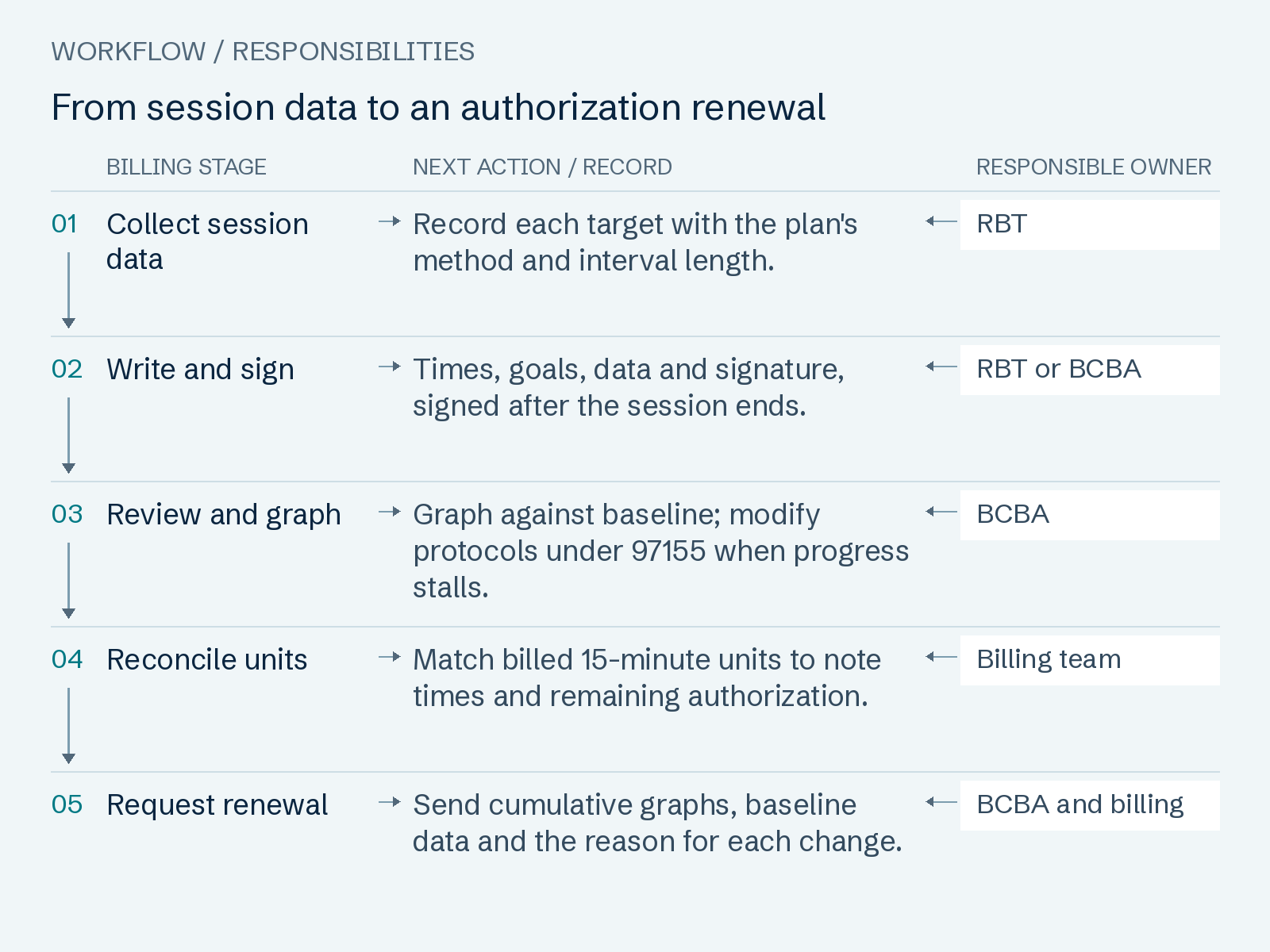
Read the workflow as text
- Collect session data — Record each target with the plan's method and interval length. Owner: RBT.
- Write and sign — Times, goals, data and signature, signed after the session ends. Owner: RBT or BCBA.
- Review and graph — Graph against baseline; modify protocols under 97155 when progress stalls. Owner: BCBA.
- Reconcile units — Match billed 15-minute units to note times and remaining authorization. Owner: Billing team.
- Request renewal — Send cumulative graphs, baseline data and the reason for each change. Owner: BCBA and billing.
Choosing a method for each target behavior
The supervising BCBA picks the measurement method per target, writes it into the treatment plan and keeps it the same from baseline through each progress report. Work through these questions for every target:
- Can a technician count or time every instance while running the session? If yes, use frequency, rate or duration. Continuous data needs no explanation of sampling error in a progress report.
- Is the goal to reduce or to increase the behavior? Partial interval recording leans high, which suits reduction targets; whole interval recording leans low, which suits increase targets.
- Does the behavior come in brief bursts or long episodes? Brief, frequent behaviors are poorly caught by momentary time sampling; long, ongoing states are poorly described by partial interval recording.
- How long are the intervals? Shorter intervals bring every method closer to the continuous measure. State the interval length in the plan, for example 30-second partial intervals.
- Will the method stay the same across the authorization period? Powell and colleagues found that sampling error is not consistent across conditions. If you change methods mid-goal, start a new baseline and say so in the progress report.
Record each choice in the plan in one line: the target, its operational definition, the method, the interval length and the goal criterion. That line is what a payer reviewer compares your session data against.
Session notes for 97153 and 97155 that pass payer audits
A session note has to prove three things on its own: that the service on the claim happened, that it matched the code billed, and that its minutes add up to the units billed. Under the ABA Coding Coalition's FAQ, every adaptive behavior code is billed in 15-minute units, work lasting 8 to 22 minutes is one unit, and work under 8 minutes is not reportable. Time billed must be face-to-face with the patient or caregiver, and writing the session note is indirect work that is not billable under the current codes, except 97151.
What a 97153 note must show
Centene's CP.BH.105 lists the elements its affiliated plans expect in every service note, completed before the claim is submitted: the provider organization and rendering technician, the client's name and date of birth or identifier, the exact start and end time, any pauses with the times they started and stopped, the location, the service type with its code, the signature of the rendering provider, the target areas addressed, the techniques used, the client's response, progress toward goals and everyone who took part. For the code itself, see our 97153 billing guide. If your clinicians also write therapy notes in a fixed format, our comparison of SOAP, BIRP and DAP note templates shows how a structured layout maps to these elements.
What a 97155 note adds
A 97155 note must show protocol modification, not observation. The ABA Coding Coalition says that when the qualified professional decides no change is needed, the note should record the protocol components they considered, and that noting only that they observed the protocol being run is not sufficient. Centene's policy asks for a list of the modifications made, or the components reviewed and the clinical reason for keeping the protocol as written.
Annotated session note sample
Illustrative example, not client data. The table below walks through one 97153 note, its tie to the treatment plan and how its minutes convert to units. A session from 1:00 to 3:30 pm with a 15-minute pause runs 135 face-to-face minutes, which is 9 units of 97153.
| Note field | Example entry | What an auditor checks |
|---|---|---|
| Organization, technician, client | Agency name; technician name and RBT credential; client name on each page, with date of birth or client ID | The rendering provider on the claim matches the person who signed |
| Date and times | 11/03/2026, 1:00 pm to 3:30 pm; paused 2:10 to 2:25 pm for lunch | Billed minutes exclude the pause; 135 minutes supports 9 units, not 10 |
| Location and code | Client's home; 97153 | The place and code match the claim line |
| Goals addressed | Goal 2 (reduce elopement) and Goal 4 (request a break), as numbered in the treatment plan | Each goal exists in the current authorized plan |
| Data collected | Elopement: 30-second partial intervals, 9 of 60 intervals scored (15%); break requests: 6 independent of 8 opportunities | The method and interval length match the plan, and the data supports the time billed |
| Techniques and response | Functional communication training with a break card; prompt fading from gestural to independent; client used the card without prompts twice | Active treatment ran through the billed time, not free play or waiting |
| Signature | Technician signature with credential, time-stamped 3:34 pm | The note was signed after the session ended, not before |
Common documentation gaps that trigger recoupments
Federal auditors have now reviewed ABA session notes line by line. In its July 2025 report A-06-23-01002, HHS-OIG estimated that Wisconsin made at least $18.5 million in improper fee-for-service Medicaid ABA payments. In 96 of 100 sampled enrollee-months, at least one claim line did not meet documentation requirements. The full report lists what the session notes failed to do:
- support the CPT code billed (79 sampled enrollee-months);
- support the number of units billed (77);
- support the dates of service billed (16);
- carry the rendering provider's signature (9).
Behind those counts sit specific habits. In 53 sampled enrollee-months, providers signed notes more than 8 minutes before the session's recorded end time. In 75 of the 95 enrollee-months with a 97155 line, the notes did not show that any issue was resolved or any protocol changed. Every one of the 100 enrollee-months had notes that potentially lacked a full description of services, the goals addressed or the data collected, 93 referred to recreational activities, and 85 included potential non-therapy time such as lunch, naps or travel. In January 2026, HHS-OIG reported that Maine made at least $45.6 million in improper payments for its rehabilitative and community support services for children with autism, citing session notes without a full description of services, the goals addressed or data collected.
Commercial and managed-care plans write the same risk into policy. Centene's CP.BH.105 states that billed units not fully supported by documentation may be denied or recouped, and it sets a minimum for protocol modification: at least two hours a week or 10% of direct service hours, whichever is greater. 97153 and 97154 units in the six-month authorization period that this minimum does not support can be denied or recouped; in the policy's own example, 7 hours of modification against 100 hours of 97153 and 97154 leaves 30 hours unsupported. The BACB adds an ethical duty: under Standard 2.06, a behavior analyst who discovers a billing inaccuracy informs the relevant parties, corrects it promptly and documents what was done.
Payer audit checklist for ABA notes
Run these checks on a sample of notes each month, before an auditor does:
- Every billed date of service has a note you can retrieve.
- Start, end and pause times are recorded, and billed units equal the face-to-face minutes under the 8-minute rule.
- The signature time-stamp falls after the session end time.
- The rendering provider on the claim is the person who signed the note, at the credential level billed.
- Each goal named in the note appears in the current authorized treatment plan.
- Data is recorded for each goal addressed, using the method and interval length in the plan.
- Lunch, naps, travel and unstructured play are excluded from billed time unless the note documents teaching during them.
- Every 97155 note lists the protocol changes made, or the components reviewed and the reason for no change.
- Overlapping 97153 and 97155 minutes follow your payer's concurrent-billing rule.
- Units billed stay within the authorization's remaining units and dates.
Unit reconciliation against each authorization is where clinical documentation meets the claim. Our ABA therapy billing service checks billed units against session times and authorizations before claims go out. To see which unpaid ABA claims are closest to their filing deadlines, start with The Free A/R Deadline Map: Get my free A/R Deadline Map (Clock starts with your claim-level aging export and signed BAA; above 10 requests in a week, we confirm your date within 1 business day.).
Common questions
- What is discontinuous measurement in ABA?
- Discontinuous measurement records a sample of a behavior instead of every occurrence. The session is split into intervals, and each interval is scored as occurred or not occurred under one of three rules: partial interval recording, whole interval recording or momentary time sampling. The result is a percentage of intervals, which estimates the behavior rather than measuring it exactly.
- What is partial interval recording?
- Partial interval recording scores an interval when the target behavior occurs at any point during it, whether once, many times or for the whole interval. It suits brief or frequent behaviors that are hard to count, and it is usually used for behaviors you aim to reduce. Report its results as a percentage of intervals, not a percentage of time.
- Does partial interval recording overestimate behavior?
- Yes. In Powell, Martindale and Kulp's 1975 JABA study, partial interval sampling consistently overestimated the continuous measure, whole interval sampling consistently underestimated it, and momentary time sampling erred in both directions about equally often. More frequent samples, meaning shorter intervals, brought the estimates closer to the continuous measure.
- What should an ABA session note include for billing?
- At minimum: the provider and client identifiers, the exact start and end times with any pauses, the location, the code, the goals addressed from the treatment plan, the data collected, the techniques used, the client's response and the rendering provider's signature, signed after the session ends. A 97155 note also lists the protocol changes made or the components reviewed. Your payer's manual may add elements, so check it.
- How long should ABA data be kept?
- There is no single national number. Standard 2.05 of the BACB Ethics Code requires behavior analysts to follow every applicable requirement for retaining and destroying records (BACB rules, laws, regulations, contracts, funder and organization requirements), and Standard 4.05 sets at least 7 years for supervision documentation. Keep client records for the longest period your state law, Medicaid program and payer contracts require.
- Can 97153 and 97155 be billed for the same minutes?
- It depends on the payer. The ABA Coding Coalition says both may be reported concurrently when each code's criteria are met, but a single qualified professional may not report both at once. Wisconsin Medicaid told providers not to bill 97153 separately during simultaneous direction of a technician, and HHS-OIG counted overlapping units as overpayments there. Check your payer's rule before billing the overlap.
Sources and review
Page revised November 4, 2026 · Review contact: Hyder Shah (inquiries@claimpillar.com). Every source below was retrieved and checked on November 4, 2026. Payer rules apply only to the payer and program named; check your own payer's current manual and contract.
- BACB: Ethics Code for Behavior Analysts (updated 08/2024), Standards 2.05, 2.06, 2.17 and 4.05
- ABA Coding Coalition: Frequently Asked Questions (units, 8-minute rule, 97155 documentation, concurrent billing)
- ABA Coding Coalition: Billing Codes (codes effective January 1, 2027)
- Powell, Martindale and Kulp (1975), An evaluation of time-sample measures of behavior, Journal of Applied Behavior Analysis 8(4)
- Centene clinical policy CP.BH.105: Applied Behavioral Analysis Documentation Requirements (revised 02/26), SilverSummit Healthplan copy
- HHS-OIG A-06-23-01002: Wisconsin Made at Least $18.5 Million in Improper Fee-for-Service Medicaid Payments for ABA (July 2025)
- HHS-OIG A-06-23-01002 full report (PDF)
- HHS-OIG news release: Maine made at least $45.6 million in improper Medicaid payments for autism services (January 22, 2026)