SOAP note format: subjective, objective, assessment, plan
The SOAP note format is a four-part structure for one encounter: Subjective, Objective, Assessment and Plan. A StatPearls review of SOAP notes credits Larry Weed with the structure and describes it as both a documentation checklist and a framework for clinical reasoning. For a therapist, the order mirrors the session: what the client told you, what you saw, what you concluded, and what you will do next.
The format itself never gets a claim paid. What a payer reviewer reads for is the content inside it. CGS's Medicare fact sheet for outpatient psychiatry and psychology services lists what psychotherapy documentation should include: the time, modalities and frequency, and a note for each encounter summarizing the diagnosis, symptoms, functional status, a focused mental status exam, the treatment plan, prognosis and progress, and the name, signature and credentials of the person who performed the service. The template below maps each of those items to a SOAP section, so a complete note answers the reviewer's checklist without extra writing.
SOAP note template for a therapy session
Copy these fields into your EHR's custom note or a document template. The third column is the medical-necessity check for that section.
| Section | What to write | Medical-necessity check |
|---|---|---|
| Header | Client ID, date of service, session start and stop times, setting or telehealth location, people present | Time recorded and matches the code billed |
| S: Subjective | Client's report in their words: symptoms, frequency, stressors, homework done, risk statements | Symptoms named, tied to the diagnosis |
| O: Objective | Your observations: affect, behavior, focused mental status findings, scores from any measure given | Observable findings, not opinion only |
| A: Assessment | Your judgment: progress toward each treatment-plan goal, change in risk, response to the intervention used | Progress or barriers stated against goals |
| P: Plan | Next session date and frequency, interventions planned, homework, referrals, any plan change | Continued treatment justified |
| Sign-off | Diagnosis code, name, credential, signature and signing date | Signature and credential present |
Mental health SOAP note example
The example below is a 56-minute individual session billed as 90837, the code for 53 minutes or more of psychotherapy. Illustrative example, not a real patient or client record. The bracketed notes show what each line proves to a reviewer.
- Header: Client 0417. Telehealth, client at home. Start 2:02 pm, stop 2:58 pm (56 minutes of psychotherapy). [Time sits in the 53-minute-plus range for 90837.]
- S: Client reports panic episodes on 3 of the last 7 days, down from daily two weeks ago. Avoided the grocery store twice. Completed breathing practice 4 of 7 days. Denies thoughts of self-harm. [Symptoms, frequency and homework compliance.]
- O: Alert and oriented, speech normal in rate, affect anxious but brightened when discussing work. GAD-7 score 13, down from 17 at intake. [Focused mental status and a measurable change.]
- A: Partial progress on goal 1 (reduce panic episodes to fewer than 2 per week). Avoidance continues to limit daily activities (goal 2). Cognitive restructuring was effective in session; exposure work is indicated. [Progress against named goals and why treatment continues.]
- P: Weekly 60-minute sessions continue. Begin graded exposure hierarchy next session. Homework: one store visit with breathing practice. Reassess GAD-7 in 4 weeks. [Frequency, next intervention and when progress is measured.]
- Sign-off: Diagnosis code, clinician name, license type, signature and date.
SOAP note assessment example: weak vs strong
The Assessment is where a note most easily goes thin. "Client is doing well, continue therapy" names no goal, no change and no reason to continue. A strong assessment answers three questions in two or three sentences: which treatment-plan goal moved and by how much, what still limits the client's functioning, and why the next session's intervention follows from that. The 90837 example above does all three in four short sentences.
BIRP notes: behavior, intervention, response, plan (with example)
BIRP notes reorder the same clinical content around what you did in the session: Behavior (what the client presented with), Intervention (the technique you used), Response (how the client reacted) and Plan. BIRP fits structured modalities such as CBT or DBT, because the Intervention line forces you to name the technique, and the modality is one of the items Medicare contractors expect in psychotherapy documentation.
BIRP note template
- Header: client ID, date, start and stop times, location, people present.
- B: Behavior. Presenting symptoms, client statements, observed affect and behavior, risk screen.
- I: Intervention. The named technique, tied to a treatment-plan goal.
- R: Response. How the client engaged, what changed in session, progress toward the goal.
- P: Plan. Next session, frequency, homework, any plan change or referral.
- Sign-off: diagnosis code, name, credential, signature, date.
BIRP note example (90834)
Illustrative example, not a real patient or client record. A 44-minute session billed as 90834, which covers 38 to 52 minutes of psychotherapy.
- Header: Client 0938. Office. Start 10:00 am, stop 10:44 am (44 minutes). [Inside the 38 to 52 minute range.]
- B: Client reports two arguments with partner this week that escalated to shouting; rates anger 8/10 at peak. Tearful when describing the second argument. Denies thoughts of harming self or others.
- I: DBT emotion-regulation skills: identified triggers with a chain analysis of the second argument; taught the opposite-action skill (goal 1: reduce escalated conflicts).
- R: Client identified two early warning signs and role-played opposite action once with prompting. Rated anger 4/10 by end of session.
- P: Weekly 45-minute sessions continue. Homework: daily diary card. Review chain analysis next session.
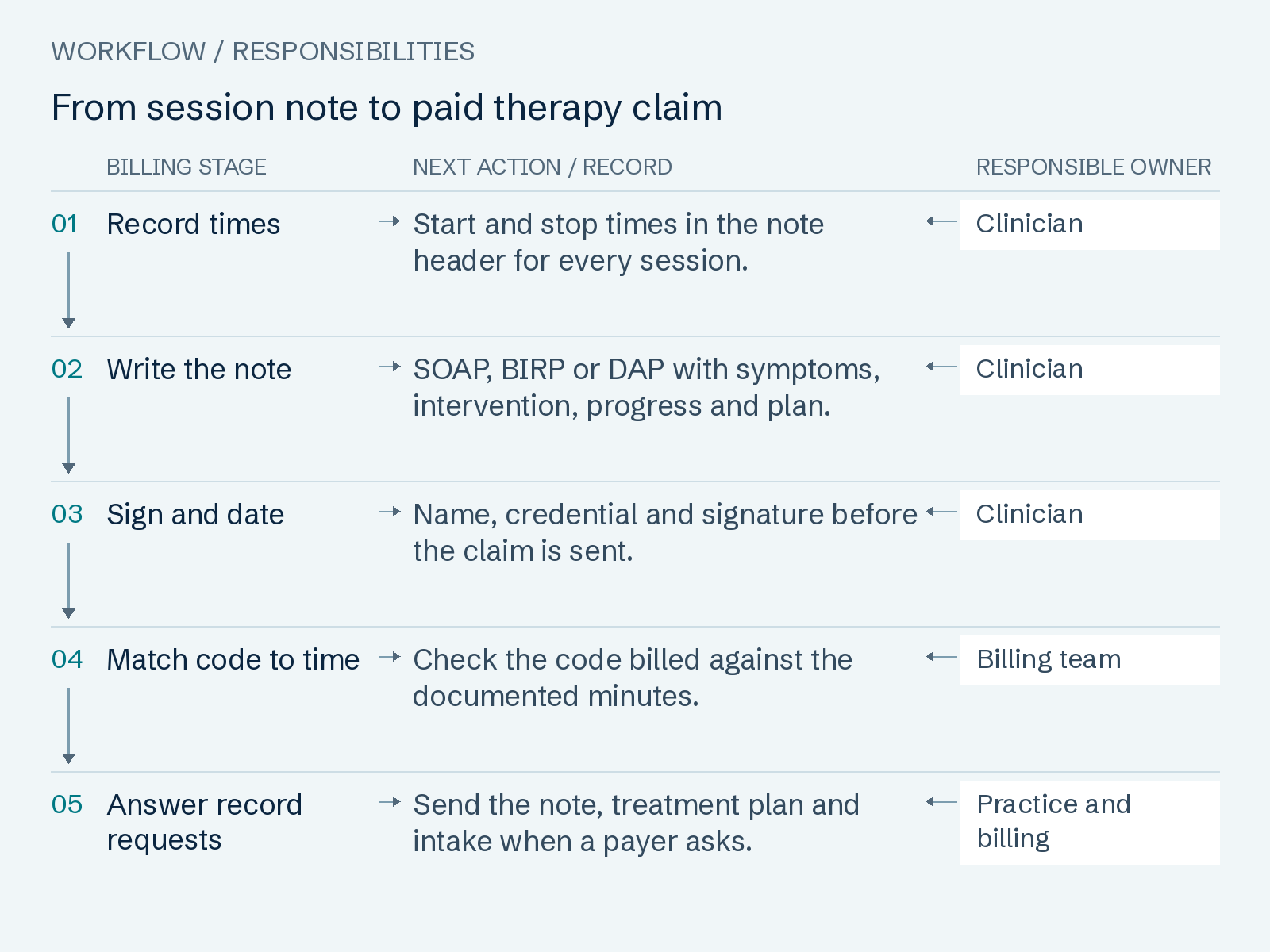
Read the workflow as text
- Record times — Start and stop times in the note header for every session. Owner: Clinician.
- Write the note — SOAP, BIRP or DAP with symptoms, intervention, progress and plan. Owner: Clinician.
- Sign and date — Name, credential and signature before the claim is sent. Owner: Clinician.
- Match code to time — Check the code billed against the documented minutes. Owner: Billing team.
- Answer record requests — Send the note, treatment plan and intake when a payer asks. Owner: Practice and billing.
DAP note example: data, assessment, plan
DAP notes merge SOAP's Subjective and Objective sections into one Data section, followed by Assessment and Plan. The result is shorter, which suits clinicians who see many clients a day. The risk is that the merged Data section drifts into a narrative of the conversation and loses the observable findings a reviewer looks for, so keep a separate line for mental status and any measure scores.
DAP note template
- Header: client ID, date, start and stop times, location, people present.
- D: Data. Client's report, your observations, mental status findings, measure scores, the intervention used.
- A: Assessment. Progress toward each goal, current risk, why treatment continues.
- P: Plan. Next session, frequency, homework, plan changes, referrals.
- Sign-off: diagnosis code, name, credential, signature, date.
DAP note example
Illustrative example, not a real patient or client record.
- Header: Client 1162. Telehealth, client at home. Start 4:00 pm, stop 4:41 pm (41 minutes).
- D: Client reports sleeping 5 hours a night, low mood most days, missed one workday. Affect flat, speech slow, oriented. PHQ-9 score 16, down from 19 last month. Used behavioral activation: scheduled three activities for the week.
- A: Modest improvement on goal 1 (reduce depressive symptoms, measured by PHQ-9). Missed work shows continued functional impairment. No change in risk.
- P: Weekly sessions continue. Review activity log next session. Coordinate with prescriber on sleep, with client's signed release on file.
Which format to use: therapy type, payer, EHR
Choose the format that makes your notes complete with the least effort, because no Medicare rule picks one for you. For outpatient therapy, the Medicare Benefit Policy Manual, chapter 15, section 220.3 says plainly that the format of treatment notes "shall not be dictated by contractors" and may vary by clinician and setting. For psychotherapy, the MAC documents cited on this page list required content and never a layout. Commercial plans and Medicaid programs can add their own rules, so check your contracts and your state program's manual. Whichever template your EHR offers, pick one format per practice so every clinician's notes read the same way in an audit.
Physical therapy: a SOAP note that carries Medicare's treatment-note elements
If your PT clinic writes SOAP notes, keep the format and add what Medicare's manual requires in every treatment note whatever the format: the date of treatment; each intervention or modality provided and billed, in words that can be compared with the claim; total timed-code treatment minutes and total treatment time; and the signature and professional identification of the qualified professional. The same section 220.3 requires a progress report at least once every 10 treatment days. Illustrative example, not a real patient or client record.
- S: Patient reports right knee pain 4/10 on stairs, down from 6/10 at evaluation; completed home exercises daily.
- O: Knee flexion 115 degrees (evaluation: 98). Therapeutic exercise (97110), 25 minutes: quad strengthening and step-ups. Manual therapy (97140), 13 minutes: patellar mobilization. Total timed-code minutes 38; total treatment time 38 minutes.
- A: Progressing toward goal 2 (climb one flight of stairs without a rail). Step-up control still limited on the right.
- P: Continue 2 times a week per plan of care; progress report due at treatment day 10.
- Sign-off: therapist name, PT credential, signature, date.
| Format | Sections | Fits best | Watch for |
|---|---|---|---|
| SOAP | Subjective, Objective, Assessment, Plan | PT, OT and speech visits; mixed medical and therapy practices; clinicians who measure change each visit | Long notes; Subjective and Objective repeating each other |
| BIRP | Behavior, Intervention, Response, Plan | Structured modalities (CBT, DBT); group and skills sessions; notes that must name the technique | Thin Behavior section with no symptoms or risk screen |
| DAP | Data, Assessment, Plan | High-volume talk therapy; clinicians who want short notes | Data section turning into a transcript; missing observable findings |
Counseling intake form: what to capture
The intake form feeds two things: the diagnostic evaluation that justifies treatment, and the claim that gets it paid. A form that misses either side costs you later, either in a denied claim or in an evaluation that cannot support the first treatment plan.
Clinical fields the first evaluation needs
CGS's fact sheet lists what the psychiatric diagnostic evaluation (90791) requires: a complete medical and psychiatric history including past, family and social history; a mental status examination; an initial diagnosis; an evaluation of the patient's ability and capacity to respond to treatment; and an initial plan of treatment. Your intake form collects the history so the session can focus on the examination and the plan.
- Reason for seeking care, in the client's words, and when symptoms started.
- Current symptoms and how they affect work, school, relationships and self-care.
- Psychiatric history: prior diagnoses, therapy, hospitalizations, medications.
- Medical history, current medications and prescribers.
- Family and social history: household, relationships, work, substance use.
- Safety screen: current and past thoughts of self-harm or harm to others.
- Client goals for treatment, which become the first treatment-plan goals.
Billing fields the claim needs
- Legal name, date of birth, address and phone, exactly as on the insurance card.
- Insurance card front and back, subscriber name and date of birth, and the client's relationship to the subscriber.
- Secondary insurance, if any.
- Signed consent to treat, financial policy and authorization to bill insurance.
- Releases of information for any prescriber or provider you will coordinate with.
Medical-necessity lines that keep claims paid
Payers do not pay for a session because it happened; they pay because the record shows it was needed and delivered as billed. The HHS Office of Inspector General's 2023 audit of Medicare psychotherapy (A-09-21-03021) found that providers met Medicare requirements for only 84 of 216 sampled enrollee days, estimated $580 million in improper payments, and gave missing psychotherapy time and missing signatures as examples of the errors. Optum's October 2025 provider notice on the most common psychotherapy record errors starts with the same basics: signature, credentials and start and stop times.
Medical-necessity checklist for every note
Run this list against a sample of your notes each month, whichever format you use:
- The diagnosis on the claim appears in the note or the current treatment plan.
- Current symptoms are named, with frequency or severity.
- Functional impairment is stated: work, school, relationships or self-care.
- The intervention used is named and tied to a treatment-plan goal.
- Progress toward the goal is stated, with a measure score where you use one.
- The plan says why treatment continues and at what frequency.
- Session time is recorded and matches the code billed.
- The note carries the clinician's name, credential and signature.
Progress notes vs psychotherapy notes
HIPAA treats private process notes differently from the billing record. Under 45 CFR 164.501, psychotherapy notes are a mental health professional's notes analyzing session conversation, kept separate from the medical record, and the definition excludes session start and stop times, modalities and frequencies, test results, and any summary of diagnosis, functional status, treatment plan, symptoms, prognosis and progress. Every item a payer reviews belongs in the progress note, not in your separate process notes.
Time documentation for 90832-90837
Psychotherapy codes are picked by time, so time is a line every reviewer checks. Palmetto GBA's psychotherapy guidance (published February 23, 2026) gives the ranges below, says not to bill psychotherapy for sessions under 16 minutes, and asks providers to record the psychotherapy time on its own rather than one time period that includes an E/M service. How the two longer codes compare is set out in 90837 vs 90834.
Start and stop times or total time
First Coast's Medicare billing article A57520 (revision effective October 1, 2026) states that start and stop times or total times must be documented for 90832, 90834 and 90837. CGS's fact sheet says exact times must be documented, and Optum asks clinicians to verify start and stop times. Recording both start and stop times satisfies every one of these, so put them in the header of every template above.
When billing time-based codes, your notes and your claims have to agree minute for minute. Our behavioral health billing service codes every session from its documented minutes and queries notes with no time, and our physical therapy billing service converts each day's total timed minutes to units and queries any note without a minute total. To see which of your unpaid claims are closest to their filing deadline, request The Free A/R Deadline Map: Clock starts with your claim-level aging export and signed BAA; above 10 requests in a week, we confirm your date within 1 business day. ABA providers documenting session data can turn to discontinuous measurement and ABA session notes.
| Code | Psychotherapy time | What the note must show |
|---|---|---|
| Under 16 minutes | Not billable as psychotherapy | Time recorded; no psychotherapy code |
| 90832 (or add-on 90833 with E/M) | 16 to 37 minutes | Start and stop times or total time |
| 90834 (or add-on 90836 with E/M) | 38 to 52 minutes | Start and stop times or total time |
| 90837 (or add-on 90838 with E/M) | 53 minutes or longer | Start and stop times or total time |
Common questions
- What is the SOAP note format?
- SOAP is a four-part note: Subjective (what the client reports), Objective (what you observe and measure), Assessment (your judgment of progress) and Plan (next steps). It was developed by Larry Weed, according to StatPearls, and is used across medicine and therapy. See the SOAP template above.
- What is a BIRP note?
- A BIRP note records Behavior (what the client presented with), Intervention (the technique you used), Response (how the client reacted) and Plan. It suits structured therapies because it makes you name the intervention, which Medicare contractors list among the items psychotherapy documentation should show.
- What is the difference between SOAP and DAP notes?
- DAP combines SOAP's Subjective and Objective sections into one Data section, so the note is shorter. The Assessment and Plan sections are the same. Keep a separate line in Data for mental status findings and measure scores so the observable evidence is not lost.
- What should a mental health SOAP note include?
- Session date and start and stop times, the client's reported symptoms, your observations and mental status findings, progress toward treatment-plan goals, the plan and frequency, the diagnosis, and your name, credential and signature. CGS's Medicare fact sheet lists these items for psychotherapy documentation.
- Do therapy notes need start and stop times?
- For time-based psychotherapy codes, Medicare contractors require the time. First Coast's article A57520 accepts start and stop times or total time for 90832, 90834 and 90837, and Optum asks clinicians to verify start and stop times. Recording both satisfies each rule cited here; check your own payer contracts.
- Are progress notes the same as psychotherapy notes?
- No. Under 45 CFR 164.501, psychotherapy notes are a clinician's separate notes analyzing session conversation. Session times, diagnosis, symptoms, treatment plan and progress are excluded from that definition, so they belong in the progress note that supports your claim.
Sources and review
Page revised November 5, 2026 · Review contact: Hyder Shah (inquiries@claimpillar.com). Every source below was retrieved and checked on November 5, 2026. Payer rules apply only to the payer, contractor and program named; check your own MAC, Medicaid program and commercial contracts. All patient examples on this page are illustrative and contain no real patient data.
- Palmetto GBA JM Part B: Psychotherapy Services (published 02/23/2026), retrieved 2026-11-05
- CMS Medicare Coverage Database: Billing and Coding article A57520, Psychiatric Diagnostic Evaluation and Psychotherapy Services (First Coast, revision effective 10/01/2026), retrieved 2026-11-05
- CGS Administrators: Outpatient Psychiatry and Psychology Services fact sheet, LCD L34353 (revised May 26, 2021), retrieved 2026-11-05
- Optum Provider Express: Top 3 errors in psychotherapy and E/M records (October 2025), retrieved 2026-11-05
- eCFR: 45 CFR 164.501, definition of psychotherapy notes, retrieved 2026-11-05
- CMS: Medicare Benefit Policy Manual, Chapter 15, section 220.3, therapy documentation (Rev. 13889), retrieved 2026-11-05
- HHS-OIG A-09-21-03021: Medicare improperly paid providers for some psychotherapy services (May 2, 2023), retrieved 2026-11-05
- Podder, Lew and Ghassemzadeh: SOAP Notes, StatPearls (2023), Europe PMC record, retrieved 2026-11-05