ABA CPT codes at a glance (97151-97158, 0362T, 0373T)
The ABA code set has ten codes, and every one of them is timed. Eight are Category I codes, 97151 to 97158. Two are Category III codes, 0362T and 0373T, used when a patient's behavior is dangerous enough to need two or more technicians and a QHP on site. The table gives each code in our own plain words, not the AMA descriptor, with who renders it and the ABA Coding Coalition rule that most often decides whether the line pays.
Medicare does not set a national price for any of them. In our dataset built on the CMS CY 2026 physician fee schedule relative value file, all ten carry status C (contractor-priced) with zero RVUs, so the 2026 national Medicare amount (unadjusted) is blank. Commercial plans, Medicaid programs and TRICARE set ABA rates in their own contracts and fee schedules. ABA codes are a separate set from the psychotherapy codes a licensed therapist on your staff would use, such as the 90837 cpt code for a long individual session.
What changes on January 1, 2027?
The Coalition's 2027 code crosswalk, dated September 11, 2026, says the AMA added six new codes, revised the wording of 97151 to 97158 and permanently deleted the Category III T codes. From 2027, harmful-behavior assessment moves to 97148 with add-on 97149, harmful-behavior treatment moves to 97159 with add-on 97160, QHP one-to-one treatment gets its own code (97173) instead of 97155, and QHP non-face-to-face work gets 97180, which the crosswalk says may be reported once per week by summing the prior seven days. The Coalition's billing codes page lists the 2027 set. Plan your payer contract and authorization updates for January dates of service now.
| Code | Our plain description | Rendered by | Rule that decides payment | From Jan 1, 2027 |
|---|---|---|---|---|
| 97151 | QHP assessment and treatment plan | QHP | Only code that counts non-face-to-face time | 97151 |
| 97152 | Technician-run supporting assessment | Technician | QHP decides it is needed; that QHP time is bundled | 97152 |
| 97153 | One-to-one treatment by technician, per protocol | Technician (QHP may substitute) | QHP substituting without protocol changes bills 97153 with a modifier | 97153 |
| 97154 | Technician-led group treatment | Technician | Group of 2 to 8 patients; bill for each patient | 97154 |
| 97155 | QHP protocol change or technician direction | QHP | One QHP cannot bill it with their own 97153 or 97154 | 97155; QHP one-to-one moves to 97173 |
| 97156 | Caregiver guidance for one patient's family | QHP | Payer policy defines who counts as a caregiver | 97156 |
| 97157 | Caregiver guidance for several families | QHP | Bill for each set of caregivers who attend | 97157 |
| 97158 | QHP-led group treatment | QHP | Never with 97154 for the same group | 97158 |
| 0362T | Harmful-behavior assessment, two-plus technicians | Technicians, QHP on site | Customized environment and on-site QHP required | 97148 + add-on 97149 |
| 0373T | Harmful-behavior treatment, two-plus technicians | Technicians, QHP on site | Count one technician's time only | 97159 + add-on 97160 |
Assessment codes: 97151 and 97152
97151 is the QHP's assessment: administering assessments with the patient or caregivers, then analyzing data and writing the treatment plan. The Coalition FAQ says it is the only code in the current set that allows non-face-to-face time, so scoring, record review and report writing count toward its units. Payer policy or medical necessity sets how often a reassessment under 97151 may be billed, so the authorization usually caps it.
97152 is the supporting assessment a technician runs face-to-face with the patient, such as structured observation. The QHP decides it is needed and reviews the procedures with the technician, and the Coalition says that QHP work is bundled into 97152 rather than billed on its own line.
When does 0362T replace 97152?
0362T is the supporting assessment for a patient with severe harmful behavior. It needs two or more technicians, a QHP on site and a setting customized to the behavior. Bill 0362T through December 31, 2026; for dates of service from January 1, 2027, the crosswalk moves it to 97148 for two technicians plus add-on 97149 for the third to fifth technician.
Treatment codes: 97153 and 97154
97153 is the code most ABA claims carry: one-to-one treatment delivered by a technician, usually an RBT, following the protocol the QHP wrote. Because a client in an intensive program can receive many hours of it every week, 97153 is also where rounded-up units and exhausted authorizations show up first. The guide to how 97153 is billed, unit by unit goes deeper on documentation and payer limits.
When a QHP steps in and runs the technician's protocol without changing it, the Coalition says to bill 97153 with a modifier that shows the higher-level provider, not 97155. Which modifier depends on the payer.
97154 is technician-led treatment for a group. The Coalition defines a group as at least 2 and no more than 8 patients, and you report the code for each patient in the group. Check the plan's ABA policy before the first group claim.
How is 0373T counted?
0373T is treatment of severe harmful behavior by two or more technicians with a QHP on site. Report the time of one technician only: the Coalition's example is three technicians for a 3-hour session, which is 12 units, not 36. From January 1, 2027, the crosswalk replaces it with 97159 for two technicians plus add-on 97160 for each extra technician.
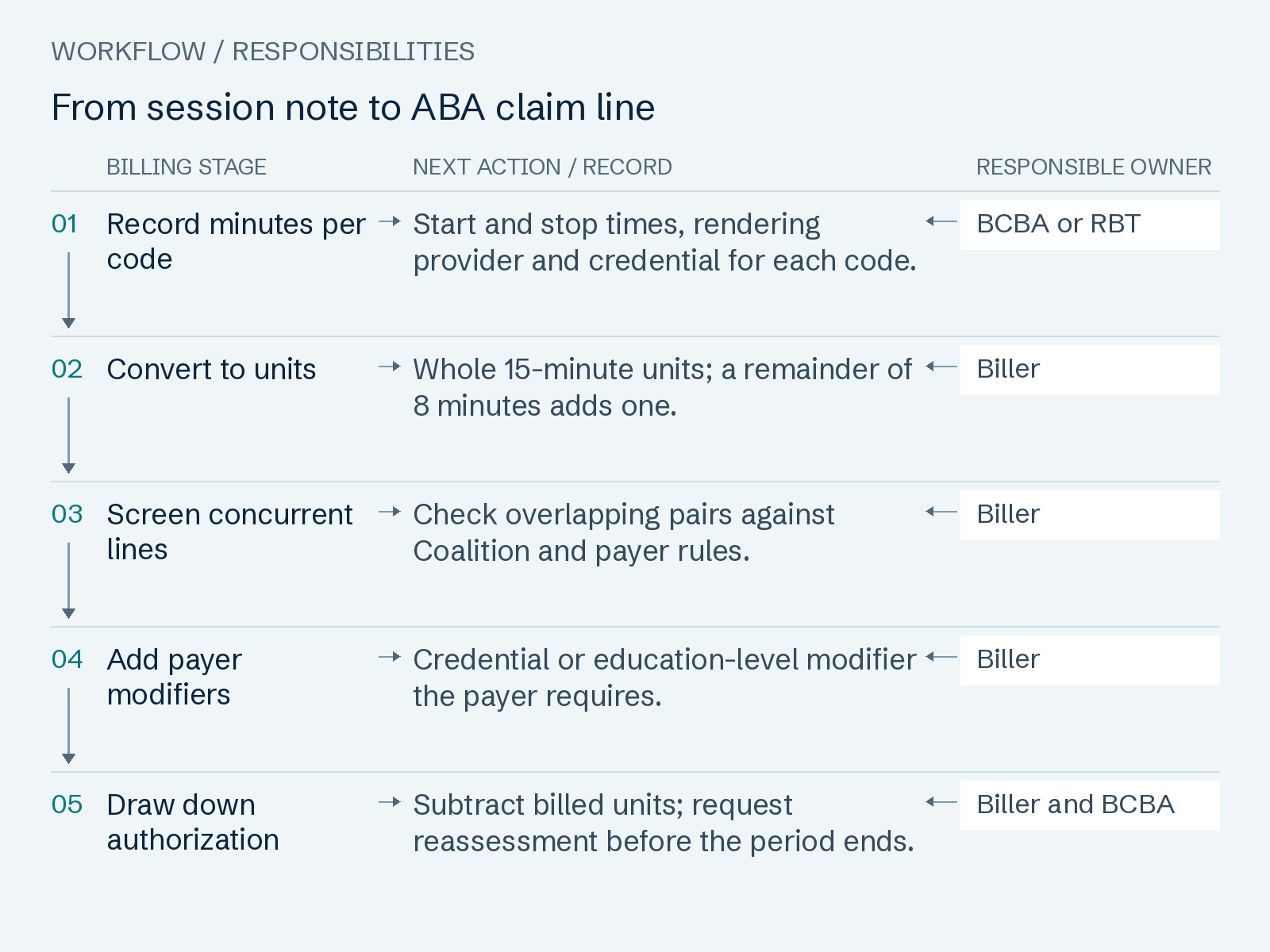
Read the workflow as text
- Record minutes per code — Start and stop times, rendering provider and credential for each code. Owner: BCBA or RBT.
- Convert to units — Whole 15-minute units; a remainder of 8 minutes adds one. Owner: Biller.
- Screen concurrent lines — Check overlapping pairs against Coalition and payer rules. Owner: Biller.
- Add payer modifiers — Credential or education-level modifier the payer requires. Owner: Biller.
- Draw down authorization — Subtract billed units; request reassessment before the period ends. Owner: Biller and BCBA.
Supervision and protocol modification: 97155 and 97158
97155 is the QHP's face-to-face code for adjusting a protocol or directing the technician during a session. The Coalition calls this "direction" and keeps it apart from general supervision of staff, which CPT codes do not pay for. Two rules decide whether it pays. First, the patient must be present: the Coalition FAQ says supervising a technician without the patient present cannot be billed with these codes, and the 2027 crosswalk notes that directing a technician without the client present was not separately reportable in the 2019 code set. Second, the Coalition says a single QHP may not report 97155 at the same time as their own 97153 or 97154.
From 2027, the work splits. QHP one-to-one treatment moves to 97173, and 97155 keeps the direction-of-technician role with revised wording. Directing or training a technician on protocols without the patient present moves to the non-face-to-face section of the crosswalk, reported with 97180, the new weekly code.
97158 is group treatment led by the QHP rather than a technician. The Coalition says it is meant for QHP-led group sessions only, which is why it is never billed alongside 97154 for the same group. When the BCBA runs the group, bill 97158; when a technician runs it, bill 97154.
Family guidance: 97156 and 97157
97156 is the QHP training a patient's caregivers, with or without the patient in the room. Who counts as a caregiver is the payer's call: the Coalition FAQ says immediate family is almost always covered and some payers also accept others, such as babysitters or teachers. The Coalition also says 97156 can be reported while the patient receives direct treatment from another provider, because the two are separate services to different people.
97157 is the QHP leading a group of caregivers from several families, without the patients present. Report it for each set of caregivers who attend, so two parents from one family are one line, not two.
Who can bill each code: BCBA, BCaBA, RBT
The CPT codes name two roles, not credentials: the physician or other qualified health care professional (QHP) and the technician. The Coalition's 2027 crosswalk defines a QHP to include licensed behavior analysts and licensed assistant behavior analysts, BCBA-D, BCBA and BCaBA certificants, and other professionals whose scope of practice includes ABA. The Behavior Analyst Certification Board describes the RBT as a paraprofessional certification whose holders practice under the direction and close supervision of a responsible supervisor, which is why RBTs deliver the technician codes.
Who appears on the claim is a separate question, set by each payer. Some payers credential each BCBA and bill under their own NPI; others bill everything under a supervising analyst and use a modifier to show who actually rendered the service. Your ABA insurance credentialing setup decides which of those you can use with each plan.
Can a BCaBA bill the QHP codes?
It depends on the payer. The Coalition's FAQ list of possible QHPs for the current codes names licensed behavior analysts, BCBAs, BCBA-Ds and other licensed professionals, but not BCaBAs; its 2027 crosswalk adds BCaBAs and licensed assistant behavior analysts to the QHP definition. Montana Medicaid lets a BCaBA deliver 97151 and 97155 with modifier TC and bills every ABA service, including RBT services, under the BCBA's NPI. Read the payer's ABA policy before you assign a BCaBA to assessment or protocol work.
| Credential | Role in the code set | Codes usually delivered | Payer check before billing |
|---|---|---|---|
| BCBA or BCBA-D | QHP | 97151, 97155, 97156, 97157, 97158; may substitute on 97153 | Individual enrollment, or billing under the agency or a supervisor |
| Licensed behavior analyst | QHP | Same as BCBA | Some states enroll only the licensed analyst as the rendering provider |
| BCaBA or licensed assistant | QHP in the 2027 crosswalk; not named in the FAQ for current codes | QHP codes where the payer allows | Payer may require a modifier or bill under the supervising BCBA |
| RBT or other technician | Technician | 97152, 97153, 97154; with a QHP on site, 0362T and 0373T | Whose NPI goes on the claim, and which credential modifier |
Units, concurrent billing and daily caps
Every ABA code bills in 15-minute units. The Coalition applies the CPT time rule: 8 to 22 minutes of work is one unit, and under 8 minutes is not reportable. Count each code's minutes separately, from the start and stop times in the session note, then convert:
- Add up the face-to-face minutes for one code on one date of service (97151 may also include its non-face-to-face minutes).
- Divide by 15 and keep the whole units.
- Add one more unit if 8 or more minutes remain.
- Check the result against the units left on the authorization and the payer's daily cap before the claim goes out.
Worked example (illustration only): an RBT delivers 97153 from 2:00 to 4:50 p.m., 170 minutes. Eleven units cover 165 minutes; the 5 minutes left are under 8, so the line is 11 units, not 12. Session notes that record only a time block, without minutes per code, leave the biller guessing; writing ABA session notes that support each unit removes the guesswork.
Which ABA codes can be billed at the same time?
Concurrent billing means two codes for the same patient in overlapping minutes. The Coalition allows some pairs when two different people deliver them and bars others outright. Payer policy can be stricter than the matrix below, so treat it as the ceiling, not the floor.
Do payers cap ABA units per day?
Many do. Aetna Better Health of New Jersey, a Medicaid plan, says that from January 1, 2024 it denies 97151, 97153 or 0373T above 32 units per code per day; 97155 above 24 units; 97154 above 18 units; and 97152, 97156, 97157, 97158 or 0362T above 16 units per code per day. Other plans cap total hours or authorize units by period instead. If your agency also bills telehealth, note that all ten ABA codes are on CMS’s CY 2026 list of Medicare telehealth services; commercial and Medicaid telehealth rules for ABA vary by payer and state law, the Coalition says.
| Code pair (same patient, same minutes) | Allowed? | Condition (ABA Coding Coalition FAQ) |
|---|---|---|
| 97153 (technician) + 97155 (QHP) | Yes | Two different people: the QHP directs, the technician treats |
| 97153 + 97155, both by one QHP | No | A single QHP may not report both concurrently |
| 97154 + 97155, both by one QHP | No | A single QHP may not report both concurrently |
| 97154 + 97158, same group | No | 97158 is for QHP-led groups only |
| 0373T + 97155 | No | QHP direction is bundled into 0373T |
| 97156 (caregivers) + 97153 (patient) | Yes | Separate services to different people by different providers |
| 97152 + separate QHP line for directing it | No | QHP work for 97152 is bundled into 97152 |
Modifiers and state Medicaid variations
The CPT codes say what was done; modifiers tell the payer who did it. The Coalition's crosswalk lists the education-level modifiers commonly used with ABA codes: HM (high-school education), HN (four-year degree), HO (master's degree) and HP (doctoral degree). Payers map them to credentials differently, and some use other modifiers entirely, so the same RBT session can need a different modifier for each plan you bill.
State Medicaid programs add the most variation, because each state decides who enrolls, whose NPI goes on the claim and how units are authorized. Three samples show how far apart the rules sit:
Texas: the analyst is the rendering provider
Texas rule 1 TAC §354.5011 says the enrolled licensed behavior analyst serves as the Medicaid rendering provider for all ABA evaluation, treatment and supervision services, and that the person who actually rendered each service (analyst, assistant or behavior technician) may or must, as applicable, be shown on the claim with an appropriate Medicaid modifier.
Montana: one NPI, a TC modifier and a unit package
Montana Medicaid’s ABA fee schedule (effective July 1, 2025) says all services are billed under the BCBA's NPI, including services by an intermediate professional or RBT, and that BCaBA work on 97151 and 97155 carries modifier TC. It lists an authorization package of 1,260 units of service for all procedure codes, to be used over 180 calendar days.
Before the first claim to any Medicaid program or plan, confirm four things in its ABA manual: who enrolls, the modifier for each credential, the unit or hour caps, and the authorization period. A reassessment sent after the period ends leaves sessions without units to bill, so authorization tracking belongs in the same workflow as coding.
When should an ABA agency hand off this work?
If unit, overlap and modifier errors keep coming back, the gap is usually process: nobody screens overlapping lines or owns the authorization ledger. Our ABA therapy billing service runs those checks on every claim, from the signed session note to the posted payment. For the bigger picture, what ABA billing involves end to end sets out each step. A free billing audit shows where your current claims stand.
| Program (source) | Who bills | Credential signal on the claim | Unit rule |
|---|---|---|---|
| Texas Medicaid (1 TAC §354.5011) | Enrolled licensed behavior analyst is the rendering provider | Medicaid modifier for the actual renderer (LBA, LaBA or BT) | Set by the state's ABA policy |
| Montana Medicaid (fee schedule, July 1, 2025) | All services under the BCBA's NPI | Modifier TC for BCaBA on 97151 and 97155 | 1,260 units across all codes per 180 days |
| Aetna Better Health of New Jersey (notice, Jan 1, 2024) | ABA provider | Not stated in the notice | Daily caps per code: 16 to 32 units |
Common questions
- What are the CPT codes for ABA therapy?
- Through December 31, 2026, ABA therapy uses ten codes: 97151 and 97152 for assessment, 97153 and 97154 for technician treatment, 97155 and 97158 for QHP treatment and direction, 97156 and 97157 for caregiver guidance, and 0362T and 0373T for severe harmful behavior. From January 1, 2027, the Coalition's crosswalk adds 97148, 97149, 97159, 97160, 97173 and 97180 and deletes the two T codes.
- Which ABA codes can an RBT bill?
- An RBT delivers the technician codes: 97152, 97153 and 97154, and, as one of two or more technicians with a QHP on site, 0362T and 0373T. Whether the RBT's own NPI goes on the claim depends on the payer: Montana Medicaid, for example, bills RBT services under the BCBA's NPI, and Texas Medicaid names the licensed analyst as the rendering provider.
- Can ABA codes be billed concurrently?
- Some pairs can, when two different people deliver them. A technician's 97153 and a QHP's 97155 can cover the same minutes, and 97156 with caregivers can run while the patient receives 97153. The Coalition FAQ bars one QHP from billing 97153 or 97154 together with 97155, bars 97154 with 97158, and bundles 97155 into 0373T. Payer policy can be stricter.
- Are ABA codes timed?
- Yes. Every ABA code is billed per 15 minutes. Under the CPT time rule the Coalition applies, 8 to 22 minutes is one unit and less than 8 minutes is not reportable. Only 97151 counts non-face-to-face time; for every other code, count face-to-face minutes only.
- What CPT codes can a BCBA bill?
- A BCBA bills the QHP codes: 97151, 97155, 97156, 97157 and 97158. When a BCBA runs a technician's protocol without changing it, the Coalition says to bill 97153 with a modifier for the higher-level provider. From January 1, 2027, BCBA one-to-one treatment moves to 97173 and weekly non-face-to-face work can be billed as 97180.
- Does Medicare pay a set rate for ABA codes?
- No. All ten ABA codes are status C (contractor-priced) in the CMS CY 2026 physician fee schedule file, so there is no 2026 national Medicare amount (unadjusted). Commercial, Medicaid and TRICARE rates come from each payer's own contract or fee schedule. All ten codes are on CMS's CY 2026 Medicare telehealth list.
Sources and review
Page revised November 5, 2026 · Review contact: Hyder Shah (inquiries@claimpillar.com). Every source below was retrieved and checked on November 5, 2026. Medicare status comes from our dataset built on the CMS CY 2026 PFS relative value file (RVU26D); actual ABA payment is set by each payer's contract or fee schedule. Payer and state rules apply only to the program named.
- ABA Coding Coalition: Frequently Asked Questions (time rule, concurrent billing, 0373T units), retrieved 2026-11-05
- ABA Coding Coalition: Billing Codes (codes effective January 1, 2027), retrieved 2026-11-05
- ABA Coding Coalition: 2027 Coding Crosswalk and letter (September 11, 2026), retrieved 2026-11-05
- CMS: List of Telehealth Services (CY 2026 final list), retrieved 2026-11-05
- Behavior Analyst Certification Board: Registered Behavior Technician, retrieved 2026-11-05
- Montana Medicaid: Applied Behavior Analysis Services Fee Schedule (July 1, 2025), retrieved 2026-11-05
- 1 Tex. Admin. Code §354.5011, Providers of ABA Services (Cornell LII), retrieved 2026-11-05
- Aetna Better Health of New Jersey: Medicaid provider notice, ABA unit limits (January 1, 2024), retrieved 2026-11-05