ABA billing in plain English
Running an ABA agency? This guide explains how ABA billing works. If you would rather hand it off, our ABA therapy billing services run your claims from session note to posted payment, track authorized units and work denials for 7.5% to 8.5% of insurance payments.
ABA billing turns the hours your BCBAs and technicians spend with a child into paid insurance claims. ABA stands for applied behavior analysis; in medical billing, the term covers the adaptive behavior services that the CPT code set describes in codes 97151 to 97158. The ABA Coding Coalition, the group that writes the coding guidance behavior analysts and payers use, publishes how those codes are meant to be reported.
An ABA claim differs from a typical therapy claim in three ways that matter to an agency owner:
- It is built from minutes, not visits. Every code is time-based, so a claim line is a count of 15-minute units.
- Several people bill for one child. A BCBA assesses and directs, technicians deliver most treatment, and caregivers are trained. Each of those services has its own code and its own rules about who can render it.
- The plan of care is paid in advance by authorization. The payer approves codes and units for a period, and your claims draw them down.
The ABA claim lifecycle
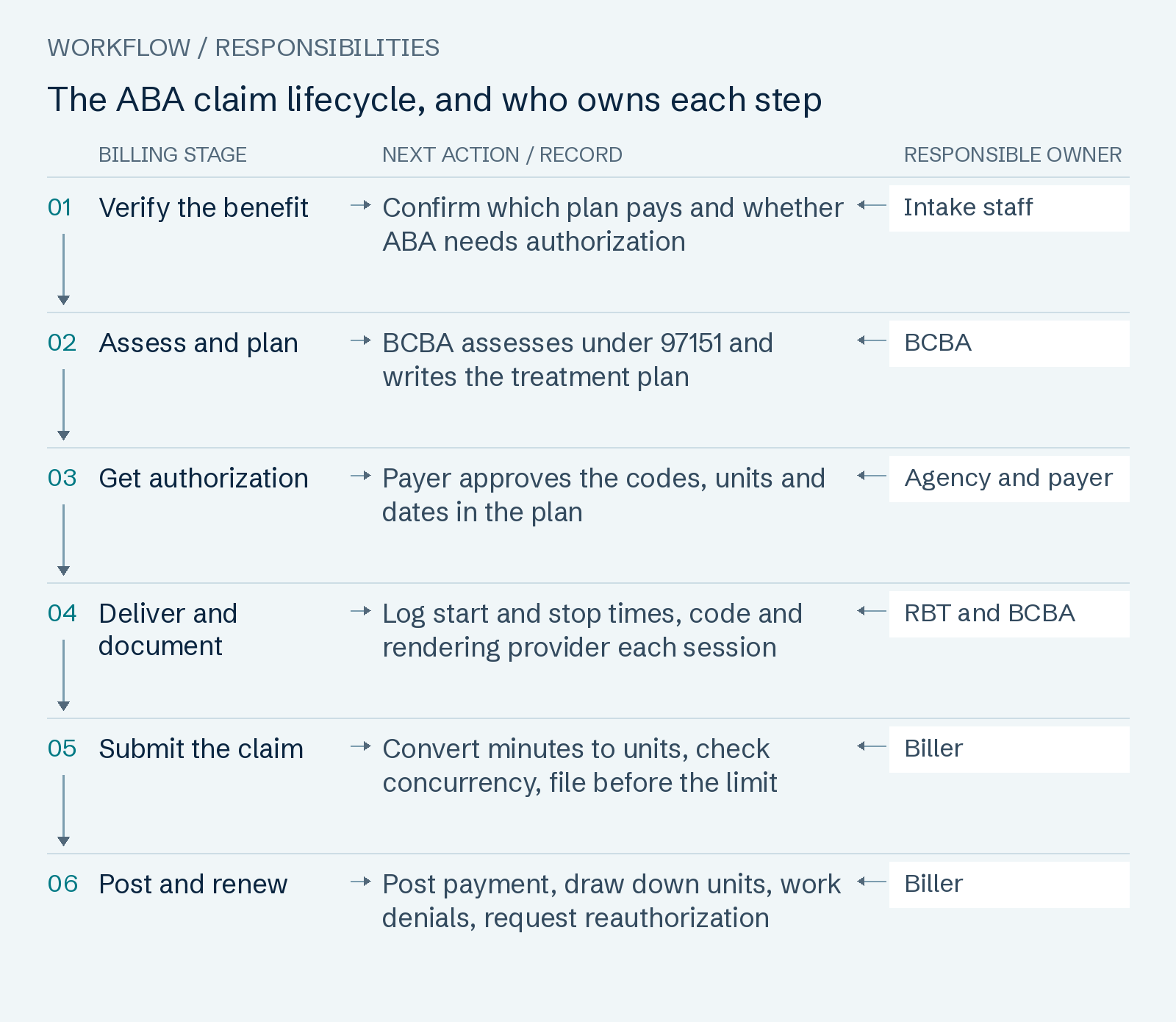
A claim starts before the first session and ends only when the payment is posted and the units are subtracted from the authorization. The figure shows the six steps and who usually owns each one inside an agency. A mistake in the first three steps usually shows up only later, as a denial on a claim that was already sent.
Read the workflow as text
- Verify the benefit — Confirm which plan pays and whether ABA needs authorization Owner: Intake staff.
- Assess and plan — BCBA assesses under 97151 and writes the treatment plan Owner: BCBA.
- Get authorization — Payer approves the codes, units and dates in the plan Owner: Agency and payer.
- Deliver and document — Log start and stop times, code and rendering provider each session Owner: RBT and BCBA.
- Submit the claim — Convert minutes to units, check concurrency, file before the limit Owner: Biller.
- Post and renew — Post payment, draw down units, work denials, request reauthorization Owner: Biller.
Who pays for ABA: Medicaid, commercial, TRICARE
Who pays decides almost every billing rule your agency follows: who enrolls, what modifiers go on the line, how long authorizations run and how long you have to file.
Medicaid
Medicaid is the payer for many children in ABA. A July 7, 2014 CMS informational bulletin reminds states that, for individuals eligible for the EPSDT benefit (children and adolescents under 21), they must cover any Medicaid-coverable service that is medically necessary to correct or ameliorate a physical or behavioral condition. The bulletin sets the coverage duty, not the claim rules: enrollment, authorization and unit limits come from each state's Medicaid program and its managed care plans.
Commercial plans
Commercial plans write their own ABA policies. The Coalition notes that payer policy decides who counts as a caregiver for 97156 and how often reassessments happen, so two plans can pay the same session under different conditions.
TRICARE
TRICARE pays for ABA through the Comprehensive Autism Care Demonstration (ACD), not its basic medical benefit. The 2022 Federal Register notice extending the demonstration says it covers ABA services for TRICARE-eligible beneficiaries diagnosed with autism spectrum disorder and continues through December 31, 2028. TRICARE's East and West regional contractors both state a one-year limit for filing claims after the date of service.
| Payer type | Who it covers for ABA | Where the billing rules come from | What to watch on the claim |
|---|---|---|---|
| State Medicaid | Children under 21 eligible for EPSDT, when ABA is medically necessary | The state's Medicaid manual and each managed care plan | Which clinicians must enroll; in Texas only the licensed behavior analyst's own NPI bills |
| Commercial plans | Members whose plan covers ABA | Each plan's ABA policy and your contract | Caregiver definition, reassessment frequency and provider-level modifiers vary by plan |
| TRICARE (ACD) | TRICARE-eligible beneficiaries diagnosed with autism | The Autism Care Demonstration rules and the regional contractor | One-year filing limit; the demonstration currently runs through December 31, 2028 |
| Medicare | Medicare beneficiaries | CMS and the Medicare contractor | 97151-97158 are contractor-priced in the 2026 fee schedule, with no national amount |
The ABA code set 97151-97158
The ABA code set has eight CPT codes, 97151 to 97158, plus two Category III codes for severe harmful behavior, 0362T and 0373T, in use through December 31, 2026. The table gives our own short labels, not the AMA descriptors, with who delivers each service and the Coalition rule that most often decides payment. Our ABA billing codes guide covers each code in depth, and the technician one-to-one treatment code has its own page on CPT 97153.
Medicare publishes no national amount for these codes: in the CY 2026 physician fee schedule file (RVU26D) from the CMS relative value files page, 97151 to 97158 all carry status C, contractor-priced. Your rates come from each Medicaid fee schedule, commercial contract and TRICARE.
What changes on January 1, 2027
The Coalition's 2027 code crosswalk (September 11, 2026) says the AMA added six new codes, revised 97151 to 97158 and permanently deleted the T codes, replacing them with Category I codes. The new set on the Coalition's codes page takes effect January 1, 2027. For an agency, three changes reach the claim: harmful-behavior work moves to 97148 with add-on 97149 (assessment) and 97159 with add-on 97160 (treatment); a BCBA's own one-to-one treatment gets code 97173; and BCBA non-face-to-face work gets code 97180, which the crosswalk says may be reported once per week by summing the prior seven days. Payer contracts and authorizations will need to reflect the new numbers before your first 2027 session.
| Code | Our short description | Who delivers it | Rule that decides payment |
|---|---|---|---|
| 97151 | BCBA assessment and treatment plan | BCBA or other QHP | The only current code that counts non-face-to-face time |
| 97152 | Supporting assessment run by a technician | Technician | Reported for the technician's face-to-face time |
| 97153 | One-to-one treatment following the written protocol | Technician (QHP may substitute) | A BCBA cannot bill 97155 for the same minutes as their own 97153 |
| 97154 | Protocol treatment for a small group | Technician | A group is 2 to 8 patients |
| 97155 | BCBA protocol changes and technician direction | BCBA or other QHP | Can run alongside a technician's 97153 when both codes' criteria are met |
| 97156 | Caregiver training for one family | BCBA or other QHP | Payer policy defines who counts as a caregiver |
| 97157 | Caregiver training for several families | BCBA or other QHP | Group caregiver session led by the QHP |
| 97158 | BCBA-led group treatment | BCBA or other QHP | Not reported alongside 97154 for the same group |
| 0362T, 0373T | Harmful-behavior assessment and treatment, two-plus technicians | Technicians, QHP on site | Replaced by 97148/97149 and 97159/97160 on January 1, 2027 |
Units, time and concurrent billing
Every ABA claim line is a calculation, so the unit count is where a session's minutes either become payable or do not. The Coalition's FAQ states that all codes use 15-minute units and applies the CPT time rule: work lasting 8 to 22 minutes is one unit, and work under 8 minutes is not reportable.
Illustrative example, not client data: a technician delivers one-to-one treatment from 2:00 to 4:50 p.m., which is 170 minutes. Eleven units cover 165 minutes. The 5 minutes left are under the 8-minute threshold, so the line is 11 units of 97153, not 12.
Which time counts
Only face-to-face time counts, with one exception. The Coalition says 97151 is the only code in the current set that allows non-face-to-face time, such as scoring assessments and writing the treatment plan. It also notes that some payers add their own codes for indirect work, naming H0032, G9012 and H2019 as examples, so check each contract before assuming that time is unpaid.
Concurrent billing
Concurrent billing means two codes for the same child in the same minutes, and it is allowed only in set pairings. Per the Coalition:
- A BCBA directing a technician can bill 97155 while the technician bills 97153, as long as both codes' criteria are met.
- A single BCBA may not bill 97153 and 97155 for the same time, or 97154 and 97155.
- 97158 is for BCBA-led groups only and is not reported alongside 97154.
Each payer can add its own limits on top of these pairings, such as modifiers that show whether the child was present, so read the plan's ABA policy before your first concurrent claim.
Credentialing BCBAs and RBTs
ABA credentialing decides whose NPI can appear on the claim, and payers answer that question differently. The TMHP guide is a clear example: in Texas Medicaid, only the licensed behavior analyst enrolls, and the LBA's individual NPI is both the rendering and the billing provider. An employer's NPI may not be used in either role. Assistant behavior analysts and behavior technicians (who must be RBTs, BCATs or ABATs) are authorized, not enrolled, and work under the LBA's direct supervision.
Commercial networks have their own paperwork. Optum's page for ABA providers says CAQH participation is required in most states to join its network, and lists incomplete or expired CAQH profiles, mismatched group or location details and unsigned W-9s or wrong tax IDs among the application problems its audit found.
The practical rule for an owner: no new BCBA or technician sees a funded client until you know, payer by payer, whether that person must be enrolled, and the enrollment is active. Our ABA insurance credentialing page covers how we file agency and BCBA applications.
Common ABA billing mistakes
Most ABA billing mistakes come from the rules above, applied one claim at a time. These are the ones to check first when payments slow down:
- Billing under the wrong NPI. Claims sent under the agency's NPI where the payer pays only the enrolled analyst, as in Texas Medicaid, are not reimbursed.
- Rounding units up. A remainder under 8 minutes adds no unit; billing it overstates the line.
- Pairing codes the Coalition rules out. The same BCBA billing 97153 and 97155 for the same minutes, or 97154 with 97158.
- Counting indirect time. Notes and data review outside 97151 are not billable unless the payer adds a code for them, until code 97180 takes effect on January 1, 2027.
- Running past the authorization. Sessions delivered after the units or end date are used up.
- Missing provider-level modifiers. The Coalition's crosswalk lists HM, HN, HO and HP, which mark the rendering provider's education level, as modifiers commonly used with these codes; a plan that requires one denies the line without it.
- Lapsed enrollment. An expired CAQH profile or an inactive provider record stalls every claim for that clinician.
- Filing late. TRICARE allows one year, but Medicaid plans can allow far less: UnitedHealthcare Community Plan of Texas requires claims within 95 days of the service date. The Medicaid plan limits in our timely filing table show the rest.
Each of these leaves a trace in your aging report: claims stuck on one payer, one clinician or one code.
In-house vs outsourced ABA billing
In-house ABA billing works when someone on staff has the hours and knows these rules for every payer you take; outsourcing fits when the units ledger, the concurrency checks and the denial follow-up keep slipping behind clinical work. Either way, the billing software is a separate decision: the comparison of ABA billing software and an ABA billing service sets out what each covers, and our guide to in-house or outsourced billing covers the general trade-off.
If you hand it off, our ABA therapy billing service takes each claim from the signed session note to the posted payment, keeps the unit ledger against each authorization and works every denial. The rate is 8.5% for 1 clinician, 8.0% for 2–5 clinicians and 7.5% for 6–15 clinicians, of insurance payments, and 0% of what families pay you; see our pricing for the full rate card.
Not sure where your claims stand? Start with The Free A/R Deadline Map: A claim-by-claim list of every unpaid insurance claim over 90 days in the aging report you send: payer, amount, the deadline it faces, the denial reason and the next action, sorted by deadline. It arrives in 5 business days. Clock starts with your claim-level aging export and signed BAA; above 10 requests in a week, we confirm your date within 1 business day. Get my free A/R Deadline Map.
Common questions
- What is ABA billing?
- ABA billing is how an applied behavior analysis agency gets paid by insurance for autism treatment. The agency verifies the child's benefit, gets an authorization for the treatment plan, bills each session in 15-minute units under codes 97151 to 97158, and files claims with Medicaid, a commercial plan or TRICARE.
- What does ABA mean in medical billing?
- In medical billing, ABA means applied behavior analysis, which the CPT code set calls adaptive behavior services. It covers the assessment, technician treatment, BCBA direction and caregiver training billed under 97151 to 97158, plus two harmful-behavior codes that are replaced on January 1, 2027.
- How is ABA therapy billed to insurance?
- ABA therapy is billed in 15-minute units of face-to-face time: 8 to 22 minutes counts as one unit, according to the ABA Coding Coalition. Each line carries the code, the units and the rendering provider the payer requires, and it must fit inside the child's authorization.
- What is the most common ABA billing code?
- 97153, one-to-one treatment by a technician following the BCBA's written protocol, is the code for the day-to-day treatment sessions in an ABA program. We found no published all-payer count ranking the codes. Our 97153 guide covers its rules.
- Does TRICARE cover ABA?
- Yes. TRICARE covers ABA for TRICARE-eligible beneficiaries diagnosed with autism spectrum disorder through its Comprehensive Autism Care Demonstration, which a 2022 Federal Register notice extended through December 31, 2028. Claims fall under TRICARE's one-year filing limit.
- How do I outsource my ABA billing?
- Pull an aging report first so you know which claims are near a deadline, then give the billing company read access to your practice management system, your payer contracts and each child's authorization. Our ABA billing service starts from that handoff; The Free A/R Deadline Map is a free first step. Clock starts with your claim-level aging export and signed BAA; above 10 requests in a week, we confirm your date within 1 business day.
Sources and review
Page revised November 5, 2026 · Review contact: Hyder Shah (inquiries@claimpillar.com). Every source below was retrieved on November 5, 2026. Payer rules apply to the payer and program named; your contract, the child's plan or state law can set different rules. Code labels are our own, not AMA descriptors.
- ABA Coding Coalition: Frequently asked questions
- ABA Coding Coalition: Adaptive behavior services codes (effective January 1, 2027)
- ABA Coding Coalition: 2027 CPT code crosswalk (September 11, 2026)
- Federal Register: Extension of the Comprehensive Autism Care Demonstration (August 4, 2022)
- CMS: CMCS Informational Bulletin on services for individuals with autism spectrum disorder (July 7, 2014)
- TMHP: Licensed behavior analyst enrollment in Texas Medicaid
- Optum Provider Express: ABA providers
- CMS: PFS relative value files (RVU26D)