What ABA billing software does, and what it doesn't do for your agency
ABA billing software is the system your agency records sessions, authorizations and claims in. Most ABA platforms bundle billing with scheduling, data collection and payroll. AlohaABA’s pricing page, for example, lists billing, scheduling, payroll, authorization management, a client portal, accounts receivable and reports in its practice-management plan.
The software does the counting and the formatting. It turns a signed session note into claim lines, holds each client's authorized units and dates, sends claims to your clearinghouse and shows what is unpaid. What it does not do is decide or chase. Someone on your team still has to read each denial, fix the claim or write the appeal, call the payer about a claim that has sat for 45 days, and notice that a client's units will run out before the renewal is approved.
The billing work that stays with your staff when you buy software
- Correcting rejected claims and resubmitting them.
- Reading remittances and posting payments, or checking the auto-posted ones.
- Working denials and writing appeals.
- Following up unpaid claims with each payer before the filing limit passes.
- Billing families for copays and coinsurance.
The Bureau of Labor Statistics expects that "automated invoice processing software will increase the productivity" of billing and posting clerks (BLS Occupational Outlook Handbook). Productivity is the right word: software makes each biller faster, but someone on your team still does the work.
| Billing task | ABA billing software | Who still does it |
|---|---|---|
| Turn session minutes into 15-minute units | Calculates from the times in the note | Your staff checks notes missing start or stop times |
| Track authorized units and end dates | Holds the balance and can warn you | Your staff acts on the warning |
| Create and send claims | Builds claim lines and sends a batch | Your staff reviews edits and sends |
| Post payments | Imports electronic remittances | Your staff matches and posts exceptions |
| Work denials and appeals | Lists denied lines | Your staff corrects, resubmits or appeals |
| Follow up unpaid claims | Shows an aging report | Your staff calls or messages each payer |
What an ABA billing service adds: people, follow-up and guarantees
An ABA billing service adds the labor and the accountability. The team does the tasks in the right-hand column of the table above, on deadlines written into the contract, and answers for the result each month.
Our ABA billing service covers Claim creation and scrubbing, submission, payment posting, denial work and appeals, insurance A/R follow-up, eligibility checks for new patients and changed coverage, authorization expiry tracking, coding checks against your documentation, patient balances calculated and statements sent in your practice's name, and a KPI report with written definitions by the 10th of each month.
Deadlines and guarantees in writing
Software has no stake in whether a claim pays. A service contract can. Ours carries two guarantees on the terms below:
- On-Our-Watch Guarantee. If a claim misses a filing, corrected-claim or appeal deadline while it is on our watch, we pay you what it would have paid. Claims we get complete 10+ business days before the deadline; contracted rate less any copay you collected, paid automatically within 30 days of final denial; capped $10,000/month; your holds excluded.
- Clock-or-Credit Guarantee. From go-live, every new claim goes out within 1 business day of complete charge data, and every denial is worked within 2 business days of posting — or $25 comes off your invoice for each late one. Mon–Fri ET business days by your system's timestamps; worked: resubmitted, appealed or returned with the fix; auto-credited; capped at monthly fee; clearinghouse outages excluded.
A service also covers what an in-house seat cannot: vacations, sick days and the weeks after a biller resigns. When a single biller leaves, claims stop going out while filing clocks keep running. Our in-house vs outsourced billing cost model prices that gap for any practice; the sections below apply it to an ABA agency.
Cost comparison: subscription plus staff vs 7.5%–8.5% of insurance payments
The software subscription is usually the smaller line. The larger one is the person who runs it. BLS puts the median billing and posting clerk wage at $48,500 a year (May 2025), about $4,042 a month. Wages were 70.0% of private-industry employer compensation costs in June 2026, with benefits the other 30.0% (BLS Employer Costs for Employee Compensation). Dividing the wage by that share gives a loaded cost of about $5,774 a month. That is an illustration from national figures; use your own payroll.
Software prices vary in how they count. AlohaABA publishes $29.99 per staff member per month for practice management, and separate per-client pricing for data collection, sold only with its practice-management plan (AlohaABA pricing, retrieved 2026-11-05). CentralReach publishes no price and routes visitors to a consultation. Rethink Behavioral Health's pricing page says pricing varies with the number of users, modules and services (both retrieved 2026-11-05). Get a written quote that counts your RBTs as well as your BCBAs.
Our ABA rate is 8.5% for 1 clinician, 8.0% for 2–5 clinicians and 7.5% for 6–15 clinicians, of insurance payments. Clinicians are counted on the 1st of each month from the rendering NPIs we billed the month before (for ABA, BCBAs and BCaBAs, not RBTs). Your rate moves with your size band the next month, in either direction. We take 0% of what families pay you. Invoices 1–3: only percentage fees on that month's insurance payments, plus any statements or add-ons you order. Percentage fees and mailed statements are capped at 9.0% of that month's insurance payments; from invoice 4, the $400 minimum applies even in a month when the cap comes to less. The full ABA row sits on our rate card by specialty and agency size.
Medicaid claims and percentage fees
Many ABA agencies bill Medicaid. Federal Medicaid rules let a state pay a billing service that receives payments in the provider's name only if its pay is not a percentage of the amount billed or collected (42 CFR 447.10(f)). Every payment goes straight to your practice's own bank account. We never receive, deposit or endorse your payments; we invoice you once a month. Where a state Medicaid program does not let a billing company charge a percentage, we bill your Medicaid claims at a flat fee per claim, agreed in writing before we start.
| Monthly cost line | Software plus in-house biller | Billing service working in your software |
|---|---|---|
| ABA software subscription | Yes: vendor's price for your staff or client count | Yes: you keep paying your vendor |
| Clearinghouse fees | Yes | Yes: paid to your clearinghouse |
| Biller wage and benefits | About $5,774 a month at the national loaded estimate | None |
| Cover for vacations, sickness and turnover | Overtime, temps or claims left unworked | No separate cost to you |
| Service fee | None | 7.5%–8.5% of insurance payments |
| In a slow month | Payroll stays the same | Fee falls with payments; $400 minimum from your 4th monthly invoice |
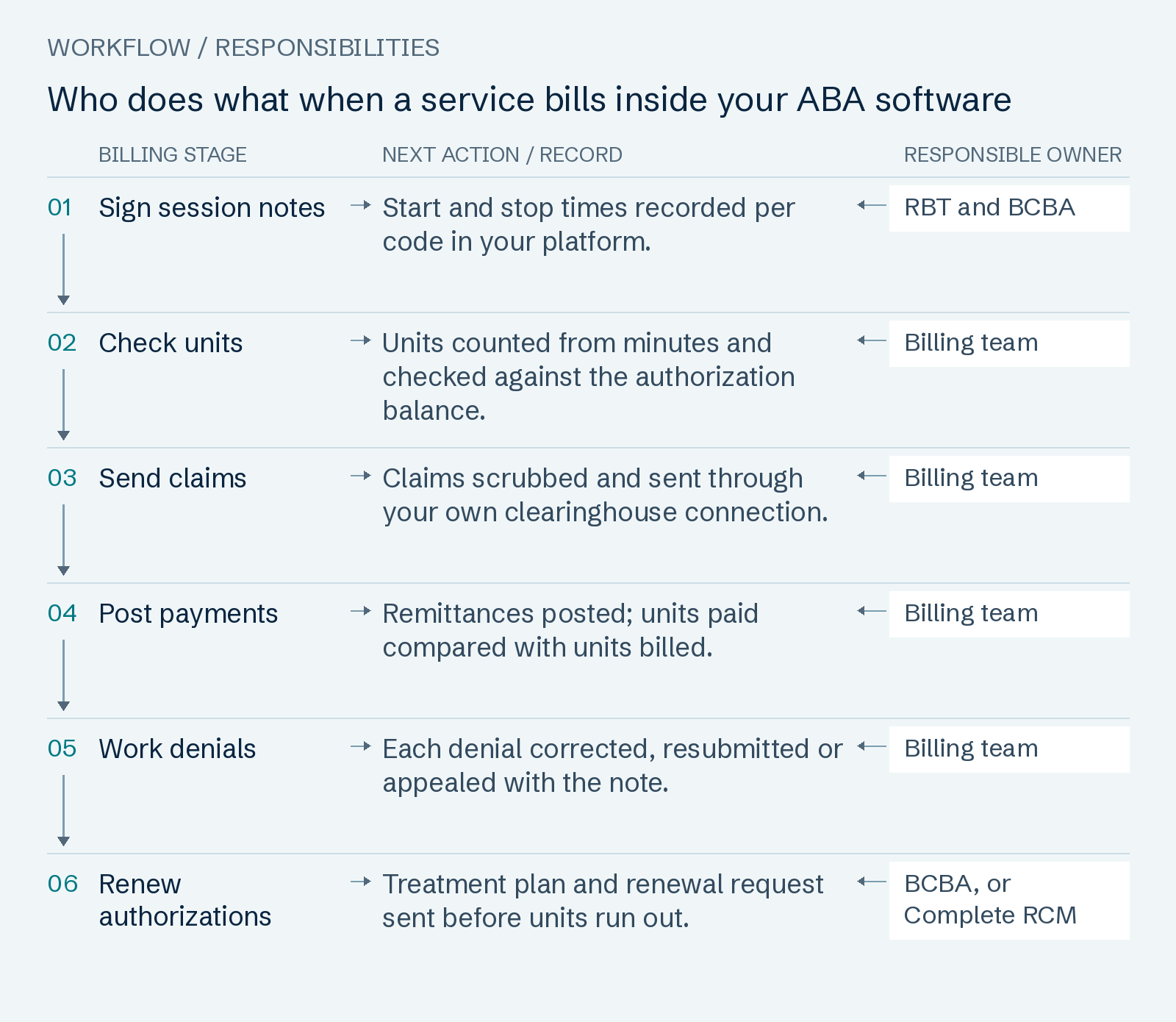
Read the workflow as text
- Sign session notes — Start and stop times recorded per code in your platform. Owner: RBT and BCBA.
- Check units — Units counted from minutes and checked against the authorization balance. Owner: Billing team.
- Send claims — Claims scrubbed and sent through your own clearinghouse connection. Owner: Billing team.
- Post payments — Remittances posted; units paid compared with units billed. Owner: Billing team.
- Work denials — Each denial corrected, resubmitted or appealed with the note. Owner: Billing team.
- Renew authorizations — Treatment plan and renewal request sent before units run out. Owner: BCBA, or Complete RCM.
Using both: a billing service inside your ABA software
Most agencies don't choose between software and a service. They keep the software and change who works in it. Your RBTs keep collecting data and signing notes in the platform they know; the billing team logs in to the same system to send claims and work the results.
The software vendors sell this pairing themselves. CentralReach describes CR BillMax as a team of revenue-cycle experts who manage billing processes inside CentralReach, and AlohaABA's pricing page promotes an all-in-one RCM solution with a free consultation, without a published price (both retrieved 2026-11-05). An independent billing service works the same way inside whichever system you license.
We work inside your existing practice-management system and clearinghouse; tell us which ones and we confirm in writing within 1 business day. Your agency keeps its data-collection and scheduling tools, and your claim history stays in software you hold the contract for. Access starts only after a signed BAA, with named logins; our EHR and practice-management compatibility page lists the access we need. This page names these products as examples only, not because of any partnership with or endorsement by their vendors; each vendor's user roles decide what a billing team can do in your account.
When ABA billing software alone is enough
Software alone is enough when billing is someone's job and that person has backup. Three conditions together make it work:
- A trained biller with protected hours for denials and follow-up, not only for sending claims.
- A second person who can send claims and post payments when the biller is away.
- An aging report under control: few claims over 90 days, and none near a filing limit.
If any of the three is missing, the software holds the problem without solving it. The table sets out common situations.
| Your agency's situation | Option to compare | Check first |
|---|---|---|
| Solo BCBA billing at night after sessions | Billing service in your current software | The monthly minimum against a slow month |
| Experienced biller, trained backup, low aged A/R | Software alone | How denials and appeals are tracked |
| Biller quit or gave notice | Billing service, at least for now | Claims nearest their filing limit go first |
| Sessions run past authorized units | Service with an authorization ledger | Who requests renewals: your BCBA or the service |
| Growing past one biller's workload | Second hire vs service quote | Measured hours, not clinician count |
Break-even example by agency size
Illustrative example, not client data. The break-even is the monthly insurance payment level at which our ABA fee equals the in-house cost it replaces. Because a service working inside your software leaves your subscription and clearinghouse in place, those lines cancel out; the comparison is the biller's cost against the fee.
- Take the monthly in-house cost you would avoid: wage and benefits, plus any overtime or temp cover.
- Divide it by the ABA rate for your size band (a rate of 8% is 0.08).
- Compare the result with your average monthly insurance payments over the last 12 months, leaving out family payments.
The table runs that formula at our rate-card rates for agencies with 1, 5 and 15 BCBAs and BCaBAs, using the national wage and loaded-cost estimates above. Above the break-even, an in-house biller costs less on paper; below it, the service does, before counting backup cover and the claims an empty seat leaves unworked.
Run your own numbers
In the calculator, enter one month of insurance payments as the collections figure and our rate for your size band as the percentage. In the flat-fee field, enter your biller's monthly payroll and benefits, and put overtime or temp cover in its extras; leave the subscription out, because you keep it under both options. The calculator does not apply our $400 minimum, which replaces a lower percentage fee from your 4th monthly invoice. If the gap is close, start with The Free A/R Deadline Map: A claim-by-claim list of every unpaid insurance claim over 90 days in the aging report you send: payer, amount, the deadline it faces, the denial reason and the next action, sorted by deadline. Clock starts with your claim-level aging export and signed BAA; above 10 requests in a week, we confirm your date within 1 business day. To hand billing over, our ABA therapy billing service sets out what we take over and what your agency keeps.
| Agency size (BCBAs and BCaBAs) | Our ABA rate | Break-even vs biller wage only ($4,042/mo) | Break-even vs one loaded biller ($5,774/mo) | Break-even vs two loaded billers ($11,548/mo) |
|---|---|---|---|---|
| 1 | 8.5% | $47,553 a month | $67,929 a month | $135,859 a month |
| 5 | 8.0% | $50,525 a month | $72,175 a month | $144,350 a month |
| 15 | 7.5% | $53,893 a month | $76,987 a month | $153,973 a month |
Common questions
- What is the best ABA billing software?
- No single product is best for every agency, and we do not rank them. Compare on stated criteria: whether billing, authorizations, scheduling and data collection share one system; how the price is counted (per staff member, per client or by quote); and whether the vendor or an outside service can work your claims in it. AlohaABA publishes its practice-management price; CentralReach and Rethink Behavioral Health quote on request (retrieved 2026-11-05).
- Is ABA billing software enough without a biller?
- Rarely. The software counts units, builds claims and shows what is unpaid, but it does not correct rejections, work denials, write appeals or call payers. Someone has to do those tasks every week. If that person is your BCBA after sessions, compare the hours with a service fee at your size.
- How much does an ABA billing service cost?
- Our ABA rate is 8.5% for 1 clinician, 8.0% for 2–5 clinicians and 7.5% for 6–15 clinicians, of insurance payments, with 0% of family payments and $0 setup. Invoices 1–3: only percentage fees on that month's insurance payments, plus any statements or add-ons you order. Percentage fees and mailed statements are capped at 9.0% of that month's insurance payments; from invoice 4, the $400 minimum applies even in a month when the cap comes to less. Other companies' rates and fee bases differ, so compare quotes on the same base. The ABA row of our pricing lists every term.
- Can a billing service work in CentralReach or AlohaABA?
- Yes, in general: CentralReach sells its own managed billing service run within CentralReach, and outside services log in as users of your account. We work inside your existing practice-management system and clearinghouse; tell us which ones and we confirm in writing within 1 business day. What we can do in any platform depends on the user roles your plan allows.
- When should an ABA agency outsource billing?
- When billing has no owner with time and backup: your biller quit, a BCBA bills after hours, sessions keep running past authorized units, or claims over 90 days are piling up. Outsourcing also fits when your payments sit below the break-even for your size. Our ABA billing service for agencies starts from your current software.
- What is the most affordable ABA billing software?
- It depends on how your agency is staffed. A per-staff price grows with every RBT you hire; a per-client price grows with caseload. AlohaABA lists $29.99 per staff member per month for practice management (retrieved 2026-11-05); CentralReach and Rethink do not publish prices. Price the subscription plus the staff hours it needs, not the subscription alone.
Sources and review
Page revised November 5, 2026 · Review contact: Hyder Shah (inquiries@claimpillar.com). Vendor facts come from each company's own pages, retrieved 2026-11-05; prices and products change, so confirm them with the vendor.
- AlohaABA: Pricing (practice management and data collection plans), retrieved 2026-11-05
- CentralReach: home page (no published pricing; Managed Billing product), retrieved 2026-11-05
- CentralReach: CR BillMax managed billing, retrieved 2026-11-05
- Rethink Behavioral Health: Pricing, retrieved 2026-11-05
- ABA Coding Coalition: Frequently Asked Questions (15-minute units, concurrent billing), retrieved 2026-11-05
- Aetna Better Health of New Jersey: Medicaid provider notice, ABA daily unit limits (effective January 1, 2024), retrieved 2026-11-05
- eCFR: 42 CFR 447.10, prohibition against reassignment of provider claims (business agents), retrieved 2026-11-05
- BLS Occupational Outlook Handbook: Financial Clerks (May 2025 wages), retrieved 2026-11-05
- BLS: Employer Costs for Employee Compensation, June 2026, retrieved 2026-11-05