Medicare crossover definition
A Medicare crossover is the automatic hand-off of a processed Original Medicare claim to the payer that pays after Medicare. You send the claim once, to your Medicare Administrative Contractor (MAC). After the MAC adjudicates it, Medicare transmits the claim, with its own payment and adjustment data, to the patient's secondary coverage. Chapter 28 of the Medicare Claims Processing Manual describes this as a post-adjudicative transaction sent through the Benefits Coordination & Recovery Center (BCRC) to "COB trading partners and Medigap plans."
The receiving payers are called COBA trading partners. CMS's COBA trading partners page defines them as issuers of insurance that supplements Medicare, a state agency that runs Medicaid (Title XIX), or a federal agency or its contractor. Clearinghouses and billing services that only route or translate files are not trading partners, so your clearinghouse cannot create a crossover on its own.
For a therapy practice the secondary is usually one of three payers: a Medigap or other supplemental plan, a retiree or other plan that has signed a Coordination of Benefits Agreement, or your state Medicaid program for a client who has both Medicare and Medicaid.
How automatic crossover works (COBA)
Each trading partner signs a Coordination of Benefits Agreement (COBA) with CMS and sends the BCRC one national eligibility file listing the Medicare beneficiaries it covers. That file is loaded into Medicare's Common Working File. When a claim is processed, the Common Working File applies the trading partner's claim selection criteria to claims whose service dates fall inside the coverage dates on file, and tells the MAC which partners should receive it. The BCRC then checks the claim's format and sends it to each partner as an 837 transaction (chapter 28, section 70.6).
Eligibility-file and claim-based crossovers
Most crossovers are eligibility-file based: the secondary payer's file, not anything you typed, decides the match. That includes Medigap insurers that send CMS an eligibility file. The exception is the Medigap claim-based crossover, used when the client has assigned Medigap benefits to a participating provider: the provider enters the CMS-assigned 5-digit Medigap COBA ID in item 9d of the CMS-1500 (or loop 2330B on an electronic 837), and on the current 02/12 form items 9, 9a and 9d must be complete and accurate. The manual states that if a participating provider leaves the ID out, the claim is not transferred to the Medigap insurer.
How you can tell a claim crossed over
Your remittance tells you. Chapter 28 has the MAC name a trading partner and its COBA ID in the crossover loop of the 835 electronic remittance advice (when a client has several, only the first in CMS's sort order is named), and print remark code MA18 when Medigap information was forwarded. No trading partner on the remittance generally means no crossover: plan to bill the secondary yourself. The EOB and remittance guide shows where these lines appear.
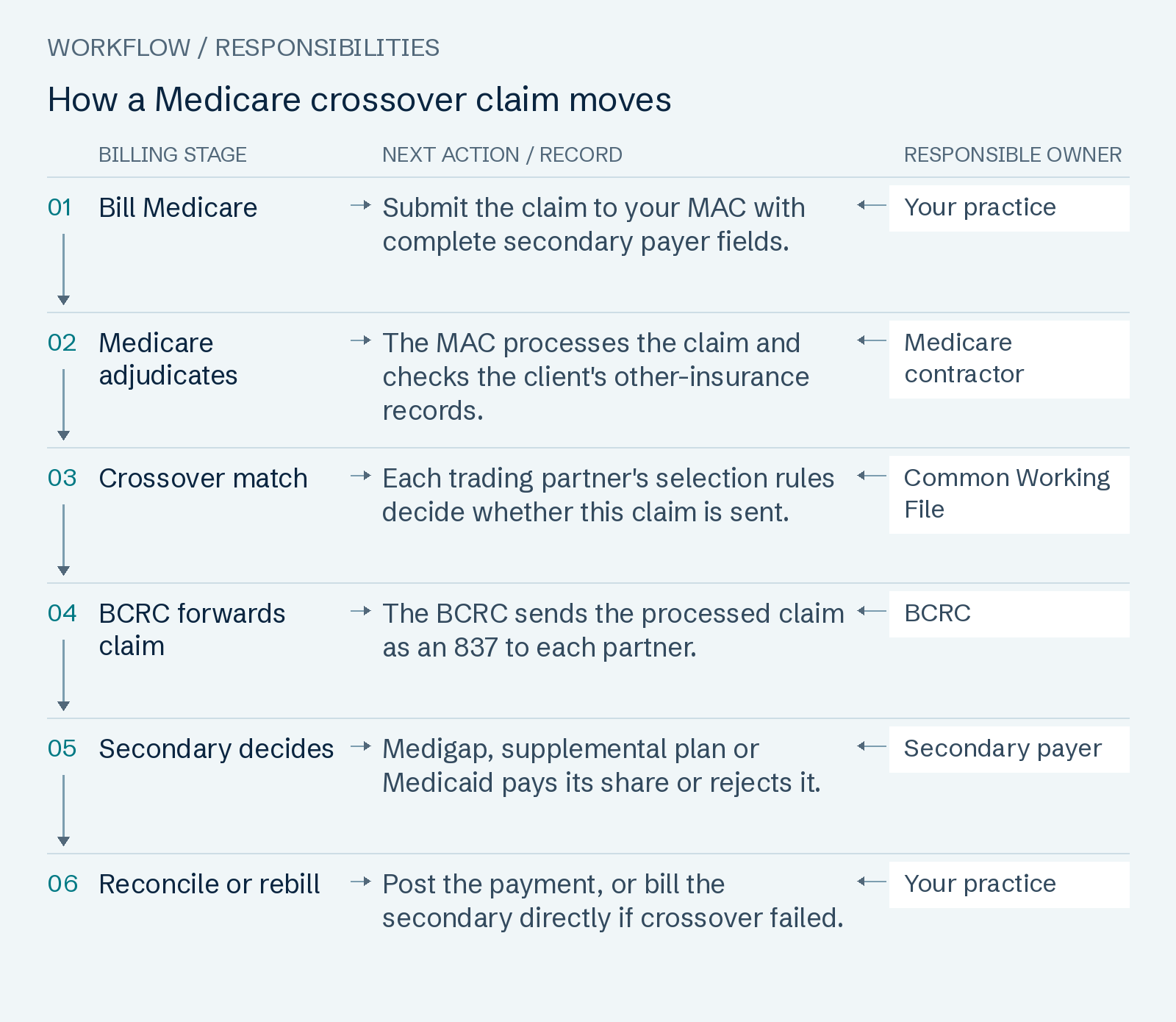
Read the workflow as text
- Bill Medicare — Submit the claim to your MAC with complete secondary payer fields. Owner: Your practice.
- Medicare adjudicates — The MAC processes the claim and checks the client's other-insurance records. Owner: Medicare contractor.
- Crossover match — Each trading partner's selection rules decide whether this claim is sent. Owner: Common Working File.
- BCRC forwards claim — The BCRC sends the processed claim as an 837 to each partner. Owner: BCRC.
- Secondary decides — Medigap, supplemental plan or Medicaid pays its share or rejects it. Owner: Secondary payer.
- Reconcile or rebill — Post the payment, or bill the secondary directly if crossover failed. Owner: Your practice.
Dual-eligible clients: Medicare plus Medicaid
A dual-eligible client has Medicare and some level of Medicaid help. The CMS fact sheet Beneficiaries Dually Eligible for Medicare & Medicaid (MLN006977) confirms that Medicare pays first for services both programs cover, and lists the Medicare Savings Program groups. Only some of them pay your client's cost sharing:
| Medicaid group | What Medicaid pays | Crossover matters for the claim? |
|---|---|---|
| QMB (Qualified Medicare Beneficiary), with or without full Medicaid | Part A and Part B premiums, deductibles, coinsurance and copayments | Yes: the state is the payer for the cost sharing |
| SLMB (Specified Low-Income Medicare Beneficiary) | Part B premium only | Only if the client also has full Medicaid |
| QI (Qualifying Individual) | Part B premium only | No other Medicaid coverage is allowed |
| Full-benefit Medicaid without QMB | Services under the state plan; the state sets payment rates | Yes, under the state's own rules |
Crossovers for LCSWs, LPCs and LMFTs since 2024
Clinical social workers were already billing Medicare before 2024; CMS's MFT and MHC enrollment FAQ notes that a group already billing LCSW services keeps its group PTAN when it adds counselors and therapists. What changed is that effective January 1, 2024, marriage and family therapists and mental health counselors can bill Medicare independently. CMS's mental health counselor category covers licenses such as mental health counselor, clinical professional counselor and professional counselor, so an LPC who meets the requirements enrolls as an MHC. Their enrollment cannot start before January 1, 2024.
For crossovers, two enrollment points matter:
- Medicare enrollment is separate. The FAQ is direct: enrolling in Medicaid does not enroll you in Medicare. Without a Medicare enrollment there is no Medicare claim to cross over.
- Medicaid enrollment for cost sharing. Under 42 CFR 455.410(d), a state Medicaid agency must allow Medicare-enrolled providers to enroll for processing Medicare cost-sharing claims, even if the state does not recognize that provider type. An LMFT or LPC in a state whose Medicaid plan does not cover their license can still enroll so the state can process the crossover.
If your counselors or therapists joined Medicare in 2024 or later, check both enrollments before you treat dual-eligible clients. Our behavioral health billing service covers Medicare billing and enrollment for these clinicians.
Why crossovers fail and what to check
A missing secondary payment usually means one of the conditions below. Each comes from chapter 28 of the Claims Processing Manual or the CMS QMB fact sheet; work down the checklist in order.
Two details in the checklist need more care. When the BCRC or the partner rejects a claim, the MAC must notify you within five business days of receiving the error report, giving the claim's ICN, the beneficiary, the date of service and, for HIPAA-format or trading-partner rejections, the rejection code, with a line saying the claim was not crossed over due to claim data errors or was rejected by the supplemental insurer. And remark code MA19 is how CMS tells you the Medigap information was invalid and the secondary claim must go directly to that insurer.
The secondary payer sees the claim data you sent Medicare, so an error you fix for Medicare, such as your NPI or the place of service code, has to be right before the crossover can be. Use the ICN from the notice (see DCN and ICN claim numbers) when you call either payer.
| What you see | Likely cause | What to check or do |
|---|---|---|
| No crossover payer named on the remittance | The secondary's eligibility file did not match the client and date of service, or the payer has no COBA | Confirm the secondary coverage and bill it directly |
| Remark code MA19 on the remittance | Missing or wrong 5-digit Medigap COBA ID in item 9d, incomplete Medigap fields in item 9, or more than one Medigap insurer listed | Correct the Medigap details and send the secondary claim yourself |
| Partner named before, but a reprocessed claim did not cross | The trading partner's selection criteria exclude that claim type, such as fully denied or adjustment claims | Bill the adjustment to the secondary directly |
| Medicaid did not receive the claim | The state uses Medicaid's other-insurance exclusion and the client has other active supplemental coverage, which pays before Medicaid | Bill the other supplemental payer first, then Medicaid |
| A MAC letter saying the claim was not crossed over | Claim data errors, or a rejection by the BCRC or the trading partner | Fix the field named in the rejection code and bill the secondary |
| No crossover and a placeholder provider ID on the claim | Claims with a placeholder NPI are excluded automatically | Correct the NPI with Medicare, then bill the secondary |
| Medicaid rejects or never pays the cost sharing | You are not enrolled with the state Medicaid program or the client's Medicaid managed care plan | Enroll for cost-sharing claims, then rebill |
| The client's card is a Medicare Advantage plan | COBA forwards Original Medicare claims processed by MACs | Ask the plan how secondary and Medicaid claims are submitted |
Billing the secondary manually
When a claim does not cross over, you send the secondary claim yourself. Chapter 28 sets the rule that makes it valid: on a secondary claim, the primary payer's paid amount plus its adjusted amounts must equal the billed amount for the services, with standard claim adjustment reason codes explaining each adjustment. In practice:
- Confirm on the remittance that no trading partner was named, or find the MAC's not-crossed-over notice.
- Fix whatever caused the failure: the Medigap COBA ID, the insurer details or your Medicaid enrollment.
- Copy Medicare's paid amount and adjustment lines exactly as the 835 shows them; do not net or round them.
- Submit to the Medigap plan, supplemental plan or state Medicaid program under its own filing rules and deadline.
- Record the submission date, and follow up if the secondary has not answered.
If the secondary then denies the claim, work the denial like any other; our denial management services page shows how we work denials.
Patient balances on dual-eligible clients
Do not bill a QMB client for Medicare deductibles, coinsurance or copayments. The CMS fact sheet Prohibition on Billing Qualified Medicare Beneficiaries (MLN7936176, September 2025) states that federal law bars all Original Medicare and Medicare Advantage providers, not only those that accept Medicaid, from billing QMBs for Part A and Part B cost sharing. It applies even when Medicaid pays nothing, and a provider that breaks it may be subject to sanctions. QMBs cannot choose to pay the cost sharing either. The dual-eligible fact sheet adds that Medicare and Medicaid payments, plus any small Medicaid QMB copayment, are payment in full.
States can limit what they pay toward Medicare cost sharing, so the Medicaid crossover payment may be small or zero. That shortfall stays with the practice. What CMS asks providers to do:
- Check each Medicare client's QMB status through your MAC's portal, your clearinghouse's eligibility response, the Medicare remittance and MSN, or the state's Medicaid eligibility system.
- Recall any bills sent to QMBs for cost sharing, including those sent to collections, and refund what was collected.
- Enroll with the state so it can process your cost-sharing claims.
SLMB and QI clients receive only premium help through those groups, so check what other Medicaid coverage they have before deciding whether a balance can be billed. For any client, bill a balance only when the remittance assigns it to the patient and the payer's rules allow it.
Unpaid secondaries age quietly while the practice waits for a crossover that never came. To see which open claims are closest to a payer deadline, get my free A/R Deadline Map; Clock starts with your claim-level aging export and signed BAA; above 10 requests in a week, we confirm your date within 1 business day.
Common questions
- What is a Medicare crossover claim?
- It is an Original Medicare claim that Medicare sends on to the patient's secondary payer after processing it, through CMS's Coordination of Benefits Agreement process. The secondary, such as a Medigap plan or state Medicaid, receives Medicare's payment data with the claim, so you do not have to bill it separately.
- Why didn't my Medicare claim cross over?
- The common reasons are: the secondary's eligibility file did not match the client, the Medigap COBA ID or item 9 fields were missing or wrong, the trading partner excludes that type of claim, the claim had data errors, or the client is in Medicare Advantage. Check your remittance for a named crossover payer and any not-crossed-over notice from your MAC.
- Can I bill a dual-eligible client a balance?
- Not for Medicare cost sharing if the client is a QMB. CMS states that all Original Medicare and Medicare Advantage providers are barred from billing QMBs for deductibles, coinsurance and copayments, even when Medicaid pays nothing. Other dual-eligible clients depend on their Medicaid coverage; bill a balance only when the remittance assigns it to the patient and the payer's rules allow it.
- How long does a crossover take?
- The CMS sources on this page set no fixed number of days for the secondary payer. Medicare forwards the claim after it finishes processing, so the crossover payer is named on the same remittance. If a crossover is rejected, the MAC must notify you within five business days of receiving the BCRC's error report. After that, follow up with the secondary under its own timelines.
- Do Medicare Advantage claims cross over?
- Not through the COBA process this page describes, which forwards claims processed by Medicare Administrative Contractors under Original Medicare. A Medicare Advantage plan pays its own claims; CMS tells Medicare Advantage providers to contact the plan about how it identifies and handles QMB members. Ask the plan how secondary and Medicaid claims are submitted.
Sources and review
Page revised November 5, 2026 · Review contact: Hyder Shah (inquiries@claimpillar.com). The workflow checklists are editorial recommendations; payer requirements depend on the program and current policy.
- Medicare Claims Processing Manual, chapter 28, section 70.6 (CMS, rev. effective 2026-01-01, retrieved 2026-11-05)
- COBA trading partners (CMS, retrieved 2026-11-05)
- Prohibition on Billing Qualified Medicare Beneficiaries, MLN7936176 (CMS, September 2025, retrieved 2026-11-05)
- Beneficiaries Dually Eligible for Medicare & Medicaid, MLN006977 (CMS, June 2024, retrieved 2026-11-05)
- Marriage and family therapists and mental health counselors (CMS, retrieved 2026-11-05)
- MFT and MHC provider enrollment FAQs (CMS, May 2024, retrieved 2026-11-05)
- 42 CFR 455.410: enrollment and screening of providers (eCFR, retrieved 2026-11-05)