Modifier GT: what it meant and who still asks for it
Modifier GT is a HCPCS Level II modifier whose descriptor reads "via interactive audio and video telecommunication systems". For years it was how Medicare and most plans recognized a telehealth line. That changed in three steps, which CMS MLN Matters MM10583 sets out:
- January 1, 2017: CMS created POS 02 to identify services furnished via telehealth.
- CY 2018 PFS final rule: CMS eliminated the GT requirement for all professional claims.
- October 1, 2018: GT became allowed only on institutional claims billed by a critical access hospital (CAH) under Method II. MM10583 says a GT line billed in any other circumstance is rejected with group code CO and CARC 4.
The current CMS booklet MLN901705 (December 2025) keeps that rule: distant site practitioners billing under CAH optional payment Method II submit institutional claims with GT. A therapist or counselor billing Medicare Part B on a CMS-1500 has no reason to use it.
Who still asks for GT
Medicaid programs and commercial plans write their own rules, and some kept GT. NC Medicaid Clinical Coverage Policy 1H (amended February 15, 2025) says GT must be appended to show a service was provided via interactive audio-visual communication, and not to virtual patient communications, including telephonic evaluation and management, or to remote patient monitoring. Cigna policy R31 accepts GT as one of five telehealth modifiers, and UnitedHealthcare accepts it as informational. Before you strip GT from a claim template, check every plan that template feeds.
95 modifier: synchronous telemedicine
Modifier 95 is the CPT modifier for a service delivered live over real-time audio and video, with the clinician and patient at different sites. GT and 95 describe the same kind of session; the difference is who wrote the modifier and which payers ask for it.
For Medicare professional claims, the booklet and the manual differ. MLN901705 lists only POS 02 or 10 for professional billing, but Medicare Claims Processing Manual chapter 26, section 10.5 (Rev. 14466, issued May 27, 2026) says POS 02 or POS 10 "must be paired with the appropriate telehealth modifier (modifier 93 for audio-only and modifier 95 for audio/video)" and that the modifier does not change the rate of payment; only the POS sets the facility or non-facility rate. Follow the manual and append 95 to a Medicare video line. MLN901705 also names modifier 95 under institutional billing, for outpatient therapy by physical therapists, occupational therapists or speech-language pathologists employed by hospitals. The CY 2024 PFS final rule summary (MM13452) adds that 95 is used when the clinician is in the hospital and the patient is at home, and that, except for CAHs electing Method II, the 95 modifier is required on those institutional claims from all providers.
Modifier 95 on commercial claims
Commercial plans split three ways. Cigna requires one of its listed telehealth modifiers, 95 included. UnitedHealthcare commercial policy 2026R0046A says modifiers 95, GT, GQ and G0 are not required but are accepted as informational. Blue Cross and Blue Shield of Minnesota's commercial policy 007 recognizes 95 but tells providers to append it only to codes listed in CPT Appendix P, the AMA's list of codes eligible for the modifier. A 95 on a code outside a payer's eligible list is a denial risk, not a safety margin.
Modifier 93 and FQ: audio-only sessions
For audio-only telehealth, 42 CFR 410.78 requires CPT modifier 93 on the claim, plus Medicare modifier FQ for rural health clinics (RHCs) and federally qualified health centers (FQHCs). The modifier verifies the regulation's conditions: the patient is at home, the clinician is technically capable of video, and the patient is not capable of, or does not consent to, video.
The CMS telehealth FAQ (updated October 8, 2026) says patients may receive audio-only telehealth at home through December 31, 2027. From January 1, 2028, audio-only behavioral health to a patient at home continues under those same two conditions, for new and established patients.
Commercial plans add their own limits. UnitedHealthcare pays audio-only services with modifier 93 and POS 02 or 10 only for codes in CPT Appendix T, the AMA's audio-only list; a 93 on any other code is not eligible. Cigna has accepted 93 and FQ since October 15, 2022, and requires the record to identify the delivery method, audio/video or telephone only.
Audio-only documentation checklist
Each item comes from 42 CFR 410.78, the CMS FAQ or Cigna R31:
- Delivery method: the note says audio-only, not just "telehealth".
- Patient location: the patient was at home, which also sets POS 10 for Medicare.
- Video capability: the clinician could have used video for this session.
- Patient reason: the patient could not use video, or declined it.
- Modifier on the line: 93, plus FQ when an RHC or FQHC bills.
- Code eligibility: for plans like UnitedHealthcare, the code appears on the payer's audio-only list.
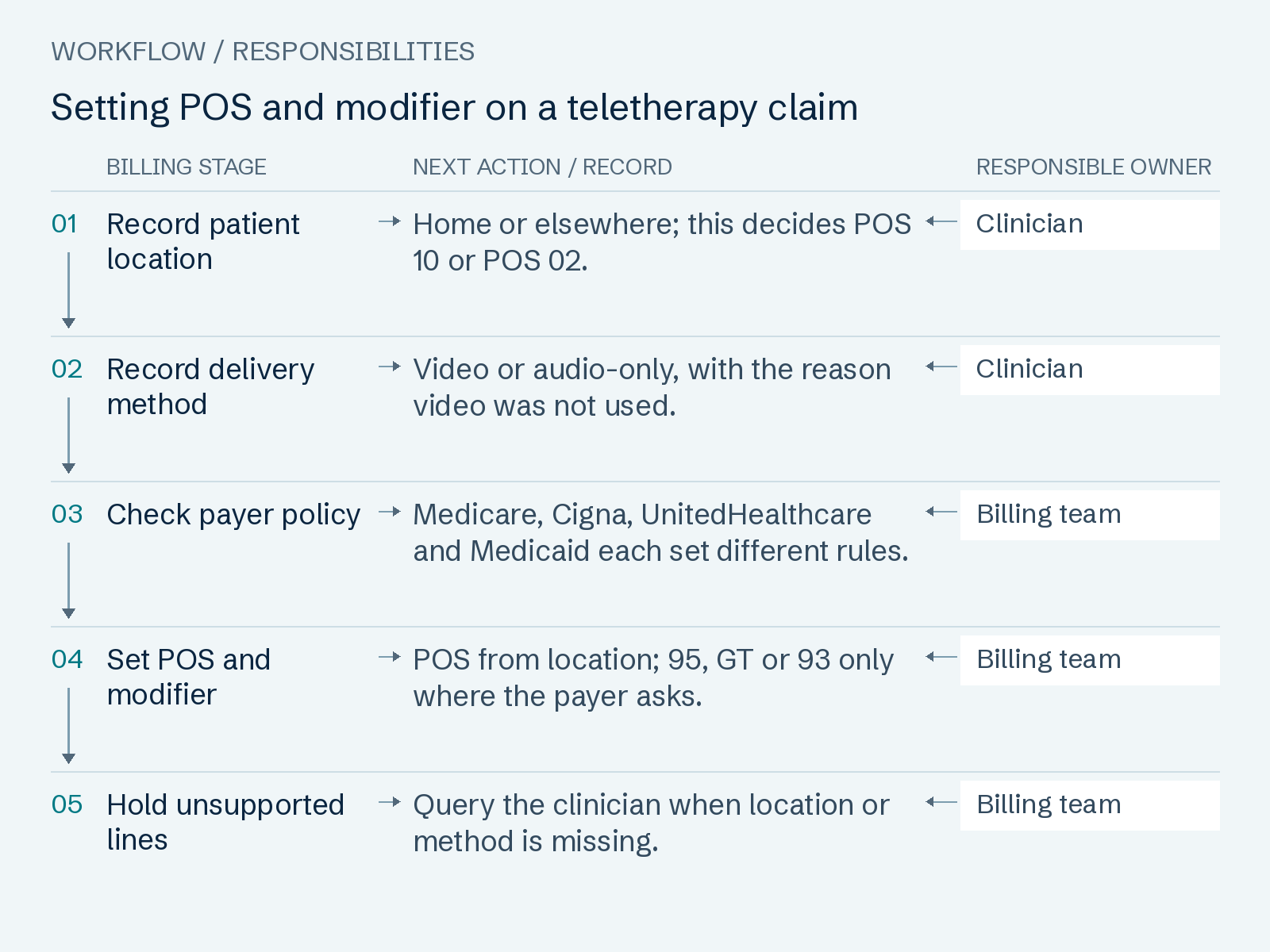
Read the workflow as text
- Record patient location — Home or elsewhere; this decides POS 10 or POS 02. Owner: Clinician.
- Record delivery method — Video or audio-only, with the reason video was not used. Owner: Clinician.
- Check payer policy — Medicare, Cigna, UnitedHealthcare and Medicaid each set different rules. Owner: Billing team.
- Set POS and modifier — POS from location; 95, GT or 93 only where the payer asks. Owner: Billing team.
- Hold unsupported lines — Query the clinician when location or method is missing. Owner: Billing team.
POS 02 vs POS 10 with each modifier
The place of service code reports where the patient was; the modifier reports how the session was delivered. The CMS FAQ tells practitioners to use POS 02 when the patient is not at home and POS 10 when the patient is at home, and since January 1, 2024 Medicare pays telehealth to patients at home at the non-facility rate. The grid below combines both choices by payer. The full set of place of service codes, from POS 02 and 10 to POS 22, covers the in-person codes NC Medicaid expects instead.
Do you need modifier 95 with POS 10? For Medicare, yes: chapter 26 section 10.5 of the claims manual pairs POS 02 or 10 with 95 for video and 93 for audio-only, even though MLN901705 lists only the POS. UnitedHealthcare does not require it. Cigna's behavioral health policy asks for POS 02 rather than POS 10, plus a modifier. Medicaid plans decide for themselves (Washington Apple Health wants 95 for non-facility pay on lower-acuity behavioral health), which is why a single claim template rarely works for every payer.
| Payer and session | POS | Modifier | Source |
|---|---|---|---|
| Medicare, video, patient at home | 10 | 95 (93 if audio-only) | Claims Processing Manual ch. 26 §10.5 |
| Medicare, video, patient elsewhere | 02 | 95 (93 if audio-only) | Claims Processing Manual ch. 26 §10.5 |
| Medicare, audio-only, patient at home | 10 | 93 (FQ added by RHCs and FQHCs) | 42 CFR 410.78 |
| Medicare, CAH Method II institutional claim | Institutional claim | GT | MLN901705; MM10583 |
| UnitedHealthcare commercial, video | 02 or 10 | 95 or GT optional, informational | Policy 2026R0046A |
| UnitedHealthcare commercial, audio-only | 02 or 10 | 93, Appendix T codes only | Policy 2026R0046A |
| Cigna behavioral health, video or audio | 02 | One of 93, 95, FQ, GQ or GT | Policy R31 |
| BCBS of Minnesota commercial | 02 or 10 | 95 on Appendix P codes; 93 for audio-only | Policy 007 |
| Washington Apple Health, lower-acuity behavioral health, video or audio | 02 or 10 | 95 for non-facility pay; 93 for audio-only | HCA FAQ, effective Jan 1, 2025 |
| NC Medicaid, video | Your usual POS, not 02 | GT | Policy 1H |
Medicare telehealth rules for mental health in 2026
The codes therapy practices bill most stay on the CMS list of Medicare telehealth services for calendar year 2026: the CY 2026 file marks 90791, 90832, 90834, 90837, 90846, 90847 and 90853 as maintained, along with 97153, 92507 and 97110. The code and its time rules do not change for video; a 53-minute video session is still billed as the 90837 CPT code, with the POS and any modifier added on top.
The CMS FAQ sets out four rules that shape mental health telehealth through 2027 and beyond:
- No geographic or setting limit. The Consolidated Appropriations Act, 2021 permanently removed geographic and place of service restrictions for behavioral health telehealth, so patients in rural and urban areas can be seen at home.
- Audio-only allowed. Two-way, interactive audio-only technology is permitted for behavioral health telehealth; 42 CFR 410.78 requires modifier 93 on those claims.
- In-person visit after 2027. After December 31, 2027, Medicare requires periodic in-person visits for mental health telehealth; the dates and the documented exception are in telehealth billing for therapists.
- New modifiers BB and BC. They become required for certain telehealth claims from January 1, 2027: BB for services furnished through a virtual platform owned by an entity the clinician contracts or has a payment arrangement with, BC for incident-to telehealth. CMS says they have no payment implications.
What still pays by telehealth after 2027, beyond therapy codes, is in what your practice can still bill by telehealth.
Commercial and Medicaid payer differences
The table below shows what each payer's own policy says about telehealth modifiers for professional claims. Last verified: November 4, 2026, from each payer's published policy. Policies are scoped to the plan and state named; your contract or provider manual may say more.
How to read the payer table
"Required" means the claim is not paid as telehealth without it. "Accepted" or "recognized" means the payer takes the modifier but does not demand it. Cigna and NC Medicaid are the strict ones here: Cigna wants a modifier and POS 02, and NC Medicaid wants GT with your usual in-person POS. UnitedHealthcare reads the POS instead. Medicare's claims manual wants the POS and a telehealth modifier together.
| Payer (policy, date) | GT | 95 | 93 (audio-only) | POS |
|---|---|---|---|---|
| Medicare Part B professional (Claims Processing Manual ch. 26 §10.5, Rev. 14466, May 27, 2026; MLN901705, Dec 2025) | CAH Method II institutional claims only | Paired with POS 02 or 10 for audio-video (manual); MLN901705 lists POS only | Required for audio-only | 02 or 10 |
| NC Medicaid (Policy 1H, amended Feb 15, 2025) | Required for audio-video | Not named in the policy | Not named in the policy | Usual POS, not 02; POS 12 for hybrid home visits |
| UnitedHealthcare commercial (2026R0046A) | Accepted, informational | Accepted, informational | Required, Appendix T codes | 02 or 10 |
| Cigna behavioral health (R31, updated Feb 17, 2026) | One of five required | One of five required | One of five required | 02 |
| BCBS of Minnesota commercial (Policy 007, reviewed Sep 23, 2025) | Recognized | Recognized, Appendix P codes only | Recognized | 02 or 10 |
Telehealth denials and fixes
Most telehealth modifier denials come from a template built for one payer and sent to all of them. Check these in order before you correct and resubmit:
- GT on a Medicare professional claim. MM10583 says the line is rejected with group code CO and CARC 4. Remove GT and report POS 02 or 10 with modifier 95 (93 if audio-only).
- POS 10 sent to Cigna. Cigna's behavioral health policy asks for POS 02. Resubmit with POS 02 and one of its five modifiers.
- No modifier on a Cigna claim. R31 pays virtual care only when 93, 95, FQ, GQ or GT is appended.
- POS 02 sent to NC Medicaid. Policy 1H wants your usual POS with GT. Correct the POS and add the modifier.
- Modifier 93 on a code outside the payer's audio-only list. UnitedHealthcare does not pay 93 on codes outside CPT Appendix T. Check the list before you schedule phone sessions.
- Audio-only without the conditions documented. Under 42 CFR 410.78, modifier 93 verifies that the clinician could use video and the patient could not or declined. If the note does not show it, the modifier is not supported.
- Originating site fee on a home visit. UnitedHealthcare does not pay Q3014 when the claim shows POS 10. Drop the fee line.
- Missing BB or BC from 2027. From January 1, 2027, the CMS FAQ requires BB or BC where a contracted virtual platform or incident-to telehealth applies.
- Clinician not licensed or enrolled where the patient was. Confirm the license, compact privilege or payer enrollment for that state before the next session; past sessions may not be billable.
Correct a claim only when the record supports the change, and watch the payer's filing window while you do. When the same corrections repeat every month, the cause is upstream in the template or the intake form. Our mental health billing services apply each payer's current telehealth policy, including its POS and modifier rules, to every teletherapy claim. To see which unpaid telehealth claims are closest to their filing deadlines, get my free A/R Deadline Map: The Free A/R Deadline Map (Clock starts with your claim-level aging export and signed BAA; above 10 requests in a week, we confirm your date within 1 business day.).
Common questions
- What is the GT modifier?
- GT is a HCPCS Level II modifier for a service delivered via interactive audio and video telecommunication systems. Medicare stopped requiring it on professional claims in 2018 and, since October 1, 2018, allows it only on CAH Method II institutional claims (CMS MM10583). Some Medicaid programs, such as NC Medicaid, still require it.
- What is the difference between GT and 95 modifiers?
- Both describe a live audio-video session. GT is a HCPCS Level II modifier that Medicare now limits to CAH Method II institutional claims; 95 is a CPT modifier that many commercial plans recognize. Which one a payer wants is set by its policy: NC Medicaid requires GT, Cigna accepts either, and UnitedHealthcare treats both as informational.
- Which modifier is used for audio-only therapy?
- Modifier 93 for Medicare, plus FQ when an RHC or FQHC bills, under 42 CFR 410.78. The patient must be at home, the clinician able to use video, and the patient unable or unwilling to use it. UnitedHealthcare pays 93 only on codes in CPT Appendix T.
- Do I need modifier 95 with POS 10?
- For Medicare, yes: Medicare Claims Processing Manual chapter 26, section 10.5 says POS 02 or 10 must be paired with modifier 95 for audio and video, or 93 for audio-only, though MLN901705 lists only the POS. The modifier does not change the payment rate. UnitedHealthcare commercial does not require 95 and accepts it only as informational. Cigna's behavioral health policy asks for POS 02 plus a telehealth modifier instead of POS 10. Check each Medicaid plan's own policy.
- Does Medicare still accept the GT modifier?
- Only on institutional claims billed by a critical access hospital under Method II. MLN901705 (December 2025) keeps that rule, and CMS MM10583 says GT billed in any other circumstance is rejected. Professional claims report telehealth with POS 02 or 10, paired with modifier 95 for video or 93 for audio-only under the Claims Processing Manual, chapter 26 section 10.5.
Sources and review
Page revised November 5, 2026 · Review contact: Hyder Shah (inquiries@claimpillar.com). Every source below was retrieved and checked on November 4, 2026. Telehealth rules change every year; payer rules apply only to the payer, plan and state named.
- CMS MLN Matters MM10583: Revisions to the Telehealth Billing Requirements for Distant Site Services (revised September 6, 2018)
- CMS MLN901705: Telehealth & Remote Monitoring (December 2025)
- CMS MLN Matters MM13452: Medicare Physician Fee Schedule Final Rule Summary, CY 2024
- CMS Medicare Claims Processing Manual, Chapter 26, section 10.5 (Rev. 14466, issued 05-27-26)
- CMS Telehealth FAQ (updated 10/8/2026)
- CMS: List of Medicare Telehealth Services, CY 2026
- eCFR: 42 CFR 410.78, Telehealth services
- UnitedHealthcare Commercial Reimbursement Policy 2026R0046A, Telehealth/Virtual Health
- Cigna Reimbursement Policy R31, Virtual Care (updated 02/17/2026)
- Blue Cross and Blue Shield of Minnesota Commercial Reimbursement Policy 007, Telehealth and Virtual Care Services (last reviewed 09/23/25)
- Washington HCA, Behavioral health telemedicine policy and billing FAQ (effective January 1, 2025)
- NC Medicaid Clinical Coverage Policy 1H: Telehealth, Virtual Communications and Remote Patient Monitoring (amended February 15, 2025)