Why payers use provider-level modifiers
A provider-level modifier tells the payer who delivered a service when the rendering NPI alone does not. That matters most when a payer pays different clinicians different rates for the same code, or when a supervisor's NPI sits on the claim. Indiana Medicaid bulletin BT202655 (April 9, 2026) shows the money at stake: billed under a supervising practitioner's NPI, a licensed clinical social worker's service pays at 75% of the physician rate, an APRN's at 85%, a licensed psychologist's at 100% and a behavioral health intern's at 50%. The modifier is how the system knows which rate to apply.
Ohio states the same purpose in its Medicaid Behavioral Health Provider Requirements and Reimbursement Manual, version 1.28.1 (March 24, 2026): modifiers are used to count toward soft limits, price services and adjudicate claims. Medicare works differently. It identifies a clinical social worker by provider specialty code 80 and pays that service at 75% of the physician fee schedule, per the Medicare Claims Processing Manual, chapter 12, §150, so it no longer needs a credential modifier to do the math.
Modifier reference table
The descriptors in the table are quoted, or condensed where two or three modifiers share a row, from the CMS October 2026 alpha-numeric HCPCS file. Modifiers 95 and 93 are CPT modifiers, so their meanings are our own summaries. The last column covers only the payers cited on this page; checked November 5, 2026.
| Modifier | Meaning | Discipline | Payers on this page that require it |
|---|---|---|---|
| SA | Nurse practitioner rendering service in collaboration with a physician | Nurse practitioner / APRN | Indiana Medicaid (with HE) for an APRN billed under another practitioner's NPI |
| HO | Masters degree level | Any behavioral health staff | Ohio Medicaid for master's-level QMHS, care management specialists and peer supporters |
| HN | Bachelors degree level | Any behavioral health staff | Ohio Medicaid for bachelor's-level QMHS, care management specialists and peer supporters |
| HM | Less than bachelor degree level | Any behavioral health staff | Ohio Medicaid for high school and associate's-level staff |
| HP | Doctoral level | Any behavioral health staff | None of the payers cited here |
| AJ | Clinical social worker | Clinical social work | Not Medicare since 2013; Indiana replaced it with HE in 2025 |
| AH | Clinical psychologist | Psychology | Indiana Medicaid for a psychologist billed under a supervising NPI; not Medicare since 2013 |
| HE | Mental health program | Behavioral health | Indiana Medicaid for LCSW, LMFT, LMHC and LCAC services under a supervising NPI |
| GP / GO / GN | Services delivered under an outpatient physical therapy / occupational therapy / speech language pathology plan of care | PT / OT / SLP | Medicare on always-therapy codes, and on sometimes-therapy codes under a therapy plan of care |
| CQ / CO | Outpatient PT / OT services furnished in whole or in part by an assistant | PTA / OTA | Medicare, paired with GP / GO |
| 95 | Live audio-video telehealth (our summary) | Any | Medicare institutional claims for hospital-employed PT, OT and SLP telehealth |
| 93 | Audio-only telehealth (our summary) | Any | Medicare audio-only telehealth, under 42 CFR 410.78 |
HO, HN, HM and HP: education level
The H-series modifiers report a degree, not a license. The CMS HCPCS file defines HO as masters degree level, HN as bachelors degree level, HM as less than bachelor degree level and HP as doctoral level. Because they say nothing about licensure, payers that use them usually apply them to unlicensed or paraprofessional staff whose pay rate depends on education.
Ohio Medicaid is the clearest example. Its manual's Table 1-3 assigns HM to a qualified mental health specialist (QMHS), care management specialist or certified peer supporter with a high school or associate's degree, HN to the bachelor's level and HO to the master's level, and UK to a QMHS with three years' experience. The manual says these education-level modifiers are required for the services it lists. The licensed clinicians Table 1-3 lists get U-modifiers instead: U2 for a licensed professional counselor, U4 for a licensed social worker and U5 for a licensed marriage and family therapist, optional for fee-for-service unless the clinician holds more than one license and renders a service available only under the second.
When is the HO modifier used?
Use HO when your payer's manual ties it to a master's-level clinician for the code you bill. In Ohio that is a master's-level QMHS, care management specialist or peer supporter, and Ohio also uses HO for a licensed behavioral health practitioner, RN or LPN on an ACT team. Outside the payer's table, HO is just a degree flag, and adding it where the payer does not ask can trip an invalid modifier-to-code edit.
AJ and AH: clinical social worker and psychologist
AJ means clinical social worker and AH means clinical psychologist in the HCPCS file. For Medicare, CMS Transmittal 2656 (Change Request 8010, effective February 19, 2013) tells contractors not to require AJ for clinical social workers or AH for clinical psychologists, because they are no longer necessary for identification. The same transmittal says the modifiers are not eliminated, only no longer required. A Medicare claim from an LCSW billing the 90837 psychotherapy code (53+ minutes) under the LCSW's own NPI goes out without AJ.
Medicaid programs decide for themselves, and they change their minds. Indiana bulletin BT2024202 (December 17, 2024) replaced AH, AJ and HF with a single HE modifier from January 1, 2025, for behavioral health services billed under a supervising practitioner's NPI. BT202655 then brought AH back: effective immediately and retroactive to dates of service on or after January 1, 2025, a licensed psychologist billed under a supervising NPI carries AH. Both rules apply to fee-for-service and managed care, and neither applies to Medicaid Rehabilitation Option services.
Sample Medicaid behavioral health modifier grid
Two states, two systems. Ohio codes the clinician's license or degree on the line; Indiana codes only the supervision arrangement. Both from the state documents cited above, checked November 5, 2026.
| Rendering clinician | Ohio Medicaid (manual 1.28.1) | Indiana Medicaid, billed under a supervising NPI (BT202655) |
|---|---|---|
| Licensed clinical social worker | Not listed in Table 1-3 (U4 is for a licensed social worker, LSW; optional for FFS unless multi-licensed) | HE |
| Licensed marriage and family therapist | U5 (optional for FFS unless multi-licensed) | HE |
| Licensed professional or mental health counselor | U2 for a licensed professional counselor, LPC (optional for FFS unless multi-licensed) | HE for an LMHC |
| Licensed psychologist | Not listed in Table 1-3 (U1 is for psychology assistants, interns and trainees) | AH |
| Nurse practitioner / APRN | UC on an ACT team | HE SA for behavioral health; no modifier under the APRN's own NPI |
| Physician assistant or clinical nurse specialist | SA on an ACT team | PA: not applicable, cannot bill under a supervising NPI |
| Bachelor's or master's-level staff | HN or HO (required) | Not in the bulletin's table |
| Intern or trainee | U1, U7, U9 or UA by discipline | HL |
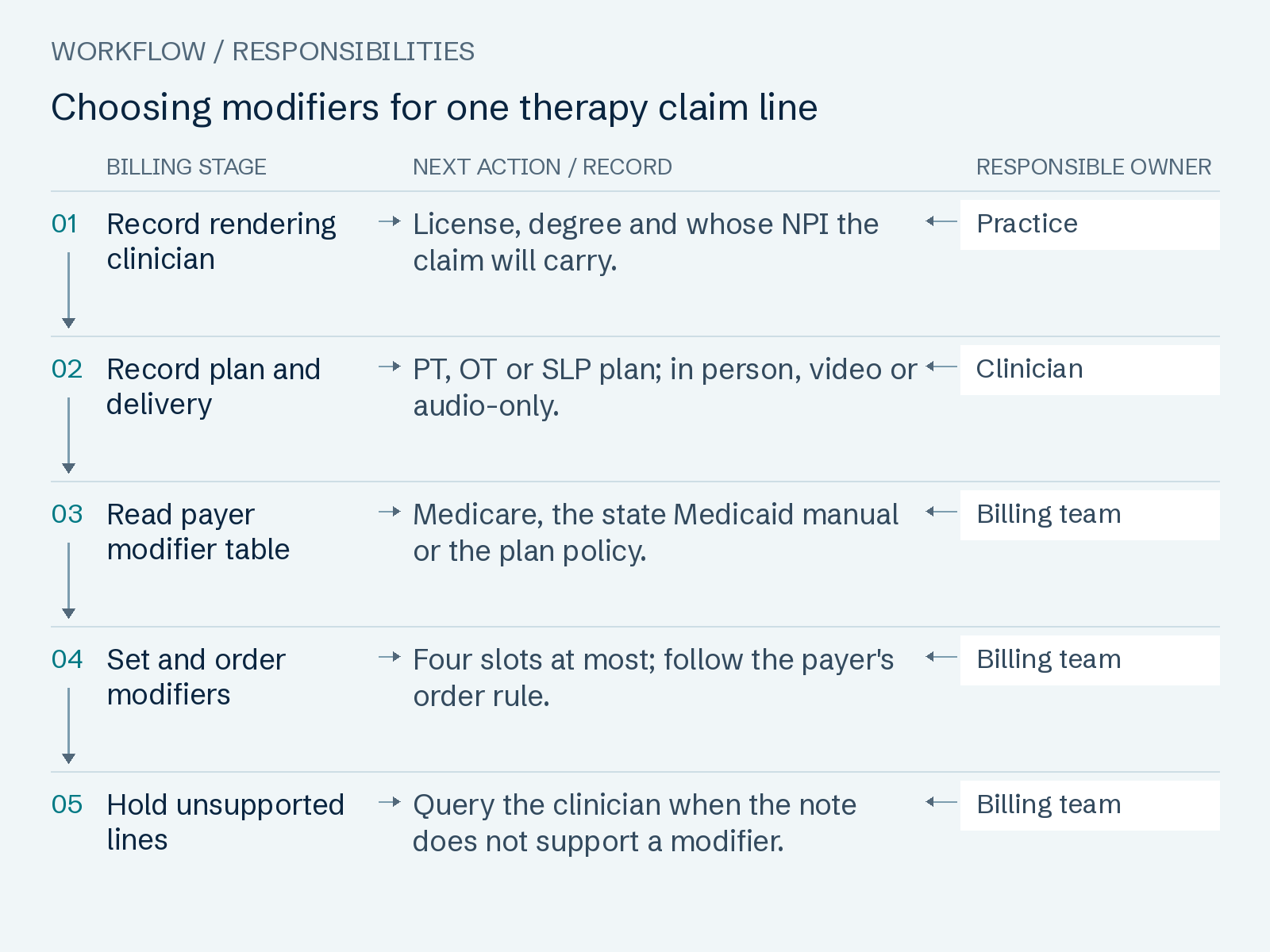
Read the workflow as text
- Record rendering clinician — License, degree and whose NPI the claim will carry. Owner: Practice.
- Record plan and delivery — PT, OT or SLP plan; in person, video or audio-only. Owner: Clinician.
- Read payer modifier table — Medicare, the state Medicaid manual or the plan policy. Owner: Billing team.
- Set and order modifiers — Four slots at most; follow the payer's order rule. Owner: Billing team.
- Hold unsupported lines — Query the clinician when the note does not support a modifier. Owner: Billing team.
SA modifier: nurse practitioner services
The SA modifier's HCPCS descriptor is "Nurse practitioner rendering service in collaboration with a physician". Like the H-series, it means what each payer's policy says it means on that payer's claims, and the two state programs on this page use it differently:
- Indiana Medicaid: an APRN's service billed under another practitioner's NPI carries SA, combined with HE for behavioral health services. Under the APRN's own NPI, no modifier is needed. Either way the service pays at 85%.
- Ohio Medicaid: on an assertive community treatment (ACT) team, SA marks a physician assistant or clinical nurse specialist, while a certified nurse practitioner gets UC.
Do not confuse SA with AS. CMS Transmittal 2656 says assistant-at-surgery services by a PA, NP or clinical nurse specialist are reported with AS only. That is a surgical modifier and has no place on a psychotherapy or medication management line. The same transmittal sets Medicare's NP payment at 80% of the lesser of the actual charge or 85% of the physician fee schedule amount.
GP, GO and GN: PT, OT and speech plans of care
The GP modifier description in the HCPCS file is "Services delivered under an outpatient physical therapy plan of care". GO and GN say the same for occupational therapy and speech-language pathology. The Medicare Claims Processing Manual, chapter 5, §20.1 requires one of them on codes on the list of applicable therapy codes, from physicians, nonphysician practitioners, therapists in private practice, hospitals, SNFs and any other biller. The exception is a "sometimes therapy" code that a physician or NPP bills as a medical service, not under a therapy plan of care: chapter 5, §20 says that line goes out without the therapy modifier. The modifier names the plan of care, not the license, and the manual says it never lets anyone deliver a service they are not qualified to perform.
The edits Medicare runs
- Only therapy codes. GP, GO and GN are never used on codes outside the therapy list; CMS gives respiratory and nutrition therapy as examples.
- One discipline per line. Institutional claims may not carry more than one of GN, GO or GP on a line, and revenue codes 42x, 43x and 44x take only GP, GO and GN respectively.
- Evaluations match the discipline. A physical therapy evaluation code always carries GP; contractors return institutional claims that break these rules.
- Assistants pair correctly. CQ must pair with GP and CO with GO, or the claim is rejected as unprocessable. Since January 1, 2022, those lines pay 85% of the otherwise applicable amount.
Telehealth modifiers on top: 95 and 93
A provider-level modifier says who; a telehealth modifier says how. When both apply, they sit on the same line. For Medicare audio-only telehealth, 42 CFR 410.78 requires CPT modifier 93, plus FQ for rural health clinics and FQHCs, to verify that the patient was at home, the clinician could use video and the patient could not or did not consent to it.
Modifier 95 marks a live audio-video session. The CMS booklet MLN901705 (December 2025) uses it on institutional claims for outpatient therapy delivered by telehealth by PTs, OTs and SLPs employed by hospitals; professional claims report telehealth through POS 02 or POS 10. State Medicaid programs set their own rule: Ohio's manual requires GT for any service delivered by secured video-conferencing or another allowed telehealth method. Our guide to the 95 vs GT modifier by payer has the commercial and Medicaid grid.
Modifier order and common denials
The Medicare Claims Processing Manual, chapter 26 (item 24D) says the CMS-1500 holds up to four modifiers per line, so a supervised, assistant-delivered or telehealth service can run out of room. Order rules come from the payer:
- Pricing first. Centene payment policy CC.PP.028 (reviewed October 14, 2025) says pricing modifiers, which change the payment, go before informational modifiers, which add context only.
- Any order, no gaps. Ohio Medicaid accepts modifiers in any order but requires the fields filled from one to four, with no empty first field.
- No stated order. Indiana's bulletin prints the APRN combination as HE SA but states no order rule; check the managed care plan's policy.
Examples
- Indiana Medicaid, APRN psychotherapy under a supervising practitioner's NPI: HE and SA both on the line, printed in the bulletin as HE SA.
- Medicare, PTA-delivered therapeutic exercise in a PT private practice: GP and CQ both on the line, when the assistant furnished the service in whole or in part. CQ without GP is rejected.
- Medicare, audio-only psychotherapy to a patient at home: 93 on the line and POS 10; no AJ for an LCSW billing under the LCSW's own NPI.
Common denials
The repeat offenders are a missing GP, GO or GN on a therapy code, two discipline modifiers on one line, CQ or CO without its pair, a credential modifier the payer's table does not list for that code (Centene's code editing denies invalid modifier-to-procedure combinations), and a supervised Medicaid claim missing the modifier that sets the clinician's rate. When a modifier is wrong for a reason other than credential, such as a reduced or distinct service, see modifiers 52, 53 and 59. Correct a line only when the record supports the change.
When the same modifier denials come back every month, the cause is usually a claim template built for one payer. Our behavioral health billing services set the place of service and modifier each payer requires for the documented session setting, and our physical therapy billing services check the discipline and required modifiers against the plan of care and treating clinician before release. To see which denied or unpaid claims are closest to their filing deadlines, get my free A/R Deadline Map: The Free A/R Deadline Map (Clock starts with your claim-level aging export and signed BAA; above 10 requests in a week, we confirm your date within 1 business day.).
Common questions
- What is the SA modifier?
- SA is a HCPCS Level II modifier whose CMS descriptor reads "Nurse practitioner rendering service in collaboration with a physician". Medicaid programs decide how to use it: Indiana requires it, with HE for behavioral health, when an APRN's service is billed under another practitioner's NPI. See SA modifier: nurse practitioner services.
- What does the GP modifier mean?
- GP means the service was delivered under an outpatient physical therapy plan of care. Medicare requires GP, GO or GN on every "always therapy" code and on "sometimes therapy" codes billed under a therapy plan of care, and requires CQ lines to carry GP. See GP, GO and GN.
- When is the HO modifier used?
- HO reports a master's degree level clinician, when the payer's table asks for it. Ohio Medicaid requires HO for master's-level qualified mental health specialists, care management specialists and peer supporters. See when HO is used.
- Does Medicare require the AJ modifier?
- No. Since February 19, 2013, CMS Transmittal 2656 has told Medicare contractors not to require AJ for clinical social workers or AH for clinical psychologists. The modifiers still exist, and some Medicaid programs require them. See AJ and AH.
- What order should modifiers go in?
- Follow the payer's rule. Centene's policy puts pricing modifiers before informational ones; Ohio Medicaid accepts any order as long as the fields are filled from one to four. The CMS-1500 holds four modifiers per line. See the order examples.
Sources and review
Page revised November 5, 2026 · Review contact: Hyder Shah (inquiries@claimpillar.com). Every source below was retrieved and checked on November 5, 2026. HCPCS descriptors are quoted from CMS; CPT modifiers 93 and 95 are described in our own words. Medicaid rules apply only to the state named, and managed care plans may add their own.
- CMS HCPCS Quarterly Update: October 2026 alpha-numeric HCPCS file (modifier descriptors)
- CMS Transmittal 2656, Change Request 8010: AH and AJ no longer required (February 7, 2013)
- Medicare Claims Processing Manual, chapter 5, §20.1: therapy modifiers GP, GO, GN, CQ and CO
- Medicare Claims Processing Manual, chapter 12, §150: clinical social worker services
- Medicare Claims Processing Manual, chapter 26: CMS-1500 item 24D
- 42 CFR 410.78: Telehealth services (modifiers 93 and FQ)
- CMS MLN901705: Telehealth & Remote Monitoring (December 2025)
- Ohio Medicaid Behavioral Health Provider Requirements and Reimbursement Manual, version 1.28.1 (March 24, 2026)
- Indiana Health Coverage Programs bulletin BT2024202: behavioral health modifier changes (December 17, 2024)
- Indiana Health Coverage Programs bulletin BT202655: practitioner reimbursement and modifier update (April 9, 2026)
- Centene payment policy CC.PP.028: Modifier to Procedure Code Validation (reviewed October 14, 2025)