CPT modifiers: what they tell the payer
A CPT modifier is a two-character code added to a procedure code to report a circumstance the code alone cannot show. The NCCI Policy Manual for 2026, chapter I, section E sets the rule every modifier on this page follows: a modifier may be appended only if the clinical circumstances justify it, and never solely to get past an NCCI edit.
Modifiers 52, 53 and 59 answer different questions, which is why they are confused so often:
- 52 says you did less of the service than the code describes.
- 53 says a physician started a procedure and stopped it.
- 59 and its four X subsets say two services that an NCCI edit bundles were separate and distinct.
Which modifiers can bypass an NCCI edit
NCCI procedure-to-procedure (PTP) edits pair a column 1 code with a column 2 code that is normally included in it. Chapter I lists the only modifiers that can bypass a PTP edit: the anatomic modifiers (E1-E4, FA, F1-F9, TA, T1-T9, LT, RT, LC, LD, RC, LM, RI), the global surgery modifiers 24, 25, 57, 58, 78 and 79, and 27, 59, 91, XE, XS, XP and XU. Modifiers 52 and 53 are not on that list, so neither one unbundles anything. Each edit also carries a modifier indicator: 0 means no modifier can bypass it, 1 means an associated modifier can bypass it when the record supports it, and 9 means modifier use is not specified, which CMS uses for pairs deleted on the same date they took effect. The table compares the modifiers this guide covers, plus the facility modifiers 73 and 74.
| Modifier | What it reports (our summary; X definitions from CMS) | Who reports it | Medicare payment effect | Documentation line that supports it |
|---|---|---|---|---|
| 52 | Service partly reduced or eliminated; no anesthesia planned | Physicians and other professionals, hospital outpatient and ASC | Physician surgery: priced individually only with a statement and operative report; hospital outpatient and ASC: 50% | What was planned, what was done, and why the service was reduced |
| 53 | Physician stopped a procedure already started, for reasons outside their control such as a risk to the patient | Physicians and other professionals only; not outpatient hospital | Code-specific; an incomplete colonoscopy has its own lower value | When the procedure started, how far it got, and why it stopped |
| 73 | Facility procedure stopped after prep, before anesthesia | Hospital outpatient departments and ASCs | 50% of the facility rate | Patient prepared and in the room; reason for stopping; no anesthesia given |
| 74 | Facility procedure stopped after anesthesia or after it began | Hospital outpatient departments and ASCs | Full facility rate (ASC: may take the multiple procedure discount) | Operative report: reason, services and supplies used, time in each stage |
| 59 | Distinct procedural service, used only when no more specific modifier fits | Any provider; never on an E/M code | Lets the bundled code pay when the edit's indicator is 1 | A separate site or encounter, separate time blocks, or a non-overlapping service |
| XE | “Separate encounter, a service that is distinct because it occurred during a separate encounter” | Any provider | Same as 59, for separate encounters on one date | Times of both encounters, each with its own note |
| XS | “Separate structure, a service that is distinct because it was performed on a separate organ/structure” | Any provider | Same as 59, for a separate organ or structure | The anatomic site of each procedure |
| XP | “Separate practitioner, a service that is distinct because it was performed by a different practitioner” | Any provider | Same as 59, for a different practitioner | Each practitioner's name and signed note |
| XU | “Unusual non-overlapping service, the use of a service that is distinct because it does not overlap usual components of the main service” | Any provider | Same as 59, for a non-overlapping service | Why the second service was not part of the first |
Modifier 52: reduced services
Modifier 52 means the clinician performed part of a service and the code stays the same. CMS's Claims Processing Manual, chapter 4, section 20.6.4 describes it as reporting partial reduction, cancellation or discontinuation of a service for which anesthesia is not planned, a way to report a reduced service “without disturbing the identification of the basic service.”
For physician surgery, Medicare's Claims Processing Manual, chapter 12, section 40.2 lets you bill 52 when the work was significantly less than usual, and says the biller must send a concise statement of how the service differed plus the operative report. Section 40.4 adds that claims with 52 are priced by individual consideration when that documentation is included; without it, the 52 line is not priced. Unlike modifier 22, 52 is not limited to codes with a 0-, 10- or 90-day global period.
What 52 pays: Medicare vs commercial plans
Facility payment is fixed: hospital outpatient procedures without planned anesthesia that are reduced or cancelled after the patient is in the room are paid at 50 percent of the OPPS rate, and ASCs take the same 50 percent cut for discontinued radiology and other procedures that do not need anesthesia. Commercial plans write their own rule. Priority Health pays 52 lines at 50% of its base fee schedule under all plans, and Blue Cross Blue Shield of North Dakota has a policy effective January 1, 2027 that pays them at 50% of the allowable amount.
When modifier 52 is the wrong choice
- Another code already describes what you did. Priority Health says not to use 52 when a CPT code accurately describes the service.
- The code is an E/M visit. Both payer policies above call 52 inappropriate on E/M codes; BCBSND says a visit below the lowest level is not reportable at all.
- The code is time-based, all-or-nothing or unlisted (BCBSND lists all three as inappropriate).
- Anesthesia was planned and the setting is a facility: use 73 or 74 instead.
BCBSND names one common appropriate case: a procedure the code defines as bilateral, performed on one side only.
Documentation lines that support 52
- The service that was ordered or planned.
- What was actually performed, and what was not.
- The reason for the reduction, in the clinician's words.
- For surgery billed to Medicare, the operative report and a short statement sent with the claim.
Modifier 53: discontinued procedure (and why ASCs use 73 and 74)
Modifier 53 reports a procedure the physician started and then stopped because of circumstances outside their control, such as a risk to the patient. Priority Health allows it on diagnostic and surgical codes, and rules it out for elective cancellations, for E/M and anesthesia codes, and on ASC or hospital facility claims. Chapter 4 of the Claims Processing Manual says the same for Medicare: 53 is for physician services and is not approved for outpatient hospital services, and an elective cancellation is not reported at all.
The incomplete colonoscopy
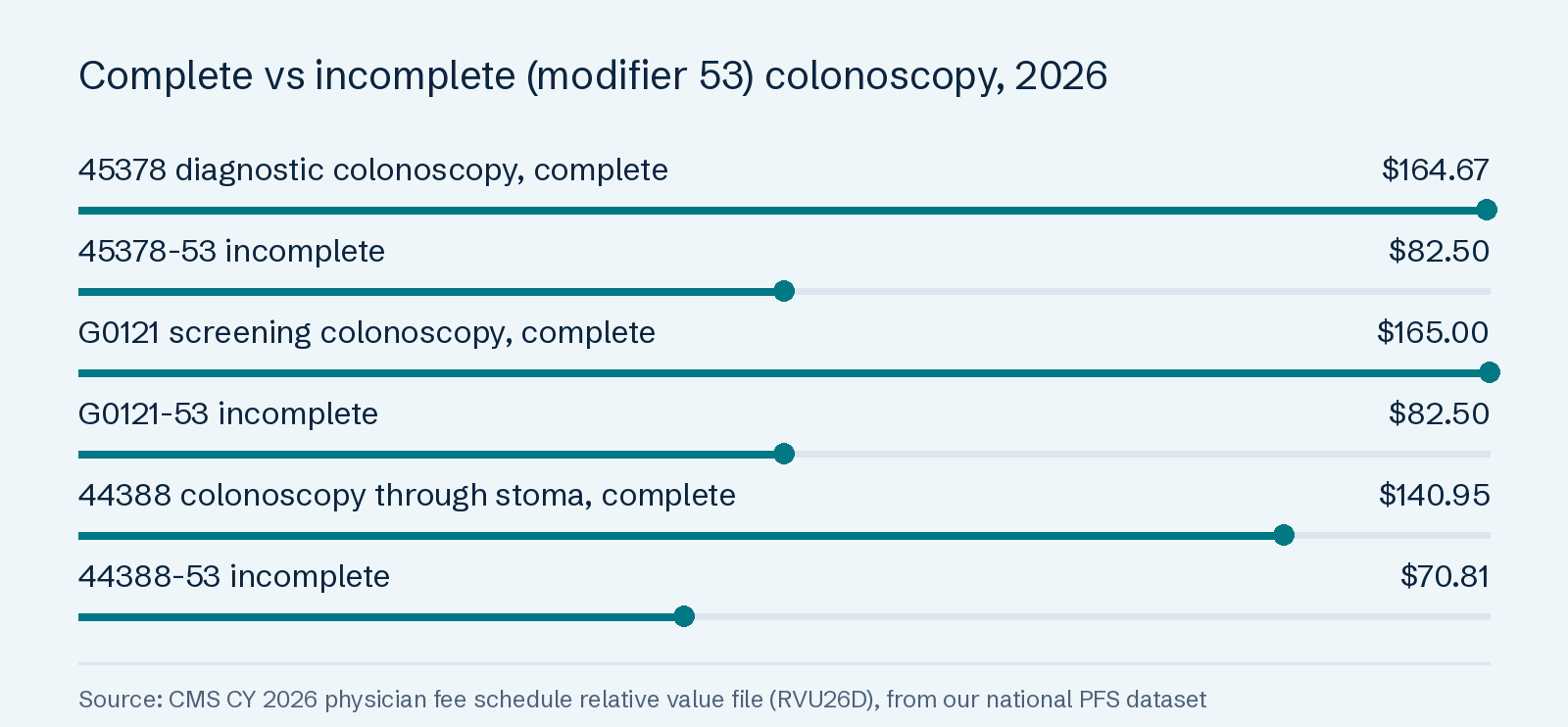
Colonoscopy is the clearest Medicare case. Chapter 12, section 30.1 says an incomplete colonoscopy, for example when the scope cannot reach the cecum because of unforeseen circumstances, is billed with 53 on 44388, 45378, G0105 or G0121, and that since January 1, 2016 Medicare pays it at a rate built from one-half the value of the code's inputs. The chart shows the effect, using 2026 national Medicare amounts (unadjusted, facility setting) from the CMS CY 2026 relative value file (RVU26D). Actual payment varies by locality, setting and payer.
Facility claims: 73 and 74 instead of 53
Hospital outpatient departments and ASCs report discontinued procedures with 73 or 74, and only when anesthesia was planned or provided. The anesthesia definition includes local, regional blocks, moderate sedation, deep sedation and general anesthesia.
- 73: the patient was prepared and taken to the procedure room, and the procedure stopped before anesthesia. Medicare pays 50 percent of the facility rate.
- 74: the procedure stopped after anesthesia was given or after it began (incision made, scope inserted). Medicare pays the full facility rate.
- No modifier, no payment: chapter 14 says an ASC claim for a procedure cancelled before the patient entered the room is denied, for example a surgery postponed because the patient arrived with a cold.
An ASC's claim for a terminated surgery must have an operative report on file that states the reason, the services and supplies used and not used, the time spent in each stage, and the code the completed surgery would have carried. In an ASC, lines billed with 52 or 73 are not reduced again by the multiple procedure discount.
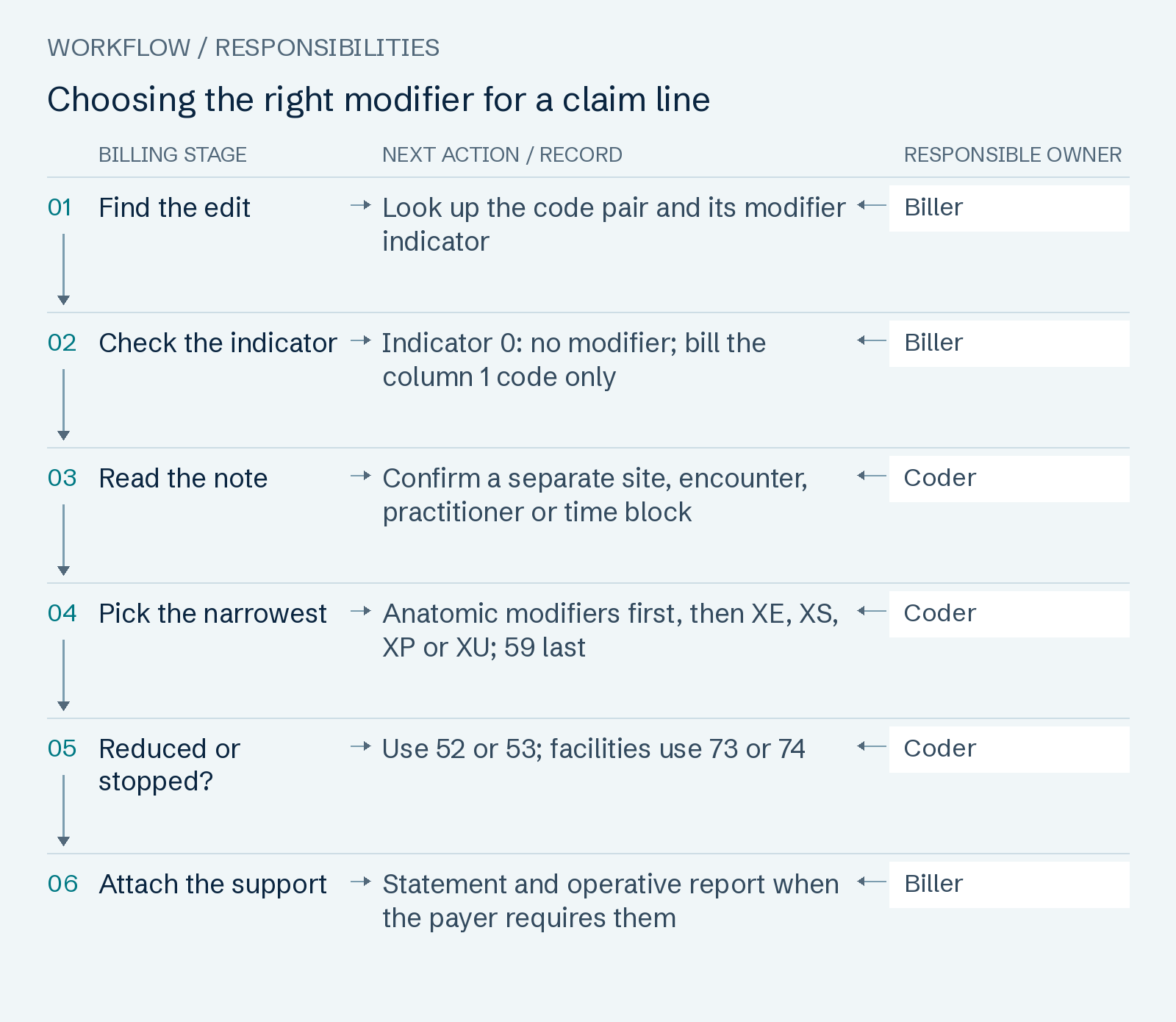
Read the workflow as text
- Find the edit — Look up the code pair and its modifier indicator Owner: Biller.
- Check the indicator — Indicator 0: no modifier; bill the column 1 code only Owner: Biller.
- Read the note — Confirm a separate site, encounter, practitioner or time block Owner: Coder.
- Pick the narrowest — Anatomic modifiers first, then XE, XS, XP or XU; 59 last Owner: Coder.
- Reduced or stopped? — Use 52 or 53; facilities use 73 or 74 Owner: Coder.
- Attach the support — Statement and operative report when the payer requires them Owner: Biller.
59 modifier and XE, XS, XP, XU
Modifier 59 tells the payer that two services an NCCI edit treats as overlapping were separate and distinct. CMS's MLN booklet on modifiers 59, XE, XP, XS and XU (MLN1783722, April 2026) says its main NCCI purpose is to show procedures at different anatomic sites or different patient encounters, and that 59 is used only when no other modifier better describes the relationship.
CMS added XE, XS, XP and XU as subsets of 59 effective January 1, 2015 in Change Request 8863, which says 59 was being treated as the modifier for bypassing NCCI edits. Five rules come from those two documents:
- Use the X modifier that fits instead of 59 whenever possible.
- Never put 59 and an X modifier on the same line; CR 8863 calls that incorrect.
- Expect some edits to require an X modifier: CR 8863 says CMS may require one for codes at high risk of incorrect billing, and contractors may require one for local program-integrity needs.
- Either code of the pair may carry the modifier; Medicare accepts it on the column 1 or column 2 code (CR 11168, cited in MLN1783722).
- Use the anatomic modifiers first. A pair done on opposite sides of the body takes RT and LT, not 59 or XS.
What 59 cannot do
Modifier 59 does not go on an E/M service. A separately identifiable visit on the same day as a procedure, such as a 99213 office visit, takes modifier 25. A different diagnosis on each line is neither required nor enough: MLN1783722 says the codes stay bundled unless the procedures were at different sites, at separate encounters, or in one of three limited cases. Two codes with different descriptors are not separate either; the booklet says not to use 59 or XU on that basis alone.
The three limited cases in one encounter
- Timed codes done one after the other (59 or XE): two timed services in separate, unmingled time blocks.
- A diagnostic procedure that decided the treatment (59 or XU): done first, not mingled with the treatment, and not a service the treatment would have required anyway.
- A diagnostic procedure after treatment (59 or XU): only when it is not a common, expected or necessary follow-up to that treatment.
Therapy examples: 97140 with 97530 and other NCCI pairs
The 97140 and 97530 pair is the one PT practices ask about most, and the current Medicare file answers it. In the October 2026 practitioner PTP edit files on the CMS NCCI PTP edits page, the edit pairing manual therapy (97140) with therapeutic activities (97530) shows a deletion date of December 31, 2019, and no active edit pairs the two codes. Medicare's NCCI edits therefore do not require 59 or an X modifier when both are billed on one date. A commercial plan or Medicaid program may run its own edit, so check that payer's policy before dropping a modifier you have been told to use.
The pairs below are active in the same file (practitioner edits; hospital outpatient edits are a separate file). Codes are described in our own words. For context, manual therapy (97140) carries a 2026 national Medicare amount (unadjusted) of $27.72 per unit in the office, so each wrongly bundled unit costs that much before locality adjustment.
PT and OT pairs
- 97140 with 97750 (physical performance test), indicator 1: CMS's own example says 59 fits when the two are done in distinctly different 15-minute blocks, and not when they share a block.
- 97140 with 97124 (massage), indicator 0: no modifier bypasses it, so Medicare pays only the column 1 code.
- 97150 (group therapy) with 97530, 97110 or 97140, indicator 1: a modifier applies only when the record shows the services were separate and distinct.
- PT evaluations 97161-97163 and OT evaluations 97165-97167 with 97750, indicator 0.
- OT evaluations 97165-97167 with the OT re-evaluation 97168, indicator 0.
Speech therapy with PT or OT codes
Chapter XI of the NCCI Policy Manual says speech language pathologists do not report 97110, 97112, 97150 or 97530 as unbundled services with speech treatment codes 92507, 92508 or 92526. It also says one practitioner may not bill 92507 or 92508 on the same date as 97129, 97130 or 97533, but a practice that employs a speech language pathologist and an occupational therapist may report both, with an NCCI PTP-associated modifier, when each was done by a different type of practitioner. XP describes that case.
Chiropractic pairs
Chapter XI, section S says 97112, 97124 and 97140 are not separately reportable in a spinal region that received chiropractic manipulative treatment. When they were done in a different region and the provider may bill those codes under Medicare, CMT and those codes may be reported with 59 or XS. The PTP file matches: 98940, 98941 and 98942 pair with 97140, 97112 and 97124 at indicator 1, and with the PT and OT evaluation codes 97161-97172 at indicator 0.
Modifier 59 is separate from the therapy discipline modifiers. GP, GO and GN, and payer modifiers such as SA, are covered in our guide to therapy provider modifiers including the SA modifier.
| Column 1 code | Column 2 code | Modifier indicator (Oct 2026) | What it means for the claim |
|---|---|---|---|
| 97140 manual therapy | 97530 therapeutic activities | No active edit (ended Dec 31, 2019) | No NCCI modifier needed for Medicare; check commercial policy |
| 97140 manual therapy | 97750 performance test | 1 | 59 or XE only for separate time blocks |
| 97530 therapeutic activities | 97750 performance test | 1 | 59 or XE only for separate time blocks |
| 97140 manual therapy | 97124 massage | 0 | No modifier bypasses; 97124 is not paid |
| 97150 group therapy | 97530 therapeutic activities | 1 | Modifier only when the record shows separate services |
| 97161-97163 PT evaluation | 97750 performance test | 0 | No modifier bypasses |
| 97165-97167 OT evaluation | 97168 OT re-evaluation | 0 | No modifier bypasses |
| 98940-98942 chiropractic manipulation | 97140, 97112 or 97124 | 1 | 59 or XS only for a different region than the CMT |
| 98940-98942 chiropractic manipulation | 97161-97172 PT or OT evaluation | 0 | No modifier bypasses |
Specialist examples: biopsies, cystoscopy, EKG
The same rules play out differently in procedure-heavy specialties. These examples come from CMS's own documents.
Skin biopsy with lesion destruction
MLN1783722's first example pairs a tangential skin biopsy (11102) with destruction of a premalignant lesion (17000). 59 or XS may go on either code when the two were done at different anatomic sites on the same side of the body. On opposite sides, the claim takes RT and LT instead.
Cystoscopy with biopsies
Chapter VII of the NCCI Policy Manual says cystourethroscopy with biopsy (52204) includes all biopsies done during the procedure and is reported as one unit, so extra bladder biopsies take no extra units and no 59. When two endoscopic approaches are medically necessary in one encounter to perform different procedures, the less extensive procedure takes modifier 51. When two approaches attempt the same procedure, only the completed approach is reported.
Rhythm ECG with a stress test
MLN1783722's seventh example pairs a cardiovascular stress test (93015) with a 1-3 lead rhythm ECG (93040). 59 or XE fits only when the rhythm ECG was interpreted and reported at a different encounter that day; a rhythm ECG read during the stress test is not billed separately, with or without 59.
When no modifier works
The booklet's sixth example, two arthroscopic procedures on the same shoulder in one session (29827 and 29820), takes no modifier at all: the column 2 code is not reported. On different shoulders, RT and LT apply, not 59.
Modifier denials and how to appeal them
A modifier denial is usually one of three things: a column 2 code denied because the claim had no PTP-associated modifier, a 52 line left unpriced because the documentation was missing, or a modifier the payer's own policy does not accept. Work them in this order:
- Check the edit's indicator. At 0, no modifier or appeal makes the column 2 code payable; write it off as correctly bundled and fix the habit.
- Read the note before adding anything. Add 59 or an X modifier only when the record shows a separate site, encounter, practitioner or time block.
- Use a reopening for a modifier slip. Claims Processing Manual, chapter 34, section 10.4 lists an incorrect data item, such as the use of a modifier, as a clerical error a contractor may correct by reopening. The contractor decides what qualifies, and a reopening cannot add services that were never billed.
- Appeal with the record. A Medicare redetermination must be filed within 120 days of receiving the initial determination, which is presumed received 5 calendar days after the notice date; the contractor generally decides within 60 days. Send the note that shows the separation or reduction, and for a 52 surgery line the statement and operative report.
- Follow each commercial plan's policy. Payment rules differ, as the 50% policies above show; appeal against the plan's written policy, not Medicare's.
Practices that want this worked for them can hand denials to our denial management services, and have codes checked against the note by our medical coding service: We check every code against your clinician's documentation and never change a code without the clinician's sign-off. To see which denied or unpaid claims are closest to a filing or appeal deadline first, Get my free A/R Deadline Map: Clock starts with your claim-level aging export and signed BAA; above 10 requests in a week, we confirm your date within 1 business day.
Common questions
- What does modifier 52 mean?
- Modifier 52 means the service was partly reduced or eliminated, the code still describes it, and no anesthesia was planned. Medicare prices a physician surgery with 52 only when a statement and the operative report come with the claim, and pays hospital outpatient and ASC 52 lines at 50 percent. See modifier 52: reduced services.
- What is the difference between modifier 52 and 53?
- Modifier 52 reports a service that was reduced, usually at the clinician's choice, with no anesthesia planned. Modifier 53 reports a procedure a physician started and stopped because of circumstances outside their control, such as a risk to the patient. Neither is for an elective cancellation, and facilities use 73 or 74 instead of 53.
- When should I use the 59 modifier?
- Use 59 only when an NCCI edit with indicator 1 bundles two codes, the record shows they were separate (different site, encounter, practitioner or time block), and no more specific modifier fits. CMS asks for XE, XS, XP or XU instead of 59 whenever one applies, and 59 never goes on an E/M code.
- Do PT practices need modifier 59 for 97140?
- Not with 97530 under Medicare: the NCCI practitioner edit between 97140 and 97530 ended December 31, 2019 and no active edit pairs them in the October 2026 file. 97140 still needs 59 or XE with 97750 when they are done in separate time blocks, and 59 or XS with chiropractic manipulation in a different region. Commercial plans may set their own edits.
- What are the X modifiers?
- XE, XS, XP and XU are HCPCS modifiers CMS created in 2015 as narrower versions of 59: a separate encounter, a separate organ or structure, a different practitioner, and an unusual non-overlapping service. Use the one that fits instead of 59, and never put 59 and an X modifier on the same line.
- Can my practice bill modifier 53 for a patient who cancels?
- No. Medicare says an elective cancellation is not reported, and Priority Health rules out 53 for elective cancellations. In an ASC, a procedure cancelled before the patient enters the room is denied; 73 applies only after the patient was prepared and taken to the room.
Sources and review
Page revised November 4, 2026 · Review contact: Hyder Shah (inquiries@claimpillar.com). Every source below was retrieved on November 4, 2026. Edit pairs come from the CMS October 2026 practitioner PTP files; Medicare amounts come from the CMS CY 2026 relative value file in our national PFS dataset. CPT codes are AMA property; the descriptions on this page are our own summaries.
- CMS MLN1783722: Proper Use of Modifiers 59, XE, XP, XS and XU (April 2026)
- Medicare NCCI Policy Manual 2026, Chapter I (section E, modifiers and modifier indicators)
- Medicare NCCI Policy Manual 2026, Chapter XI (speech, physical medicine, chiropractic)
- Medicare NCCI Policy Manual 2026, Chapter VII (cystourethroscopy)
- CMS Medicare NCCI PTP edits (October 2026 practitioner files)
- Medicare Claims Processing Manual, Chapter 4, section 20.6.4 (modifiers 52, 53, 73, 74)
- Medicare Claims Processing Manual, Chapter 12 (sections 30.1, 40.2 and 40.4)
- Medicare Claims Processing Manual, Chapter 14, section 40.4 (ASC terminated procedures)
- Medicare Claims Processing Manual, Chapter 34 (reopenings and clerical errors)
- CMS Change Request 8863, Transmittal 1422 (X modifiers)
- Priority Health provider manual: modifier 52
- Priority Health provider manual: modifier 53
- BCBS North Dakota reimbursement policy: modifier 52
- CMS: first level of appeal, redetermination
- CMS PFS relative value files (CY 2026, RVU26D)