Telehealth vs telemedicine: the definitions
Telemedicine is the older word and telehealth the one most rules use now; for a therapy claim the difference is vocabulary, not payment. Medicaid.gov defines telehealth as the use of telecommunications and information technology for health assessment, diagnosis, intervention, consultation and supervision, and notes that telehealth in Medicaid had been referred to as telemedicine. The table compares how the sources your practice deals with use each word.
What each source calls a video or phone session
Read the table by column: the term a source uses, and what that source actually counts as a remote session. The second column is what affects your claims.
| Source | Term it uses | What it counts as a remote session |
|---|---|---|
| Medicare regulation (42 CFR 410.78) | Telehealth services | Two-way, real-time audio and video; audio-only allowed for a patient at home under set conditions |
| CMS place of service code set | Telehealth (POS 02 and POS 10) | Care through telecommunication technology, split by whether the patient is at home |
| Medicaid.gov (CMS) | Telehealth, formerly telemedicine | States set most delivery details; services must meet the state plan |
| UnitedHealthcare commercial policy 2026R0046A | Telehealth/Telemedicine, used interchangeably | Live, interactive audio and video only; audio-only is a separate category |
| ASPPB and PSYPACT | Telepsychology | A psychologist's remote practice across state lines under the compact |
Which term payers and regulators use
Medicare uses telehealth throughout. 42 CFR 410.78 defines an interactive telecommunications system as audio and video equipment permitting two-way, real-time communication, and Medicare pays for services on its telehealth list delivered that way. CMS's telehealth booklet (MLN901705) lists clinical psychologists, clinical social workers, marriage and family therapists and mental health counselors among the practitioners who can bill Medicare for telehealth.
Commercial plans and state laws use either word, sometimes both. UnitedHealthcare's commercial telehealth policy says the terms telehealth and telemedicine are used interchangeably, and limits that category to live audio and video. The Center for Connected Health Policy's state law tracker quotes statutes using telehealth, telemedicine or both, depending on the state.
When the word still matters to your practice
The label matters when a payer defines it narrowly. Under UnitedHealthcare's policy, a phone session is not telehealth/telemedicine at all; it is billed under the audio-only rules with modifier 93, and only for codes on the AMA's audio-only list. Read each payer's definition before you schedule phone sessions, not after the denial.
Billing teletherapy: codes, POS and modifiers in brief
Teletherapy uses the same psychotherapy code as an office session, chosen by the minutes in the note; our guide to the 90837 code for 53-minute sessions covers the time rule. The place of service says where the client was (Medicare: POS 10 at home, POS 02 elsewhere), and modifier 93 marks an audio-only session. Payers disagree on modifiers 95 and GT and on POS 10, so the payer-by-payer grid lives in our GT and 95 modifier guide.
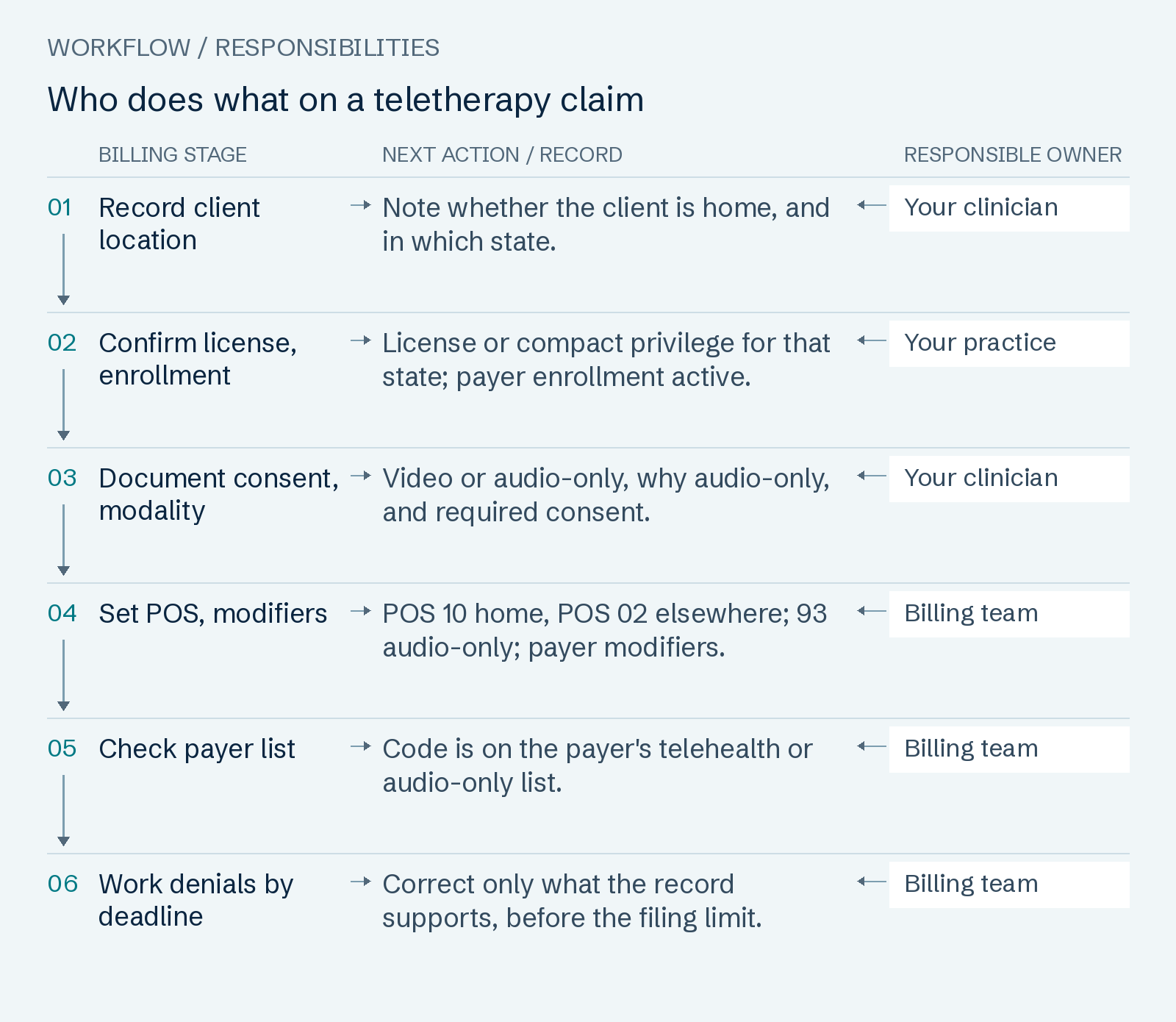
Read the workflow as text
- Record client location — Note whether the client is home, and in which state. Owner: Your clinician.
- Confirm license, enrollment — License or compact privilege for that state; payer enrollment active. Owner: Your practice.
- Document consent, modality — Video or audio-only, why audio-only, and required consent. Owner: Your clinician.
- Set POS, modifiers — POS 10 home, POS 02 elsewhere; 93 audio-only; payer modifiers. Owner: Billing team.
- Check payer list — Code is on the payer's telehealth or audio-only list. Owner: Billing team.
- Work denials by deadline — Correct only what the record supports, before the filing limit. Owner: Billing team.
Teletherapy claim checklist: what every session needs before it bills
Run these five checks on every teletherapy claim. Each one maps to a common denial reason.
- Code. The psychotherapy code matches the minutes in the note, and the code is on the payer's telehealth list (Medicare's list, or the payer's own).
- POS. POS 10 if the client was at home, POS 02 if not, per the CMS telehealth FAQ, unless a payer's policy says otherwise.
- Modifier. 93 for an audio-only session, any modifier the payer requires for video, and from January 1, 2027 Medicare's BB or BC where they apply.
- Consent. Any telehealth consent your state or the payer requires is on file, and an audio-only note records why video was not used.
- Location. The note records the client's physical location and state, and the clinician is licensed or compact-authorized there and enrolled with the payer.
Medicare telehealth dates for therapy practices: 2027 and 2028
Medicare telehealth status, checked November 5, 2026 against the CMS Telehealth FAQ updated October 8, 2026:
- Through December 31, 2027: beneficiaries can receive Medicare telehealth anywhere in the United States, and audio-only telehealth at home continues.
- Behavioral health at home stays: the Consolidated Appropriations Act, 2021 made it permanent, audio-only included.
- From January 1, 2027: CMS requires modifier BB (a platform contracted or paid for by the practitioner) and BC (incident-to telehealth) where they apply; CMS says they do not change payment.
- After December 31, 2027: an in-person, non-telehealth visit is required within 6 months before the first mental health telehealth service, and CMS says patients who began before that date are treated as established; they need at least one in-person visit every 12 months.
- From January 1, 2028: physical therapists, occupational therapists, speech-language pathologists and audiologists can no longer furnish Medicare telehealth.
The 12-month rule in 42 CFR 410.78 allows an exception when the clinician and patient agree the risks and burdens of an in-person visit outweigh the benefits and the reason is documented, and a colleague of the same specialty and subspecialty in the same group may provide the visit if the treating clinician is unavailable. Track each Medicare client's last in-person date now so 2028 does not start with unpaid sessions.
| Date | What changes for Medicare telehealth | What your practice does |
|---|---|---|
| January 1, 2027 | Modifier BB (practitioner-contracted platform) or BC (incident-to telehealth) required where they apply; no payment change | Ask your billing team which claims need BB or BC |
| After December 31, 2027 | In-person visit within 6 months before the first mental health telehealth service; established clients need one every 12 months | Log each Medicare client's last in-person date, or document the exception |
| January 1, 2028 | Physical therapists, occupational therapists, speech-language pathologists and audiologists can no longer furnish Medicare telehealth | Move those Medicare visits in person |
Licensure across state lines: PSYPACT and the Counseling Compact
A teletherapy session takes place where the client is, so the clinician needs authority to practice in that state. CMS adds that all distant site providers are subject to state licensing requirements and need a separate Medicare enrollment for each state where they provide services. The license or compact privilege stays with the clinician; payer enrollment is a separate step, and our credentialing for LPCs, LCSWs, LMFTs and psychologists files it with Medicare and the other plans you choose. Two compacts cover two license types.
PSYPACT for psychologists
ASPPB describes a two-step process: an E.Passport from ASPPB, then an Authorization to Practice Interjurisdictional Telepsychology (APIT) from the PSYPACT Commission. The psychologist must be licensed and physically present in a participating home state when delivering telepsychology, renew with three hours of technology-related continuing education a year, and follow the scope of practice of the client's state. ASPPB's fee page lists the E.Passport at $400.00, or $440.00 including the APIT processing fee.
The Counseling Compact for professional counselors
The Counseling Compact lets professional counselors licensed and living in a member state obtain a privilege to practice, equivalent to a license, in other member states. On November 5, 2026 its site listed licensees in 11 states as live: Arizona, Arkansas, Georgia, Indiana, Louisiana, Minnesota, Missouri, Ohio, Oklahoma, Tennessee and Wyoming, each able to apply for privileges in the others. Recent graduates still completing supervised hours are not eligible.
Neither compact covers clinical social workers or marriage and family therapists. For them, and for any state outside a compact, check with the licensing board in the client's state before the first session.
Consent, privacy and HIPAA-compliant platforms
Consent rules come mostly from states and payers. CCHP's state requirements tracker shows how they differ: California, for example, ties a telehealth patient's consent to section 2290.5 of its Business and Professions Code, and Colorado's workers' compensation telemedicine rule points practitioners to its practice acts and informed-consent rules. Keep your state's wording on your intake form, and record consent before the first remote session.
For audio-only Medicare sessions, consent is part of the claim itself: the regulation allows audio-only when the patient is not capable of, or does not consent to, video, and modifier 93 certifies that.
Your video platform and the business associate agreement
Under the HIPAA Privacy Rule, 45 CFR 164.502(e) lets a covered entity allow a business associate to create, receive, maintain or transmit protected health information only with satisfactory assurance that the information will be safeguarded. In practice that means a signed business associate agreement with your video platform, scheduling tool and billing company before any of them touch client data. Ask the vendor for its BAA before you sign up, not after.
Telehealth denials and fixes
Most teletherapy denials trace back to one of the checklist items above: the wrong place of service, audio-only without modifier 93, a payer-specific modifier rule, or a clinician not licensed or enrolled where the client was. Correct a claim only when the record supports the change, and watch the payer's filing limit while you do. The full denial list, with the fix for each payer, is in our telehealth modifier guide.
When to hand teletherapy billing off
Hand billing off when these corrections repeat every month or the oldest sessions are near their filing limit. Our behavioral health billing service checks place of service, modifiers and enrollment on each claim. If claims have already aged, start with The Free A/R Deadline Map: A claim-by-claim list of every unpaid insurance claim over 90 days in the aging report you send: payer, amount, the deadline it faces, the denial reason and the next action, sorted by deadline. Clock starts with your claim-level aging export and signed BAA; above 10 requests in a week, we confirm your date within 1 business day.
Common questions
- What is the difference between telehealth and telemedicine?
- For billing, none that changes payment. Medicare uses telehealth, Medicaid.gov says telehealth was formerly called telemedicine, and UnitedHealthcare uses the two interchangeably. The place of service and modifiers decide payment, not the word.
- Is teletherapy billed differently from in-person therapy?
- The psychotherapy code is the same and is chosen by documented minutes. What changes is the place of service (POS 10 for a client at home, POS 02 elsewhere for Medicare), modifier 93 for audio-only sessions, and any modifier the payer requires. Medicare pays a home session at the non-facility rate.
- Which POS code do I use for telehealth therapy?
- For Medicare, CMS says POS 10 when the client is in their home and POS 02 when they are somewhere else. UnitedHealthcare commercial plans accept the same two codes. Check other payers' policies, since some set their own place of service rule.
- Can I see clients in another state by telehealth?
- Only with authority to practice in the client's state: a license there, a PSYPACT authorization for psychologists, or a Counseling Compact privilege for counselors in live member states. Medicare also requires a separate enrollment for each state where you provide services.
- Does Medicare still cover telehealth therapy?
- Yes. Behavioral health telehealth to a client at home is permanent, and audio-only is allowed. Broader flexibilities run through December 31, 2027; after that, an in-person visit is required within 6 months before the first mental health telehealth service and every 12 months, with a documented exception allowed.
- Which modifier do I use for an audio-only therapy session?
- Medicare requires modifier 93 on audio-only telehealth, plus FQ for RHCs and FQHCs, when the clinician could use video and the client could not or did not consent. UnitedHealthcare pays 93 only on codes in the AMA audio-only list.
Sources and review
Page revised November 5, 2026 · Review contact: Hyder Shah (inquiries@claimpillar.com). Every source below was retrieved and checked on November 5, 2026. Medicare amounts are 2026 national Medicare amounts (unadjusted) from our dataset built on the CMS CY 2026 PFS relative value file (RVU26D); actual payment varies by locality, setting and payer. Payer rules apply only to the payer and program named.
- CMS Telehealth FAQ (updated 10/8/2026)
- CMS MLN901705: Telehealth & Remote Monitoring (December 2025)
- CMS MLN Matters MM13452: Medicare Physician Fee Schedule Final Rule Summary, CY 2024
- eCFR: 42 CFR 410.78, Telehealth services
- Medicaid.gov: Telehealth
- UnitedHealthcare Commercial Reimbursement Policy 2026R0046A: Telehealth/Virtual Health Policy, Professional
- ASPPB: E.Passport (practicing telepsychology under PSYPACT)
- ASPPB: E.Passport FAQs (fees)
- Counseling Compact: privilege to practice and live states
- eCFR: 45 CFR 164.502, uses and disclosures of protected health information
- Center for Connected Health Policy: state telehealth requirements