OT CPT codes at a glance
The table lists the codes an outpatient occupational therapy practice bills most often; AOTA publishes its own yearly list of frequently used OT CPT and HCPCS codes for comparison. The labels are our own short descriptions, not the official CPT wording. The status column comes from the CMS 2026 Therapy Code List and Dispositions: an always-therapy code needs a therapy modifier whoever performs it, and a sometimes-therapy code needs one when a therapist furnishes it under a plan of care. Amounts are the 2026 national Medicare amount (unadjusted, non-facility) from the CMS CY 2026 physician fee schedule relative value file; actual payment varies by locality, setting and payer.
Two Medicare reductions apply after these numbers. The CMS therapy services page pays the highest practice-expense service of the day in full and 50% of the practice-expense part of the second and later always-therapy services, and lines an OT assistant furnished in whole or in part pay at 85%. Psychotherapy codes are not on this list; clinics that also bill counseling will find that side on our 90837 CPT code page.
| Code | Our short label | Timed or untimed | Medicare therapy status | 2026 national Medicare amount (unadjusted) |
|---|---|---|---|---|
| 97165 | OT evaluation, low complexity | Untimed, 1 unit | Always therapy, GO only | $100.54 |
| 97166 | OT evaluation, moderate complexity | Untimed, 1 unit | Always therapy, GO only | $100.54 |
| 97167 | OT evaluation, high complexity | Untimed, 1 unit | Always therapy, GO only | $100.54 |
| 97168 | OT re-evaluation | Untimed, 1 unit | Always therapy, GO only | $68.47 |
| 97530 | Dynamic functional activities | Timed, per 15 minutes | Always therapy | $35.07 |
| 97535 | Self-care and home management training | Timed, per 15 minutes | Always therapy | $32.40 |
| 97110 | Therapeutic exercise | Timed, per 15 minutes | Always therapy | $29.06 |
| 97112 | Neuromuscular re-education | Timed, per 15 minutes | Always therapy | $32.73 |
| 97140 | Manual therapy | Timed, per 15 minutes | Always therapy | $27.72 |
| 97129 | Cognitive function intervention, first 15 minutes | Timed | Sometimes therapy | $22.38 |
| 97130 | Cognitive intervention add-on, each extra 15 | Timed, add-on | Sometimes therapy | $21.04 |
| 97533 | Sensory integration, one-on-one | Timed, per 15 minutes | Always therapy | $60.79 |
| 97542 | Wheelchair management | Timed, per 15 minutes | Always therapy | $31.06 |
| 97150 | Group therapy, per patient | Untimed | Always therapy | $18.04 |
| 97760 | Orthotic management, first encounter | Timed, per 15 minutes | Always therapy | $46.09 |
| 97763 | Orthotic management, later encounters | Timed, per 15 minutes | Always therapy | $50.10 |
| 97550 | Caregiver training without patient, first 30 minutes | Timed | Sometimes therapy | $52.77 |
Evaluation codes 97165-97167 and re-evaluation 97168
The OT evaluation level is set by three components, and all three must reach the level billed. The component structure comes from the CPT descriptors CMS published in its CY 2017 physician fee schedule final rule (81 FR 80170), when the codes took effect. The guide below summarizes them in our own words; the CPT codebook holds the controlling text.
One evaluation per date
The NCCI Policy Manual, chapter 11, lets an occupational therapist report only one evaluation or re-evaluation (97165 to 97168) on a date of service. A PT evaluation and an OT evaluation on the same day pay only when two different practitioners performed them. Re-evaluation 97168 is not a routine progress check: during a planned course of care it needs a change in the patient's status, and then modifier 59 or XU goes on 97168 where a pair edit applies. All four OT evaluation codes carry a GO-only flag on the CMS therapy code list, so bill them with GO and never GP.
| Component | 97165 (low) | 97166 (moderate) | 97167 (high) |
|---|---|---|---|
| Occupational profile and history | Brief review of records tied to the presenting problem | Expanded record review plus added physical, cognitive or psychosocial history | Extensive added history affecting current function |
| Performance deficits found | 1 to 3 | 3 to 5 | 5 or more |
| Clinical decision making | Low: limited treatment options, no comorbidities affecting occupational performance | Moderate: several options, comorbidities may affect performance | High: multiple options, comorbidities affect performance |
| Help needed to finish the assessment | None | Minimal to moderate task modification or assistance | Significant task modification or assistance |
| Typical face-to-face time in the descriptor | About 30 minutes | About 45 minutes | About 60 minutes |
Most-billed timed codes: 97530, 97535, 97110, 97112, 97140
These five codes carry most OT treatment minutes, and all five are always-therapy codes billed in 15-minute units. The Medicare Claims Processing Manual, chapter 5, section 20.2, counts units from the total timed minutes of the day: 8 to 22 minutes is 1 unit, 23 to 37 is 2, 38 to 52 is 3 and 53 to 67 is 4. Its own occupational therapy example is 60 minutes of 97530 billed as 4 units. When a visit mixes codes, the minutes are pooled first and then split, so each code gets a unit for every full 15 minutes before the leftovers decide the rest. Our guide to physical therapy billing units works mixed PT and OT visits minute by minute, including payers that count each code on its own.
97530 or 97535: what the session trained
The two codes sound alike but answer different questions. 97530 fits dynamic, task-based activity aimed at functional performance, such as reaching, lifting or transfer practice. 97535 fits training in the patient's own daily routines: dressing, bathing, meal preparation, safety at home and use of adaptive equipment. The note should name the activity and the goal it serves, because the label on the claim has to match what the record says the therapist trained.
97110, 97112 and 97140 on an OT plan
Exercise, neuromuscular re-education and manual therapy are shared with physical therapy. On an OT plan of care they take GO instead of GP; the code does not change. The Medicare practitioner pair edits that once bundled 97140 with 97530 and 97530 with 97535 were deleted (effective end dates of December 31, 2019 and December 31, 2021 in the CMS practitioner PTP edit file, version 32.3). The NCCI manual still bars two therapy services in the same 15 minutes, apart from supervised modalities, so each code needs its own minutes.
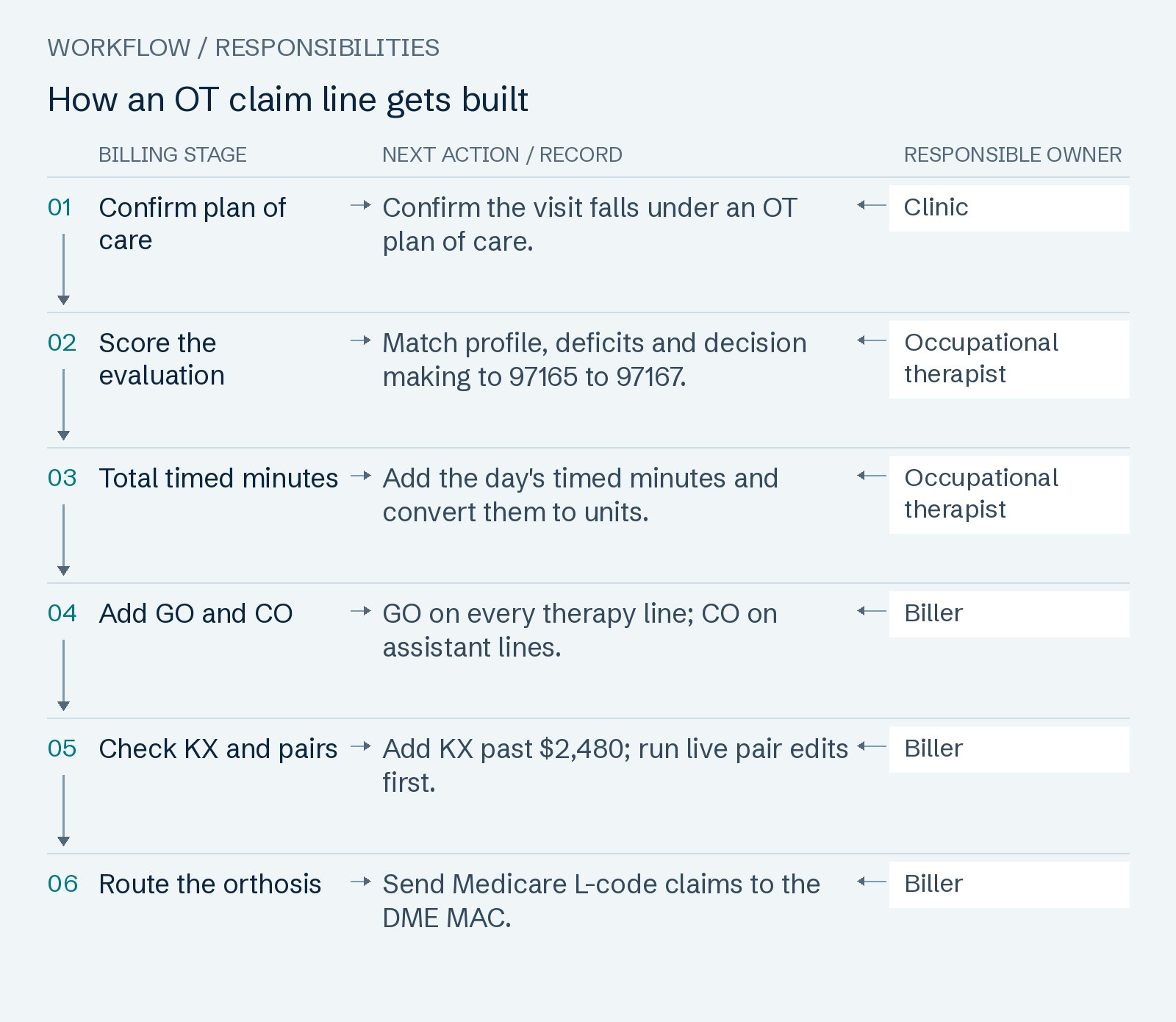
Read the workflow as text
- Confirm plan of care — Confirm the visit falls under an OT plan of care. Owner: Clinic.
- Score the evaluation — Match profile, deficits and decision making to 97165 to 97167. Owner: Occupational therapist.
- Total timed minutes — Add the day's timed minutes and convert them to units. Owner: Occupational therapist.
- Add GO and CO — GO on every therapy line; CO on assistant lines. Owner: Biller.
- Check KX and pairs — Add KX past $2,480; run live pair edits first. Owner: Biller.
- Route the orthosis — Send Medicare L-code claims to the DME MAC. Owner: Biller.
Cognitive and sensory codes (97129, 97130, 97533)
97129 and 97130 report one-on-one cognitive intervention: 97129 for the first 15 minutes and 97130 as the add-on for each further 15 minutes, so 97130 never stands alone on a claim. The CMS 2026 therapy code list marks both as sometimes-therapy codes: when an occupational therapist furnishes them under a plan of care they are therapy services and need GO, and when a psychologist or physician bills them outside a therapy plan the therapy modifiers and thresholds do not apply.
97533, one-on-one sensory integration in 15-minute units, is an always-therapy code, and its 2026 national Medicare amount (unadjusted) is $60.79 per unit, the highest of the OT treatment codes in the table above. Its value makes the documentation matter: the note should show direct one-on-one contact for the minutes billed.
The NCCI manual adds a same-day rule that hits pediatric and neuro clinics. A single practitioner may not report speech treatment 92507 or 92508 on the same date as 97129, 97130 or 97533. When a speech-language pathologist provides the speech treatment and an occupational therapist provides the cognitive or sensory work, one billing entity may report both with an NCCI PTP-associated modifier.
Orthotic fitting and L-codes in hand therapy
A hand therapy orthotic visit can carry two kinds of code: a CPT code for the therapist's time (97760 or 97763) and a HCPCS Level II L-code for the orthosis itself. 97760 covers orthotic management and training at the first orthotic encounter, and 97763 covers later encounters, both in 15-minute units. The CMS October 2026 HCPCS file spells out what each L-code includes, and several custom-fabricated descriptors say "includes fitting and adjustment". 97760 counts fitting only when it is not otherwise reported, so bill only the management and training minutes the device code does not already pay for, and record them separately.
Pair edits that deny orthotic lines
- 97763 with an OT evaluation (97165 to 97167): an active Medicare edit with no modifier bypass when one practitioner or two of the same specialty did both. Move the follow-up orthotic work to another visit.
- 97760 with 97763: active, with no modifier bypass. The first encounter is 97760; later ones are 97763.
- 97760 with 97168: not separately reportable when the same practitioner or specialty does both, per the NCCI manual.
- 97760 with 97110, 97112 or 97140: active edits that allow a modifier when the services filled different time intervals.
- 97760 with gait training 97116: the CMS 2026 therapy code list says not to report them for the same extremity; the pair edit allows a modifier when they apply to different extremities.
Who bills the device to Medicare
The therapy time goes on the Part B claim to your A/B MAC. The orthosis does not: the Medicare Claims Processing Manual, chapter 1, section 10.1.5.1, sends claims from suppliers of durable medical equipment, prosthetics, orthotics and supplies (DMEPOS) to a DME MAC, apart from items furnished incident to a physician's service, which the A/B MAC processes; CMS keeps a jurisdiction list by HCPCS code that settles which contractor takes each code. A practice that wants Medicare to pay for the splint therefore bills it as a DMEPOS supplier. Commercial plans and Medicaid set their own rules for therapist-supplied orthoses, so check each plan's policy first.
| L-code | Device (per the HCPCS file) | Custom or prefabricated | Fitting in the descriptor |
|---|---|---|---|
| L3806 | Wrist hand finger orthosis with nontorsion joints | Custom fabricated | Yes, fitting and adjustment |
| L3807 | Wrist hand finger orthosis without joints | Prefabricated, customized to fit by an individual with expertise | Customization to fit |
| L3808 | Rigid wrist hand finger orthosis without joints | Custom fabricated | Yes, fitting and adjustment |
| L3809 | Wrist hand finger orthosis without joints | Prefabricated, off-the-shelf | No |
| L3913 | Hand finger orthosis without joints | Custom fabricated | Yes, fitting and adjustment |
| L3919 | Hand orthosis without joints | Custom fabricated | Yes, fitting and adjustment |
| L3921 | Hand finger orthosis with nontorsion joints | Custom fabricated | Yes, fitting and adjustment |
| L3923 | Hand finger orthosis without joints | Prefabricated, customized to fit by an individual with expertise | Customization to fit |
| L3924 | Hand finger orthosis without joints | Prefabricated, off-the-shelf | No |
Modifiers: GO, KX, CQ, 59
Four modifiers decide whether a Medicare OT line pays, and one of the names in this heading belongs to physical therapy. CQ marks a PT assistant's service; the occupational therapy match is CO, which the CMS therapy services page requires beside GO when an OT assistant furnished the service in whole or in part, paying the line at 85%. A practice that runs both disciplines should check that no OT line carries CQ.
| Modifier | What it tells the payer | When it goes on an OT line |
|---|---|---|
| GO | Service delivered under an outpatient OT plan of care (Claims Processing Manual, chapter 5) | Every always-therapy line, and every sometimes-therapy line a therapist furnishes; never with GP or GN on the same line |
| CO | An OT assistant furnished the service in whole or in part | Beside GO on assistant lines; Medicare pays 85% of the fee schedule amount |
| CQ | A PT assistant furnished the service | Not on OT lines; it belongs on GP lines |
| KX | Services above the threshold are medically necessary and documented | Once the patient's 2026 OT total passes $2,480; claims above it without KX are denied, and OT above $3,000 may be picked for targeted medical review |
| 59 or XU | A distinct service despite a pair edit | Only when the two services filled different time intervals, or on 97168 after a documented change in status |
Pediatric OT coding tips
Pediatric OT claims lean on a different part of the code set than adult rehab: sensory integration, self-care and play-based functional activity, group sessions and parent training. Five points cover most of the coding questions a pediatric clinic meets.
- Separate 97533 from 97530 by what the child did. Sensory-processing work under one-on-one contact is 97533; task practice aimed at a functional goal is 97530. Each needs its own minutes.
- Coordinate same-day speech visits. When the same child sees a speech-language pathologist that day, 92507 and the OT's 97533 or 97129 can both be reported by one entity with an NCCI modifier, because two different practitioners furnished them. The speech therapy billing codes guide covers the SLP side.
- Bill parent training without the child as caregiver training. CMS added 97550, 97551 and 97552 in 2024 for training a caregiver face to face without the patient present, and lists them as sometimes-therapy codes that take GO when a therapist furnishes them under a plan of care. Since 2025, 97550 bills only when the full first 30 minutes were provided.
- Use 97150 only for true groups. Group therapy treats two or more patients at the same time. The Medicare Benefit Policy Manual, chapter 15, section 230, requires the therapist's constant attendance but not one-on-one contact, so minutes billed to one-on-one codes need one-on-one time in the note.
- Check the payer before applying Medicare rules. Medicaid and commercial plans publish their own unit, authorization and modifier rules. The Medicare rules on this page are a baseline, not a guarantee of how another payer edits a claim.
When OT claims keep coming back
Most rejected OT lines trace to a short list: an evaluation billed with GP, units counted code by code, CO missing from an assistant line, KX left off past $2,480, 97763 billed on an evaluation day, or an orthosis sent to the wrong contractor. Each one is visible on the claim before it goes out, which makes a pre-submission check worth more than a fast appeal.
If those denials keep returning, you can hand the work off. Our page on billing for occupational therapy sets out what we take over for private-practice occupational therapists and multi-discipline rehab groups. To see where your open claims stand first, request The Free A/R Deadline Map: A claim-by-claim list of every unpaid insurance claim over 90 days in the aging report you send: payer, amount, the deadline it faces, the denial reason and the next action, sorted by deadline. Clock starts with your claim-level aging export and signed BAA; above 10 requests in a week, we confirm your date within 1 business day. Start the free A/R review, or ask us about your OT claims.
Common questions
- What are the most common occupational therapy CPT codes?
- The core set is evaluations 97165, 97166 and 97167, re-evaluation 97168, and the timed treatment codes 97530 (functional activities), 97535 (self-care and home management training), 97110 (exercise), 97112 (neuromuscular re-education) and 97140 (manual therapy). Pediatric and neuro clinics add 97533 and 97129, and hand therapy adds 97760, 97763 and L-codes. AOTA also publishes a yearly list of frequently used OT codes.
- How is OT evaluation complexity chosen?
- By three components that must all reach the level billed: how deep the occupational profile and history go, how many performance deficits the assessment finds (1 to 3, 3 to 5, or 5 or more), and how complex the clinical decision making is, including comorbidities and how much help the patient needs to finish the assessment. Medicare pays all three levels the same 2026 national amount (unadjusted), $100.54, but the note still has to support the level.
- Can 97530 and 97535 be billed on the same day?
- Yes, when each has its own minutes. Medicare's pair edit between the two was deleted after December 31, 2021 (CMS PTP edits), but the NCCI manual still bars two therapy services in the same 15 minutes. Each code needs its own minutes, and check commercial payers, which may run their own edits.
- What is the GO modifier?
- GO tells the payer the service was delivered under an outpatient occupational therapy plan of care. The Claims Processing Manual, chapter 5, requires GO, GP or GN on every therapy line and allows only one of them per line. OT evaluation codes 97165 to 97168 accept GO only.
- What is the 2026 KX threshold for occupational therapy?
- $2,480 for OT, tracked separately from the $2,480 shared by physical therapy and speech-language pathology, per CMS. Lines above the threshold without KX are denied, and OT claims above $3,000 may be selected for targeted medical review.
- Can an occupational therapist bill Medicare for a splint?
- The therapist's time bills as 97760 or 97763 on the Part B claim. The orthosis itself is an L-code that Medicare processes through the DME MAC, which takes claims from DMEPOS suppliers, so the practice bills the device as a supplier. Custom-fabricated L-codes such as L3808 and L3913 already include fitting and adjustment.
Sources and review
Page revised November 5, 2026 · Review contact: Hyder Shah (inquiries@claimpillar.com). Every source below was retrieved and checked on November 5 or 6, 2026. Medicare amounts are 2026 national Medicare amounts (unadjusted) from our dataset built on the CMS CY 2026 PFS relative value file (RVU26D); actual payment varies by locality, setting and payer. Pair edits come from the fourth-quarter 2026 practitioner PTP file (version 32.3). CPT descriptions are our own short labels.
- CMS: Therapy Services (2026 KX threshold, CO payment, MPPR)
- CMS: Annual Therapy Update, 2026 Therapy Code List and Dispositions
- CMS Medicare Claims Processing Manual, Chapter 5 (therapy modifiers, timed units)
- CMS NCCI Policy Manual for Medicare Services, Chapter 11 (revised January 1, 2026)
- CMS: Medicare NCCI procedure-to-procedure edits (practitioner file v32.3, Q4 2026)
- AOTA: 2026 Frequently Used CPT and HCPCS Codes for Occupational Therapy
- Federal Register, 81 FR 80170 (Nov. 15, 2016): CY 2017 PFS final rule, OT evaluation codes
- CMS: HCPCS Quarterly Update (October 2026 alpha-numeric file)
- CMS Medicare Claims Processing Manual, Chapter 1, Section 10.1.5.1 (DMEPOS claims to DME MACs)
- CMS Medicare Benefit Policy Manual, Chapter 15, Section 230 (group therapy)
- CMS CY 2026 PFS relative value files (RVU26D)