Which sources do our medical billing pages accept?
A billing rule on this site is only as good as the document behind it, so our pages cite the organization that sets the rule: CMS for Medicare, a Medicare Administrative Contractor (MAC) for its own jurisdiction, the payer for its own contract terms, and the state agency for its Medicaid program. A billing-company blog can help locate an official document; agreement among blogs does not verify a rule.
Primary sources we cite
A primary source is the document the rule comes from. For Medicare's claim deadline, that is the Medicare Claims Processing Manual, Chapter 1, which says that, in general, Medicare fee-for-service claims must be filed "no later than 12 months, or 1 calendar year, after the date the services were furnished." We quote that sentence; we do not quote someone else's summary of it.
Every rule keeps its scope
A MAC article covers the states in that MAC's jurisdiction, a Medicare Advantage rule covers that product line, and a facility rule is not a clinician rule. Readers should check the named payer, program, jurisdiction and effective date against their own situation. Our practice-owner guides keep those distinctions with the claims they qualify.
| Source type | What we use it for | What we never use it for |
|---|---|---|
| CMS manuals, MLN booklets, transmittals | Medicare billing, filing and appeal rules | Rules for commercial or Medicaid plans |
| Medicare Administrative Contractor pages | Denial causes and fixes, cited to that MAC | National rules, unless CMS says the same |
| eCFR and the Federal Register | Regulation text and effective dates | Plan-specific deadlines |
| Payer provider manuals and web pages | That payer's filing limits and claim rules | Other payers' or other states' terms |
| State Medicaid manuals | That state's fee-for-service program rules | Managed-care plan contract terms |
| Billing blogs and directories | Finding the official document's address | Any number, deadline or rule we publish |
How we record and check source evidence
Source review and automated page checks answer different questions. A saved document supports the particular passage checked against it. A build check can catch a broken link or unresolved field, but it cannot establish that every billing statement is correct or current. Our source records include dated retrievals, stored passages and documented exceptions; they do not establish a fresh check of every claim on every revision date.
- Identify the primary source. Start with the payer, CMS, the responsible Medicare contractor, a regulation or the state agency.
- Record the retrieval. Save when the document was accessed. If an archived copy is used because the current source is unavailable, identify that limitation rather than treating the archive as current.
- Keep supporting evidence. Retain the relevant passage or dataset record with its source address and date, and preserve the payer, program and effective-date conditions.
- Separate source values from calculations. Identify the formula and assumptions for a worked calculation; label examples and national comparisons so they cannot be mistaken for a practice-specific quote or payment.
- Run structural checks. Validate page links, offer references, required fields and rendered output. These checks supplement factual and professional review.
- Record the kind of update. A page revision, a source retrieval and a completed professional review are separate events. Report only the event that the record establishes.
A worked example: one payer’s filing limit
Our filing dataset preserves the Cigna source address, its retrieval date, the participating and out-of-network conditions, and the exceptions recorded in the source. The timely filing guide explains how a practice checks a filing deadline. A retrieved payer page supports a dated observation; the applicable agreement and program still need to be checked before acting on it.
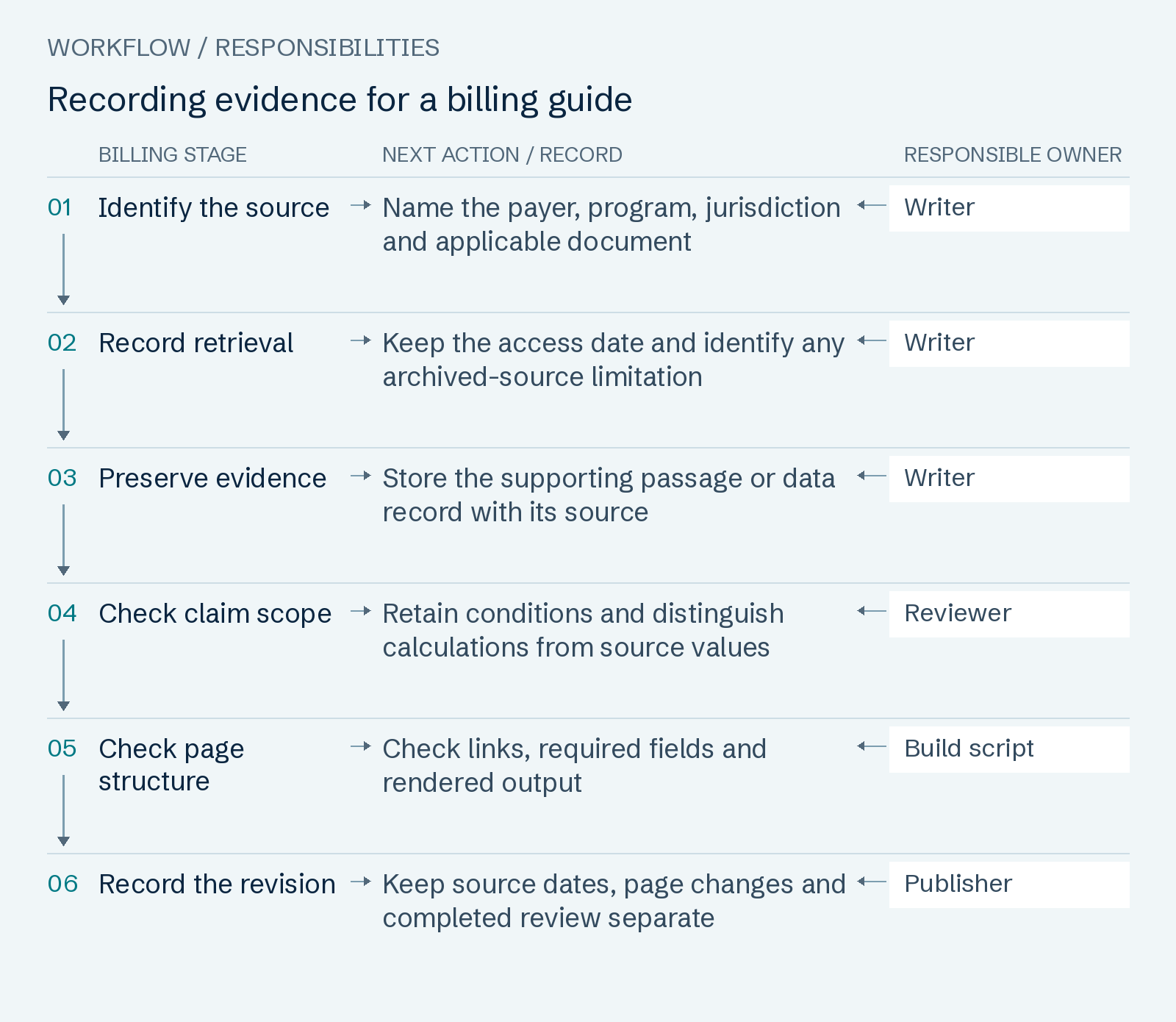
Read the workflow as text
- Identify the source — Name the payer, program, jurisdiction and applicable document Owner: Writer.
- Record retrieval — Keep the access date and identify any archived-source limitation Owner: Writer.
- Preserve evidence — Store the supporting passage or data record with its source Owner: Writer.
- Check claim scope — Retain conditions and distinguish calculations from source values Owner: Reviewer.
- Check page structure — Check links, required fields and rendered output Owner: Build script.
- Record the revision — Keep source dates, page changes and completed review separate Owner: Publisher.
How our deadline and Medicare-amount datasets are built
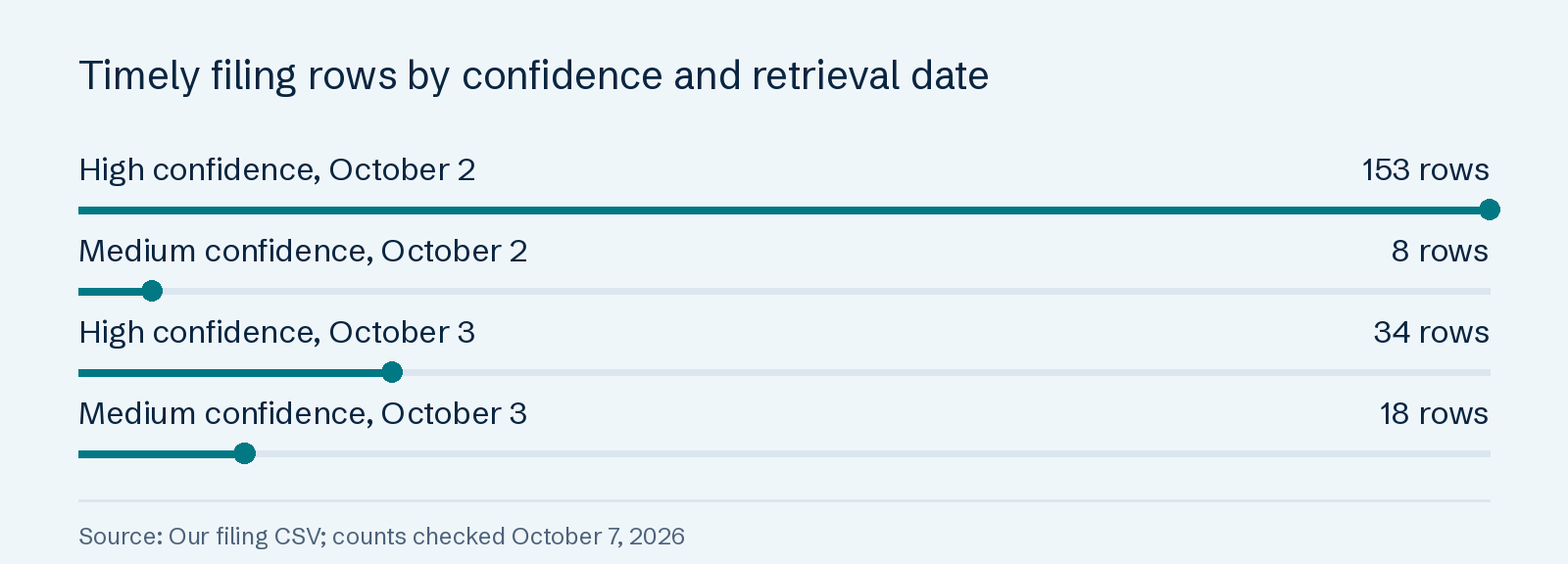
Our owner guides use source-derived Medicare amounts and payer filing limits. The physician-fee-schedule dataset uses the CMS file fetched on October 2, 2026; the filing dataset includes source retrievals from October 2 and 3. These are research datasets, not measurements of our clients’ results.
2026 Medicare amounts from the CMS RVU file
Our physician-fee-schedule comparisons use the CMS CY 2026 PFS relative value file (RVU26D), the October 2026 release used for this dataset. The comparison multiplies the applicable total relative value units by the conversion factor identified for that clinician category and year; the non-QP comparisons shown here use $33.4009 at national values. We label it "2026 national Medicare amount (unadjusted)" because actual payment varies by locality, setting and payer. Example: CPT 99213, an established-patient office visit (level 3), has 2.85 non-facility RVUs; 2.85 × $33.4009 = $95.19. A blank amount means CMS sets no national fee-schedule amount for that code in that setting: the code is contractor-priced, bundled, non-covered or excluded, or CMS marks the setting not applicable. The dataset leaves those amounts blank rather than inventing a fee. Laboratory-fee-schedule comparisons use the separately identified CMS CLFS dataset; a PFS calculation is not the method for every Medicare figure on the site.
Payer timely filing limits, quoted verbatim
Our timely filing dataset has 213 rows, each tied to the payer's or agency's own document. It powers the deadline calculator in our guide to preventing timely filing denials, and you can download it as a CSV. Each row records its source, retrieval date and confidence. The dataset readme explains the publisher, method and limits for someone arriving directly at the file. The version metadata identifies the current file and its source-date range. The current CSV has 187 high-confidence rows and 26 medium-confidence rows, counted on October 7, 2026. Source retrieval dates are October 2 or 3, 2026. Saved-source quote checks establish provenance; they do not mean a payer has confirmed a deadline for your contract. To cite it: ClaimPillar Medical Billing, “Payer timely-filing source compilation” (213 rows; sources retrieved October 2–3, 2026), timely-filing.csv.
What we leave out of the dataset
Third-party values never enter the table. Our exclusions list holds 12 entries: values that appeared only on billing blogs, payer directories or a 2016 copy of a payer manual, plus one payer whose manuals sit behind a login. Where a payer's manual defers to the provider agreement or state law, the row says that rather than borrowing a blog's number.
| Dataset | Built from | Size | Check we ran | Result |
|---|---|---|---|---|
| 2026 Medicare amounts | CMS RVU26D file, October 2026 release | 19,453 code rows | 25 amounts compared with CMS's PFS Look-up Tool | 25 of 25 match to the cent |
| Payer timely filing limits | Payer manuals, CMS, eCFR, state Medicaid | 213 rows (187 high, 26 medium) | Current CSV inventory checked October 7, 2026 | Source and retrieval date recorded per row |
CPT and denial-code text we do not reproduce
Two code sets used on every claim belong to private publishers, and both restrict how their text is used.
CPT codes
The American Medical Association states in its CPT licensing FAQ that "CPT is copyrighted by the AMA and as such must be licensed to be used in electronic products or other forms." Our pages show the code number with our own plain-English description of eight words or fewer, and never the AMA descriptor. HCPCS Level II and ICD-10-CM descriptors are quoted only where they help the reader.
Denial codes (CARC and RARC)
X12 lists Claim Adjustment Reason Codes and Remittance Advice Remark Codes among its code lists, and its intellectual property policy states that X12 "prohibits the entry of X12 standards and related X12 intellectual property" into AI tools and prohibits "the creation of any derivative of X12 IP using AI without express written permission."
How AI tools are used in drafting
AI tools help draft and structure these pages. That assistance does not establish the truth of a claim or replace professional review. Source links, stored evidence, dated dataset records and documented corrections let readers inspect the basis and limitations of the material.
We do not use an AI answer as evidence of a payer rule, a staff credential, a customer result or an approved business commitment. Unsupported statements should be removed or corrected when identified. A source list or page timestamp alone is not a claim that every sentence has been freshly verified.
Dates, updates and corrections
The updated date records the most recent substantive revision to a page. It does not mean every cited source was checked on that date. Where we record a source retrieval date, it identifies when that document was accessed; it does not guarantee the rule remains unchanged. A changed payer manual, CMS release or substantiated error report is a reason to review the affected claims. Material correction notes explain consequential changes without inventing an earlier publication date.
How to report an error
- Send the page address and the sentence you believe is wrong through our contact page.
- Include the source that shows the correct rule, such as the payer manual section or the CMS page.
- We fetch that source, compare it with ours, and correct the page if the source supports the change.
- A substantive correction updates the page revision date and records the material change in the page’s correction notes. Source retrieval dates change only when those sources are accessed again; spelling and formatting fixes alone do not renew them.
Please do not send patient information with a correction. A page address and a source are all we need.
How our reference pages relate to our services
We sell medical billing services, and our reference pages link to them. That commercial interest does not change a deadline, a code meaning or a Medicare amount: those come from the sources above. Our prices and terms come from one published rate card, and wherever we name a guarantee, its terms appear beside it.
Our guides help practice owners make billing decisions and link to relevant service scope where it helps the next decision. If recurring denials lead you to consider outside support, our denial management service is the next step; if you want to talk through your practice's claims, start on the consultation page.
Common questions
- What sources does this site use for medical billing rules?
- Primary sources only: CMS manuals and MLN materials, Medicare Administrative Contractor pages, eCFR, state Medicaid manuals and each payer's own provider manual or web page. Billing blogs are used only to find the official document, never as the source of a number or rule.
- Where do the Medicare amounts on this site come from?
- Physician-fee-schedule comparisons identify the CMS RVU file, clinician category, conversion factor and setting used. Laboratory-fee-schedule comparisons identify the separate CLFS dataset. These are source-derived comparisons, not a prediction of your practice’s payment; check the relevant page’s dataset and assumptions.
- How current are the timely filing limits?
- The current filing dataset records source retrievals on October 2 and 3, 2026. Each row names the payer or agency source and its retrieval date; October 7 is the date we checked the current inventory counts. The provider's contract can set a different limit, so confirm against your agreement before relying on a deadline. See the filing limits by payer.
- Why don't your pages show the official CPT descriptions?
- CPT descriptors are copyrighted by the American Medical Association and licensed separately. We show the code number with our own short plain-English description instead.
- Why don't your pages quote the official denial code descriptions?
- X12 publishes the CARC and RARC code lists, states that all its work products are copyrighted, and restricts their use with AI tools. We explain each code as CMS or a Medicare contractor explains it and link to x12.org/codes for the official wording.
- Do you use AI to write this content?
- AI tools help draft and structure pages. They are not factual sources. Our records retain source passages, retrieval dates and limitations; the page revision date does not mean every source was fetched again. Named professional review is stated only when that work is documented.
- How do I report a mistake on a page?
- Send the page address, the sentence and the source showing the correct rule through our contact page. We fetch that source, compare it with ours and correct the page when the source supports the change. Please leave out any patient information.
Sources and review
Page revised October 8, 2026 · Review contact: Hyder Shah (inquiries@claimpillar.com). The process wording and dataset scope were corrected October 8, 2026. The policy’s original source retrievals and the filing dataset’s October 2–3 retrieval dates remain separate from this revision. Dataset inventory counts were checked October 7; the downloadable version metadata identifies the current file.
- CMS: PFS Relative Value Files (RVU26A–RVU26D for 2026)
- CMS: Medicare Claims Processing Manual, Chapter 1 (§70 time limits)
- Cigna Healthcare: Submit and pay claims (filing deadlines)
- AMA: CPT licensing frequently asked questions
- X12: Intellectual property (IP) use policy
- Google Search Central: Creating helpful, reliable, people-first content
Correction notes
- : Removed statements that every claim used a source fetched on its writing day and that every page update was a source-check date. Clarified the limits of automated checks and separated PFS calculations from other Medicare datasets.