What our medical billing company does
Our medical billing company runs the insurance side of your revenue cycle from inside the systems your practice already uses. Our main service is Full-Service Billing. Its scope: Claim creation and scrubbing, submission, payment posting, denial work and appeals, insurance A/R follow-up, eligibility checks for new patients and changed coverage, authorization expiry tracking, coding checks against your documentation, patient balances calculated and statements sent in your practice's name, and a KPI report with written definitions by the 10th of each month. Each of our other billing services lists its own scope.
Three jobs stay with your practice: seeing patients, signing off encounters so every charge is complete, and collecting copays at the front desk. We sell billing work only. We do not market your practice or send you patients, so our fee never mixes billing with referrals.
| Service line | What it covers | How it is priced |
|---|---|---|
| Full-Service Billing | Claims, payment posting, denials, insurance A/R, eligibility, statements, monthly KPI report | 5.0% to 8.5% of insurance payments; $0 setup |
| Complete RCM | Everything in full-service billing plus credentialing, prior authorizations, aged A/R and a named senior billing lead | 9.0% of insurance payments |
| Credentialing & Payer Enrollment | Credentialing and payer enrollment for each clinician, tracked to the payer's confirmed effective date | $149 per payer. Billed only after the payer confirms your effective date; $0 if denied or panel closed; filed within 5 business days of your complete packet. |
Which practices we work with
We bill for independent practices whose revenue depends on insurance claims. Five practice types share one fee base and one set of terms; the rate depends on the practice type and the number of clinicians we bill for. Each rate in the table is a percentage of insurance payments.
How clinicians are counted
Clinicians are counted on the 1st of each month from the rendering NPIs we billed the month before (for ABA, BCBAs and BCaBAs, not RBTs). Your rate moves with your size band the next month, in either direction. Multi-specialty practices: each clinician's claims are billed at that clinician's segment rate; the size band counts every clinician.
Practices we quote separately
16+ clinicians, or anesthesia, radiology, DME, lab and home health: written quote within 1 business day, same fee base, cap and terms. The complete rate card, with a fee calculator, is on our medical billing pricing page.
| Practice type | Who it covers | 1 clinician | 2–5 clinicians | 6–15 clinicians |
|---|---|---|---|---|
| Mental & behavioral health | Therapists, counselors, psychologists and psychiatric practices | 8.0% | 7.5% | 7.0% |
| ABA therapy | ABA agencies; size counts BCBAs and BCaBAs, not RBTs | 8.5% | 8.0% | 7.5% |
| PT, OT, speech & chiropractic | Physical, occupational and speech therapy and chiropractic practices | 7.5% | 7.0% | 6.5% |
| Primary care, pediatrics & urgent care | Primary care, pediatric and urgent care practices | 6.5% | 6.0% | 5.5% |
| Specialist physician groups | Cardiology, orthopedics, gastroenterology, dermatology, urology, OB-GYN, oncology and other office-based specialists | 6.0% | 5.5% | 5.0% |
How we are paid, and why your payments never pass through us
We are paid a percentage of the insurance payments on claims we handle. Every payment goes straight to your practice's own bank account. We never receive, deposit or endorse your payments; we invoice you once a month.
What the fee is taken on
Your fee is a percentage of insurance payments posted on claims we submitted or worked, net of payer recoupments and refunds. We take 0% of patient payments, copays and anything your front desk collects. Not in the fee base: patient payments, copays, capitation, incentive or grant payments, and payments on claims we never submitted or worked.
Invoices, the minimum and the cap
Invoiced on the 10th for the prior month's insurance payments, due within 15 days by ACH. Invoices 1–3: only percentage fees on that month's insurance payments, plus any statements or add-ons you order. Percentage fees and mailed statements are capped at 9.0% of that month's insurance payments; from invoice 4, the $400 minimum applies even in a month when the cap comes to less.
Why the money stays in your account
Federal payment rules treat a billing company that receives a practice's payments differently from one that only prepares the bills. The table quotes each rule, whose rule it is and what it covers, beside how our payment flow handles it. The rules are 42 CFR 424.73 and 42 CFR 424.80 for Medicare, section 30.2.4 of the Medicare Claims Processing Manual, 42 CFR 447.10 for Medicaid, and the HHS-OIG compliance guidance for third-party billing companies. The table describes how we built our model; it is not legal advice for your practice, and your own counsel has the last word on your arrangements.
| Rule and its scope | What it says | How our model handles it |
|---|---|---|
| Medicare: 42 CFR 424.73(b)(3), applied to physicians and other suppliers by 424.80(b)(5). Covers an agent that receives payment for the practice. | Medicare may pay such an agent only if its compensation "is not related in any way to the dollar amounts billed or collected" and "is not dependent upon the actual collection of payment." | Medicare payments post to your account. We never receive or negotiate them. |
| Medicare: Claims Processing Manual (Pub. 100-04), chapter 1, section 30.2.4, payment to agent. | The conditions "do not apply if the agent merely prepares bills for the provider and does not receive and negotiate the checks payable to the provider/supplier." | We prepare, submit and work claims. You receive and deposit every payment. |
| Medicaid: 42 CFR 447.10(f), a requirement every state Medicaid plan must meet. Covers a business agent that receives payments in the provider's name. | The agent's pay must be "Not related on a percentage or other basis to the amount that is billed or collected." | Medicaid payments also post to your account. We do not receive them. |
| HHS-OIG Compliance Program Guidance for Third-Party Medical Billing Companies (1998). Guidance, not a regulation. | OIG has "a longstanding concern that percentage billing arrangements may increase the risk of upcoding." | A written coding rule, described in the next section. |
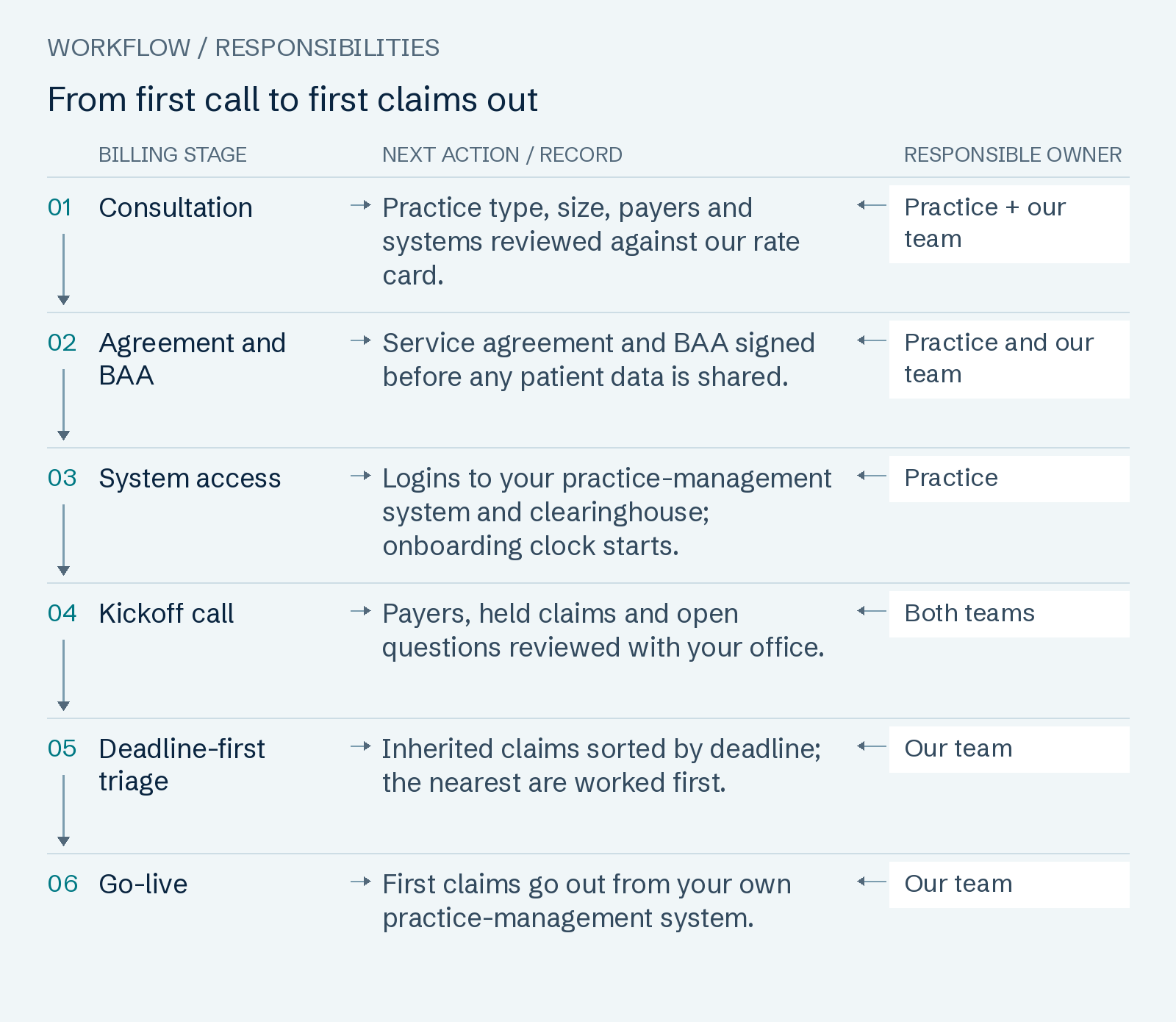
Read the workflow as text
- Consultation — Practice type, size, payers and systems reviewed against our rate card. Owner: Practice + our team.
- Agreement and BAA — Service agreement and BAA signed before any patient data is shared. Owner: Practice and our team.
- System access — Logins to your practice-management system and clearinghouse; onboarding clock starts. Owner: Practice.
- Kickoff call — Payers, held claims and open questions reviewed with your office. Owner: Both teams.
- Deadline-first triage — Inherited claims sorted by deadline; the nearest are worked first. Owner: Our team.
- Go-live — First claims go out from your own practice-management system. Owner: Our team.
Why a percentage-paid biller needs a written coding rule
A percentage fee grows when payments grow, and that incentive is the one HHS-OIG named: its guidance for billing companies lists upcoding among the risk areas and states the agency's concern that percentage arrangements may increase it. Our answer is a written rule: We check every code against your clinician's documentation and never change a code without the clinician's sign-off.
When the documentation does not support a code, the question goes back to the clinician and the claim waits for the answer instead of going out on a guess. How our coding review works covers the checks in detail.
What we put in writing
Our service standards: Payments posted within 2 business days of the remittance, emails answered within 1 business day, and the KPI report with written definitions by the 10th. No billing company can force a payer to approve a claim. What we commit to is our side of the clock, and the two guarantees below put a cost on us when we miss it.
On-Our-Watch Guarantee
If a claim misses a filing, corrected-claim or appeal deadline while it is on our watch, we pay you what it would have paid. Claims we get complete 10+ business days before the deadline; contracted rate less any copay you collected, paid automatically within 30 days of final denial; capped $10,000/month; your holds excluded.
Clock-or-Credit Guarantee
From go-live, every new claim goes out within 1 business day of complete charge data, and every denial is worked within 2 business days of posting — or $25 comes off your invoice for each late one. Mon–Fri ET business days by your system's timestamps; worked: resubmitted, appealed or returned with the fix; auto-credited; capped at monthly fee; clearinghouse outages excluded.
Clean-Exit Terms
Leave with 30 days' notice and no termination fee. Want a run-out? We keep working the claims we submitted for 90 days at your plan rate. Decline it and we charge nothing on payments that post after you leave. Notice by email; optional run-out covers claims we submitted before your exit date, at your plan rate; handover file within 10 business days of exit. Handover file: Every open claim with its status and next action, the denial log, payer correspondence and credentialing files, in CSV and PDF.
How we handle patient information
We sign a business associate agreement (BAA) with your practice before we access your practice-management system, your clearinghouse or any patient data. That includes The Free A/R Deadline Map: Clock starts with your claim-level aging export and signed BAA; above 10 requests in a week, we confirm your date within 1 business day.
HIPAA makes this a contract, not a courtesy. HHS names billing and practice management, when the work involves protected health information, among the activities that make a vendor a business associate, and a practice may share protected health information with one only after it obtains "satisfactory assurances" in a written BAA. HHS also requires a business associate to sign a BAA with any subcontractor before passing protected health information to it.
What our BAA must contain
HHS lists ten provisions every BAA must carry. Summarised from the HHS sample business associate agreement provisions, these are the clauses to look for in ours:
- Which uses and disclosures of protected health information the agreement permits or requires.
- No use or disclosure beyond the contract or what the law requires.
- Safeguards, including the HIPAA Security Rule for electronic records.
- Reporting to you any use or disclosure the contract does not allow, including breaches.
- Making records available for patients' access, amendment and accounting requests.
- Following the Privacy Rule wherever we carry out one of your obligations under it.
- Opening our records about your patients' information to HHS when it checks your compliance.
- Returning or destroying the information when the contract ends, where feasible.
- Binding any subcontractor with access to the same restrictions.
- Your right to end the contract if we violate a material term.
How we start with a new practice
Go-live, when your first claims go out, comes within 5 business days of access; any unbilled backlog follows within 10 business days of access. Clock starts with your signed agreement, signed BAA and working system logins; it extends day for day while we wait on access.
- Book a consultation through our contact page and tell us your practice type, size and payer mix.
- Sign the service agreement and the BAA.
- Grant logins to your practice-management system and clearinghouse. We work inside your existing practice-management system and clearinghouse; tell us which ones and we confirm in writing within 1 business day. The systems practices ask us about are listed with the access we need.
- Join the kickoff call to walk through payers, held claims and open questions.
- Inherited claims are sorted by deadline, and the nearest are worked first. Every inherited claim within 30 days of a filing, corrected-claim or appeal deadline is worked within 5 business days of access. Starts at access; covers up to 250 claims (more gets a day-1 deadline schedule); worked means submitted, corrected, appealed or returned with the fix.
- Go-live: new claims start going out from your own system.
Your part, in short: Sign the service agreement and BAA, give us logins to your practice-management system and clearinghouse, join one 45-minute kickoff call, sign off encounters so charges are complete, and answer our documentation questions within 5 business days.
How we research and publish this site
Every page on this site follows our editorial policy. Payer and regulatory rules link to the payer's or regulator's own document, and each page lists its sources. A page's updated date marks its last substantive revision, not a fresh check of every source; our datasets record when each source was retrieved. We describe CPT codes in our own words instead of reproducing AMA descriptors, and we explain denial codes only as CMS or a Medicare contractor publicly explains them.
Our research uses the source-derived datasets and provider review in the table. The filing-data counts below were checked against our current file on October 7, 2026. Our review of 40 medical billing provider pages records how other providers describe their services; it does not rank them. Its counts appear in our checklist for choosing a billing company.
| Dataset | Built from | Size | How we label it |
|---|---|---|---|
| 2026 Medicare amounts | CMS CY 2026 PFS relative value file (RVU26D), downloaded October 2, 2026 | 19,453 code rows | 2026 national Medicare amount (unadjusted); actual payment varies by locality, setting and payer |
| Payer timely-filing limits | Each payer's or agency's own manual, page or regulation, quoted word for word | 213 payer, program and state rows | 187 high-confidence and 26 medium-confidence rows; source link and retrieval date on every row |
| Provider landscape | Service pages of 40 selected billing providers | 40 pages, 6 service categories | Mentions only; not a ranking of quality or demand |
How to check us before you sign
We publish client results only with written permission. Until we have them, judge us by the guarantees and the free Deadline Map. So this page carries no testimonials, client counts or review scores.
Four checks you can run before you commit:
- Read the BAA and the service agreement before any login is shared.
- Get your practice-management system and clearinghouse confirmed in writing.
- Order our Free A/R Deadline Map with your aging export and judge the work on your own claims.
- Score us against any other company with our billing company evaluation checklist.
Common questions
- What does a medical billing company do?
- A medical billing company turns completed visits into insurance claims and works each one toward payment: it creates and submits claims, posts payments, works denials and follows up on unpaid insurance balances. Ours does that inside your own practice-management system and clearinghouse, for a percentage of insurance payments. See our rate card for the rate by practice type and size.
- Do you ever receive our insurance money?
- No. Every payment goes straight to your practice's own bank account. We never receive, deposit or endorse your payments; we invoice you once a month. Medicare limits how a billing agent that receives a provider's payments may be paid, and CMS's manual says those conditions do not apply to an agent that only prepares bills and does not receive and negotiate the checks.
- Will you change our codes to raise payments?
- Only when the documentation supports the change. We check every code against your clinician's documentation and never change a code without the clinician's sign-off. HHS-OIG has a longstanding concern that percentage billing arrangements can raise upcoding risk, which is why the rule is written down.
- Do you sign a BAA before seeing patient data?
- Yes. We sign a business associate agreement before we access your systems or any patient data, including for The Free A/R Deadline Map. Clock starts with your claim-level aging export and signed BAA; above 10 requests in a week, we confirm your date within 1 business day. HHS lists billing among the activities that make a vendor a business associate.
- Do you work in our software?
- We work inside your existing practice-management system and clearinghouse; tell us which ones and we confirm in writing within 1 business day. Our EHR and practice-management compatibility page lists the access we need and the systems practices ask about.
- Do you have reviews or case studies?
- We publish client results only with written permission. Until we have them, judge us by the guarantees and the free Deadline Map.
- Can we leave if it does not work out?
- Clean-Exit Terms: Leave with 30 days' notice and no termination fee. Want a run-out? We keep working the claims we submitted for 90 days at your plan rate. Decline it and we charge nothing on payments that post after you leave. Notice by email; optional run-out covers claims we submitted before your exit date, at your plan rate; handover file within 10 business days of exit.
Sources and review
Page revised October 8, 2026 · Review contact: Hyder Shah (inquiries@claimpillar.com). Rules quoted from eCFR, CMS, HHS and HHS-OIG pages retrieved October 2, 2026.
- 42 CFR 424.73: payment to an agent (Medicare, eCFR)
- 42 CFR 424.80: reassignment by suppliers (Medicare, eCFR)
- Medicare Claims Processing Manual, chapter 1, section 30.2.4 (CMS)
- 42 CFR 447.10: Medicaid payment to business agents (eCFR)
- Compliance Program Guidance for Third-Party Medical Billing Companies (HHS-OIG, 1998)
- Business Associates (HHS Office for Civil Rights)
- Sample Business Associate Agreement Provisions (HHS Office for Civil Rights)
Correction notes
- : Replaced a statement that every payer and regulatory rule was fetched and dated before publication with what our records support: pages link and list their sources, datasets record retrieval dates, and an updated date marks a revision rather than a fresh check of every source.