What does your result say about the money your practice is owed?
Your net collection rate is the share of collectible money your practice actually received. Collectible means what is left of your charges after the discounts your payer contracts require. The American Academy of Family Physicians (AAFP) describes the same measure, under the name adjusted collection rate, as what you collected versus what you could have or should have collected, and says it shows revenue lost to bad debt, untimely filing and other noncontractual adjustments.
A result of 95.0% means 5 cents of every collectible dollar on those claims has not arrived. The calculator turns that gap into dollars: on its example, $4,500 is still uncollected. That figure is either still open in A/R, written off for a reason a contract did not require, or owed by patients. Each of those has a different owner, which is why the number is a question to ask, not a verdict.
The result is only as good as the three inputs. Payments must belong to the charges you entered, and only contractual adjustments may come off the charges. A result above 100% usually means the payments include money for claims from another period; the calculator says so. It runs in your browser, and nothing you type is sent anywhere.
How do you calculate net collection rate? The formula, worked
The net collection rate formula is payments ÷ (charges − contractual adjustments). We use that one definition on every page of this site. AAFP writes the same ratio: divide payments (net of credits) by charges (net of approved contractual agreements) for the selected time frame and multiply by 100. Net of credits means refunds you paid back come off the payments.
Step 1: what your contracts allow you to collect
Subtract contractual adjustments from charges. In the example the calculator opens with, a practice billed $150,000 and its payer contracts required $60,000 of write-offs: $150,000 − $60,000 = $90,000 collectible. This is an example with round numbers, not a practice's data.
Step 2: payments ÷ what was collectible
The same claims brought in $85,500 from payers and patients: $85,500 ÷ $90,000 = 95.0%. The $4,500 difference is what is still uncollected. On $90,000 collectible, each percentage point is worth $900, so the same practice at 97% would be missing $2,700 and at 99% would be missing $900.
Gross vs net collection rate
Divide the same payments by full charges, without subtracting contractual adjustments, and you get a gross figure: $85,500 ÷ $150,000 = 57.0%. That number mostly reflects how far your fee schedule sits above what your contracts pay, so it can drop when you raise fees even though collections did not change. AAFP measures against charges net of contractual adjustments instead.
| Step | Arithmetic (example) | Result |
|---|---|---|
| Charges billed on the claims | From the charge report | $150,000 |
| Contractual adjustments on the same claims | Required by payer contracts | $60,000 |
| Collectible after contractual adjustments | $150,000 − $60,000 | $90,000 |
| Payments received for those claims | Payers plus patients, net of refunds | $85,500 |
| Net collection rate | $85,500 ÷ $90,000 | 95.0% |
| Still uncollected | $90,000 − $85,500 | $4,500 |
| Gross collection rate, for comparison | $85,500 ÷ $150,000 | 57.0% |
Which numbers should you pull from your reports?
Each input has to cover the same claims. An article on HFMA's website, published as vendor-sponsored content, puts it plainly: “it is important that the calculation is based on matching payments to the associated charges.” The simplest way is to pick a range of dates of service, then pull the charges, the contractual adjustments and the payments posted against those visits. AAFP recommends a 12-month time frame. A window that ends last month will read low, because its newest claims have not paid yet.
Which adjustments count as contractual?
Only the discount a payer contract or fee schedule requires. For Medicare, a provider who accepts assignment takes the Medicare-approved amount as payment in full, so the gap between your charge and that amount is contractual. The remittance shows it: the Medicare Claims Processing Manual, chapter 22, section 60.1 says group code CO is used when a contractual agreement or a regulatory requirement caused the adjustment, and those amounts are generally a write-off not billed to the patient. Note the second half: a CO line can be a regulatory write-off, not a contract discount. Group code PR marks an amount that may be billed to the patient, typically deductible and copay, so it stays in the collectible total. The official code wording is at x12.org/codes.
| Input | Include | Leave out | Where an owner finds it |
|---|---|---|---|
| Payments received for these claims | Insurance and patient payments posted to those dates of service, net of refunds | Payments for visits outside the window | Payment or transaction report filtered by date of service |
| Charges billed | Every charge on those visits, at your full fee | Charges for visits outside the window | Charge report for the same dates of service |
| Contractual adjustments | Write-offs a payer contract or fee schedule requires | Untimely filing, missing authorization, denial and bad-debt write-offs; patient balances | Adjustment report split by adjustment code |
What is a good net collection rate for a medical practice?
A good net collection rate is 95% or higher, by the one primary source we found. AAFP's practice-finance guidance says the adjusted collection rate should be 95%, at minimum; the average is 95% to 99%, and the highest performers achieve a minimum of 99%. A vendor-sponsored article on HFMA's website repeats the 95% minimum, calls 97% to 99% optimal, and adds that the benchmarks are general guidelines that vary by specialty, geography and payer mix.
Your billing report may not use the name at all. HFMA's own MAP Keys, its standard revenue cycle KPIs, which it says apply to physician organizations, include none named net collection rate; related measures there include cash collection as a percentage of net patient service revenue (FM-2) and denial write-offs (AR-6), the reimbursement a provider stopped appealing or chose to write off. So ask for the formula behind whatever collection figure you are shown. We print no specialty benchmark, because we could not confirm one in a public primary source. The calculator's example, 95.0%, sits exactly on AAFP's minimum: acceptable, with $4,500 still worth chasing.
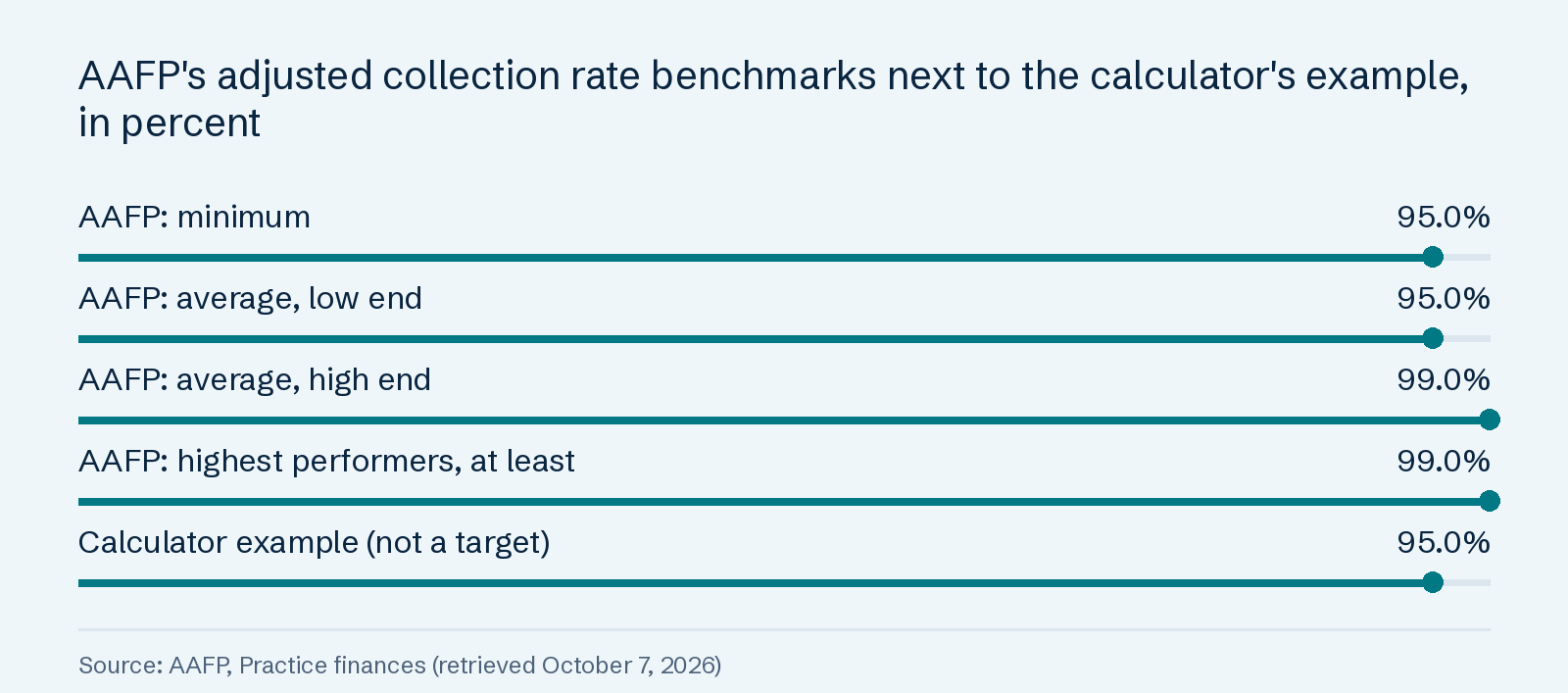
Data table for this chart
| Source | What it says | Scope and caveat |
|---|---|---|
| AAFP, Practice finances | 95% at minimum; average 95% to 99%; highest performers at least 99% | Calls it the adjusted collection rate; recommends a 12-month time frame |
| Vendor-sponsored article on HFMA's website | At least 95%; 97% to 99% optimal | Says payments must be matched to the charges they pay; benchmarks vary by specialty, geography and payer mix |
| HFMA MAP Keys | No KPI named net collection rate | Related measures: cash collection (FM-2) and denial write-offs (AR-6) |
Why is your net collection rate falling, or looking better than it is?
A falling net collection rate can signal uncollected balances, but first check that the compared claims have had similar time to pay and use consistent inputs. AAFP names the losses the measure shows: uncollectible bad debt, untimely filing and other noncontractual adjustments. An unrecoverable timely-filing write-off reduces collections, so check the payer's deadline and any applicable exception before closing the balance. The guide to which payers give your practice the least time to file explains the clocks to track. Denials that are written off instead of worked pull it down too; our guide to what drives claim denials covers the causes an owner can check.
A high rate can hide the same losses. AAFP warns that failing to distinguish noncontractual from contractual adjustments gives a misleading view of how well your practice collects the money it has earned. Example: if $3,000 of untimely-filing write-offs on the claims above were posted as contractual, collectible falls to $87,000 and the rate reads $85,500 ÷ $87,000 = 98.3% instead of 95.0%. The practice lost the same money; the report just stopped showing it. Underpayments posted as contractual adjustments do the same. AAFP's advice to keep fee schedules and reimbursement schedules on hand, to see what you should have been paid, is the check for both.
What should you ask whoever reports your net collection rate?
Net collection rate is most useful as a trend: same window length, same adjustment rules, run on the same day each month. Then ask whoever does your billing, in-house or outsourced, for these:
- The formula behind the rate on your report, with the date-of-service window it covers.
- Adjustments split into contractual and noncontractual, with noncontractual write-offs totalled by category, since AAFP says categorizing them reveals the sources of errors.
- The rate by payer, with patient balances as their own line, so a shortfall at one payer is not averaged away.
- Denial write-offs for the month and why each was not appealed.
- A sample of contractual adjustments checked against the contracted fee schedule.
- The uncollected dollars on the claims, split into still open, patient balance and written off.
Compare each month with your own past months before any published benchmark. If the uncollected dollars are mostly old open claims, what to do about claims older than 90 days covers which ones can still be paid. Speed is a separate question: the A/R days calculator shows how long collection takes, and our page on the numbers to check in a monthly billing report puts both beside denial rate and cost to collect.
What if your rate stays below 95% month after month?
A rate that stays under the 95% floor for several months, or one nobody can recompute from the reports, needs someone who owns the gap between what was allowed and what was paid. Our revenue cycle management service posts each remittance line by line with its adjustments, works each denial and open claim, and reports the net collection rate every month with its written formula, so you can recompute it from your own system. We set no target rate in advance: your first month is the baseline. Our published rates show what that costs for your specialty and size.
Common questions
- What is a good net collection rate for a medical practice?
- At least 95%. AAFP says the adjusted collection rate should be 95% at minimum, that the average is 95% to 99%, and that the highest performers reach 99% or more (AAFP). A vendor-sponsored article on HFMA's website calls 97% to 99% optimal and notes the figure varies by specialty, geography and payer mix. Your own trend is the first comparison.
- What is the difference between gross and net collection rate?
- Net collection rate divides payments by charges minus contractual adjustments; a gross figure divides payments by full charges. On our example, $85,500 ÷ $90,000 = 95.0% net, while $85,500 ÷ $150,000 = 57.0% gross. The gross figure mostly reflects how your fees compare with contracted rates, so it says little about billing performance.
- Which adjustments count as contractual in our net collection rate?
- Only the write-offs a payer contract or fee schedule requires, such as the gap between your charge and the Medicare-approved amount when you accept assignment. Untimely filing, missing prior authorization, unappealed denials and bad debt are noncontractual and stay in the collectible total. A CO group code alone does not settle it: CMS also uses CO for adjustments a regulation requires.
- Why is our net collection rate falling?
- Possible causes include denials written off instead of worked, claims past their filing limit, patient balances not collected, or underpayments nobody checked. Ask for noncontractual adjustments by category and the rate by payer. Also check the window: one that ends last month reads low because its newest claims have not paid yet.
- Do patient payments count in the net collection rate?
- Yes. Payments include what patients pay as well as insurers, and patient deductibles and copays stay in the collectible total because on Medicare remittances CMS marks them as amounts that may be billed to the patient. Ask for patient balances as their own line on the report, so slow patient collections do not hide inside the payer total.
- Why does our net collection rate come out above 100%?
- The payments usually include money for claims outside the charges you entered, such as a month of deposits divided by that month's charges. The calculation only works when payments are matched to the charges they pay. Pull payments, charges and adjustments for the same dates of service and the rate comes back below 100%.
Sources and review
Page revised October 7, 2026 · Review contact: Hyder Shah (inquiries@claimpillar.com). Every source below was retrieved and checked on October 7, 2026. The worked examples are our arithmetic on round numbers, labelled as examples.