96374 cpt code description: initial IV push
In plain words, 96374 is a single IV push of a therapeutic, preventive or diagnostic drug that starts the encounter. The official descriptor belongs to the AMA's CPT code set; this page uses the code number and our own summary. The code pays for giving the drug, not for the drug itself.
CMS defines a push in Claims Processing Manual chapter 12, section 30.5 as either an injection where the clinician stays continuously present to give the drug and watch the patient, or an infusion of 15 minutes or less. Anything that runs longer is an infusion, not a push.
96374 is one of five initial codes
The NCCI Policy Manual, chapter XI lists 96360, 96365, 96374, 96409 and 96413 as the initial service codes, and a patient encounter carries only one of them unless the drugs must go in through separate IV access sites. In the CY 2026 relative value file (RVU26D), 96374 is status A (payable) with global code XXX, which marks it as a standalone code rather than an add-on. Its 2026 national Medicare amount (unadjusted) is $37.74 in the office; the file publishes no facility amount.
What 96374 already pays for
NCCI chapter XI says starting a peripheral IV line (for example 36000 or 36410) is part of the push and is not billed separately, and the fluid used to carry a drug is incidental hydration. The same chapter says the drug administration codes are valued to include the work of 99211, so 99211 is not billed with 96374.
96375 cpt code description: sequential push of a new drug
96375 is an add-on for each additional IV push of a different drug in the same encounter. RVU26D gives it global code ZZZ, the add-on marker, and a 2026 national Medicare amount (unadjusted) of $15.70 in the office. Chapter 12 explains that a ZZZ drug administration code is allowed when it is billed with another drug administration code, and it does not have to follow its own family's initial code.
That second point is where most coding errors start. CMS says in chapter 12 that a subsequent injection reports with a subsequent code even when it is the first service of its kind, and gives the example of the first IV push after a one-hour infusion, which reports as a subsequent push. So an infusion-led visit with one push bills 96365 plus 96375, never 96365 plus 96374.
How many units of 96375
Bill one unit for each new drug pushed after the initial service. The CMS practitioner MUE table effective October 1, 2026 allows up to 6 units of 96375 per date of service and 1 unit of 96374, both as date-of-service edits. A second push of a drug already given is not 96375; that is the 96376 question below.
96376 and why physician offices rarely report it
96376 is the add-on for a repeat IV push of the same drug, and Medicare does not pay it to physicians. RVU26D lists 96376 with status X, which the file's own documentation defines as a statutory exclusion: the item is outside the statutory definition of physician services, no RVUs or amounts are shown, and no payment may be made under the physician fee schedule.
The edit tables agree. The October 1, 2026 MUE tables set 96376 at 0 units per date on practitioner claims, with "CMS Policy" as the rationale, and at 10 units on outpatient hospital claims. NCCI chapter XI says hospital outpatient facilities may report drug administration services themselves, which is where 96376 belongs.
A repeat dose in the office
For a physician office, the repeat push of the same drug produces no extra administration line on a Medicare claim. The drug line still counts every unit given, so a second dose of the same drug raises the J-code units, not the administration codes. Commercial plans set their own rules for 96376, so check the plan's drug administration policy before billing it to them.
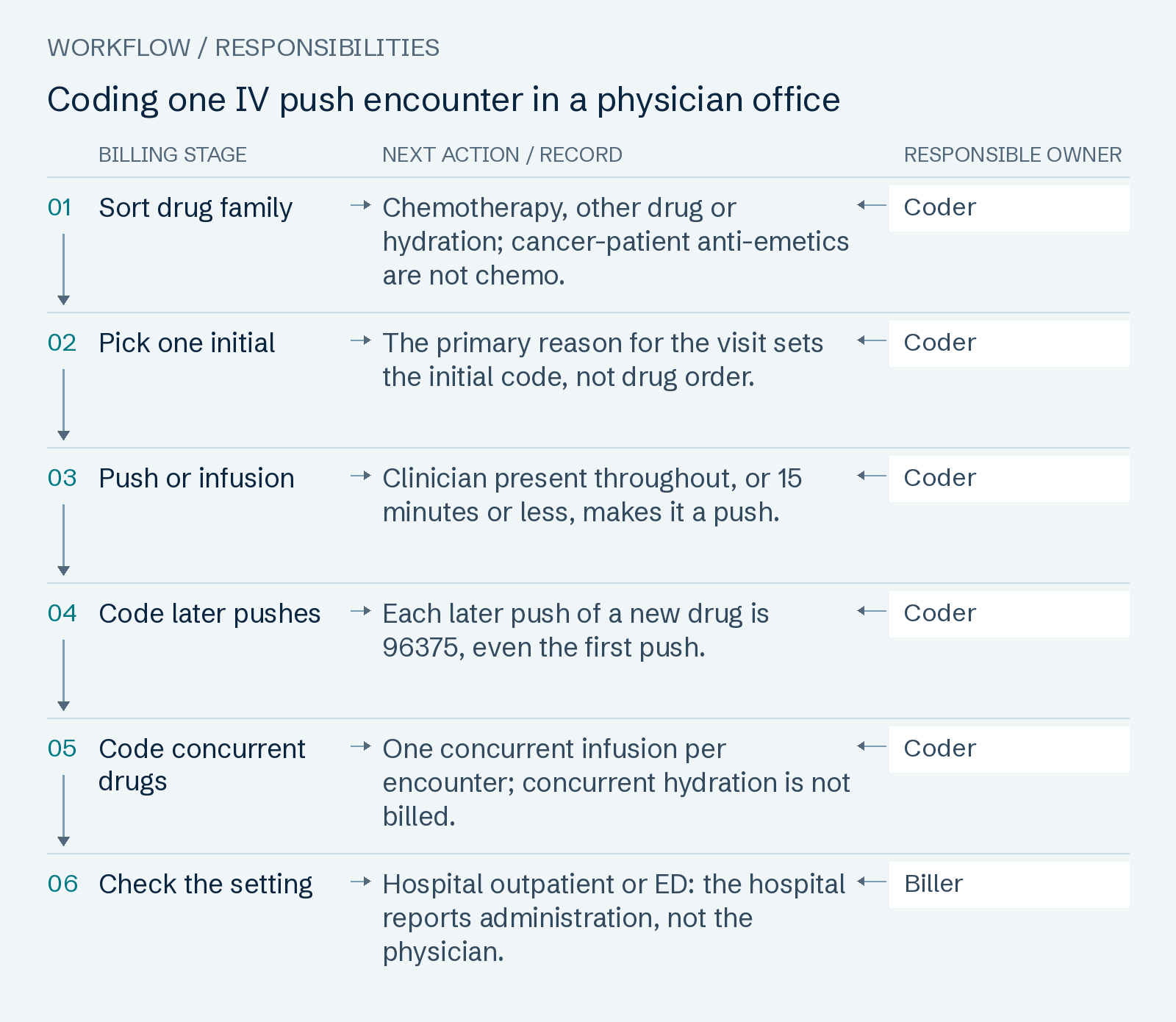
Read the workflow as text
- Sort drug family — Chemotherapy, other drug or hydration; cancer-patient anti-emetics are not chemo. Owner: Coder.
- Pick one initial — The primary reason for the visit sets the initial code, not drug order. Owner: Coder.
- Push or infusion — Clinician present throughout, or 15 minutes or less, makes it a push. Owner: Coder.
- Code later pushes — Each later push of a new drug is 96375, even the first push. Owner: Coder.
- Code concurrent drugs — One concurrent infusion per encounter; concurrent hydration is not billed. Owner: Coder.
- Check the setting — Hospital outpatient or ED: the hospital reports administration, not the physician. Owner: Biller.
The infusion hierarchy: chemo, infusion, push
The initial code depends on who is billing. For physician and practitioner claims, CMS chapter 12 says the initial code is the one that best describes the key or primary reason for the encounter, reported whatever order the drugs ran in. A push given first is not automatically 96374 if an infusion was the reason for the visit.
Facility claims can follow a fixed order instead. Palmetto GBA's billing article A53778 tells facilities that infusion is primary, injections and IV pushes come next, and hydration comes last. That article binds facility claims in Palmetto's jurisdictions J and M (Alabama, Georgia, Tennessee, South Carolina, Virginia, West Virginia and North Carolina); other contractors publish their own instructions. Chemotherapy sits above both: chapter 12 calls chemotherapy administration highly complex, and its pushes and infusions (96409, 96413) are themselves initial codes.
The flowchart shows the order to code one encounter in a physician office. The table sorts the push and infusion codes by their role in the encounter.
Initial, sequential and concurrent services
Two exceptions let a second initial code through on the same day: a protocol that requires two separate IV sites, or a patient who comes back for a separately identifiable service. CMS has those billed with modifier 59 (chapter 12); NCCI chapter XI refers to its PTP-associated modifiers. Both lumens of a double-lumen catheter count as one access site, so they never justify two initial codes.
| Role in the encounter | Push code | Infusion code | Rule that applies |
|---|---|---|---|
| Initial (one per encounter) | 96374; chemo push 96409 | 96365 drug, 96360 hydration, 96413 chemo | The primary reason for the visit, not the first drug given |
| Sequential, new drug | 96375 | 96367 | Used even for the first push or infusion after the initial service |
| Sequential, same drug | 96376 (Medicare: facility claims only) | Not applicable | Status X on the physician fee schedule; practitioner MUE 0 |
| Concurrent | Not applicable | 96368 | One concurrent infusion per patient per encounter; concurrent hydration is not billed |
Pairing pushes with J-codes, units and JW/JZ
Every push claim has two halves: the administration line (96374 or 96375) and the drug line, a HCPCS code such as a J-code. The units on the drug line count billing units, not vials. CMS's October 2026 Part B payment limit file shows each code's billing unit, for example 1 mg for J2405 (ondansetron) and 15 mg for J1885 (ketorolac), so a 4 mg dose of ondansetron is 4 units.
Medicare adds a modifier rule for single-dose containers. The CMS JW and JZ modifier FAQ says that, for separately payable Part B drugs from single-dose containers, JW reports the discarded amount on its own line and JZ attests that nothing was discarded, required no later than July 1, 2023. Claims without the right modifier on or after October 1, 2023 may be returned as unprocessable. The policy does not apply to drugs that are not separately payable, or to drugs given in an RHC or FQHC.
Worked claim example: one push with JZ
Illustrative example, not client data. A Medicare patient in a physician office receives ondansetron 4 mg by IV push for nausea, the only drug given. Pfizer's how-supplied listing shows a 2 mL single-dose vial holding 4 mg (2 mg/mL), and the whole vial is given.
- Administration line: 96374 x 1, the primary and only administration.
- Drug line: J2405-JZ x 4 units, because the billing unit is 1 mg and nothing was discarded.
- If only 2 mg were given from that 4 mg vial: J2405 x 2 units with no modifier, plus J2405-JW x 2 units for the discarded amount, on a second line, as the FAQ's two-line examples show.
- If a second, different drug is pushed later: add 96375 x 1 and that drug's own HCPCS line.
A 20 mL multiple-dose vial of the same drug falls outside the single-dose rule, since the FAQ limits JW and JZ to single-dose containers. The October 2026 file sets J2405's payment limit at $0.084 per unit, so the drug line in the example is small next to the $37.74 administration amount.
IV push in oncology, infusion and urgent care practices
The same codes behave differently depending on what drives the visit and where it happens.
Oncology and infusion practices
CMS says in chapter 12 that anti-emetic and anti-anemia drugs given to cancer patients are not chemotherapy administration. When chemotherapy is the reason for the visit, the chemo code is the initial service, and an anti-emetic push before it reports as 96375, not 96374 and not a chemo push code. Hydration that runs at the same time as another drug administration is not separately reportable (NCCI chapter XI). Our oncology billing services code infusion days from the infusion record, start and stop times included.
Urgent care practices
Chapter 12, section 20.4.2 lists the Urgent Care Facility (POS 20) among the settings paid at non-facility rates, the same as an office (POS 11). An urgent care clinic billing on POS 20 therefore reports 96374 and 96375 on its professional claim. A hospital outpatient department or emergency room is different: NCCI chapter XI says physicians do not report 96360-96379 for services in those facility settings, and the hospital reports the administration instead. A same-day visit can be billed when it is significant and separately identifiable, for example a 99213 with modifier 25 on the visit line; see our office visit code guide for how the level is chosen. For full claim handling, see our urgent care billing services.
Common IV push denials
Most IV push denials trace back to one of three things: the wrong initial code, a unit count that breaks an edit, or a drug line missing its modifier. The table pairs each problem with the rule behind it and the fix.
If push lines keep coming back denied, look at the charge-entry rules before appealing one claim at a time; our denial management services work the pattern and the appeals. To see which unpaid claims are closest to their filing deadlines, get my free A/R Deadline Map: The Free A/R Deadline Map (Clock starts with your claim-level aging export and signed BAA; above 10 requests in a week, we confirm your date within 1 business day.).
| Problem | Why it fails | Fix |
|---|---|---|
| 96374 billed after an infusion-led visit | Chapter 12: a push after the initial service is subsequent | Recode the push as 96375 |
| Two initial codes on one date | The MAC denies the second unless two IV sites or a return visit | Keep one initial; use modifier 59 only when the record shows the exception |
| 96376 on a Medicare physician claim | Status X; practitioner MUE is 0 | Remove the line; bill the extra drug units on the J-code line |
| More than 6 units of 96375 | Practitioner MUE is 6 per date of service | Check that each unit is a different drug |
| 99211 billed with 96374 | NCCI: the push is valued to include 99211 | Drop 99211; bill 99212 or higher with 25 only for a separate visit |
| IV start (36000 or 36410) billed with the push | NCCI: peripheral IV access is part of the push | Drop the IV start line |
| Push billed by the physician for a hospital ED patient | NCCI: physicians do not report drug administration in facility settings | Let the hospital report it |
| Single-dose drug line without JW or JZ | CMS FAQ: may be returned as unprocessable since October 1, 2023 | Add JZ, or split the discarded amount onto a JW line |
| Drug units counted as vials | Units follow the HCPCS billing unit in the payment limit file | Convert the dose to billing units (4 mg of J2405 = 4) |
Common questions
- What is CPT code 96374?
- The initial IV push of an encounter: one drug given by IV injection with the clinician present throughout, or run in 15 minutes or less (CMS chapter 12). Only one initial code is billed per encounter. Its 2026 national Medicare amount (unadjusted) is $37.74 in the office.
- When do you bill 96375?
- For each IV push of a new, different drug after the initial service in the same encounter, including the first push after an initial infusion. It is an add-on (ZZZ) worth $15.70 nationally in the 2026 office setting (unadjusted), with a Medicare practitioner limit of 6 units per date.
- Can 96374 and 96365 be billed together?
- Not as two initial codes in one encounter, unless protocol requires separate IV sites or the patient returns for a separately identifiable service; then the second carries modifier 59. Otherwise one is initial and the other reports as subsequent: a push after an initial 96365 is 96375, and an infusion of a new drug after an initial 96374 is 96367.
- What is the minimum time for an IV push?
- CMS sets no minimum. Its definition is an injection where the clinician stays continuously present to give the drug and watch the patient, or any infusion of 15 minutes or less. Over 15 minutes, the service becomes an infusion and moves to 96365 or 96367.
- Do I need a J-code with 96374?
- 96374 pays only for giving the drug. When your practice bought the drug and it is separately payable, bill it on its own HCPCS line in billing units. For Medicare single-dose containers, add JZ when nothing was discarded or a JW line for the discarded amount (CMS JW/JZ FAQ).
- Is 96374 paid in a hospital emergency department?
- Not to the physician. NCCI chapter XI says physicians do not report drug administration codes for services in facility settings such as a hospital outpatient department or emergency department; the hospital reports the administration on its own claim.
Sources and review
Page revised November 5, 2026 · Review contact: Hyder Shah (inquiries@claimpillar.com). Every source below was retrieved and checked on November 5, 2026. Medicare amounts are 2026 national Medicare amounts (unadjusted) from our dataset built on the CMS CY 2026 PFS relative value file (RVU26D); actual payment varies by locality, setting and payer. Palmetto GBA's article binds only its jurisdiction J and M facility claims.
- CMS Medicare Claims Processing Manual, Chapter 12 (sections 20.4.2 and 30.5)
- CMS NCCI Policy Manual for Medicare Services, Chapter XI (revision 1/1/2026)
- CMS PFS relative value files (RVU26D, including the status indicator definitions)
- CMS Medicare NCCI Medically Unlikely Edits (practitioner and outpatient hospital tables effective October 1, 2026)
- CMS: Discarded Drugs and Biologicals, JW Modifier and JZ Modifier Policy FAQ
- Palmetto GBA billing article A53778: Infusion, Injection and Hydration Services
- CMS ASP pricing files: October 2026 Medicare Part B payment limit file
- Pfizer: Ondansetron Injection, USP, how supplied