93000 CPT code description: the global EKG
In plain words, 93000 is a routine 12-lead EKG where one practice does both halves of the test. The first half is the tracing: staff place the electrodes, run the machine and capture the recording. The second half is the interpretation and report: a physician or other qualified clinician reads the tracing and writes up the findings. The code number and our own summary are all this page uses; the official descriptor belongs to the AMA's CPT code set.
CMS treats 93000 as a global test-only code. In the CY 2026 relative value file it carries PC/TC indicator 4, which means modifiers 26 and TC do not apply and its value equals the professional-only code plus the technical-only code. Those two codes are 93005 for the tracing and 93010 for the read. The same file gives 93000 and 93005 physician supervision code 01 (general supervision of the tracing), while 93010 carries code 09, where the supervision concept does not apply.
What the read must contain
A billable read is a written report, not a glance. Noridian's Medicare billing article A57326 says each payable interpretation must include a complete written report similar to one a specialist would prepare, and that a notation such as "EKG-normal" is a review paid through the visit. CMS states the same rule for emergency room patients in Claims Processing Manual chapter 13, section 100.1: the report should address the findings, relevant clinical issues and comparative data when available.
93005 tracing only vs CPT 93010 interpretation only
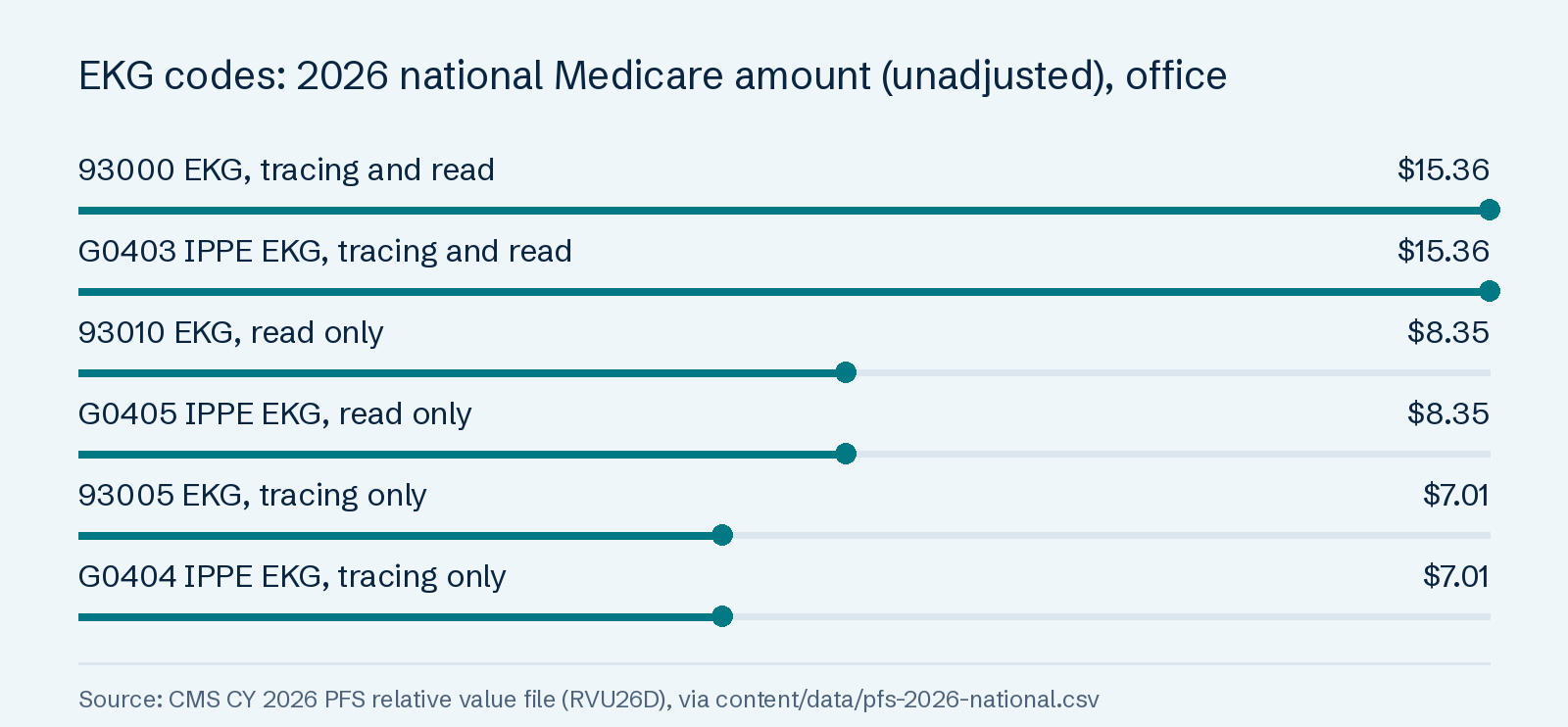
The EKG code follows who did the work. Ask two questions for every EKG: did our staff record it on our equipment, and did our clinician write the read? Two yeses mean 93000. One yes means the matching component code, and the other party bills the other half. The table sets out the three codes with the 2026 national Medicare amounts (unadjusted) from the CMS RVU26D file; actual payment varies by locality, setting and payer.
The arithmetic is exact: $7.01 for 93005 plus $8.35 for 93010 equals $15.36 for 93000. Splitting the test does not change Medicare's total; it changes who collects which part. The RVU file marks 93000 and 93005 "NA" in the facility setting, so a physician reading an EKG on a hospital patient bills only 93010, whose facility and office amounts are both $8.35.
| Code | Part of the EKG | Who reports it | 2026 national Medicare, office | Facility |
|---|---|---|---|---|
| 93000 | Tracing and written read | The practice that recorded the tracing and wrote the read | $15.36 | NA (not published) |
| 93005 | Tracing only | The practice or entity that owns the equipment and recorded the tracing | $7.01 | NA (not published) |
| 93010 | Written read only | The physician or qualified clinician who read a tracing recorded elsewhere | $8.35 | $8.35 |
Who bills what when the EKG is read elsewhere
When two parties touch one EKG, only one of them can send the global code. Match each arrangement to its codes:
- Your office records it and sends it to a cardiology group to read. Your office bills 93005; the reading cardiologist bills 93010. Neither bills 93000.
- Your clinician reads a tracing recorded by a hospital or another office. You bill 93010 only. The hospital or office that recorded it reports the tracing.
- Your clinician over-reads a tracing that another clinician already interpreted. For emergency room patients, chapter 13, section 100.1 says Medicare generally pays only one interpretation, and pays a second read only in unusual, documented circumstances, which may be identified with modifier 77.
- Your office records it and your physician reads it later the same day. That is still 93000: timing does not split the code; ownership of the work does.
Before the claim goes out, confirm the read exists as a signed report in your chart. If your office billed 93000 but the report was written by an outside reader, rebill as 93005 so the reader's 93010 is not denied as a duplicate.
If your group reads EKGs for referring offices, our cardiology billing services include office and hospital interpretation work within their stated scope.
EKGs with E/M visits and modifier 25
An office visit and an EKG on the same day are both payable when each is supported. Medicare has paid EKG interpretations separately from visits for services on or after January 1, 1994, under Claims Processing Manual chapter 12, section 20.3. Three rules decide how the pair is billed.
Same-day E/M rules
- Do not count the read toward a time-based visit level. The CMS Evaluation and Management Services guide (MLN006764) lists independently interpreting results not separately reported as countable time, and excludes time spent performing other services you report separately. If you bill 93000 or 93010, the read's minutes stay out of the E/M total.
- Modifier 25 belongs on the E/M line, never on the EKG line. Chapter 12, section 30.6.6 limits modifier 25 to E/M services furnished by the same practitioner on the same day as another procedure or service, for a significant, separately identifiable visit. Different diagnoses are not required. Whether a particular payer's edits expect modifier 25 on a visit billed beside an EKG varies by payer; check its published policy.
- A review is not a read. If the chart only says the EKG looked normal, the review is part of the visit and no 93000 or 93010 is billed.
For choosing the visit level itself, our guide to office visit codes such as 99213 covers time and medical decision making.
EKGs with stress tests and procedures
The 2026 NCCI policy manual, chapter XI says cardiovascular stress tests include their EKG strips, so 93000-93010 and 93040-93042 are not reported with them. EKG tracings taken during a cardiac catheterization or coronary intervention are included in the procedure, while a diagnostic EKG before or after the procedure may be reported with modifier 59 or XU. Noridian's A57326 adds, for its states, that a same-day EKG outside the stress test is payable only if it adds information, such as ruling out an acute heart attack before the test.
Baseline and QTc-monitoring EKGs in psychiatric and SUD practices
Two FDA labels show why psychiatric and substance use disorder prescribers order EKGs to watch the QTc interval. The FDA-approved Celexa (citalopram) label recommends EKG monitoring for patients with the conditions it lists, such as congenital long QT syndrome or low potassium, or taking other QTc-prolonging drugs, when citalopram is still considered essential. The Methadose (methadone) label tells prescribers to closely monitor patients with QT risk factors for changes in cardiac rhythm during initiation and titration.
Billing follows the same ownership test as any other EKG. A practice that orders the EKG but neither records nor reads it bills no EKG code; whoever records and reads it bills the codes. A practice that records the tracing and has its psychiatrist or psychiatric nurse practitioner write a full report bills 93000; one that records it and sends it out to be read bills 93005.
Diagnosis pairing examples
Medical necessity rides on the diagnosis. In Noridian's A57326 covered list, the codes for drug monitoring appear, but common psychiatric diagnoses such as F32.9, F41.1 and F20.9 do not. Opioid dependence (F11.20) is also absent, while some abuse codes, such as F11.10 and F14.10, are listed. Other MACs publish their own lists, so check the article for your jurisdiction.
| Situation | ICD-10-CM codes on Noridian's A57326 list | What the chart should show |
|---|---|---|
| Monitoring a QTc-prolonging medication | Z79.899 (other long-term drug therapy) or Z51.81 (therapeutic drug level monitoring) | The drug, the reason for monitoring and the read |
| QTc already found long on a prior EKG | R94.31 (abnormal EKG) or I45.81 (long QT syndrome) when diagnosed | The prior finding and the comparison in the new report |
| Symptoms on a new medication | R00.2 (palpitations), R00.0 (tachycardia), R55 (syncope and collapse) | The symptom documented by the ordering clinician |
| Before a planned procedure | Z01.810 (preprocedural cardiovascular exam) or Z01.818 | The planned procedure and the reason for the EKG |
Screening EKGs and the Welcome to Medicare visit
A routine screening EKG is generally not a Medicare benefit. Noridian's A57326 states that an EKG is not covered when used for screening or as part of a routine physical examination. Noridian also says patients with chronic stable heart disease, or other conditions that can affect the heart, typically do not need an EKG more often than once a year.
The national exception is the initial preventive physical examination (IPPE), the Welcome to Medicare visit. Under Claims Processing Manual chapter 18, section 80, the screening EKG tied to the IPPE is billed with HCPCS codes, not a code in the 93000 series:
- G0403: screening EKG with tracing and read ($15.36 national, unadjusted).
- G0404: tracing only ($7.01).
- G0405: read only ($8.35).
Since January 1, 2009 the screening EKG has been optional rather than a required part of the IPPE, and Medicare covers it once per lifetime; repeat claims deny as a once-in-a-lifetime service. If the same physician needs an additional, medically necessary diagnostic EKG on the IPPE day, chapter 18 directs billing the 93000-series code with modifier 59. Our guide to modifier 52, 53 and 59 explains when 59 is the right distinct-service modifier.
If your office runs Welcome to Medicare visits, our family practice medical billing service checks the last paid IPPE date before the visit is billed.
Common EKG denials
Each row pairs a repeat EKG problem with the fix that stops it on the next claim. Several start when charge entry does not know who recorded and who read the tracing.
If EKG lines keep coming back denied or short-paid, look at charge entry before appealing single claims. To see which unpaid claims are closest to their filing deadlines, get my free A/R Deadline Map: The Free A/R Deadline Map (Clock starts with your claim-level aging export and signed BAA; above 10 requests in a week, we confirm your date within 1 business day.).
| Problem | Likely cause | Fix |
|---|---|---|
| 93000 billed with modifier 26 or TC | Treated like an imaging code | Rebill as 93005 or 93010 without the modifier |
| Read denied as part of the visit | Chart shows only a one-line EKG note | Bill the read only when a full written report exists |
| Reader's 93010 denied as a duplicate | Recording office billed 93000 | Recording office rebills as 93005 |
| EKG denied on a stress test day | 93000 billed beside 93015-93018 | Drop an EKG that was part of the stress test |
| Rhythm strip denied with the 12-lead | 93040 billed beside 93000 (Noridian states) | Drop the strip line |
| Screening EKG denied | Routine exam diagnosis only | Use G0403-G0405 for the IPPE; otherwise code the symptom or condition |
Common questions
- What is CPT code 93000?
- 93000 is the CPT code for a routine 12-lead EKG when the same practice records the tracing and writes the interpretation and report. Its 2026 national Medicare amount (unadjusted) is $15.36 in the office; CMS publishes no facility amount for it.
- What is the difference between 93000 and 93010?
- 93000 is the whole EKG: your staff recorded it and your clinician wrote the read. 93010 is the read alone, billed when someone else recorded the tracing. The recording party then bills 93005. In 2026 the national Medicare amounts (unadjusted) are $15.36 for 93000 and $8.35 for 93010.
- Can I bill 93000 with an office visit?
- Yes, when each is supported. Medicare pays EKG interpretations separately from visits, but the time spent on a separately billed read cannot count toward a time-based visit level. If modifier 25 is used, it goes on the E/M code for a significant, separately identifiable visit, never on 93000.
- Who bills 93010?
- The physician or qualified clinician who reads a tracing recorded by someone else, such as a cardiologist reading for a referring office or a physician reading a hospital patient's EKG. The read must be a complete written report; a one-line "normal" note does not qualify.
- Is a screening EKG covered?
- Generally not by Medicare: Noridian's article A57326 treats screening EKGs and EKGs in a routine physical as non-covered. The exception is the screening EKG tied to the Welcome to Medicare visit, billed as G0403, G0404 or G0405 once per lifetime. Commercial plans set their own preventive rules.
- Does 93000 need modifier 26 or TC?
- No. CMS assigns 93000 PC/TC indicator 4, a global test-only code, so 26 and TC do not apply. Bill 93005 for the tracing alone and 93010 for the read alone instead.
Sources and review
Page revised November 4, 2026 · Review contact: Hyder Shah (inquiries@claimpillar.com). Every source below was retrieved and checked on November 4, 2026. Medicare amounts are 2026 national Medicare amounts (unadjusted) from our dataset built on the CMS CY 2026 PFS relative value file (RVU26D); actual payment varies by locality, setting and payer. Noridian's article binds only its Medicare jurisdictions (JE and JF).
- CMS / Noridian: Billing and Coding: Electrocardiograms (A57326), revision effective 10/01/2026
- CMS Medicare Claims Processing Manual, Chapter 12 (sections 20.3 and 30.6.6)
- CMS Medicare Claims Processing Manual, Chapter 13, section 100.1 (EKG interpretation and report)
- CMS Medicare Claims Processing Manual, Chapter 18, section 80 (IPPE and screening EKG)
- CMS NCCI Policy Manual for Medicare Services, Chapter XI (2026)
- CMS MLN006764: Evaluation and Management Services guide (May 2026)
- CMS PFS relative value files (RVU26D)
- FDA: Celexa (citalopram) prescribing information
- FDA: Methadose (methadone) prescribing information