Pain management billing we handle, and what you keep
Our pain billing service is built for independent interventional pain practices with 1 clinician up to 6–15 clinicians: physiatrists, anesthesiologists and other physicians who treat spine and joint pain with injections, ablation and stimulators in the office, a surgery center or a hospital outpatient department. Practices hand off pain billing when injection denials arrive months after the sessions, or when the biller who knew each payer's injection policy leaves.
Every claim passes our coding check against the signed procedure note. We check every code against your clinician's documentation and never change a code without the clinician's sign-off. When a case happens at a surgery center or hospital, the facility bills its own claim; we bill your physician's claim and give the facility's billing office the date, levels and side so both claims match.
| Task | What we do | What you keep |
|---|---|---|
| Charge capture | Match every scheduled epidural, facet block, ablation, stimulator case and office injection to a signed note; chase missing notes by physician. | Signing notes promptly |
| Session log | Count each patient's injection and ablation sessions by spinal region over a rolling 12 months before each claim goes out. | The decision to treat |
| Levels, side and guidance | Check the levels, side and imaging guidance in the note against the claim before release. | Final say on every code |
| Site of service | Set the place of service from where your physician performed the case: office, surgery center or hospital outpatient department. | Your physicians' site schedule |
| Approvals | Record approval numbers, approved levels and expiry dates against each scheduled procedure. | Clinical notes the plan asks for |
| Drug tests | Bill the tests your practice performs after checking the order, the rationale and your CLIA certificate. | Ordering each test |
| Denials and appeals | Correct, appeal or return each session-cap, level or approval denial with its fix within 2 business days. | Answers to our note queries |
| Posting and A/R | Post each remittance within 2 business days and follow every open balance with the payer. | Deposits to your own bank account |
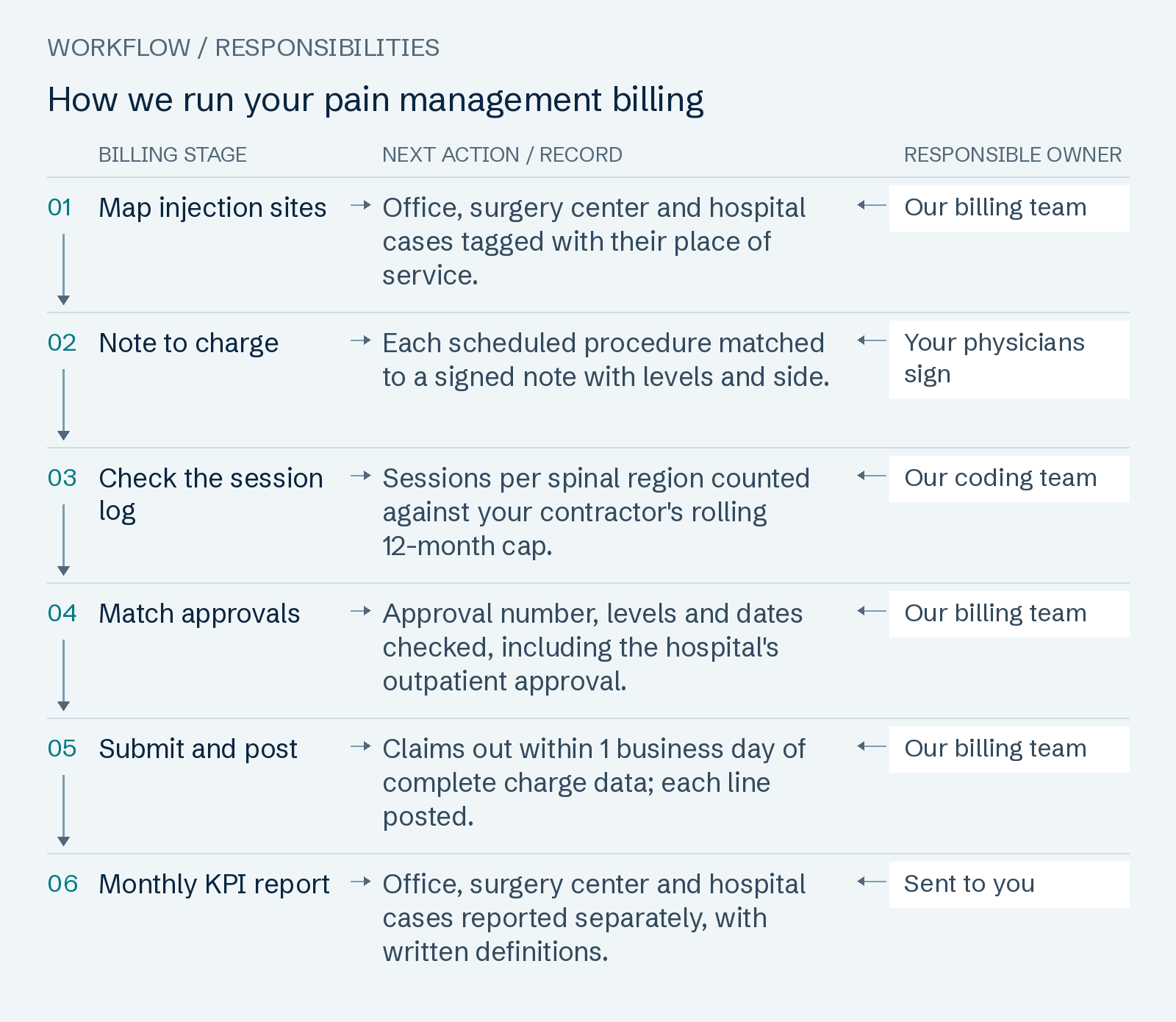
Read the workflow as text
- Map injection sites — Office, surgery center and hospital cases tagged with their place of service. Owner: Our billing team.
- Note to charge — Each scheduled procedure matched to a signed note with levels and side. Owner: Your physicians sign.
- Check the session log — Sessions per spinal region counted against your contractor's rolling 12-month cap. Owner: Our coding team.
- Match approvals — Approval number, levels and dates checked, including the hospital's outpatient approval. Owner: Our billing team.
- Submit and post — Claims out within 1 business day of complete charge data; each line posted. Owner: Our billing team.
- Monthly KPI report — Office, surgery center and hospital cases reported separately, with written definitions. Owner: Sent to you.
Injection and RFA coding we check, including imaging guidance bundling
Before an injection or ablation claim leaves, we compare the note's region, approach, levels, side and guidance with the claim. Four checks catch most mismatches:
- Guidance on epidurals. The 2026 NCCI Policy Manual, chapter VIII treats fluoroscopic or CT guidance as part of the image-guided epidural injection codes (62321, 62323, 62325 and 62327), so we never add a separate guidance line to those claims.
- Bilateral facet and ablation work. The same chapter has practitioners report a bilateral procedure on one line with modifier 50 and one unit, while a surgery center reports it on two lines with LT and RT. We format each claim for its setting, when the note documents both sides.
- Additional levels. Contiguous levels go on the add-on code for that family, not a second primary code, when the documentation supports each level; a note that lists more levels than it describes goes back to your physician.
- Ablation kept apart from blocks. RFA sessions and diagnostic or therapeutic blocks sit on separate lines of the session log, because contractors cap them separately.
LCD documentation we check on facet and epidural claims
Medicare contractors publish local coverage determinations (LCDs) that cap pain procedures by spinal region, and the caps differ by contractor. Two we load into the session log:
- Facet joint interventions. Noridian's LCD L38801, which covers its JE and JF states (current version effective April 16, 2026), reimburses no more than four diagnostic and four therapeutic facet sessions and two radiofrequency sessions per spinal region in a rolling 12 months, at one or two levels per session, and only under CT or fluoroscopic guidance.
- Epidural steroid injections. WPS's LCD L39054 limits ESIs to four sessions per spinal region in a rolling 12 months, under CT or fluoroscopy with contrast, at up to two levels for a transforaminal injection and one for an interlaminar or caudal injection.
For each claim we check the note against the documentation items in your own contractor's LCD, plus the levels, the guidance and the session count. A note missing one of them goes back to your physician, not to the payer.
Drug testing claims we bill for your practice
When your practice performs presumptive screens or definitive tests (definitive tests bill on HCPCS G0480–G0483) for patients on long-term opioid therapy, we bill them after three checks:
- Your CLIA certificate. CMS states that all laboratories must be properly certified to receive Medicare or Medicaid payments, so we confirm the certificate on file covers the tests you run before the first test claim.
- An individualized order. CGS's urine drug testing LCD L36029 (Kentucky and Ohio) treats blanket orders and routine standing orders as not reasonable and necessary, and expects the clinician's rationale for each definitive test in the record. Other contractors publish their own policies; we load yours.
- Frequency by risk group. The same LCD limits presumptive and definitive testing during chronic opioid therapy by the patient's documented risk level, so a test beyond that limit is flagged to your physician before it is billed.
Workers' comp and accident pain claims we bill
When an injury came from work or an accident, the patient's health plan may not be the first payer. For Medicare patients, the Medicare Secondary Payer Manual makes Medicare secondary to workers' compensation, liability and no-fault insurance; Medicare may make a conditional payment when the primary plan is not expected to pay promptly (within 120 days), and that payment must be repaid once the primary plan pays.
- We record the carrier and claim number from your intake forms against the injury visits.
- We bill the workers' comp or other primary carrier first, and bill Medicare only as the secondary payer rules allow.
- Your monthly report lists injury-case balances on their own lines, so they never hide in general aging.
If chiropractors in your group treat the same injury cases, our chiropractic billing services bill their visits at the rehab rate.
Rate card for your pain practice
Interventional pain groups pay the specialist row of our rate card. We charge that percentage only on insurance payments for claims we sent or worked: 0% on copays and other patient payments, and nothing on a surgery center's or hospital's facility payment for your cases. $0 setup. Invoices 1–3: only percentage fees on that month's insurance payments, plus any statements or add-ons you order. Percentage fees and mailed statements are capped at 9.0% of that month's insurance payments; from invoice 4, the $400 minimum applies even in a month when the cap comes to less.
Want us to request each approval as well as track it? Complete RCM at 9.0% of insurance payments includes authorization requests. One rate for every specialty and size up to 15 clinicians. Same $0 setup, $400 minimum from invoice 4, guarantees and Clean-Exit Terms. Multi-specialty practices: each clinician's claims are billed at that clinician's segment rate; the size band counts every clinician. If your group includes podiatrists, our podiatry billing services cover their foot and ankle claims on the same specialist row. Add-ons and exclusions sit on our published rate card.
| Pain practice size | Your percentage of insurance payments |
|---|---|
| Solo pain physician (1 clinician) | 6.0% |
| Small pain group (2–5 clinicians) | 5.5% |
| Larger pain group (6–15 clinicians) | 5.0% |
| Bigger groups or employed anesthesia providers | Pricing is by written quote. |
Appeal deadlines we work on high-dollar procedure denials
A denied stimulator implant, ablation or multi-level injection is worth appealing, and each appeal level runs on its own clock. We log every denial against its next deadline, work stimulator, ablation and multi-level injection denials first, and send the note, the LCD criteria it meets and the approval number. Our denial management services run the same clock on every denial. Original Medicare dates come from the Claims Processing Manual, chapter 1 and chapter 29; the Medicare Advantage step is 42 CFR 422.582.
The guarantees behind your pain claims
- On-Our-Watch Guarantee: If a claim misses a filing, corrected-claim or appeal deadline while it is on our watch, we pay you what it would have paid. Claims we get complete 10+ business days before the deadline; contracted rate less any copay you collected, paid automatically within 30 days of final denial; capped $10,000/month; your holds excluded.
- Clock-or-Credit Guarantee: From go-live, every new claim goes out within 1 business day of complete charge data, and every denial is worked within 2 business days of posting — or $25 comes off your invoice for each late one. Mon–Fri ET business days by your system's timestamps; worked: resubmitted, appealed or returned with the fix; auto-credited; capped at monthly fee; clearinghouse outages excluded.
Each applies on the terms above. We publish client results only with written permission. Until we have them, judge us by the guarantees and the free Deadline Map.
How we start
- Sign our service agreement and BAA.
- Give us logins to your practice-management system and clearinghouse, with read access to signed procedure notes.
- Send your claim-level aging export, which we sort by deadline first.
- Share each physician's site schedule: office days, surgery centers and hospitals.
- List your open approvals; past sessions we rebuild from your claim history.
Go-live, when your first claims go out, comes within 5 business days of access; any unbilled backlog follows within 10 business days of access. Clock starts with your signed agreement, signed BAA and working system logins; it extends day for day while we wait on access. Every inherited claim within 30 days of a filing, corrected-claim or appeal deadline is worked within 5 business days of access. Want to see your own deadlines first? Get my free A/R Deadline Map: Clock starts with your claim-level aging export and signed BAA; above 10 requests in a week, we confirm your date within 1 business day.
| Step (Original Medicare unless noted) | Time to file | What we send |
|---|---|---|
| Initial claim | 12 months after the date of service | Signed note, levels, side, guidance and approval number |
| Redetermination by your MAC | 120 days from receipt of the denial notice, presumed 5 days after its date | Corrected claim or appeal letter tied to the LCD criteria |
| Reconsideration by a QIC | 180 days from receipt of the redetermination | The full record, including imaging and the session history |
| Administrative law judge hearing | 60 days from receipt of the QIC decision, when the amount in controversy is met | The record and a case summary, for your decision on going ahead |
| Medicare Advantage plan reconsideration | 60 calendar days from receipt of the plan's decision | Appeal letter with the note and the plan's criteria |
Common questions
- How much do your pain management billing services cost?
- 6.0% of insurance payments for one pain physician, 5.5% for 2–5 clinicians and 5.0% for 6–15 clinicians. Copays and other patient payments: 0%. Setup: $0. The monthly minimum and the fee cap are in our rate card.
- Do facet injections need prior authorization, and does your team track it?
- In a hospital outpatient department, Original Medicare requires the hospital's approval before facet joint interventions under its outpatient prior authorization program, and that program covers only that setting. For office and surgery center cases we check each plan's own list at scheduling. Full-Service Billing tracks every approval; Complete RCM also requests it.
- How are drug tests billed, and can your team bill ours?
- Yes, for the tests your practice performs. We bill presumptive screens and definitive tests (definitive tests bill on HCPCS G0480–G0483) after confirming your CLIA certificate, an individualized order and the clinician's rationale in the note, against your contractor's drug testing policy. The checks are listed under drug testing claims.
- Can you bill workers' comp and accident pain claims?
- Yes, to the carrier responsible: we bill the workers' comp or other primary carrier first with its claim number, and Medicare only as its secondary payer rules allow. The steps are under workers' comp and accident claims.
- Do we have to sign a long-term contract for pain billing?
- No. Month to month. Leave with 30 days' written notice. No termination fee. If you leave, our Clean-Exit Terms apply: Notice by email; optional run-out covers claims we submitted before your exit date, at your plan rate; handover file within 10 business days of exit.
- How fast can you take over our pain practice's claims?
- Go-live comes within 5 business days of your signed agreement, BAA and working logins, and inherited claims near a filing deadline go into the deadline sweep. The start list is under how we start.
- Can you handle spinal cord stimulator trials and implants?
- Yes. We bill your physician's trial and implant claims and track the approval for each stage. In a hospital outpatient department, Original Medicare lists implanted neurostimulators in the same prior authorization program as facet joint interventions, so we confirm the hospital's approval, or its exemption, before your physician's claim goes out.
Sources and review
Page revised November 5, 2026 · Review contact: Hyder Shah (inquiries@claimpillar.com). LCD caps apply only in the named Medicare contractors' states, the hospital outpatient and WISeR programs apply only to Original Medicare in the stated settings and states, and commercial plans set their own rules.
- Noridian: LCD L38801 Facet Joint Interventions for Pain Management (JE and JF, effective 04/16/2026)
- WPS: LCD L39054 Epidural Steroid Injections for Pain Management
- CGS: LCD L36029 Urine Drug Testing
- CMS: Medicare NCCI Policy Manual 2026, Chapter VIII
- CMS: Hospital OPD Prior Authorization Operational Guide (March 2, 2026)
- CMS: WISeR Model Provider and Supplier Operational Guide, version 7.0
- CMS: Medicare Claims Processing Manual, Chapter 1, section 70 (timely filing)
- CMS: Medicare Claims Processing Manual, Chapter 29 (appeals)
- CMS: Medicare Secondary Payer Manual, Chapter 1
- CMS: Clinical Laboratory Improvement Amendments (CLIA)
- eCFR: 42 CFR 422.582, Medicare Advantage reconsideration (via content/data/timely-filing.csv)