Built for practices with 1–15 clinicians
Our small-practice billing is for independently owned practices in three size bands: 1 clinician, 2–5 clinicians and 6–15 clinicians. The band is recounted each month from the clinicians we billed, and your rate follows it in either direction.
Practices hand off billing at one of these points:
- The only biller quit or went on leave, and claims stopped going out.
- The current billing company stopped answering, and claims are aging past 90 days.
- A new clinician needs payer enrollment before the first visit.
Therapists, counselors and psychologists pay the Mental & behavioral health rates through our behavioral health billing service, and ABA providers bill through our ABA therapy billing service. Physical therapy, primary care and specialist offices use the same plan at their own segment rate. Cash-only practices are not a fit, because our fee is a share of insurance payments.
What we handle and what your front desk keeps
In a practice of one to fifteen clinicians, one absent biller can stop every claim, so we take the whole claim cycle rather than one queue. Every payment goes straight to your practice's own bank account. We never receive, deposit or endorse your payments; we invoice you once a month.
What stays with your front desk?
Your front desk keeps scheduling, check-in, copay collection and patient conversations about balances. We check eligibility for new patients and changed coverage and send coverage problems back to the desk before the claim is built.
| Task | What we do | When | What your practice keeps |
|---|---|---|---|
| Claims | Build, scrub and submit each claim from signed-off encounters | Within 1 business day of complete charge data | Signing off encounters so charges are complete |
| Payment posting | Post insurance payments and adjustments from each remittance | Within 2 business days of the remittance | Deposits land in your own bank account |
| Denials and appeals | Correct, resubmit or appeal each denial | Within 2 business days of posting | Answering our documentation questions |
| Eligibility | Check coverage for new patients and changed coverage | With each new patient or coverage change | Scheduling and patient conversations |
| Patient balances | Calculate balances after insurance posts; send statements in your practice's name | After each insurance payment posts | Payment plans and patient-policy exceptions |
| New clinician enrollment | Credentialing & Payer Enrollment at $149 per payer, billed only after the payer confirms your effective date | Filed from your complete provider packet | Licenses and the provider packet |
| Monthly report | KPI report with written definitions | By the 10th of each month | Answering the decision list |
Pricing: 5.0%–8.5% of insurance payments, 0% on patient pay
Your specialty segment and size band set one percentage, shown below; setup is $0. Your fee is a percentage of insurance payments posted on claims we submitted or worked, net of payer recoupments and refunds. We take 0% of patient payments, copays and anything your front desk collects. Not in the fee base: patient payments, copays, capitation, incentive or grant payments, and payments on claims we never submitted or worked.
Example: 3 therapists with $30,000 of insurance payments in a month pay 7.5%, or $2,250. That month's cap would be $2,700. The full small-practice rate card lists every add-on and the Complete RCM plan at 9.0%.
| Specialty segment | 1 clinician | 2–5 clinicians | 6–15 clinicians |
|---|---|---|---|
| Mental & behavioral health | 8.0% | 7.5% | 7.0% |
| ABA therapy | 8.5% | 8.0% | 7.5% |
| PT, OT, speech & chiropractic | 7.5% | 7.0% | 6.5% |
| Primary care, pediatrics & urgent care | 6.5% | 6.0% | 5.5% |
| Specialist physician groups | 6.0% | 5.5% | 5.0% |
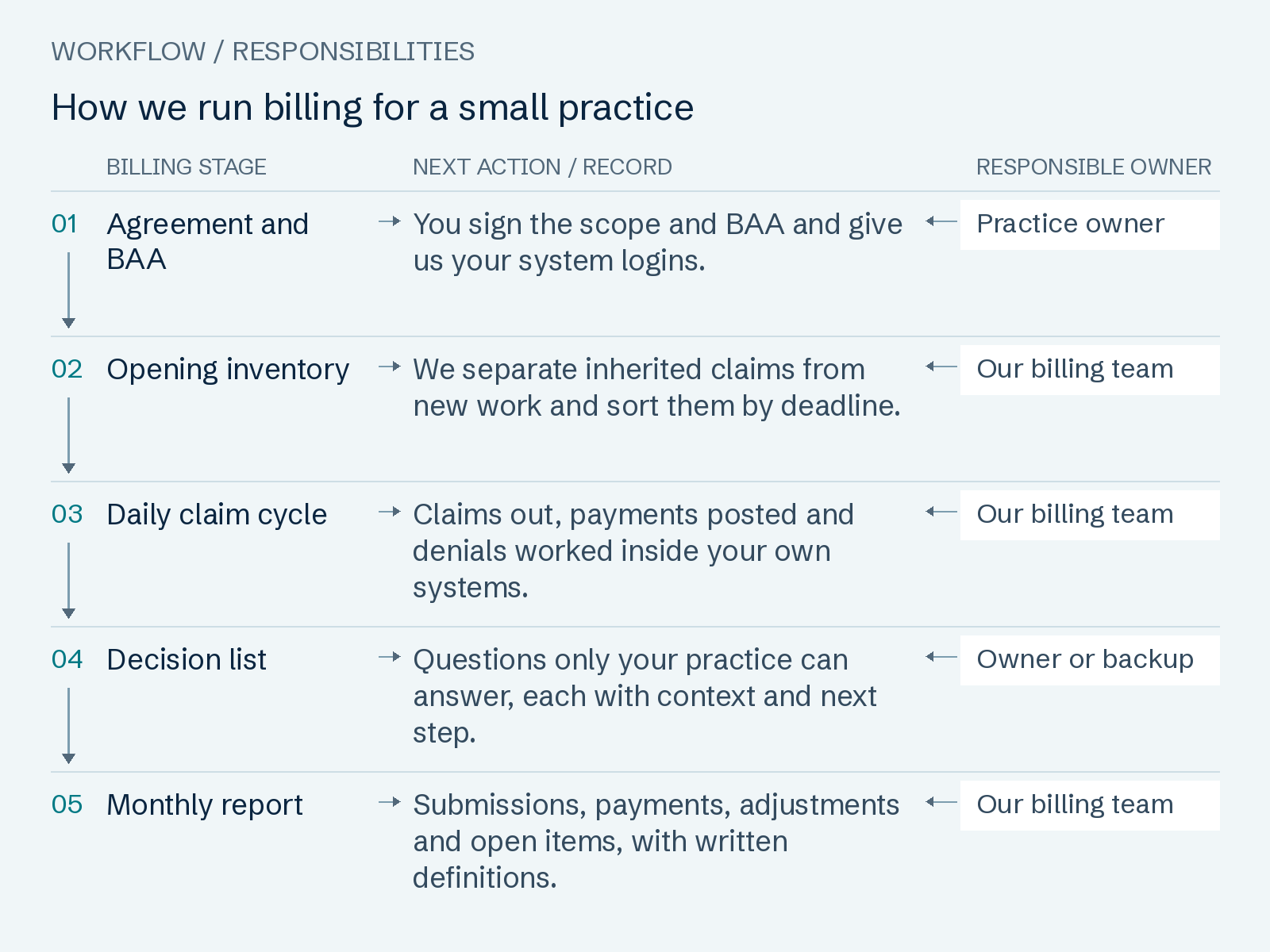
Read the workflow as text
- Agreement and BAA — You sign the scope and BAA and give us system logins. Owner: Practice owner.
- Opening inventory — We separate inherited claims from new work and sort by deadline. Owner: Our billing team.
- Daily claim cycle — Claims out, payments posted and denials worked inside your systems. Owner: Our billing team.
- Decision list — Questions only your practice can answer, each with its next step. Owner: Owner or backup.
- Monthly report — Submissions, payments, adjustments and open items, with written definitions. Owner: Our billing team.
Your monthly minimum, fee cap and statement fees explained
Three terms decide what you pay in a slow or busy month.
When does the monthly minimum apply to you?
Invoices 1–3: only percentage fees on that month's insurance payments, plus any statements or add-ons you order; the $400 minimum starts with invoice 4. After that, the minimum matters only in a month when your percentage fees come to less than $400. The same practice in a slow month: $4,000 of insurance payments at 7.5% is $300. Invoices 1–3 charge $300; from invoice 4 the $400 minimum applies, even though that month's 9.0% cap is $360.
What does the fee cap cover for you?
Percentage fees and mailed statements are capped at 9.0% of that month's insurance payments; the $400 minimum still applies from invoice 4.
What do statements and extras cost you?
Mailed patient statements are $0.95 each. Payer application fees, your software and clearinghouse fees stay with you; the rate card lists every exclusion.
Guarantees a small practice can actually enforce
No billing company can force a payer to approve a claim. We commit to the clock, in writing, checkable against your own system's timestamps.
- On-Our-Watch Guarantee. If a claim misses a filing, corrected-claim or appeal deadline while it is on our watch, we pay you what it would have paid. Claims we get complete 10+ business days before the deadline; contracted rate less any copay you collected, paid automatically within 30 days of final denial; capped $10,000/month; your holds excluded. Medicare allows 12 months, or 1 calendar year, after the date of service; commercial payers set their own limits.
- Clock-or-Credit Guarantee. From go-live, every new claim goes out within 1 business day of complete charge data, and every denial is worked within 2 business days of posting — or $25 comes off your invoice for each late one. Mon–Fri ET business days by your system's timestamps; worked: resubmitted, appealed or returned with the fix; auto-credited; capped at monthly fee; clearinghouse outages excluded.
Both apply on the terms above.
What are your exit terms if we do not work out?
Clean-Exit Terms: Leave with 30 days' notice and no termination fee. Want a run-out? We keep working the claims we submitted for 90 days at your plan rate. Decline it and we charge nothing on payments that post after you leave. Notice by email; optional run-out covers claims we submitted before your exit date, at your plan rate; handover file within 10 business days of exit.
Switching in 5 business days, backlog in 10 business days
- Agreement and BAA. You sign the agreement and a business associate agreement (BAA) before we see patient data; HIPAA names claims processing or administration and billing as business associate activities.
- Access and kickoff. You give us logins to your practice-management system and clearinghouse and join one kickoff call. We work inside your existing practice-management system and clearinghouse; tell us which ones and we confirm in writing within 1 business day.
- Opening inventory. We separate inherited claims from new work and sort them by deadline. The One-Week Deadline Sweep for Specialty Practices: Every inherited claim within 30 days of a filing, corrected-claim or appeal deadline is worked within 5 business days of access.
- Go-live. Go-live, when your first claims go out, comes within 5 business days of access; any unbilled backlog follows within 10 business days of access. Clock starts with your signed agreement, signed BAA and working system logins; it extends day for day while we wait on access.
- First review. We review the first report and decision list with you.
Claims more than 90 days old go to A/R Recovery: For inherited claims 90+ days past the date of service: 15% of the insurance payments that post after we work them, and $0 on claims that never pay. Replacing a billing company? Start with our guide to switching billing companies.
Adding a clinician while you switch?
Medicare billing privileges for a physician or non-physician practitioner start no earlier than the later of an approved application's filing date and the first date of service at the new location (42 CFR 424.520(d)). Our payer enrollment service files and tracks each application.
Small practice vs hiring a billing clerk: the math
A billing clerk is paid whether claims pay or not; our fee moves with your insurance payments. A billing and posting clerk's median wage is $48,500 a year (BLS, May 2025): about $4,042 a month before benefits, software and the clearinghouse, or about $5,774 at the private-industry benefit share (BLS, June 2026). The wage is the May 2025 median for billing and posting clerks in the BLS Occupational Outlook Handbook; the benefit figure uses the June 2026 release, where wages and salaries were 70.0 percent of employer costs for private-industry workers (BLS Employer Costs for Employee Compensation).
Your break-even is the clerk's monthly cost divided by your rate. Below it our fee costs less; above it the wage costs less on paper, before cover for leave or a resignation. A billing clerk is paid whether claims pay or not. Your first three invoices are only a share of insurance payments that already reached your account, plus any statements or add-ons you order.
Small-practice fee calculator
Enter monthly insurance payments as collections, your rate as the percentage and the clerk's monthly cost as the flat figure. It leaves out the minimum and cap. Our in-house vs outsourced billing cost model adds software and turnover.
| Option | Monthly cost | What the cost covers | What it leaves with you |
|---|---|---|---|
| Full-time billing clerk, wage only | $4,042 | One person's pay, from the BLS median | Benefits, software, clearinghouse, cover for leave |
| Full-time billing clerk, with benefits | $5,774 | Pay plus benefits at the private-industry share | Software, clearinghouse, cover for leave |
| Full-Service Billing | Your rate × that month's insurance payments | Claims, posting, denials, eligibility, statements, report | Front desk, encounter sign-off, your software |
How to check us before you sign
Check any billing company this way, us included:
- Read the BAA. HIPAA requires the contract to make the company use appropriate safeguards, report any use or disclosure not provided for by the contract, and return or destroy all protected health information at termination where feasible. Ask for ours first.
- Search the exclusion list. OIG's List of Excluded Individuals/Entities is searchable online; excluded parties can receive no payment from Federal health care programs for items or services they furnish.
- Ask how codes are checked. In its 1998 guidance for third-party billing companies, OIG stated a longstanding concern that percentage billing arrangements may increase the risk of upcoding. Our answer is in writing: We check every code against your clinician's documentation and never change a code without the clinician's sign-off.
- Read the fee base and exit terms. Confirm what the percentage applies to and what you receive when you leave.
- Test us on your own claims. Request Get my free A/R Deadline Map, every unpaid claim over 90 days sorted by deadline. Clock starts with your claim-level aging export and signed BAA; above 10 requests in a week, we confirm your date within 1 business day.
We publish client results only with written permission. Until we have them, judge us by the guarantees and the free Deadline Map. To compare providers side by side, use our questions to ask a billing company. Our comparison of medical billing services for small practices lists us as one of the options. Our medical billing outsourcing service page sets out the same scope for every practice size, and our medical billing company homepage lists every service. Ready? Ask for a small-practice quote with your provider count, specialty and software.
Common questions
- How much does medical billing cost for a small practice?
- With us, 5.0% to 8.5% of insurance payments, set by specialty segment and size band, 0% of patient payments and $0 setup. Mailed statements are $0.95 each. The rate card lists every band and add-on.
- Is there a monthly minimum?
- Yes, $400, and only from your 4th monthly invoice. Invoices 1–3: only percentage fees on that month's insurance payments, plus any statements or add-ons you order; the $400 minimum starts with invoice 4.
- Can I leave if it does not work?
- Yes. Month to month. Leave with 30 days' written notice. No termination fee. The Clean-Exit Terms above, with an optional run-out of 90 days and a handover file within 10 business days, apply in full.
- How long does it take to switch?
- Go-live, when your first claims go out, comes within 5 business days of access; any unbilled backlog follows within 10 business days of access. Clock starts with your signed agreement, signed BAA and working system logins; it extends day for day while we wait on access. Claims near a deadline are worked first.
- Do you work with solo practitioners?
- Yes. A solo clinician is our 1 clinician band: for example, a solo mental health therapist pays 8.0% and a solo ABA provider 8.5% of insurance payments. The same scope, guarantees and exit terms apply as for a group.
- Do we have to change our EHR or billing software?
- No. We work inside your existing practice-management system and clearinghouse; tell us which ones and we confirm in writing within 1 business day. Our software compatibility page lists the access we need.
Sources and review
Page revised November 4, 2026 · Review contact: Hyder Shah (inquiries@claimpillar.com). Federal and BLS sources retrieved November 4, 2026. Every price, turnaround, guarantee and term comes from our published offer terms.
- BLS Occupational Outlook Handbook: Financial Clerks (May 2025 wages), retrieved 2026-11-04
- BLS: Employer Costs for Employee Compensation, June 2026, retrieved 2026-11-04
- eCFR: 45 CFR 160.103, Definitions (business associate), retrieved 2026-11-04
- eCFR: 45 CFR 164.504(e), Business associate contracts, retrieved 2026-11-04
- eCFR: 42 CFR 424.520, Effective date of Medicare billing privileges, retrieved 2026-11-04
- CMS Medicare Claims Processing Manual, Chapter 1 (timely filing), retrieved 2026-11-04
- HHS OIG: Compliance Program Guidance for Third-Party Medical Billing Companies (63 FR 70138), retrieved 2026-11-04
- HHS OIG: Exclusions (LEIE), retrieved 2026-11-04