Cystoscopy CPT code 52000: diagnostic cystourethroscopy
In plain words, 52000 is a look-only scope of the urethra and bladder: the urologist passes a cystoscope, inspects, and does nothing else that has its own code. The official descriptor belongs to the AMA's CPT code set; this page uses code numbers and our own short summaries.
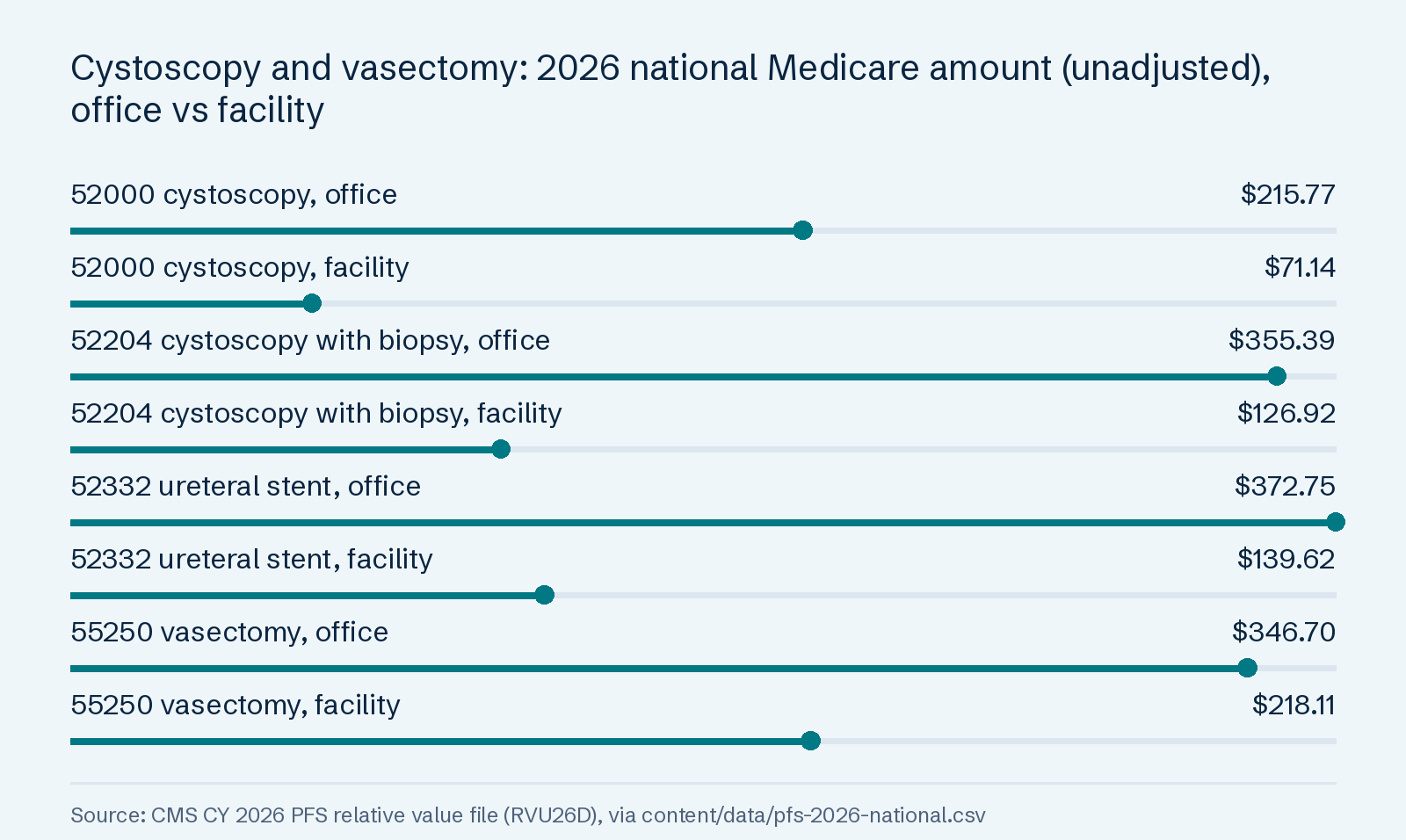
The CMS CY 2026 relative value file (RVU26D) gives 52000 a global period of 000 days and multiple-procedure indicator 2. It also lists 52000 as the endoscopic base code for most cystoscopy-with-procedure codes, including every one in the table below (the ureteroscopy codes use 52351 instead), which is why the base matters for payment (next section). The 2026 national Medicare amount (unadjusted) is $215.77 in the office and $71.14 in a facility such as a hospital outpatient department or ASC; actual payment varies by locality, setting and payer.
When 52000 is not billed
Two NCCI rules remove 52000 from a claim. The 2026 NCCI Policy Manual, chapter VII says endoscopic procedures include the minor related work done at the same encounter, so a diagnostic cystoscopy is not added to a cystoscopy that also treats something. It also says a cystoscopy done near the end of an abdominal or pelvic operation, to confirm the ureters and bladder were not injured, is not separately reportable.
Cystoscopy with procedures: biopsy, stent, fulguration
When the urologist does something through the scope, the claim carries the code for that work instead of 52000. The table lists the common office and facility cystoscopy codes with their global days and 2026 national Medicare amounts (unadjusted) from the CMS RVU26D file. "Facility only" means CMS publishes no office amount for that code.
Two cystoscopy codes in one session
Medicare does not pay two cystoscopy codes at full value. Under Claims Processing Manual chapter 12, section 40.6, when several endoscopies with the same base are billed, Medicare pays the highest-valued code in full plus the difference between the next code and the base. Example in the office: 52332 (stent) and 52204 (biopsy) in one session pays $372.75 for 52332 plus $139.62 for 52204 ($355.39 minus $215.77 for 52000), a total of $512.37 before adjustments, not $728.14.
NCCI edits that change units and lines
- 52204: one unit, however many biopsies are taken in the session.
- 52310 and 52315: carry the "separate procedure" designation, so they are not reported with another cystoscopy code in the same encounter.
- 52332: only for a stent left in place; a temporary stent placed and removed during a cystoscopy with ureteroscopy is not separately reported, and 52332 and 52005 are not reported for the same ureter in the same encounter.
- Fluoroscopy and catheters: fluoroscopy (76000, 77002) and bladder catheter placement (51701-51703) are part of the cystoscopy.
Every one of those rules comes from the 2026 NCCI chapter VII and applies to Medicare claims; other plans publish their own edits, so check each plan's policy. When a scope is stopped or reduced, our guide to modifier 52 and its neighbours sets out which modifier fits the note.
| Code | What it covers (our words) | Global days | 2026 national Medicare, office | Facility |
|---|---|---|---|---|
| 52000 | Diagnostic cystoscopy, look only | 0 | $215.77 | $71.14 |
| 52001 | Cystoscopy to wash out blood clots | 0 | $419.52 | $252.84 |
| 52204 | Cystoscopy with bladder biopsy | 0 | $355.39 | $126.92 |
| 52214 | Cystoscopy, fulguration at bladder neck or urethra | 0 | $727.47 | $151.97 |
| 52224 | Cystoscopy, treating small lesions under 0.5 cm | 0 | $760.20 | $175.69 |
| 52234 | Bladder tumor treatment, 0.5 to 2 cm | 0 | Facility only | $216.77 |
| 52235 | Bladder tumor treatment, 2 to 5 cm | 0 | Facility only | $254.51 |
| 52240 | Bladder tumor treatment, over 5 cm | 0 | Facility only | $344.36 |
| 52281 | Cystoscopy with urethral stricture dilation | 0 | $310.29 | $136.61 |
| 52310 | Cystoscopy, simple stent or stone removal | 0 | $298.60 | $134.61 |
| 52332 | Cystoscopy, indwelling ureteral stent placed | 0 | $372.75 | $139.62 |
| 55250 | Vasectomy, one or both sides | 90 | $346.70 | $218.11 |
| 89321 | Semen analysis for sperm presence | Not on the PFS (lab) | No PFS amount | No PFS amount |
CPT code for vasectomy: 55250
The CPT code for a vasectomy is 55250, whether one or both sides are done; there is no second code for the other side. The CMS RVU26D file gives it a 90-day global period, so Medicare treats it as a major procedure, and splits its value 10% preoperative, 80% intraoperative and 10% postoperative. Its 2026 national Medicare amount (unadjusted) is $346.70 in the office and $218.11 in a facility.
Three facts shape a vasectomy claim:
- The follow-up semen exams are part of 55250. The code's descriptor includes the postoperative semen examinations, as AAFP's Family Practice Management spelled out: when the same entity does the vasectomy and the semen analysis, 55250 is the code to use.
- The 90-day clock covers the follow-up. Under chapter 12, section 40.1, visits related to recovery during the 90 days are paid inside 55250, as are preoperative visits after the decision to operate, starting the day before surgery.
- Coverage, not coding, decides most vasectomy payments. Medicare and many plans treat an elective vasectomy differently from other procedures (see the coverage section below).
Post-vasectomy semen analysis: 89321
89321 is the semen analysis that checks only for the presence of sperm, the test run after a vasectomy. The CMS RVU26D file lists it with status X, a statutory exclusion from the physician fee schedule: as a lab test it is priced on the clinical laboratory fee schedule, not the PFS, so the file carries no physician amount for it.
Who bills 89321
- Your practice did the vasectomy and runs the semen check. Bill nothing extra: the exam is inside 55250 (AAFP Family Practice Management).
- An outside lab or another practice runs the test. That entity bills 89321 under its own lab certificate.
- Your practice runs the test for a patient whose vasectomy was done elsewhere. Bill 89321, provided your site holds the CLIA certificate the test requires.
Keep the semen analysis result, or the record that the patient missed the test, in the chart with the vasectomy note, so the 90-day file shows the follow-up the code includes.
Global periods and same-day E/M
Cystoscopy and vasectomy sit on opposite sides of the Medicare global surgery rules, so the same-day visit is handled differently. The 2026 NCCI Policy Manual, chapter VII, section B sets the rules:
- 0-day or 10-day codes (52000 family) are minor procedures. The decision to do the cystoscopy is paid inside it. A significant, separately identifiable E/M service unrelated to that decision is reported with modifier 25, and it does not need a different diagnosis. A new patient alone does not justify the visit.
- 90-day codes (55250) are major procedures. A visit on the day of or the day before surgery that decides to operate is reported with modifier 57 (the day-before rule is in Claims Processing Manual chapter 12, section 40.2). Other pre-op visits in that window are included.
- During the global period, visits for recovery or complications are included; a visit for an unrelated problem is reported with modifier 24.
Same-day E/M and modifier 25 examples
- Hematuria work-up, scope the same day. The urologist sees a patient, decides on a cystoscopy and performs 52000 at that visit. Bill 52000 only: the decision is part of the minor procedure.
- Surveillance scope plus a separate problem. A patient comes for a scheduled bladder-tumor surveillance 52000, and the urologist also evaluates and adjusts treatment for a separate problem, such as kidney stones, documented on its own. Bill 52000 and the visit level with modifier 25, when the documentation supports a significant, separately identifiable service; choosing that level, for example 99213 or 99214, follows the usual E/M rules.
- Vasectomy consult and procedure the same day. If the visit is where the decision to operate is made, the E/M takes modifier 57. Post-op checks inside 90 days are not billed; an unrelated visit in that window takes modifier 24.
Modifiers 25, 57 and 24 go on the E/M line, never on the procedure line. Before you bill, check the date of the last related procedure so a visit inside a 90-day global does not go out without its modifier.
Vasectomy coverage, deductibles and good-faith estimates
Whether anyone besides the patient pays for 55250 depends on the payer, and the answer should be on the estimate before the procedure is scheduled.
- Medicare: NCD 230.3 lists vasectomy as nationally non-covered when the primary indication is sterilization. CMS's advance written notice booklet (MLN006266) explains when a notice is required, when one is a courtesy, and the GA, GX, GY and GZ modifiers that report it; check it before you schedule a Medicare patient.
- HSA-qualified high-deductible plans: IRS Notice 2024-75 restates that the HRSA women's preventive guidelines do not include male sterilization and that its new guidance does not reach it. A vasectomy is therefore not preventive care for HDHP purposes, and the plan applies the deductible first.
- Other commercial plans: coverage and cost-sharing are set by the plan; verify benefits for 55250 for each patient.
- Uninsured or self-pay patients: under 45 CFR 149.610 you owe a good-faith estimate listing the expected service codes, diagnosis codes and charges. It is due within 1 business day of scheduling when the procedure is booked at least 3 business days out, within 3 business days when booked at least 10 business days out, and within 3 business days of a patient's request.
Patient estimate example: high-deductible plan
Illustrative example, not client data. Suppose a patient's plan allows $800 for 55250 in your office, the patient has $1,500 of deductible left, and the plan's coinsurance after the deductible is 20%. The whole $800 falls inside the deductible, so the estimate is $800 owed by the patient. If the same patient had only $300 of deductible left, the estimate would be $300 plus 20% of the remaining $500 ($100), or $400. Put the plan's real allowed amount and the patient's remaining deductible into the same two steps, and collect or set up payment before the day of surgery as your financial policy allows.
Prior auth and denial patterns in urology
Prior authorization for cystoscopy and vasectomy is set plan by plan, so check each commercial and Medicare Advantage plan's list when the procedure is scheduled, and record the reference number on the claim. Practices that would rather not chase these can use our prior authorization services. Most of the denials below trace back to the rules on this page.
If cystoscopy and vasectomy claims keep coming back, our urology billing services compare units and laterality with the op note before same-session scope claims go out. To see which open claims are closest to their filing deadlines first, get my free A/R Deadline Map: The Free A/R Deadline Map (Clock starts with your claim-level aging export and signed BAA; above 10 requests in a week, we confirm your date within 1 business day.).
| Problem | Rule behind it (source) | Fix |
|---|---|---|
| Second cystoscopy code paid far below its amount | Multiple-endoscopy rule pays the value above base 52000 (CMS chapter 12, section 40.6) | Expect the reduction; appeal only if the base was wrong |
| 52204 billed with several units | One unit however many biopsies (NCCI chapter VII) | Rebill with one unit |
| 52310 denied beside another cystoscopy | Separate procedure: not with other cystoscopy codes that encounter (NCCI) | Drop 52310 when another cystoscopy code is billed |
| Fluoroscopy or catheter line denied | 76000, 77002 and 51701-51703 are included (NCCI) | Remove the lines; do not appeal |
| Visit denied beside 52000 | Decision for a minor procedure is included (NCCI chapter VII, section B) | Bill the visit with 25 only for separately documented work |
| Post-op visit denied after 55250 | 90-day global includes recovery visits (CMS chapter 12, section 40.1) | Add modifier 24 only for an unrelated problem |
| 89321 denied after your own vasectomy | Semen exams are inside 55250 (AAFP FPM) | Do not bill 89321 for your own 55250 patients |
| Elective vasectomy denied by Medicare | NCD 230.3: non-covered when sterilization is the main reason | Follow MLN006266 on notices and modifiers before scheduling |
Common questions
- What is CPT code 52000?
- 52000 is a diagnostic cystoscopy: a look-only scope of the urethra and bladder, and the base code of the cystoscopy family. It has a 0-day global period, and its 2026 national Medicare amount (unadjusted) is $215.77 in the office and $71.14 in a facility. A visit the same day is billed only for significant, separately identifiable work, with modifier 25.
- What is the CPT code for vasectomy?
- 55250, for one or both sides. It carries a 90-day global period and includes the postoperative semen examinations when the same entity performs them, so your practice does not add 89321 for its own vasectomy patients. Its 2026 national Medicare amount (unadjusted) is $346.70 in the office.
- Is a vasectomy covered by insurance?
- It depends on the payer. Medicare's NCD 230.3 lists vasectomy as non-covered when the primary indication is sterilization. For HSA-qualified high-deductible plans, the IRS does not treat male sterilization as preventive care, so the deductible applies first. Other commercial plans set their own coverage and cost-sharing, so verify benefits for 55250 before scheduling.
- What is the global period for 55250?
- 90 days, according to the CMS CY 2026 relative value file. Preoperative visits from the day before surgery, the procedure, and recovery visits during the 90 days are paid inside 55250. A visit that decides to operate on the day of or day before surgery takes modifier 57; a visit for an unrelated problem during the 90 days takes modifier 24.
- Can I bill an E/M with a cystoscopy?
- Only for separate work. Because 52000 is a minor procedure, the visit that leads to the decision to scope is included. A significant, separately identifiable E/M service, documented on its own, can be billed with modifier 25 on the E/M line, and it does not need a different diagnosis. Being a new patient is not enough on its own.
- Does our practice need to send uninsured vasectomy patients a good-faith estimate?
- Yes. Under 45 CFR 149.610, uninsured or self-pay patients get a good-faith estimate with the expected service codes, diagnosis codes and charges: within 1 business day of scheduling when the vasectomy is booked at least 3 business days ahead, within 3 business days when booked at least 10 business days ahead, and within 3 business days of a request.
Sources and review
Page revised November 4, 2026 · Review contact: Hyder Shah (inquiries@claimpillar.com). Every source below was retrieved and checked on November 4, 2026. Medicare amounts are 2026 national Medicare amounts (unadjusted) from our dataset built on the CMS CY 2026 PFS relative value file (RVU26D); actual payment varies by locality, setting and payer. NCCI and Medicare coverage rules bind Medicare claims; other plans set their own policies.
- CMS: PFS relative value files (CY 2026 RVU26D)
- CMS Medicare Claims Processing Manual, Chapter 12 (sections 40.1 and 40.6)
- CMS: Medicare NCCI 2026 Policy Manual, Chapter VII
- CMS: National Coverage Determination 230.3, Sterilization
- CMS: Medicare Advance Written Notices of Non-coverage (MLN006266)
- IRS Notice 2024-75: Preventive care for HDHPs under section 223
- eCFR: 45 CFR 149.610, Good faith estimates for uninsured (or self-pay) individuals
- AAFP Family Practice Management (2003): coding the post-vasectomy semen analysis