97802 cpt code: initial MNT assessment, per 15 minutes
In plain words, 97802 is the first one-on-one nutrition therapy visit, counted in 15-minute units: the dietitian assesses the patient and starts the intervention face to face. This page uses the code number and our own summary only; the official descriptor belongs to the AMA's CPT code set.
Medicare allows 97802 once. The Medicare Claims Processing Manual, chapter 4, section 300.4 says the code is used only once, for the initial assessment of a new patient, and that every later individual visit, reassessments included, is billed as 97803. Medicare's practitioner Medically Unlikely Edits effective October 1, 2026 allow up to 12 units of 97802 on one date of service, which is 3 hours.
MNT code table with unit math
The table sets out each MNT code, its unit length, Medicare's per-date unit edit and the 2026 national Medicare amount (unadjusted) from our dataset built on the CMS CY 2026 relative value file. Actual payment varies by locality, setting and payer. Record start and stop times for every visit, and bill only whole units your payer's written time rule supports.
| Code | Our plain summary | Unit length | Medicare units per date (MUE) | 2026 national Medicare, non-facility | Unit math example |
|---|---|---|---|---|---|
| 97802 | First individual MNT visit | 15 minutes | 12 | $36.74 | 60-minute initial visit = 4 units |
| 97803 | Later individual MNT visit or reassessment | 15 minutes | 11 | $31.73 | 30-minute follow-up = 2 units |
| 97804 | Group MNT, 2 or more patients | 30 minutes | 6 | $17.03 | 90-minute group class = 3 units for each patient who attended |
| G0270 | Individual MNT after a second referral in the same year | 15 minutes | 8 | $31.73 | 45-minute visit after a change in condition = 3 units |
| G0271 | Group MNT after a second referral in the same year | 30 minutes | 4 | $17.03 | 60-minute group session = 2 units for each patient |
97803: reassessment and follow-up
97803 is every individual MNT visit after the first: follow-up interventions and reassessments, including a reassessment because the patient's condition changed in a way that affects nutrition. CMS's manual tells providers to bill all later individual visits this way, so a visit is either 97802 or 97803, never both.
First-year unit math for a Medicare patient
Illustrative example, not client data: a 60-minute initial visit (4 units of 97802) plus four 30-minute follow-ups (2 units of 97803 each, 8 in all) uses 12 units, or 3 hours, which is Medicare's first-year amount. The next calendar year allows 2 hours, for example eight 15-minute units of 97803 spread across visits. Medicare pays a registered dietitian the lesser of the actual charge or 85% of the fee schedule amount, per section 300.4 of the manual, so the national non-facility figure for one unit of 97802 works out to $36.74 × 85% = $31.23, before locality adjustment.
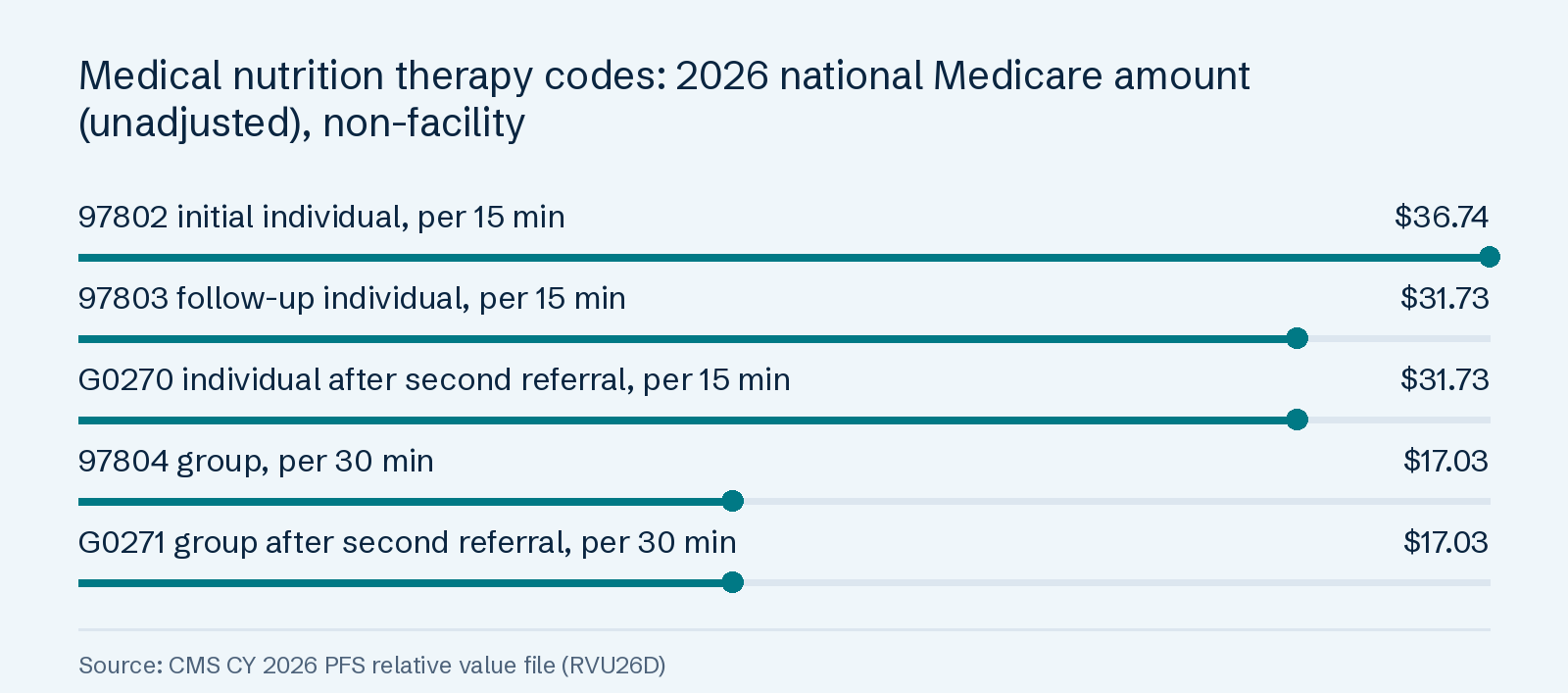
The chart compares the 2026 national Medicare amounts (unadjusted, non-facility) for the five MNT codes before the 85% rule is applied.
97804: group MNT
97804 is medical nutrition therapy delivered to a group of two or more patients, counted in 30-minute units. CMS's manual uses it for group visits whether they are the patient's first or a later one, and also when a patient whose condition changed attends a group. Section 300.1 of the Medicare Claims Processing Manual, chapter 4 lets MNT be furnished individually or in groups without restriction, and Medicare pays only for sessions the patient actually attended and the provider documented.
Bill each attending patient on their own claim for the units of group time they were present. Medicare's per-date edit for 97804 is 6 units (3 hours).
Medicare MNT: diabetes, CKD and referral rules
Medicare Part B covers MNT for three groups, as of the rules retrieved on November 5, 2026. 42 CFR 410.130 defines the conditions: diabetes mellitus, and renal disease, meaning chronic renal insufficiency (GFR 15 to 59), end-stage renal disease when the patient is not on dialysis, or the 36 months after a kidney transplant. Medicare.gov says the patient pays nothing for these services if they qualify.
Medicare MNT benefit summary
- Hours: 3 hours in the first calendar year and 2 hours in each later year (NCD 180.1, version effective January 1, 2022). Unused first-year hours do not carry into the next year (manual section 300.2).
- Referral: only a physician (MD or DO) may refer, with the diagnosis documented in the patient's record, and a new referral is needed for each year's follow-up hours (manual section 300.2). The Academy of Nutrition and Dietetics states the same: a referral by any physician (MD or DO), provided by an RDN enrolled as a Medicare provider.
- Claim: the referring physician's NPI must be on the CMS-1500, and Medicare contractors return claims without it. A claim with no diabetes or renal disease diagnosis is denied.
- Dialysis: MNT is not covered for patients on maintenance dialysis paid under the ESRD benefit; Medicare.gov says their nutrition services come with dialysis care.
- DSMT: a patient may receive both MNT and diabetes self-management training in the same period, but not on the same date of service.
Extra hours: G0270 and G0271
When the physician documents a change in diagnosis, medical condition or treatment regimen that requires a change in diet, a second referral in the same year covers more hours. CMS's NCCI policy manual, chapter XI (2026) says those services are reported with G0270 (individual) or G0271 (group), not 97802-97804. The same chapter bundles MNT into cardiac or pulmonary rehabilitation at the same encounter; at a separate encounter on the same date it may be reported with an NCCI modifier.
Commercial coverage and diagnosis pairing
Outside Medicare, MNT coverage is set by each plan and each state Medicaid program. The Academy's Medicaid mapping project (May 7, 2025) found wide variation between states in coverage policies, licensure requirements and billing practices. Before the first visit, verify benefits for the CPT code and the diagnosis together, and ask four things:
- Does the plan cover 97802 and 97803 for this diagnosis?
- Is there a visit or unit limit per year?
- Does it require a physician referral or prior authorization?
- Is the dietitian in network under their own NPI?
The diagnosis on the claim has to be one the benefit covers. For Medicare, that is diabetes or renal disease; for a commercial plan, it is whatever the plan's policy lists. The ICD-10-CM codes below come from the CMS FY 2027 ICD-10-CM code files; code to the highest specificity the record supports.
| Condition in the referral | Example ICD-10-CM codes | Medicare MNT? |
|---|---|---|
| Type 1 or type 2 diabetes | E10.9, E11.9 (and their complication codes) | Yes, with a physician referral |
| Gestational diabetes | O24.419 | Yes; the episode ends when the pregnancy ends |
| Chronic kidney disease, not on dialysis | N18.30, N18.31, N18.32, N18.4 | Yes when the record shows renal insufficiency (GFR 15 to 59) |
| Stage 5 CKD or end-stage renal disease | N18.5, N18.6 | Only when the patient is not on maintenance dialysis |
| Kidney transplant | Z94.0 | Yes, for 36 months after the transplant |
| Eating disorder | F50.00-F50.89, F50.9 | No; check the commercial or Medicaid plan |
| Severe obesity | E66.01 | No; check the commercial or Medicaid plan |
Telehealth MNT
Dietitians can bill Medicare MNT by telehealth. 97802, 97803, 97804 and G0270 are on the CMS list of Medicare telehealth services for CY 2026; G0271 is not. A registered dietitian or nutrition professional is a permitted distant-site practitioner under 42 CFR 410.78(b)(2).
Where the patient may be depends on the date. CMS's telehealth FAQ updated October 8, 2026 says that through December 31, 2027, patients can receive Medicare telehealth anywhere in the United States; from January 1, 2028, except for behavioral health, they generally need to be in a medical facility in a rural area. The same FAQ says to use place of service 10 for a patient at home and POS 02 elsewhere, that home telehealth is paid at the non-facility rate, and that modifiers BB and BC are required from January 1, 2027 where their conditions apply. Commercial and Medicaid plans set their own telehealth rules and modifiers; our guide to the telehealth modifiers 95 and GT covers which payers still ask for each.
MNT in eating disorder treatment teams
An eating disorder team usually bills three kinds of service for one patient, each under its own clinician's NPI and code family. Medicare's MNT benefit does not cover eating disorders, because 42 CFR 410.130 limits it to diabetes and renal disease, so the dietitian's visits depend on the commercial or Medicaid plan.
Eating disorder team billing note
- Therapist: individual psychotherapy by time, 90832 (16 to 37 minutes), 90834 (38 to 52) or 90837 (53 or more), per APA Services. Our guide to the 90837 psychotherapy code (53+ minutes) covers its time and documentation rules.
- Psychiatrist or psychiatric prescriber: an E/M visit, plus a psychotherapy add-on (90833, 90836 or 90838) when psychotherapy is done at the same visit, as NCCI chapter XI sets out.
- Dietitian: 97802 for the first visit and 97803 after, with the F50 eating disorder code the record supports, when the plan covers nutrition therapy for it.
Visit limits are the risk to watch. In a 2014 assurance of discontinuance, the New York Attorney General said that Cigna had applied a three-visit yearly limit to nutritional counseling for members with eating disorders that it did not apply to diabetes, and Cigna agreed to drop visit limits for medically necessary nutritional counseling prescribed for mental health disorders. If a plan caps dietitian visits for an eating disorder diagnosis, ask it in writing whether the cap also applies to medical conditions.
Credentialing registered dietitians
A dietitian bills MNT under their own enrollment. Under 42 CFR 410.134, only a registered dietitian or nutrition professional may furnish Medicare MNT: a qualifying degree, at least 900 supervised practice hours and a state license or certification, or recognition as a registered dietitian by the Commission on Dietetic Registration where the state does not license. Section 300.3 of the manual adds that the dietitian must enroll in Medicare, must accept assignment, and can bill from the license's effective date once a practice location is established. Section 300.4 says MNT cannot be billed incident to a physician, and a hospital may bill only when the dietitian has reassigned benefits to it; section 300.5 gives the Medicare specialty code for dietitians and nutritionists as 71.
Each commercial plan and Medicaid program runs its own enrollment, so a dietitian seeing patients before approval may not bill in-network. Confirm each payer's effective date before booking that plan's patients, and check that a valid referral is on file before each Medicare visit. To see which unpaid claims are closest to their filing deadlines, Get my free A/R Deadline Map: The Free A/R Deadline Map (Clock starts with your claim-level aging export and signed BAA; above 10 requests in a week, we confirm your date within 1 business day.).
Common questions
- What is CPT code 97802?
- 97802 is the CPT code for the first individual medical nutrition therapy visit, face to face, billed in 15-minute units. Medicare uses it only once, for a new patient's initial assessment, per section 300.4 of the Medicare Claims Processing Manual, chapter 4. Its 2026 national Medicare amount (unadjusted) is $36.74 per unit, non-facility.
- What is the difference between 97802 and 97803?
- Timing. 97802 is the initial individual MNT visit and is billed once; 97803 is every later individual visit, including reassessments. Both are 15-minute units. A visit is one or the other, never both.
- How many units of 97802 can be billed?
- Medicare's practitioner Medically Unlikely Edits effective October 1, 2026 allow up to 12 units of 97802 per date of service, which equals Medicare's 3 first-year hours. In practice an initial visit of 60 minutes is 4 units, and the remaining first-year hours bill as 97803. Commercial plans set their own limits.
- Does Medicare cover medical nutrition therapy?
- Yes, under Part B, for diabetes, kidney disease not treated with maintenance dialysis, and the 36 months after a kidney transplant, on a physician's referral and from a registered dietitian. Medicare.gov lists 3 hours in the first calendar year and 2 hours each year after, and says the patient pays nothing if they qualify.
- Can dietitians bill MNT via telehealth?
- Yes. 97802, 97803, 97804 and G0270 are on CMS's CY 2026 Medicare telehealth list, and registered dietitians are permitted telehealth practitioners. Through December 31, 2027 the patient can be anywhere in the United States, including at home (POS 10), according to CMS's telehealth FAQ.
- When do you bill G0270 instead of 97803?
- When the patient has used the year's covered hours and the physician makes a second referral in the same year for a change in diagnosis, medical condition or treatment regimen. CMS's NCCI manual says those visits are reported with G0270 (individual) or G0271 (group) rather than 97802-97804.
Sources and review
Page revised November 5, 2026 · Review contact: Hyder Shah (inquiries@claimpillar.com). Every source below was retrieved and checked on November 5, 2026. Medicare amounts are 2026 national Medicare amounts (unadjusted) from our dataset built on the CMS CY 2026 PFS relative value file (RVU26D); actual payment varies by locality, setting and payer. Payer rules apply only to the payer and program named.
- eCFR: 42 CFR Part 410, Subpart G, Medical Nutrition Therapy (410.130-410.134)
- CMS Medicare Claims Processing Manual, Chapter 4, Section 300: Medical Nutrition Therapy Services
- CMS National Coverage Determination 180.1: Medical Nutrition Therapy
- Medicare.gov: Medical nutrition therapy services
- CMS NCCI Policy Manual for Medicare Services, Chapter XI (2026)
- CMS Medicare NCCI Medically Unlikely Edits, practitioner services table effective October 1, 2026
- CMS: List of Medicare Telehealth Services, CY 2026
- CMS Telehealth FAQ (updated October 8, 2026)
- eCFR: 42 CFR 410.78, Telehealth services
- Academy of Nutrition and Dietetics: Medical Nutrition Therapy
- Academy of Nutrition and Dietetics: Mapping Medicaid Coverage for Medical Nutrition Therapy (May 7, 2025)
- New York Attorney General: Assurance of Discontinuance with Cigna (January 7, 2014)
- APA Services: Psychotherapy Services Frequently Asked Questions
- CMS: ICD-10 code files (FY 2027 ICD-10-CM code descriptions)
- CMS: PFS Relative Value Files (RVU26D)