How we compared RCM companies (method and disclosure)
ClaimPillar publishes this page, and we are one of the seven options in it. Read every row with that in mind. To keep the comparison checkable, every fact about another company comes from that company's own website, retrieved on November 4, 2026, and linked where it appears. We left out any billing company that shares ownership with ours.
What we checked, and what we did not
We picked companies whose own pages describe revenue cycle or billing services for small practices, therapists or ABA agencies, plus one enterprise vendor for contrast. For each one we recorded the five terms a small practice signs up to: who the company says it serves, the published price and what it is taken on, setup fees and minimums, exit terms, and any published guarantee. We did not test anyone's service, audit their claims or rank them. "Not published" means the page we checked did not state the term; it does not mean the company lacks it. Prices change, so confirm every term in a written quote.
If billing alone is your question rather than the full revenue cycle, compare the best medical billing companies for small practices, or the medical billing outsourcing companies page if you are still weighing an outside team against an in-house biller.
The scoring method: six criteria and their weights
We do not score other companies. The weights below are the method we suggest you apply to the written quotes you receive: give each criterion between zero and its full weight, out of 100. Cost and exit terms carry the most weight because they are the two things a small practice cannot fix after signing.
| Criterion | Weight (of 100) | What earns full marks |
|---|---|---|
| Total cost on your real payments | 25 | Fee base defined in writing, plus a sample invoice for a typical month and a slow month, add-ons included |
| Exit terms and data handover | 20 | Month-to-month or short notice, no termination fee, a run-out option and a dated handover file |
| Scope included in the rate | 20 | Eligibility, coding checks, submission, posting, denials, A/R follow-up and statements, with every add-on priced |
| Specialty fit | 15 | Names your claim types, payers and authorization work, and prices your specialty and size |
| Written guarantees and service levels | 10 | A stated promise with its remedy, cap and exclusions |
| Reporting | 10 | Monthly KPIs with written definitions, delivered on a fixed date |
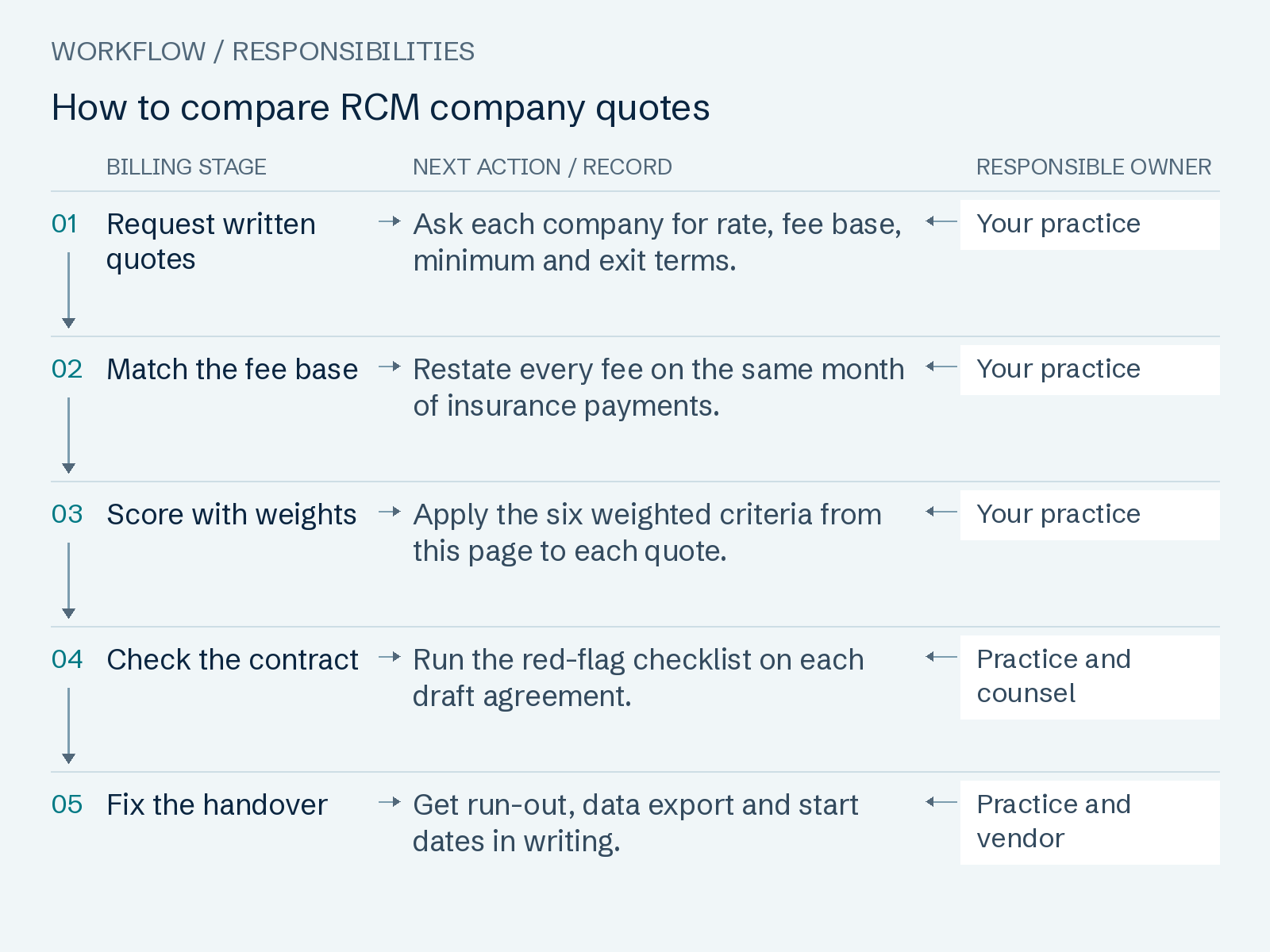
Read the workflow as text
- Request written quotes — Ask each company for rate, fee base, minimum and exit terms. Owner: Your practice.
- Match the fee base — Restate every fee on the same month of insurance payments. Owner: Your practice.
- Score with weights — Apply the six weighted criteria from this page to each quote. Owner: Your practice.
- Check the contract — Run the red-flag checklist on each draft agreement. Owner: Practice and counsel.
- Fix the handover — Get run-out, data export and start dates in writing. Owner: Practice and vendor.
Comparison table: pricing, minimums, exit terms, guarantees
The table restates each company's own published terms as of November 4, 2026: Go Medical Billing, BillingParadise, TheraThink, VG Soft Co, Motivity and Ensemble Health Partners, then our own row from our published rate card. Read the price column with its fee base. A percentage of net collections, of collected revenue, of the allowed amount and of insurance payments are four different numbers on the same month of work.
| Company and focus | Published price and fee base | Setup and minimum | Exit terms | Published guarantee |
|---|---|---|---|---|
| Go Medical Billing: 1-to-5 provider practices; says it codes for 40+ specialties | Starting at 2.49% of net collections; no per-claim charges | No setup fees; no monthly minimums | No long-term contracts; either party may end with 30 days' notice | None found on the page checked |
| BillingParadise: says its pricing is built for all practices; FTE, co-managed and full cycle RCM models | Rates range from 2.99%, by specialty, claim volume and payer mix; custom quote within 24 hours | No setup or onboarding fees; minimum not stated | Month-to-month; notice period not stated | Its comparison table marks 95% first-pass claim payment as guaranteed for its 24-hour RCM model |
| TheraThink: mental health billing for therapists and psychiatrists | 6.5%-8% of the contracted rate or allowed amount per paid claim, by volume | No start-up fee; a $35 monthly clearinghouse fee per tax ID and rendering NPI combination in months claims are filed, with a waiver condition on its pricing page | Month-by-month contract; notice period not stated | None found; it offers a free 30-day trial |
| VG Soft Co: ABA practices; also sells VGPM practice software | 3% (A/R management) or 6% (full-service RCM) of collected revenue from payers and patients | $0 setup; minimum not stated; VGPM software licensing is separate from the RCM fee | Month-to-month; 30 days' written notice; no early-termination penalty | None found on the page checked |
| Motivity: ABA practices ready to centralize billing within the Motivity platform | Not published; it asks you to contact its team | Not published | Not published | Not published |
| Ensemble Health Partners: enterprise RCM; quotes health system executives | Described as a fixed rate on collections plus tiered incentives; no rate published | Not published | Not published | No guarantee terms published |
| ClaimPillar (publisher of this page): practices of 1 to 15 clinicians | 5.0%-8.5% of insurance payments, by specialty and size; 0% of patient payments | $0 setup; $400 minimum from your 4th monthly invoice | Month to month. Leave with 30 days' written notice. No termination fee. | On-Our-Watch Guarantee and Clock-or-Credit Guarantee, each with written terms on the rate card |
What a revenue cycle management company does for a 1-15 clinician practice
A revenue cycle management company runs the money side of your practice, from the coverage check before a visit to the payment posted after it. For a practice of 1 to 15 clinicians, one outside team usually replaces a part-time biller, the front desk's eligibility calls and whoever chases unpaid claims at month-end. On vendor sites, the line between "billing" and "RCM" is mostly scope: RCM adds the steps before the claim (eligibility, authorizations, sometimes credentialing) and after it (denials, A/R follow-up and reporting).
Whether revenue cycle management should leave your office at all is the decision to settle before any sales call. It turns on how much of your A/R is aging, and on who covers billing when your biller is out.
The stages it takes over, and what stays with you
The table shows the usual split. Any company you consider should give you its own version in writing, because the right-hand column is the work your staff keeps doing.
| Stage | What the RCM company does | What stays with your practice |
|---|---|---|
| Before the visit | Checks eligibility and benefits; tracks prior authorizations | Collects insurance details and copays at the front desk |
| Charge and claim | Checks codes against documentation, then scrubs and submits claims | Signs off encounters so charges are complete |
| Payment | Posts payer payments and reconciles remittances | Owns the bank account the payments land in |
| Denials and A/R | Corrects, appeals and follows up unpaid claims before their deadlines | Answers documentation questions |
| Patient balances | Calculates balances and sends statements | Sets payment-plan and collections policy |
| Reporting | Sends monthly KPIs such as A/R days, denial rate and collections | Reads the report and asks about outliers |
Enterprise RCM vendors vs small-practice specialists
Enterprise RCM vendors are built for hospitals and health systems. Ensemble Health Partners is a clear example on its own homepage: the testimonials it quotes come from health system CEOs, CFOs and VPs in KLAS Research interviews, and it describes its pricing as "a fixed rate on collections, and tiered incentives if we outperform metrics that matter most to you." It publishes no rate.
Small-practice specialists sell a narrower service to a smaller buyer, and more of them publish their terms. Four of the six other companies in our table publish a rate on their website, and all four state that they charge no setup fee. Their differences sit in details a single rate hides: the fee base, what the rate includes, and whether the service requires their own software.
Which model fits your practice
- An enterprise vendor fits a hospital, a health system or a large multi-site group with its own revenue cycle staff to manage the contract.
- A small-practice specialist fits 1 to 15 clinicians with no full-time revenue cycle manager, who want published terms they can compare before a call.
- A software-plus-billing bundle fits a practice that is also replacing its practice-management system and wants one vendor for both. Read the software contract separately from the billing terms.
The scope of a specialist's service is easiest to judge from a stage-by-stage description; ours is on the revenue cycle management services page, with what we take over and what you keep.
Specialty fit: therapy, ABA, behavioral health, specialists
Specialty fit decides more of the result than the headline rate, because the claims that fail, and the payers that deny them, differ by specialty.
Therapy and behavioral health
Mental health practices bill many similar sessions to many commercial payers, so the fee base matters as much as the percentage. TheraThink, a mental health billing service, takes its percentage of the allowed amount, and its own example counts the patient's share inside that amount: when insurance pays $50 and the patient pays $10, it charges 8% of $60. We take our fee on insurance payments only, with 0% of patient payments. Our mental health billing service runs from 7.0% to 8.0% by practice size.
ABA agencies
Two of the ABA-focused services we checked tie billing to their own software. Motivity offers its billing team to ABA practices "ready to centralize billing and operations within Motivity," and its fit criteria include a supported clearinghouse and, reviewed case by case, a location outside Colorado, New Jersey and California, which it lists as EVV states. VG Soft Co says its RCM requires its VGPM software, which is licensed separately from the RCM fee. If you want to keep your current system, ask each ABA biller to confirm in writing that it works inside it. For our ABA billing service: We work inside your existing practice-management system and clearinghouse; tell us which ones and we confirm in writing within 1 business day. We count practice size by BCBAs and BCaBAs, not RBTs.
Specialists and rehab practices
Generalist billing companies cover many specialties: Go Medical Billing says it codes for 40+ specialties, with a published rate starting at 2.49%. For a cardiology, orthopedic or physical therapy group, ask which of your claim types the team bills every week, and how it checks authorizations before the visit. Our rates for PT, OT and speech practices start at 6.5%, and specialist physician groups start at 5.0%, by size.
Contract terms that trap small practices
Most RCM contract problems surface on the way out, or in a slow month. Run this checklist on any draft agreement, ours included, before you sign. It is a buyer's checklist, not legal advice; your own counsel has the last word on your contract.
- A fee base nobody defined. "Collections" can mean insurance payments only, payer and patient dollars together (VG Soft Co's definition), or the allowed amount per paid claim (TheraThink's). Ask for the definition in the contract, and for a sample invoice.
- Payments routed to the vendor. Under 42 CFR 424.80(b)(5), which applies the conditions of 42 CFR 424.73(b)(3) to physicians and other suppliers, Medicare may pay a billing agent only if the agent's compensation is not related in any way to the dollar amounts billed or collected. A company paid a percentage should leave payer deposits going to your own bank account.
- Percentage pay with no coding policy. The HHS-OIG compliance guidance for third-party billing companies records a longstanding concern that percentage billing arrangements may increase the risk of upcoding. Ask who may change a code, and on whose sign-off.
- A multi-year term or a termination fee. Every company in our table that publishes exit terms is month-to-month or allows 30 days' notice. A longer lock-in should buy you a lower rate, in writing.
- No run-out clause. Claims submitted before you leave keep paying for months. The contract should say who works them after your exit date, and at what fee.
- No handover deadline. Ask for a dated export of open claims, the denial log and payer correspondence, in files you can open.
- A minimum that bites in a slow month. Ask what you would pay in your worst month, not your average one.
- Add-ons outside the rate. Clearinghouse fees, mailed statements, credentialing and software licences are often priced separately. TheraThink, for example, lists credentialing at $260 per Medicare or Medicaid application and $120 per commercial plan.
Our own answers to the checklist are on the rate card. Every payment goes straight to your practice's own bank account. We never receive, deposit or endorse your payments; we invoice you once a month. Leave with 30 days' notice and no termination fee. Want a run-out? We keep working the claims we submitted for 90 days at your plan rate. Decline it and we charge nothing on payments that post after you leave. The handover file holds: Every open claim with its status and next action, the denial log, payer correspondence and credentialing files, in CSV and PDF. If you are leaving a current biller, read what to line up before switching billing companies.
Where ClaimPillar fits and where it does not
We built our service for independent practices of 1 to 15 clinicians in five segments: Mental & behavioral health; ABA therapy; PT, OT, speech & chiropractic; Primary care, pediatrics & urgent care; and Specialist physician groups. Full-Service Billing runs from 5.0% to 8.5% of insurance payments, and Complete RCM at 9.0% adds credentialing, prior authorizations and aged A/R. Invoices 1–3: only percentage fees on that month's insurance payments, plus any statements or add-ons you order. Percentage fees and mailed statements are capped at 9.0% of that month's insurance payments; from invoice 4, the $400 minimum applies even in a month when the cap comes to less.
We fit if
- you want published rates and month-to-month terms you can check before a call;
- your A/R has claims past 90 days and you want the deadline claims worked first: Every inherited claim within 30 days of a filing, corrected-claim or appeal deadline is worked within 5 business days of access. Terms: Starts at access; covers up to 250 claims (more gets a day-1 deadline schedule); worked means submitted, corrected, appealed or returned with the fix.
- you want to keep your current practice-management system and clearinghouse.
We are not the right choice if
- you run a hospital or health system: an enterprise vendor is built for that buyer;
- the lowest headline percentage is your main criterion: Go Medical Billing's published starting rate of 2.49% and BillingParadise's from 2.99% are both below our lowest rate, though on different fee bases;
- your insurance payments are small enough that the monthly minimum would be a large share of them. Example: 3 therapists with $30,000 of insurance payments in a month pay 7.5%, or $2,250. That month's cap would be $2,700. The same practice in a slow month: $4,000 of insurance payments at 7.5% is $300. Invoices 1–3 charge $300; from invoice 4 the $400 minimum applies, even though that month's 9.0% cap is $360.
- you have 16 or more clinicians, or bill anesthesia, radiology, DME, lab or home health: our flat rate card does not cover you. Pricing is by written quote.
- you want new practice software and billing from one vendor.
We publish client results only with written permission. Until we have them, judge us by the guarantees and the free Deadline Map. See the full rate card for every fee by specialty and size, or send your aging report for The Free A/R Deadline Map (Clock starts with your claim-level aging export and signed BAA; above 10 requests in a week, we confirm your date within 1 business day.).
Common questions
- What does a revenue cycle management company do?
- It runs your practice's money side from the eligibility check to the posted payment: claims checked and submitted, payments posted, denials corrected or appealed, unpaid claims followed up before their deadlines, patient statements sent and a monthly report delivered. Some companies include credentialing and prior authorizations in the rate; others price them separately. Our RCM service lists each stage we take over and what you keep.
- How much do RCM companies charge small practices?
- On the pages we checked on November 4, 2026, published rates ran from Go Medical Billing's starting rate of 2.49% of net collections to TheraThink's 6.5%-8% of the allowed amount per paid claim. BillingParadise starts from 2.99%, and VG Soft Co lists 3% or 6% of collected revenue. Ensemble and Motivity publish no rate. Ours is 5.0%-8.5% of insurance payments, with 0% of patient payments. Compare quotes on the same fee base and the same month of payments; what billing companies charge, and on what base goes deeper.
- Which RCM companies offer guarantees?
- Of the six other companies we checked, one published a guarantee: BillingParadise's pricing comparison table marks 95% first-pass claim payment as guaranteed for its 24-hour RCM model. The others published no guarantee terms on the pages checked. Ours, the On-Our-Watch Guarantee: If a claim misses a filing, corrected-claim or appeal deadline while it is on our watch, we pay you what it would have paid. Claims we get complete 10+ business days before the deadline; contracted rate less any copay you collected, paid automatically within 30 days of final denial; capped $10,000/month; your holds excluded. It applies on the terms above. Whoever you consider, ask what the company pays when it misses, and the cap.
- How long are typical RCM contracts?
- Every small-practice company in our table that publishes exit terms is month-to-month or allows cancellation on 30 days' notice: Go Medical Billing and VG Soft Co state 30 days' notice, while BillingParadise and TheraThink describe month-to-month terms. The enterprise vendor we checked publishes no contract length. Ours: Month to month. Leave with 30 days' written notice. No termination fee. Notice by email; optional run-out covers claims we submitted before your exit date, at your plan rate; handover file within 10 business days of exit.
- Should a small practice choose an enterprise RCM vendor?
- Usually not. Enterprise vendors such as Ensemble Health Partners quote health system executives on their own websites and publish no rate. A practice of 1 to 15 clinicians is usually better served by a company that publishes its terms, prices its specialty and size, and works inside the practice's existing system.
- What should our practice get in writing before signing with an RCM company?
- The fee base and a sample invoice, the minimum, the notice period, the run-out and handover terms, who may change a code, which bank account payer deposits go to, and every add-on fee. The contract checklist on this page turns each of these into a question to ask.
- Why is ClaimPillar in a comparison it publishes?
- Because we are one of the options a small practice can choose, and leaving ourselves out would hide our interest rather than remove it. We disclose it at the top, apply the same five columns to every company, use only each company's own published terms and do not score or rank anyone, ourselves included. Our rate card lists every fee we charge.
Sources and review
Page revised November 4, 2026 · Review contact: Hyder Shah (inquiries@claimpillar.com). Every company page and federal source below was retrieved on November 4, 2026; company terms are as each company published them on that date.
- Go Medical Billing: Medical billing for small practices (rate, minimums, contract terms)
- BillingParadise: Medical billing pricing
- TheraThink: Mental health billing service pricing
- VG Soft Co: ABA billing service pricing
- Motivity: ABA revenue cycle management
- Ensemble Health Partners: homepage (approach and pricing model)
- 42 CFR 424.73: payment to an agent (Medicare, eCFR)
- 42 CFR 424.80: billing agents for physicians and suppliers (Medicare, eCFR)
- HHS-OIG: Compliance program guidance for third-party medical billing companies (63 FR 70138, 1998)