CDI meaning in healthcare
CDI definition: clinical documentation improvement is the review of patient records, with clarifying questions to the clinician, so that the record accurately and completely reflects the patient's condition and the care given, and supports the codes billed. In a medical setting, "CDI" almost always means this, not the unrelated uses of the acronym in other industries.
The profession's own association renamed the term. In a 2019 position paper, the Association of Clinical Documentation Integrity Specialists (ACDIS) kept its acronym but changed the "I" from "improvement" to "integrity". ACDIS called the idea that CDI is about revenue enhancement only "mistaken, but nonetheless persistent", and said CDI professionals must clarify documentation even when that work does not raise revenue. Both names are in use, and they describe the same work.
What a CDI query is
The main tool of CDI is the query. The joint AHIMA and ACDIS practice brief, Guidelines for Achieving a Compliant Query Practice (2022 update), defines a query as a communication tool or process used to clarify documentation in the health record for documentation integrity and accurate code assignment, for an encounter in any healthcare setting. The brief says a query must be non-leading and that references to reimbursement must not occur.
Who does CDI work
Hospitals employ CDI specialists, often nurses or coders. Two credentials are common: ACDIS's Certified Clinical Documentation Specialist (CCDS) and its outpatient version, CCDS-O, and AHIMA's Certified Documentation Integrity Practitioner (CDIP), which AHIMA says health information professionals, nurses and physicians can hold.
Why CDI matters in the revenue cycle
A claim is only as strong as the note behind it. Payers pay on the codes, but when they review a claim they read the record, and a code the record does not support becomes a denial, a recoupment or an overpayment demand. Medicare's contractors put it plainly: in one billing article, First Coast states that the submitted medical record must support the use of the selected ICD-10-CM code(s), and that the CPT or HCPCS code must describe the service performed.
CMS's own error measurement shows how much turns on documentation. Its fiscal year 2025 improper payments fact sheet reports a Medicare fee-for-service improper payment rate of 6.55%, or $28.83 billion. It says 77.17% of FY 2025 Medicaid improper payments resulted from insufficient documentation, which is generally not indicative of fraud or abuse. Most Medicare Advantage (Part C) improper payments came from documentation that failed to substantiate the diagnoses submitted for payment.
That is why CDI belongs in revenue cycle management services rather than off to the side. Coding, claim edits and denial management all fix problems after the visit; CDI stops the same documentation gap from producing the next denial.
CDI for small and independent practices, not just hospitals
CDI started in hospitals, but its rules reach every setting. The AHIMA and ACDIS query brief says it applies to coding, CDI and other professionals in all healthcare settings, inpatient and outpatient. ACDIS describes its CCDS-O credential as covering the outpatient setting, which includes physician practices, hospital clinics and the emergency department.
A small practice rarely hires a CDI specialist. In practice, CDI there is shared work: the clinician writes the note, and whoever codes or bills reads it before the claim goes out and asks for clarification when the note and the code do not match. Outpatient coding rules make that check matter. The ICD-10-CM Official Guidelines for Coding and Reporting (FY 2027) say that in outpatient services you do not code diagnoses documented as "probable", "suspected", "rule out" or "working diagnosis"; you code the symptoms, signs or other reason for the visit instead. A note that says "rule out depression" supports a symptom code, not a depression code.
What CDI looks like when billing is outsourced
When an outside company codes your claims, the clarification step still has to happen, and it has to stay with the clinician. A medical coding company can find the gap and ask the question, but only the treating clinician can answer it. Our policy: We check every code against your clinician's documentation and never change a code without the clinician's sign-off.
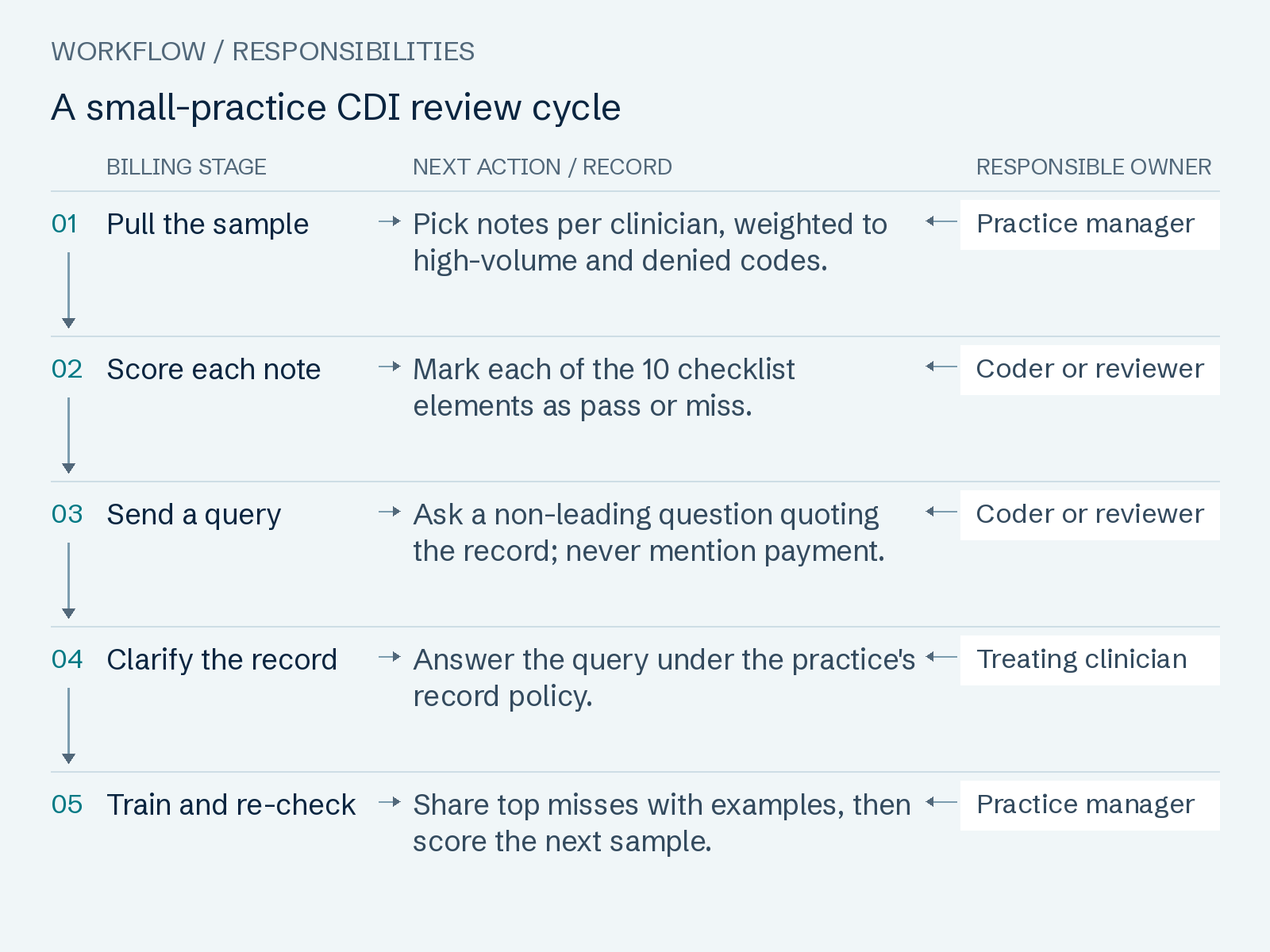
Read the workflow as text
- Pull the sample — Pick notes per clinician, weighted to high-volume and denied codes. Owner: Practice manager.
- Score each note — Mark each of the 10 checklist elements as pass or miss. Owner: Coder or reviewer.
- Send a query — Ask a non-leading question quoting the record; never mention payment. Owner: Coder or reviewer.
- Clarify the record — Answer the query under the practice's record policy. Owner: Treating clinician.
- Train and re-check — Share top misses with examples, then score the next sample. Owner: Practice manager.
Therapy and behavioral health CDI: medical necessity, time, treatment plans
Psychotherapy notes are where small-practice CDI pays off fastest, because the services are time-based and medical necessity has to be shown in every note. First Coast's local coverage determination L33252, Psychiatric Diagnostic Evaluation and Psychotherapy Services, is one Medicare contractor's rule set; other contractors, Medicaid programs and commercial plans publish their own, so check your payers' policies. It is a useful model of what a reviewer looks for:
- Medical necessity: the record shows a psychiatric illness or emotional or behavioral symptoms sufficient to alter baseline functioning.
- What happened in the session: the LCD says statements such as "supportive psychotherapy given" are not adequate; the note needs a clear description of what the psychotherapy entailed and how it addresses the presenting problem.
- Progress: the patient's response, progress toward goals, and changes or lack of changes in symptoms or behavior.
- Treatment plan: measurable and objective goals, the interventions, session frequency and estimated duration, updated generally at least every three months.
Time is the other half. The companion billing article A57520 says start and stop times or total times must be documented for 90832, 90834 and 90837, that psychotherapy time is face-to-face time with the patient, and that 90837 is the code for 53 or more minutes. Note structure helps here; a consistent SOAP note format or BIRP or DAP template makes each element hard to skip.
Before and after: a 90837 note
Illustrative example, not client data. The "before" note leaves out the time, describes no intervention, shows no change in function and gives an unspecified diagnosis. The "after" note covers each element the LCD and billing article name, with no new facts added: every change comes from what the clinician actually did and observed.
| Element | Before (weak note) | After (supports 90837) |
|---|---|---|
| Time | Not recorded | Start 10:02, stop 10:58; 56 minutes face-to-face |
| Diagnosis | Anxiety (F41.9, unspecified) | Generalized anxiety disorder (F41.1), as diagnosed at intake and documented |
| Medical necessity | Not stated | Worry and panic symptoms caused two missed workdays this week |
| Intervention | Supportive psychotherapy given | Cognitive restructuring of catastrophic work thoughts; breathing practice rehearsed in session |
| Response and progress | Doing better | Engaged; identified two thought patterns; goal 1 partly met, sleep unchanged |
| Plan | Continue | Weekly sessions per the treatment plan; plan review due next month |
| Signature | Initials only | Clinician's full signature and credentials |
Specificity: ICD-10 and risk adjustment
Specificity is the second job of CDI. The ICD-10-CM guidelines say diagnosis codes are to be reported at their highest number of characters available and to the highest level of specificity documented in the medical record. The coder can only go as far as the note does: if the note says "anxiety", the coder cannot pick a specific anxiety disorder.
The same guidelines warn against overcorrecting. Unspecified codes are acceptable when they most accurately reflect what is known at that encounter, and it would be inappropriate to select a specific code the record does not support. The guidelines also say to code all documented conditions that coexist at the visit and require or affect patient care, treatment or management. CDI asks for clarity; it never asks a clinician to add a diagnosis that was not made.
Why risk adjustment raises the stakes
For Medicare Advantage patients, diagnoses feed risk adjustment, and CMS audits them. Under its Risk Adjustment Data Validation (RADV) program, CMS confirms that diagnoses a Medicare Advantage organization submitted for risk adjustment are supported in the enrollees' medical records, and it may collect overpayments when they are not. Those medical records are the notes your clinicians write, so a vague note in your chart can become an unsupported diagnosis in an audit.
Running a simple CDI review: sample, score, train
A small practice does not need CDI software to start. It needs a fixed checklist, a small sample and a routine.
- Sample. Each month or quarter, pull a set number of notes per clinician that you can keep reviewing at that pace, weighted toward your highest-volume codes and any code that was recently denied.
- Score. Check each note against the 10 elements below and record pass or miss for each. Score the note, not the clinician.
- Query. Where the note is unclear, ask the clinician a non-leading question that quotes what the record says. Follow your record policy for any amendment; never change a note or code yourself.
- Train. Share the most common misses with the whole team, with one corrected example each.
- Re-check. Score the next sample against the same checklist and see whether the same misses come back.
Small-practice CDI checklist: 10 chart elements
Rows 1 to 5 come from the A57520 billing article and the ICD-10-CM guidelines and apply to every specialty. Rows 6 to 10 come from LCD L33252 and the A57520 billing article and apply to psychotherapy and behavioral health; substitute your own payers' rules for other specialties.
| # | Chart element | Applies to | Source of the rule |
|---|---|---|---|
| 1 | Patient name and date of service on every page | All specialties | Billing article A57520 |
| 2 | Legible signature of the clinician who provided the care | All specialties | Billing article A57520 |
| 3 | Diagnosis documented to the specificity of the code billed | All specialties | ICD-10-CM guidelines I.B.2 |
| 4 | Uncertain diagnoses (rule out, probable) coded as symptoms instead | All outpatient visits | ICD-10-CM guidelines IV.H |
| 5 | Coexisting conditions that affect care documented and coded | All specialties | ICD-10-CM guidelines IV.J |
| 6 | Symptoms that alter baseline functioning (medical necessity) | Psychotherapy and behavioral health | LCD L33252 |
| 7 | Start and stop times or total time for timed psychotherapy codes | Psychotherapy and behavioral health | Billing article A57520 |
| 8 | What the therapy entailed, not "supportive psychotherapy given" | Psychotherapy and behavioral health | LCD L33252 |
| 9 | Patient response and progress toward goals | Psychotherapy and behavioral health | LCD L33252 |
| 10 | Treatment plan with measurable goals, frequency and duration, updated about every 3 months | Outpatient psychotherapy | LCD L33252 |
CDI vs coding audits
CDI and coding audits use the same chart but answer different questions. CDI asks whether the record says clearly what happened, ideally before the claim goes out. A coding audit asks whether the codes on claims already billed match the record. Many practices need both, and an audit's findings are often the best way to pick what your CDI review should look at next.
Where to start if denials already point to documentation
If your denials keep citing medical necessity or missing records, start with the claims at risk. The Free A/R Deadline Map lists every unpaid insurance claim over 90 days from the aging report you send, with the deadline each faces and its denial reason (Clock starts with your claim-level aging export and signed BAA; above 10 requests in a week, we confirm your date within 1 business day.). Get my free A/R Deadline Map. The Front-Desk Fix Sheet in our billing offer turns the same idea into a routine: Each month, your top 3 denial causes with the exact front-desk or documentation fix for each, for future visits, plus a 20-minute call with your front desk every quarter. For behavioral health practices, see behavioral health billing, and for rates, the pricing page.
| CDI review | Coding audit | |
|---|---|---|
| Question asked | Does the record clearly show what happened? | Do the billed codes match the record? |
| Timing | Before or soon after the claim, while the clinician can clarify | After claims are billed, often months later |
| Main output | Queries to clinicians and documentation training | Error rates, corrected claims and refunds where owed |
| Who acts on it | The clinician answers the query | The billing team corrects claims; clinicians get feedback |
| Rule set | AHIMA/ACDIS query brief, payer documentation rules | Coding guidelines and payer billing rules |
Common questions
- What is CDI in healthcare?
- CDI stands for clinical documentation improvement, now often called clinical documentation integrity. It is the review of patient records, with clarifying questions to the clinician, so the record accurately shows the patient's condition and care and supports the diagnosis and service codes billed.
- What does a CDI specialist do?
- A CDI specialist reviews records, finds documentation that is unclear, incomplete or conflicting, and sends compliant queries asking the clinician to clarify. They also train clinicians on recurring gaps. Common credentials are ACDIS's CCDS and outpatient CCDS-O and AHIMA's CDIP.
- How does CDI affect revenue cycle management?
- Payers review the record, not just the claim, so codes the record does not support turn into denials, recoupments or overpayment demands. CMS reports that 77.17% of FY 2025 Medicaid improper payments came from insufficient documentation. CDI fixes the note before those problems reach your revenue cycle.
- Do small practices need CDI?
- They need the function, not usually a dedicated specialist. The AHIMA and ACDIS query guidance covers all settings, and outpatient rules such as not coding "rule out" diagnoses apply to every practice. A monthly or quarterly review of a small sample of notes against a fixed checklist is a workable start.
- What is a CDI query?
- A query is a question to the clinician that asks them to clarify the record so codes can be assigned accurately. Under the AHIMA and ACDIS practice brief, it must be non-leading, cite the relevant clinical information from the record, and never refer to reimbursement.
- Is CDI the same as a coding audit?
- No. CDI checks whether the record clearly documents what happened, ideally before billing, and its output is queries and training. A coding audit checks whether codes already billed match the record, and its output is error rates and corrected claims.
Sources and review
Page revised November 5, 2026 · Review contact: Hyder Shah (inquiries@claimpillar.com). The workflow checklists are editorial recommendations; payer requirements depend on the program and current policy.
- ACDIS: From "improvement" to "integrity", ACDIS position paper published (September 26, 2019; retrieved 2026-11-05)
- AHIMA and ACDIS: Guidelines for Achieving a Compliant Query Practice, 2022 update (retrieved 2026-11-05)
- ACDIS: About ACDIS' certifications and certificates, CCDS and CCDS-O (retrieved 2026-11-05)
- AHIMA: Certified Documentation Integrity Practitioner (CDIP) (retrieved 2026-11-05)
- First Coast LCD L33252: Psychiatric Diagnostic Evaluation and Psychotherapy Services (CMS Medicare Coverage Database, retrieved 2026-11-05)
- First Coast billing and coding article A57520: Psychiatric Diagnostic Evaluation and Psychotherapy Services (retrieved 2026-11-05)
- ICD-10-CM Official Guidelines for Coding and Reporting, FY 2027 (CMS, retrieved 2026-11-05)
- CMS: Medicare Advantage Risk Adjustment Data Validation (RADV) program (retrieved 2026-11-05)
- CMS: Fiscal Year 2025 improper payments fact sheet (retrieved 2026-11-05)