Our substance abuse billing services by level of care
Rehab revenue is billed in days, not sessions: one patient can move from withdrawal management to residential care to PHP to IOP inside a month, and each step changes the claim form, the code set and the authorization. Your facility's per-diem claims follow those steps; the clinician claims we bill sit inside them. The table uses Virginia Medicaid's ARTS reimbursement schedule as a worked example, because it publishes the crosswalk from ASAM Criteria levels to billing codes; your state Medicaid plan and each commercial contract set their own. ASAM released the Fourth Edition of the Criteria in 2023, so check which edition's level numbers each payer's schedule uses.
Your clinical team places each patient, and your facility billing claims the per diem for the level the plan approved. We bill the clinician visits delivered inside each level.
| ASAM level (Virginia example) | Codes on that schedule | Authorization on that schedule | Check before the claim goes out |
|---|---|---|---|
| 2.1 Intensive outpatient | H0015, or revenue code 0906 with H0015 on a facility claim; 1 unit = 1 day | Service authorization request; urgent requests reviewed within 72 hours. Program minimum: 3 hours a day, averaging 9 to 19 a week for adults | Bill only program days that reached the hour minimum your payer sets |
| 2.5 Partial hospitalization | S0201, or revenue code 0913 with S0201; 1 unit = 1 day | Service authorization request; urgent requests reviewed within 72 hours. Program minimum: 5 hours a day, at least 20 a week | Match each billed day to the attendance log and the approved date span |
| 3.1 Low-intensity residential | H2034 per diem; 1 unit = 1 day | Service authorization request with an ASAM assessment by an independent third party; urgent requests reviewed within 72 hours | Bill the per diem for each authorized day in residence |
| 3.3 and 3.5 Clinically managed residential | H0010 with revenue code 1002 per diem; modifier TG for 3.3, HB for adults or HA for adolescents at 3.5 | Service authorization request with an ASAM assessment by an independent third party; urgent requests reviewed within 72 hours | Add the population or age modifier the schedule lists on each claim |
| 3.7 Medically monitored inpatient | H2036 with revenue code 1002 per diem; modifier HB for adults or HA for adolescents | Service authorization request with an ASAM assessment by an independent third party; urgent requests reviewed within 72 hours | Hold days past the approved end date until the extension is on file |
| 4.0 Medically managed inpatient | H0011 with revenue code 1002; psychiatric hospitals per diem, acute care hospitals by DRG | Urgent telephonic approval within 24 hours | Confirm the payment method in your contract before the first claim |
| Clinician visits inside any level | Physician visits, drug screens and medications billed separately where the schedule allows | Varies by service | Bill each clinician's visits under that clinician's own NPI |
How we bill your commercial, Medicaid and out-of-network SUD claims
Payer mix decides most of a rehab program's billing work, so we set up each payer type separately for your clinician claims.
Commercial plans and parity
Coverage is not automatic: the federal parity law requires that limits on SUD benefits be no more restrictive than medical and surgical limits, but CMS notes it does not require a plan to cover SUD benefits at all. Your plan with us decides which visits we check: Full-Service Billing checks eligibility for new patients and anyone reporting a coverage change; Complete RCM checks every scheduled visit.
Medicaid and out-of-network claims
For Medicaid and its managed care plans we bill clinician visits to the codes and units your state's schedule lists. On out-of-network clinician claims we bill the patient only under the condition that allows it: the plan's explanation of benefits assigning the balance to the patient. We never waive or discount patient balances for you; that is a decision for your program and its counsel.
Revenue codes, per diems and the claims we bill
Facility days and clinician visits travel on different forms. Per-diem days go on the institutional claim (UB-04 or its electronic version) with a revenue code and, where the payer asks, a HCPCS code on the same line; your facility billing files those. Clinician visits go on the professional claim, and that is the claim we bill. On Medicare institutional claims, CMS asks hospitals and community mental health centers to report condition code 41 on PHP claims and 92 on IOP claims.
Medicare covers PHP and IOP only from certain provider types, and its benefit manual ties PHP to a need for at least 20 hours of services a week and IOP to at least 9. Check that your program is one of those provider types before it bills Medicare for program days.
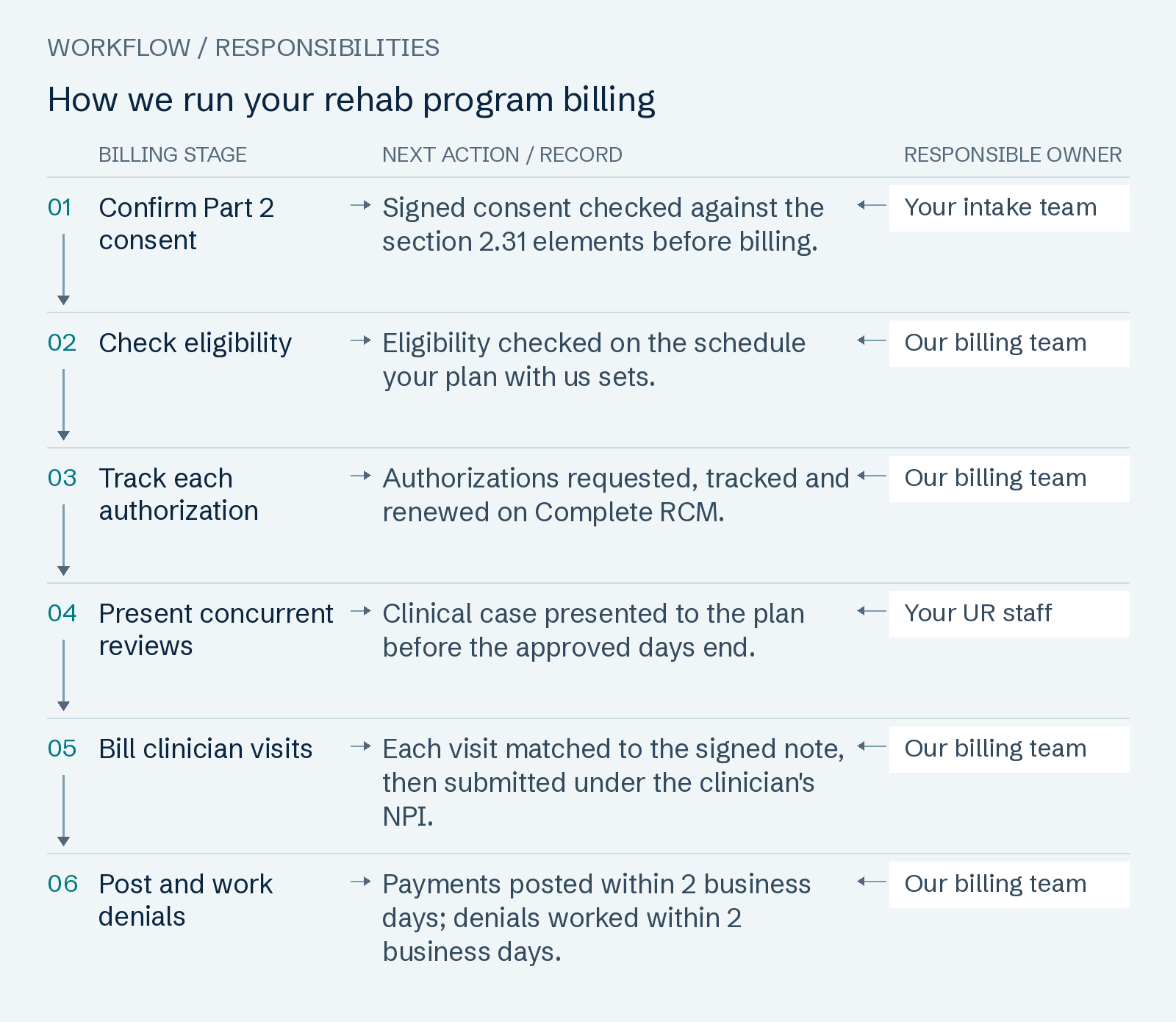
Read the workflow as text
- Confirm Part 2 consent — Signed consent checked against the section 2.31 elements before billing. Owner: Your intake team.
- Check eligibility — Eligibility checked on the schedule your plan with us sets. Owner: Our billing team.
- Track each authorization — Authorizations requested, tracked and renewed on Complete RCM. Owner: Our billing team.
- Present concurrent reviews — Clinical case presented to the plan before the approved days end. Owner: Your UR staff.
- Bill clinician visits — Each visit matched to the signed note, then submitted under the clinician's NPI. Owner: Our billing team.
- Post and work denials — Payments posted within 2 business days; denials worked within 2 business days. Owner: Our billing team.
42 CFR Part 2 consent before claims go out
SUD records from a federally assisted program are covered by 42 CFR Part 2, and a payer can only receive them with patient consent. Since the 2024 final rule, whose compliance date was February 16, 2026, a patient can give a single consent for all future uses and disclosures for treatment, payment and health care operations. We sign a BAA before any record moves, and we bill only encounters your program releases to us.
What a Part 2 consent must contain
Your counsel writes the consent form, and your intake team checks each signed form for the elements section 2.31 requires:
- the patient's name, and who may disclose the records;
- a specific description of the information disclosed;
- the recipients, such as health plans and third-party payers;
- the purpose, for example treatment, payment and health care operations;
- the right to revoke in writing, and how;
- an expiration date or event;
- the patient's signature and the date signed;
- for a treatment, payment and health care operations consent, the statement that disclosed records may be redisclosed and lose Part 2 protection, and the consequences of refusing to sign.
Release a patient's encounters to us once that patient's consent is complete.
Medication-assisted treatment claims we bill for your program
Prescriber visits for buprenorphine or other medication go on the professional claim under the prescriber's NPI, and we bill them like any other clinician visit in your program. For a Medicare-enrolled opioid treatment program, CMS pays weekly bundles billed once per 7 days in a row, on the CMS-1500 with place of service 58 or on the CMS-1450 for institutional providers. OTP weekly bundles are not part of our service.
What our SUD billing costs: behavioral rates or a written quote
Clinician claims from your program sit on the mental and behavioral health row of our rate card. Facility per diems and OTP weekly bundles are not part of our service. You pay 0% on patient payments, setup is $0, and every payment lands in your own bank account. Invoices 1–3: only percentage fees on that month's insurance payments, plus any statements or add-ons you order. Percentage fees and mailed statements are capped at 9.0% of that month's insurance payments; from invoice 4, the $400 minimum applies even in a month when the cap comes to less. The full rate card is on our pricing page.
| Your program's claims | Your fee |
|---|---|
| Clinician claims, 1 clinician | 8.0% of insurance payments |
| Clinician claims, 2–5 clinicians | 7.5% of insurance payments |
| Clinician claims, 6–15 clinicians | 7.0% of insurance payments |
| 16+ clinicians | Pricing is by written quote. |
Audits and referral-payment law: what we check on your claims
Payers audit rehab claims against three records: the authorization, the attendance or census log, and the signed note.
Federal law also makes it a crime to pay or receive anything in return for referring patients to a recovery home or clinical treatment facility; 18 U.S.C. 220 sets fines of up to $200,000, up to 10 years in prison, or both, per occurrence. Our fee is a percentage of insurance payments on claims we bill. We do not market your program or pay anyone for admissions, and nothing on this page should be read as legal advice.
For the full behavioral health picture, see our guide to behavioral health revenue cycle management. Outpatient therapy groups without a rehab program fit our behavioral health billing services better. To see your exposure first, Get my free A/R Deadline Map.
Common questions
- How does your team bill substance abuse treatment for our program?
- By level of care. We bill each clinician visit on the professional claim under that clinician's own NPI, inside whatever level the patient is in, once your program releases the encounter with Part 2 consent on file. Facility per-diem claims stay with your facility billing.
- Do you bill IOP and PHP days with revenue codes, and which ones?
- No. IOP and PHP per diems go on your facility's institutional claim, which stays with your facility billing; we bill the clinician visits inside those programs. For reference, Virginia Medicaid lists 0906 with H0015 for IOP and 0913 with S0201 for PHP, while Medicare IOP and PHP claims carry condition codes 92 and 41.
- Will you check whether a patient's plan covers residential rehab?
- It depends on your plan with us. Full-Service Billing checks eligibility for new patients and anyone reporting a coverage change; Complete RCM checks every scheduled visit. Parity law limits how plans restrict SUD benefits, but it does not oblige a plan to cover them, so we never assume coverage.
- How much do substance abuse billing companies charge?
- Our clinician claims cost 8.0% for 1 clinician, 7.5% for 2–5 clinicians and 7.0% for 6–15 clinicians, of insurance payments, with $0 setup. Programs of 16 or more clinicians are priced by written quote; facility per diems and OTP bundles are not part of our service. Compare other firms by what their percentage is taken on, their minimum and their exit terms; see our pricing page.
- Is there a long-term contract?
- No. Month to month. Leave with 30 days' written notice. No termination fee. Leave with 30 days' notice and no termination fee. Want a run-out? We keep working the claims we submitted for 90 days at your plan rate. Decline it and we charge nothing on payments that post after you leave. Notice by email; optional run-out covers claims we submitted before your exit date, at your plan rate; handover file within 10 business days of exit.
- How fast can our program switch its billing to you?
- Go-live, when your first claims go out, comes within 5 business days of access; any unbilled backlog follows within 10 business days of access. Clock starts with your signed agreement, signed BAA and working system logins; it extends day for day while we wait on access. Inherited claims near a filing deadline come first: Every inherited claim within 30 days of a filing, corrected-claim or appeal deadline is worked within 5 business days of access. Starts at access; covers up to 250 claims (more gets a day-1 deadline schedule); worked means submitted, corrected, appealed or returned with the fix.
Sources and review
Page revised November 4, 2026 · Review contact: Hyder Shah (inquiries@claimpillar.com). Level-of-care codes are one state's published example; your contracts decide your codes. Prices and terms come from our published offer.
- Virginia DMAS: Addiction and Recovery Treatment Services (ARTS) Reimbursement Structure, last updated October 4, 2023
- ASAM: About The ASAM Criteria
- eCFR: 42 CFR 2.31, Consent requirements
- eCFR: 42 CFR 2.33, Uses and disclosures permitted with written consent
- Federal Register: Confidentiality of Substance Use Disorder Patient Records, final rule (89 FR 12472, February 16, 2024)
- CMS Medicare Claims Processing Manual, Chapter 4 (PHP and IOP condition codes)
- CMS Medicare Benefit Policy Manual, Chapter 6 (partial hospitalization and intensive outpatient services)
- CMS: Opioid Treatment Program billing and payment
- CMS: The Mental Health Parity and Addiction Equity Act (MHPAEA)
- 18 U.S.C. 220, Illegal remunerations for referrals to recovery homes, clinical treatment facilities, and laboratories