Ophthalmology billing we handle for your practice
Our ophthalmology billing service is built for physician-owned eye practices of 1 clinician up to 6–15 clinicians: comprehensive ophthalmologists, cataract surgeons, and retina, glaucoma, cornea and oculoplastic subspecialists. We bill your clinic visits and the surgery your ophthalmologists perform at a surgery center or hospital. We check every code against your clinician's documentation and never change a code without the clinician's sign-off.
| Claim type | What we do | What you keep |
|---|---|---|
| Office visits | Code each visit as an eye code or an E/M from the signed note, never both for one exam. | Documenting the exam |
| Refractions | Keep refraction off the Medicare claim and set it up as the patient's balance. | Collecting the refraction fee at checkout |
| Cataract and other eye surgery | Bill each operative note with the eye, the global period and any co-management split. | Signing operative notes promptly |
| Retina injection days | Bill the injection, the eye and the drug line with its waste modifier. | Recording dose and any discarded amount |
| Imaging and field tests | Bill each scan or field test on its own line with the eye and the order. | Orders and interpretations in the chart |
| Eligibility and authorizations | Check coverage for new patients and changed plans; track authorization expiry for surgery and drugs. | Clinical notes the plan asks for |
| Denials, posting and A/R | Post remittances within 2 business days, work denials within 2 business days, follow every unpaid insurance balance. | Deposits landing in your own account |
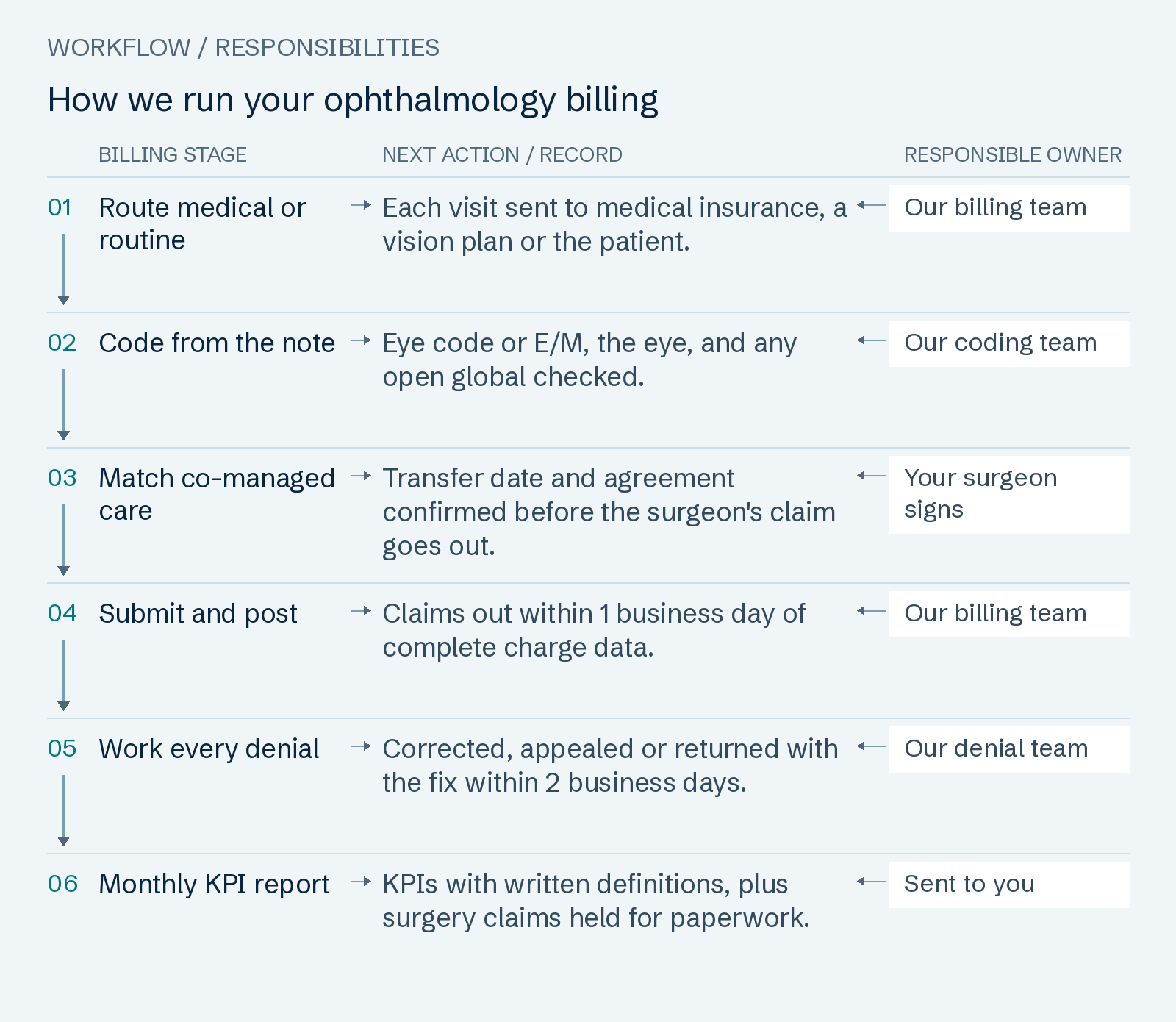
Read the workflow as text
- Route medical or routine — Each visit sent to medical insurance, a vision plan or the patient. Owner: Our billing team.
- Code from the note — Eye code or E/M, the eye, and any open global checked. Owner: Our coding team.
- Match co-managed care — Transfer date and agreement confirmed before the surgeon's claim goes out. Owner: Your surgeon signs.
- Submit and post — Claims out within 1 business day of complete charge data. Owner: Our billing team.
- Work every denial — Corrected, appealed or returned with the fix within 2 business days. Owner: Our denial team.
- Monthly KPI report — KPIs with written definitions, plus surgery claims held for paperwork. Owner: Sent to you.
Eye codes (92002–92014) or E/M: how we choose for your visits
Every office visit in your practice can be billed with one of two code families, and we pick one per visit from the signed note. The 2026 NCCI policy manual, chapter XI says the E/M service includes the general ophthalmological exam, so 92002–92014 are never billed beside an E/M for the same visit. The American Academy of Ophthalmology's exam code guide tells practices to always consider both families, and notes that 99204 is not automatically the equivalent of 92004. We score the note both ways and compare each option with the payer's allowable; any change goes to your ophthalmologist first.
| What the signed note shows | What we bill | What we check first |
|---|---|---|
| All 12 eye exam elements and a treatment plan started or continued | Comprehensive eye code (92004 new, 92014 established), or the E/M level the note supports | Which option the payer allows more for |
| Three to eleven exam elements | Intermediate eye code (92002 new, 92012 established), or E/M | Whether decision making or time supports a higher E/M |
| Decision making or total time recorded | E/M level from decision making or time | That no eye code is also on the claim |
| Commercial plan that caps how often eye codes are paid | E/M when the note supports it | The plan's frequency edit, per the AAO guide |
| OCT, fields or photos on the same day | The test on its own line beside either family | Fundus photos and OCT on one eye only when both are needed |
Refractions and non-covered services we keep off your Medicare claims
Medicare never pays for a refraction. The Medicare Benefit Policy Manual, chapter 16, section 90 excludes eye refractions "by whatever practitioner and for whatever purpose performed", along with exams to prescribe or change glasses, while care for an eye disease such as glaucoma or cataract stays covered. We split the refraction from the medical visit and post it as the patient's balance under that statutory exclusion. CMS's guide to advance written notices says no notice is required for a service Medicare never covers; a voluntary notice is a courtesy, reported with modifier GX, and the GY modifier marks a statutorily excluded line when a claim is needed. For commercial patients we check the plan's refraction benefit before the balance is set.
Cataract surgery, global periods and co-management modifiers 54 and 55 on your claims
Cataract surgery (66982, 66984) carries a 90-day global period in the CMS CY 2026 relative value file, which gives 20% of the package to postoperative care. When a co-managing optometrist takes over that care, the Medicare Claims Processing Manual, chapter 12 requires both claims to carry the same date of service and surgery code, with modifier 54 on the surgeon's claim and 55 on the post-op claim, the date care was relinquished or assumed, and a written transfer agreement in both records. We hold the surgeon's claim until the agreement and transfer date are on file.
- Decision-for-surgery visit. Chapter 12 pays an E/M with modifier 57 on the day of or day before a 90-day-global surgery when that visit led to the decision. We check the note says so before adding it.
- Both eyes on one day. NCCI chapter VIII (eye and ocular adnexa) has physicians report a bilateral eye procedure on one line with modifier 50 and one unit; we format it that way unless the payer says otherwise.
- Bundled tests. When fundus photos and OCT are both needed on one eye, NCCI chapter XI allows both with modifier 59 or XU on the fundus photo (92250); our guide to modifiers 52, 53 and 59 explains what each tells the payer.
Retina injections, J-codes and prior authorization we handle for you
An injection day produces two claim lines: the intravitreal injection (67028, a zero-day global in the 2026 relative value file) and the drug, such as J0178 (aflibercept), J2778 (ranibizumab) or J9035 (bevacizumab). CMS's JW and JZ modifier FAQs require JW for a discarded amount from a single-dose container and, since July 1, 2023, JZ when nothing was discarded. NCCI chapter VIII bars billing a subconjunctival injection with 67028 on the same eye. Medicare Advantage plans may apply step therapy to Part B drugs, but 42 CFR 422.136 limits it to new administrations with a lookback of at least 365 days. Our prior authorization services handle the requests; under full-service billing we track each authorization's expiry.
Our injectable drug claim checklist
- Authorization on file and in date for this drug, eye and visit count, when the plan requires one.
- Treated eye recorded and matched to the injection line.
- Drug J-code and units matched to the dose given.
- JW line for any amount discarded from a single-dose vial, or JZ when none, matched to the vial record.
- National drug code included when the payer asks for it.
- No subconjunctival injection line on the same eye.
Medical insurance vs vision plans: what we bill for you
Each visit is routed before the claim is built: an exam for a medical problem such as glaucoma, diabetes, cataract or a red eye goes to medical insurance, while an exam only to prescribe glasses falls under Medicare's routine-exam exclusion in chapter 16 and goes to a vision plan or the patient. We bill the medical side end to end after our eligibility checks. Vision-plan claims for routine exams, frames and lenses stay with your practice's team.
Our rate card for specialist eye practices
Ophthalmologists sit on the Specialist physician groups row of our rate card, priced by how many clinicians we bill for. Your fee is a percentage of insurance payments posted on claims we submitted or worked, net of payer recoupments and refunds. We take 0% of patient payments, copays and anything your front desk collects. A surgery center's or hospital's own facility claim for a cataract case is not part of your professional billing with us. Setup costs $0. Invoices 1–3: only percentage fees on that month's insurance payments, plus any statements or add-ons you order. Percentage fees and mailed statements are capped at 9.0% of that month's insurance payments; from invoice 4, the $400 minimum applies even in a month when the cap comes to less. Multi-specialty practices: each clinician's claims are billed at that clinician's segment rate; the size band counts every clinician. A therapy or chiropractic clinic sits on a different row; our chiropractic billing services show the rehab row, for example.
Worked example for an eye group
Illustrative example, not client data: a group of three ophthalmologists falls in the 2–5 clinicians band, so its rate is 5.5%. In a month when $60,000 of insurance payments post on claims we worked, the fee is 5.5% of that $60,000; refraction fees and other patient payments that month add nothing, and the fee never exceeds 9.0% of that month's insurance payments. Every add-on and exclusion is on our ophthalmology billing pricing page.
| Eye practice size | Your percentage of insurance payments |
|---|---|
| One ophthalmologist (1 clinician) | 6.0% |
| Small eye group (2–5 clinicians) | 5.5% |
| Larger eye group (6–15 clinicians) | 5.0% |
| 16 or more clinicians | Pricing is by written quote. |
How we start on your eye claims, and the guarantees behind them
To start, we need your signed agreement and BAA, logins to your practice-management system and clearinghouse, a claim-level aging report, your surgery schedule by site and your list of co-managing optometrists. Go-live, when your first claims go out, comes within 5 business days of access; any unbilled backlog follows within 10 business days of access. Clock starts with your signed agreement, signed BAA and working system logins; it extends day for day while we wait on access. In week one: Every inherited claim within 30 days of a filing, corrected-claim or appeal deadline is worked within 5 business days of access. Terms: Starts at access; covers up to 250 claims (more gets a day-1 deadline schedule); worked means submitted, corrected, appealed or returned with the fix.
- On-Our-Watch Guarantee. If a claim misses a filing, corrected-claim or appeal deadline while it is on our watch, we pay you what it would have paid. On the terms above: Claims we get complete 10+ business days before the deadline; contracted rate less any copay you collected, paid automatically within 30 days of final denial; capped $10,000/month; your holds excluded.
- Clock-or-Credit Guarantee. From go-live, every new claim goes out within 1 business day of complete charge data, and every denial is worked within 2 business days of posting — or $25 comes off your invoice for each late one. On the terms above: Mon–Fri ET business days by your system's timestamps; worked: resubmitted, appealed or returned with the fix; auto-credited; capped at monthly fee; clearinghouse outages excluded.
We publish client results only with written permission. Until we have them, judge us by the guarantees and the free Deadline Map. Want to see your exposure first? Get my free A/R Deadline Map. Clock starts with your claim-level aging export and signed BAA; above 10 requests in a week, we confirm your date within 1 business day.
Common questions
- How much does ophthalmology billing cost?
- Our rate is 6.0% of insurance payments for 1 clinician, 5.5% for 2–5 clinicians and 5.0% for 6–15 clinicians. We take 0% of refraction fees and other patient payments, and setup is $0. Percentage fees and mailed statements are capped at 9.0% of that month's insurance payments; the $400 minimum still applies from invoice 4. The full rate card is on our pricing page.
- When should my practice use eye codes instead of E/M, and do you decide that for us?
- The note decides: an eye code fits when the exam elements are documented, an E/M when decision making or time supports the level, and never both for one visit. We score each visit both ways, compare the payer's allowable and ask your ophthalmologist before changing a code. See how we choose.
- Is a refraction covered by Medicare, and how do you bill it for our practice?
- No. Medicare excludes refractions whoever performs them. We keep the refraction off the Medicare claim and post it as the patient's balance under that exclusion, and for commercial plans we check the refraction benefit first.
- How are cataract co-management claims billed by your team?
- Once the written transfer agreement is on file, we bill the surgeon's claim with modifier 54 and the date care was relinquished; the co-managing doctor bills the same code and date with modifier 55. Your monthly report lists any surgeon claims still waiting on that paperwork.
- Do you bill vision plans?
- We bill medical insurance for every medical eye visit, surgery and injection, and route routine exams to the vision plan or the patient. Vision-plan claims stay with your team, and payments on any claim we do not bill carry no fee from us.
- Is there a long-term contract or an exit fee?
- Neither. Month to month. Leave with 30 days' written notice. No termination fee. Clean-Exit Terms apply when you leave: Leave with 30 days' notice and no termination fee. Want a run-out? We keep working the claims we submitted for 90 days at your plan rate. Decline it and we charge nothing on payments that post after you leave. Terms: Notice by email; optional run-out covers claims we submitted before your exit date, at your plan rate; handover file within 10 business days of exit.
Sources and review
Page revised November 5, 2026 · Review contact: Hyder Shah (inquiries@claimpillar.com). All sources retrieved 2026-11-05. Global periods, the postoperative share and code status come from the CMS CY 2026 relative value file (RVU26D).
- CMS: Medicare NCCI Policy Manual 2026, Chapter XI, section G (ophthalmology)
- CMS: Medicare NCCI Policy Manual 2026, Chapter VIII (eye and ocular adnexa)
- American Academy of Ophthalmology, EyeNet: Coding 101, exam code selection (July 2025)
- CMS: Medicare Benefit Policy Manual, Chapter 16, section 90 (routine services and appliances)
- CMS MLN006266: Medicare Advance Written Notices of Non-coverage
- CMS: Medicare Claims Processing Manual, Chapter 12 (sections 30.6.6 and 40)
- CMS: Discarded Drugs and Biologicals, JW and JZ Modifier Policy FAQs
- CMS: Medicare Part B Payment Limit File, October 2026 (J0178, J2778, J9035)
- eCFR: 42 CFR 422.136, Medicare Advantage step therapy for Part B drugs
- CMS: PFS Relative Value Files (CY 2026 RVU26D)