The California payers we bill for your therapy practice
A California therapy practice usually bills four kinds of payer at once: commercial plans such as Anthem Blue Cross, Blue Shield of California and Kaiser Permanente, Medicare for clients 65 and over, and a Medi-Cal managed care plan; some practices also hold a county mental health plan contract. Each payer sets its own filing window, and the windows are short enough to matter. Medi-Cal fee-for-service, for example, pays in full only for claims received within six months of the month of service. We put every claim on a clock from the day the note is signed.
The table shows the filing windows we work to for the main California payers, taken from each payer's own manual. Your own contract can set a different window, and where it does, we work to the contract.
| Payer | Who it covers in your caseload | Filing window we work to |
|---|---|---|
| Medi-Cal fee-for-service (DHCS) | Medi-Cal clients not billed through a managed care plan | 6 months from the month of service; months 7-9 paid at 75%, months 10-12 at 50%, after month 12 denied |
| Anthem Blue Cross Medi-Cal managed care | Medi-Cal members enrolled with Anthem | 180 days from the date of service (participating); 210 days (nonparticipating) |
| Molina Healthcare of California (Medi-Cal) | Medi-Cal members enrolled with Molina | 90 calendar days from the date of service, unless your contract says otherwise |
| Anthem Blue Cross (commercial) | Employer and individual members | PPO: per your agreement; HMO non-capitated services: 12 months from the date of service |
| Blue Shield of California (commercial) | Employer and individual members | 12 months from the date of service, unless your contract says otherwise |
| Kaiser Permanente (community providers) | Kaiser HMO members referred to your practice | 90 calendar days from the date of service, unless your agreement says otherwise |
| Medicare Part B (Noridian, Jurisdiction E) | Clients 65+ and Medicare-eligible clients | 12 months (1 calendar year) from the date of service |
Medi-Cal managed care plans vs county mental health plans: which one pays
Medi-Cal mental health care in California runs through two systems, and the same client can touch both. Take Los Angeles County. L.A. Care, the county's Medi-Cal plan, sends most mental health services, including therapy and psychiatry, through its partner Carelon Behavioral Health, while the Los Angeles County Department of Mental Health serves members who need a higher level of mental health care, including specialty mental health services such as crisis care. L.A. Care also describes a "No Wrong Door" approach, so a member can start from any point and still be connected to the right care.
For your practice, that means a Medi-Cal therapy claim goes to whichever network you contracted with for that client's plan, under that network's rules. We bill Medi-Cal managed care claims; county mental health plan contracts are billed under each county's own claiming rules and are not part of our service.
How the two systems compare for your billing
| Medi-Cal managed care plan | County mental health plan | |
|---|---|---|
| Who pays your claim | The plan or its behavioral health partner (for L.A. Care, Carelon Behavioral Health) | The county behavioral health department (for example Los Angeles County DMH or County of San Diego Behavioral Health Services) |
| Typical services | Most outpatient therapy and psychiatry, per L.A. Care's member page | Specialty mental health services for members who need a higher level of care |
| How your practice joins | Credentialing and a contract with the plan's behavioral health network | A county provider contract |
| How rates are set | Your network contract | County rates built on the state's fee schedule since payment reform (see the next section) |
| What we do | Check the client's plan, county and the network you are contracted with, then bill the claim | Not billed by us: county contracts follow the county's own claiming rules |
CalAIM payment reform for county-contracted programs
CalAIM behavioral health payment reform changed how county mental health plans pay their contracted programs. The County of San Diego's payment reform overview lists three key transitions:
- From cost reimbursement to a fee-for-service payment structure.
- To intergovernmental transfers (IGTs).
- From HCPCS-only coding to a combination of HCPCS and CPT codes.
The same document dates the start of payment reform to July 2023, names DHCS Behavioral Health Information Notice 23-017 (April 2023) as the state's rate notice, and says the change eliminates cost reports. San Diego set baseline rates for its providers as a portion of the state rates, added modifiers for program size, location and specialized populations, and planned to move most eligible contractors to fee-for-service by July 1, 2024.
For a county-contracted program, revenue now depends on each encounter being coded and documented to the county's rules. County contract billing is not part of our service; we bill the Medi-Cal managed care, Medicare and commercial claims around it.
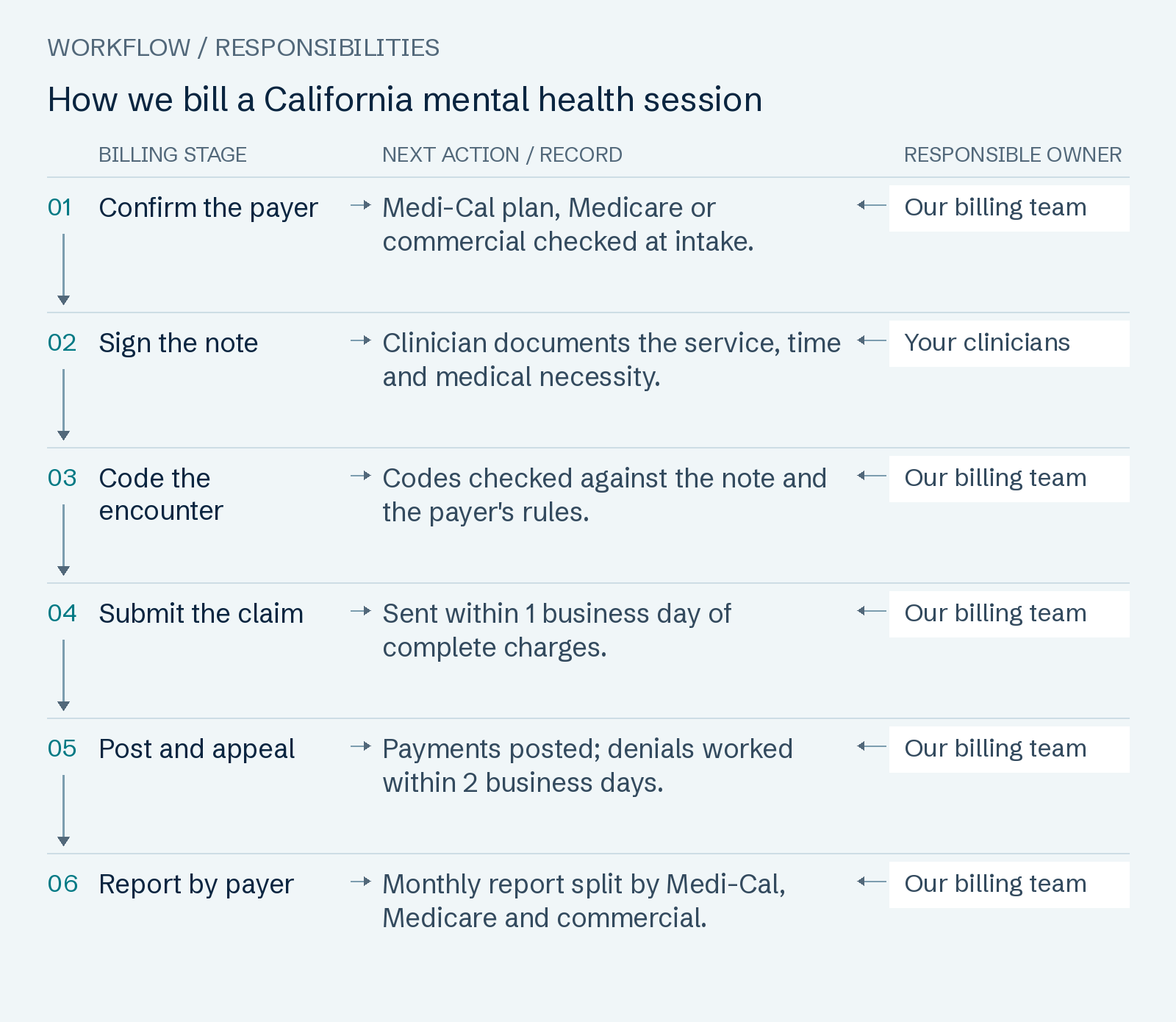
Read the workflow as text
- Confirm the payer — Medi-Cal plan, Medicare or commercial checked at intake. Owner: Our billing team.
- Sign the note — Clinician documents the service, time and medical necessity. Owner: Your clinicians.
- Code the encounter — Codes checked against the note and the payer's rules. Owner: Our billing team.
- Submit the claim — Sent within 1 business day of complete charges. Owner: Our billing team.
- Post and appeal — Payments posted; denials worked within 2 business days. Owner: Our billing team.
- Report by payer — Monthly report split by Medi-Cal, Medicare and commercial. Owner: Our billing team.
Medicare through Noridian (JE) for your LCSWs, LMFTs and LPCCs
Medicare Part B claims from California go to Noridian Healthcare Solutions, the A/B Medicare contractor for Jurisdiction E, according to CMS's list of contractors by state. Since January 1, 2024, marriage and family therapists and mental health counselors can bill Medicare independently, paid at 75% of what a clinical psychologist is paid. CMS's counselor category covers counselors licensed as mental health, clinical professional or professional counselors under state law, and California's Board of Behavioral Sciences licenses LPCCs (Licensed Professional Clinical Counselors), alongside LMFTs and LCSWs.
CMS says each clinician enrolls through PECOS or a paper CMS-855 application. We file that enrollment as part of insurance credentialing for therapists, then bill your Medicare sessions under each clinician's own NPI once Noridian confirms the effective date.
California filing and payment timelines we track, and AB 72 surprise billing
Filing on time is the part your practice controls; we track it for every claim using the windows in the payer table above. Once a claim is filed, California law also sets how fast health plans and insurers must pay or contest it. Since January 1, 2026, Health and Safety Code section 1371 gives DMHC-licensed health plans, and Insurance Code section 10123.13 gives CDI-regulated insurers, 30 calendar days after receiving a complete claim to pay it or to notify you that it is contested or denied. We flag every claim that passes its payer's payment window without a decision and follow it up.
When AB 72 applies to your clinicians
AB 72 is California's surprise-billing law for out-of-network professionals working inside in-network facilities. The California Department of Insurance's AB 72 implementation guidance describes an independent dispute resolution process for claim disputes between a health insurer and a noncontracting individual health professional, for services at a contracting health facility. A therapist seeing clients in a private office is usually outside that situation. If your clinicians also see clients inside a hospital or facility where you are out of network, we flag those claims so the patient is billed only as the law allows. For health plan members, Health and Safety Code section 1371.9 sets the matching rule: a member treated at a contracting facility by a noncontracting professional pays no more than the in-network cost-sharing amount, unless an exception in the section applies.
Our rate card for California mental health practices
A California practice is priced on the behavioral health rate card by headcount; Medi-Cal, Medicare and commercial collections are all billed at that one rate. Your fee is a percentage of insurance payments posted on claims we submitted or worked, net of payer recoupments and refunds. We take 0% of patient payments, copays and anything your front desk collects. Invoices 1–3: only percentage fees on that month's insurance payments, plus any statements or add-ons you order; the $400 minimum starts with invoice 4. Percentage fees and mailed statements are capped at 9.0% of that month's insurance payments; the $400 minimum still applies from invoice 4.
Illustrative example, not client data: Example: 3 therapists with $30,000 of insurance payments in a month pay 7.5%, or $2,250. That month's cap would be $2,700.
Month to month. Leave with 30 days' written notice. No termination fee. Claims we get complete 10+ business days before the deadline; contracted rate less any copay you collected, paid automatically within 30 days of final denial; capped $10,000/month; your holds excluded. On the terms above, our On-Our-Watch Guarantee applies: If a claim misses a filing, corrected-claim or appeal deadline while it is on our watch, we pay you what it would have paid. The full terms are on the pricing page.
| Practice size | Rate on insurance payments | Patient payments | Setup |
|---|---|---|---|
| 1 clinician | 8.0% | 0% | $0 |
| 2–5 clinicians | 7.5% | 0% | $0 |
| 6–15 clinicians | 7.0% | 0% | $0 |
How we serve Los Angeles, the Bay Area and San Diego remotely
Your billing runs from outside California: we keep no office in Los Angeles, the Bay Area, San Diego or elsewhere in the state. Our team logs in to the practice-management system and clearinghouse you already use, once a signed BAA is in place, and stays in touch through email and scheduled calls. Payers keep depositing to your own bank account. We check every code against your clinician's documentation and never change a code without the clinician's sign-off.
Location still matters for Medi-Cal. A Los Angeles client's specialty mental health services run through the Los Angeles County Department of Mental Health, while San Diego County's contracted programs bill County of San Diego Behavioral Health Services under its own payment reform rates. In the Bay Area we check each client's plan and county the same way, rather than assuming one payer for the whole caseload. Our mental health billing services cover the same core work in every state; the overview of behavioral health revenue cycle management shows how the pieces fit.
To start, send us your aging report: Get my free A/R Deadline Map. Clock starts with your claim-level aging export and signed BAA; above 10 requests in a week, we confirm your date within 1 business day.
Common questions
- Do you bill Medi-Cal for therapy?
- Yes. We bill Medi-Cal managed care plans and their behavioral health networks, and Medi-Cal fee-for-service claims. County mental health plan contracts are billed under each county's own rules and are not part of our service. Your clinicians need to be enrolled and contracted with each plan first; we can file those enrollments through our credentialing service.
- Do you handle both Medi-Cal managed care plans and county mental health plan contracts?
- We bill Medi-Cal managed care plans; county mental health plan contracts are not part of our service, because a different organization pays each claim under its own claiming rules. In Los Angeles County, for example, L.A. Care sends most therapy and psychiatry through Carelon Behavioral Health, while the County Department of Mental Health covers specialty mental health services for members who need a higher level of care. We record each client's plan and county at intake, then bill the managed care network that applies under its rules.
- Can you bill Medicare for our LPCCs?
- Yes, once each counselor is enrolled. Since January 1, 2024, Medicare pays mental health counselors and marriage and family therapists directly, at 75% of the clinical psychologist amount, and CMS's counselor category covers counselors licensed as professional clinical counselors. We file the Medicare enrollment, wait for Noridian to confirm the effective date, then bill under each clinician's own NPI.
- How much does behavioral health billing cost in California?
- California has no separate price list. A solo clinician (1 clinician) pays 8.0% of insurance payments; 2–5 clinicians pay 7.5%; 6–15 clinicians pay 7.0%. Patient payments carry 0%, setup is $0, and the $400 minimum begins with your 4th monthly invoice. Every term is on the pricing page.
- Should a California practice hire a billing company with a local office?
- It does not need to. What protects your revenue is knowing which Medi-Cal plan, county contract or commercial payer each claim belongs to, and its filing window. We bill from outside California, inside your own practice-management system, and confirm each client's plan and county before the first claim.
- How fast can we switch our billing to you?
- Go-live, when your first claims go out, comes within 5 business days of access; any unbilled backlog follows within 10 business days of access. Clock starts with your signed agreement, signed BAA and working system logins; it extends day for day while we wait on access. Every inherited claim within 30 days of a filing, corrected-claim or appeal deadline is worked within 5 business days of access.
Sources and review
Page revised November 5, 2026 · Review contact: Hyder Shah (inquiries@claimpillar.com). L.A. Care, County of San Diego, CMS, Board of Behavioral Sciences and Department of Insurance sources were retrieved on November 5, 2026; Medi-Cal, commercial and Medicare filing windows come from our timely-filing dataset, checked against each payer's manual in October 2026.
- L.A. Care Health Plan: Behavioral Health (Carelon Behavioral Health, Los Angeles County DMH, No Wrong Door)
- County of San Diego Behavioral Health Services: CalAIM Behavioral Health Payment Reform Overview (updated June 7, 2024)
- CMS: Medicare Administrative Contractors by State
- CMS: Marriage and Family Therapists & Mental Health Counselors
- California Board of Behavioral Sciences: Licensed Professional Clinical Counselor
- California Department of Insurance: Implementation Guidance AB 72:1, Independent Dispute Resolution Process (June 9, 2017)
- Medi-Cal Provider Manual: Claim Submission and Timeliness Overview (via content/data/timely-filing.csv)
- Anthem Blue Cross Medi-Cal Managed Care: Claims Timely Filing reimbursement policy (via content/data/timely-filing.csv)
- Molina Healthcare of California: Medi-Cal Provider Manual 2026 (via content/data/timely-filing.csv)
- Anthem Blue Cross California HMO Provider Manual (via content/data/timely-filing.csv)
- Blue Shield of California: Independent Physician and Provider Manual (via content/data/timely-filing.csv)
- Kaiser Permanente: HMO Provider Manual, Claim Billing and Payment (via content/data/timely-filing.csv)
- California Health and Safety Code section 1371 (claim reimbursement, operative January 1, 2026; code text via California Public Law)
- California Insurance Code section 10123.13 (claim reimbursement, operative January 1, 2026; code text via California Public Law)
- California Health and Safety Code section 1371.9 (in-network cost sharing at contracting facilities; code text via California Public Law)