Who can join Aetna's behavioral health network
Aetna takes behavioral health clinicians through a separate door. Its request-to-join page tells every behavioral health professional, including one joining a medical group, to complete the Behavioral Health Request for Participation form rather than the medical form. The May 2025 edition of the Aetna provider manual describes Aetna Behavioral Health as an internal business unit of Aetna, so the same company credentials and contracts your therapists; there is no outside carve-out vendor to apply to first.
Aetna's public join pages do not publish a list of the behavioral license types the form accepts. What they do publish is the test every applicant faces: Aetna's credentialing overview verifies licensure or certification through the state licensing boards in the areas where the clinician will care for Aetna members. In practice, that means the clinician's own license, in each state where they will see Aetna members, is what gets checked.
Aetna checks network need before anything else
Being qualified is not the same as being accepted. Aetna's joining-the-network FAQs say that, based on state law, it reviews each request against its current network serving members in a specific geographic area. A fully licensed LCSW can still be told the area is covered. That review comes first, so a complete CAQH profile does not by itself win a contract.
Before you apply: CAQH, NPI, malpractice, license
Aetna pulls the credentialing application from CAQH ProView in most states, unless state regulation requires something else, and uses ARCCVS for physicians in Arkansas, according to the provider manual. CAQH now operates as DataSpring, which says it provides the platform at no cost to clinicians, provider groups and practices and keeps profiles on a 120-day attestation cycle. Aetna's manual adds the step most often missed: you must designate Aetna as an authorized health plan, or Aetna cannot open the application.
The table maps the factors Aetna's credentialing overview says it considers to what your practice should have ready before the request goes in. Use it as the document checklist for each clinician.
| What Aetna's overview says it considers | What to have ready for each clinician | Where it lives |
|---|---|---|
| Licensure or certification, checked with state boards | An active license in every state where the clinician will see Aetna members | CAQH profile, license section |
| Current professional liability coverage | The current malpractice certificate with coverage dates | Uploaded to CAQH |
| Malpractice claim history | Every claim disclosed, with its outcome | CAQH disclosure questions |
| Disciplinary history (state boards and the NPDB) | Full answers on any license action | CAQH disclosure questions |
| Education and training | Highest degree and training program | CAQH education section |
| Work history | A complete history with dates | CAQH work history |
| Board certification, when applicable | Board name and dates (for example, BACB for a BCBA) | CAQH profile |
| DEA and state controlled-substance registration, when applicable | Current registrations for prescribers only | CAQH profile |
| Participation in Medicare or Medicaid | Enrollment status in each program | CAQH profile |
Step-by-step application
The order below follows Aetna's join page and FAQs. Two details matter for a group practice: the provider manual says providers who are required to have an NPI include it on HIPAA standard transactions, and Aetna's facility section says a separate application is needed for each provider in a group. A request for a Type 1 NPI group sent on the facility form is automatically denied.
- Confirm the clinician's license and NPI. One request per clinician, under the clinician's own individual NPI.
- Attest the CAQH profile and authorize Aetna. Aetna's join page asks for a complete CAQH ProView application to avoid credentialing delays.
- File the Behavioral Health Request for Participation. Aetna's FAQs say it works with a vendor, 3Won, to process requests through ProVault, where the contracting and credentialing process begins. Save the confirmation and the date sent.
- Watch for the CAQH registration kit, if needed. A clinician not yet registered with CAQH gets a kit within 10 business days of the request; a clinician already registered gets no other correspondence.
- Receive the eligibility answer. Aetna says it tells you within 45 days whether the clinician is eligible and begins contracting.
- Contract and complete credentialing. The owner reviews and signs the contract. If Aetna reports an information error, the clinician corrects it with the entity that reported it, such as the licensing board.
- Receive welcome materials. Aetna's join page says the contract is finalized and welcome materials follow when credentialing is complete.
Aetna's two pages describe steps 6 and 7 in different orders: the join page puts contracting before credentialing, while the FAQs describe a written credentialing notice first and contracting after it. Either way, Aetna states that both must be complete before the clinician is a network provider. The same sequence, set beside other payers, is laid out in the insurance credentialing process guide.
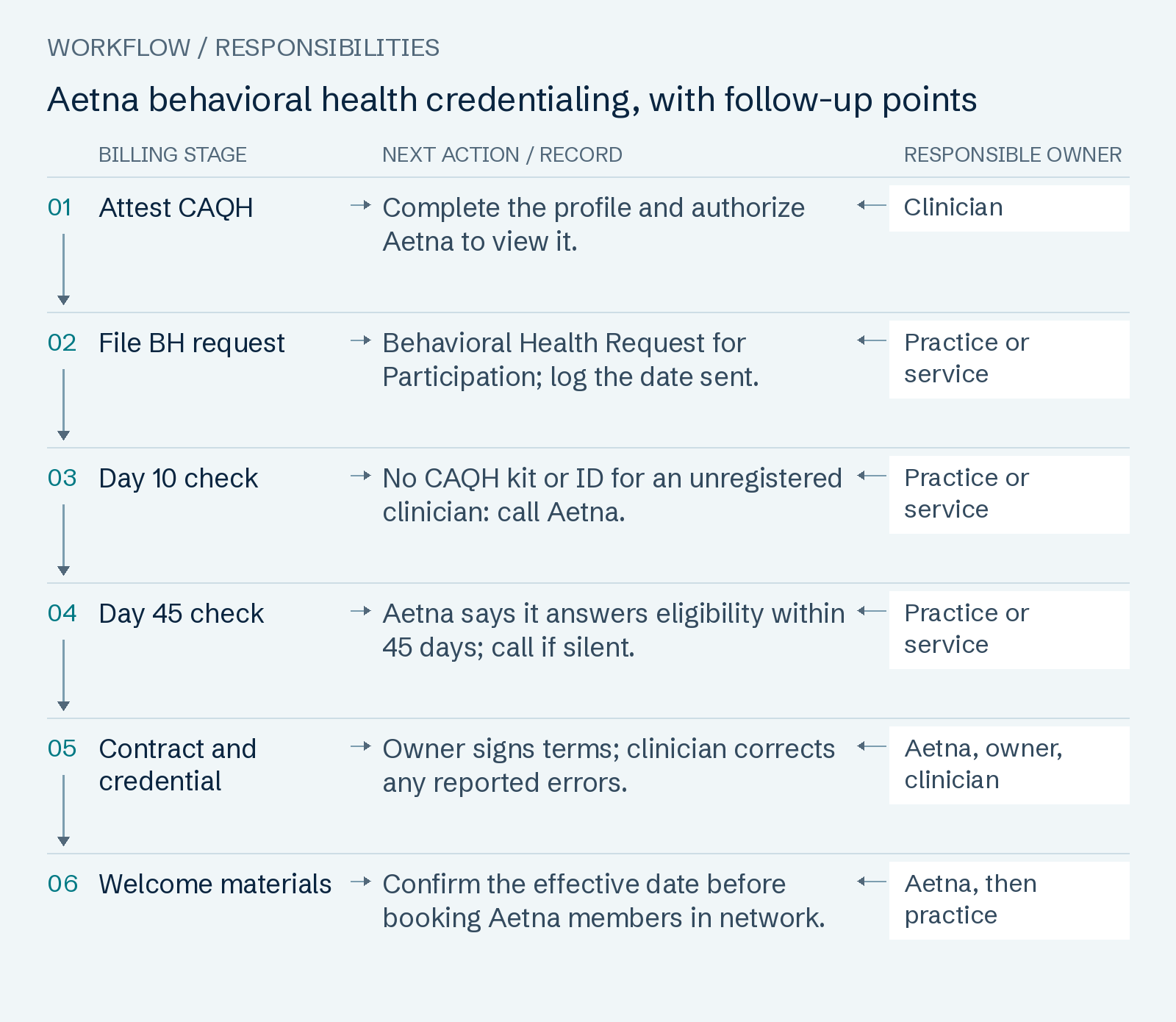
Read the workflow as text
- Attest CAQH — Complete the profile and authorize Aetna to view it. Owner: Clinician.
- File BH request — Behavioral Health Request for Participation; log the date sent. Owner: Practice or service.
- Day 10 check — No CAQH kit or ID for an unregistered clinician: call Aetna. Owner: Practice or service.
- Day 45 check — Aetna says it answers eligibility within 45 days; call if silent. Owner: Practice or service.
- Contract and credential — Owner signs terms; clinician corrects any reported errors. Owner: Aetna, owner, clinician.
- Welcome materials — Confirm the effective date before booking Aetna members in network. Owner: Aetna, then practice.
Typical timelines and how to follow up
Aetna publishes no total time from request to in-network status for behavioral health clinicians, and no one can promise one. It publishes three clocks, and each is a follow-up point for whoever owns the file. Any longer figure you read online is an estimate, not an Aetna number.
How to check an Aetna credentialing status
Status runs by phone in most states. Aetna's FAQs offer Missouri providers an online status request and tell providers in every other state to call; the provider manual lists Aetna Credentialing Customer Service at 1-800-353-1232. Ask for the date of each stage, and write down who you spoke to.
| Clock | What Aetna's pages say | Your follow-up point |
|---|---|---|
| CAQH registration kit | Arrives within 10 business days of the request, for clinicians not yet registered | Day 10 (business days): no kit and no CAQH ID, call |
| Eligibility answer | Within 45 days of the request | Day 45: no answer, call and quote the request date |
| Contracting and credentialing | No day count published | Every two weeks: ask what is outstanding and from whom |
| Welcome materials | Sent when credentialing is complete and the contract is finalized | Confirm the date the contract takes effect |
| CAQH attestation | DataSpring keeps profiles on a 120-day cycle | Re-attest before it lapses while the file is open |
| Recredentialing | Every three years, unless regulation or accreditation requires otherwise | Keep CAQH current between cycles |
Closed panels and how to appeal
Aetna tells applicants when it will not proceed. Its join page says that if the panel is not open, or Aetna does not intend to pursue a contract, you are notified by letter or email that the request has been denied. That wording appears in the facility section; for clinicians, the FAQs describe the same area-by-area review of network need under state law.
The Aetna pages reviewed for this guide describe no appeal route for a network-need decision. The provider manual's appeal processes cover coverage and claim decisions, not network admission. A closed-panel letter therefore leaves your practice with decisions, not an appeal form:
- Ask your Aetna network contact which geographic area the decision covered, and whether a different practice location would be reviewed differently.
- Ask when Aetna would accept a new request for the same clinician.
- Tell Aetna members before their first visit that this clinician is out of network, or book them with a colleague who is already in network.
The out-of-network referral route for members
A member can still reach an out-of-network therapist in some cases. The provider manual says a member may ask Aetna to approve a nonparticipating referral for routine outpatient behavioral health services, for example when the professional the member prefers is not available in network and the member's plan covers out-of-network services, or when the member is continuing or returning to treatment with that professional. Aetna reviews each request; it is the member's benefit, not a network contract.
Contracting: rates and effective dates
Credentialing verifies the clinician; contracting sets what Aetna pays. Aetna's FAQs call them separate processes and say both need to be complete before a provider is in network. Aetna's public pages publish no behavioral health fee schedule, so the rates you see are the ones in the contract Aetna sends. Before the owner signs, ask Aetna for the rates on the codes your clinicians bill most, and set them beside your self-pay fee.
Two contract facts from the FAQs help with planning. Aetna's standard contract generally includes Aetna plans, and your network rep confirms which plans you accept. Contracts generally renew automatically with no action needed; to change terms, you contact your network rep, so negotiate the rates before you sign.
When your clinician can see Aetna members in network
The finish line is the welcome materials and the contract's effective date, not the credentialing approval. Aetna's join page says the contract is finalized when credentialing is complete. Until that date, an Aetna session with that clinician is an out-of-network visit, paid only if the member's plan covers out-of-network care. Confirm the effective date in writing before the front desk books Aetna members as in-network, and pass it to whoever runs your behavioral health billing. From that date each Aetna claim also runs against a filing limit that, for most claims outside Aetna's Medicaid plans, is set in your agreement; the Aetna rows in our timely filing table show the dispute windows and state rules Aetna publishes.
ABA and specialty therapy notes
ABA agencies face two Aetna rules that general therapy practices do not. First, the provider manual says practitioners treating autism spectrum disorders with ABA need either national certification from the Behavior Analyst Certification Board (BACB) or a state behavior analyst license where they practice. Second, ABA services require precertification: the manual tells providers to call the number on the member's Aetna ID card and speak to Member Services, and Aetna's ABA Medical Necessity Guide sets the criteria. The manual lists the adaptive behavior treatment code range Aetna uses, 97151 to 97158, plus Category III codes 0362T and 0373T.
For an ABA agency, that means credentialing the BCBA is only the first gate; an authorization for each member comes before the first billable session.
Other behavioral services carry their own Aetna checks. The provider manual says inpatient admissions and select ambulatory services need precertification, that diagnoses on claims must be current and consistent with the most recent DSM criteria, and that a comprehensive diagnostic evaluation is expected before treatment starts. Practices whose therapists also join Optum can compare the steps in the Optum behavioral health provider guide, and a practice adding several payers at once can start from insurance credentialing for therapists.
What your practice can hand off
Three things stay with your practice whoever files: the clinician's CAQH attestation, the owner's signature on the contract, and answers only the clinician can give, such as disclosure questions. Everything else is follow-through: building the CAQH profile, filing the Behavioral Health request, logging the date, calling at day 10 and day 45, and chasing the file to welcome materials. A practice-level view of Aetna, including what the wait costs in visits, is in the Aetna credentialing guide for practices.
Our insurance credentialing service takes that follow-through for Aetna and the other payers your clinicians join, and reports the status of every open file every 14 days. Credentialing & Payer Enrollment: $149 per payer. Billed only after the payer confirms your effective date; $0 if denied or panel closed; filed within 5 business days of your complete packet. Every price is on our pricing page. To start credentialing for $149 per payer, tell us which clinicians need Aetna.
Common questions
- How do I get credentialed with Aetna behavioral health?
- Attest your CAQH (DataSpring) profile and authorize Aetna to view it, then file the Behavioral Health Request for Participation on Aetna's join page. Aetna reviews network need in your area and answers within 45 days, then contracts and credentials from CAQH. You are in network once both are complete and the contract is finalized.
- How long does Aetna credentialing take?
- Aetna publishes no total. Its pages give an eligibility answer within 45 days of the request and a CAQH registration kit within 10 business days for clinicians not yet registered. Contracting and credentialing after that carry no published day count, so treat any total quoted elsewhere as an estimate and plan around the welcome materials.
- Does Aetna credential LPCs and LMFTs?
- Aetna's public join pages do not list the license types its Behavioral Health form accepts. They direct every behavioral health professional to that form, and Aetna verifies licensure with the state board in each area where the clinician will see members. Confirm the clinician's license type with Aetna's network line, 1-888-632-3862, before filing.
- What if Aetna's panel is closed?
- Aetna notifies you by letter or email that the request has been denied, and the pages reviewed here describe no appeal route for that decision. Ask which area it covered and when Aetna would accept a new request. A member may still ask Aetna to approve a nonparticipating referral for routine outpatient behavioral health care when their plan covers out-of-network services.
- Can I bill Aetna before my effective date?
- Not as an in-network provider. Aetna states that credentialing and contracting both need to be complete first, and the contract is finalized when credentialing is complete. Before that date, a visit is out of network and is paid only if the member's plan covers out-of-network care. Confirm the effective date in writing before booking Aetna members.
- Do ABA providers need anything extra for Aetna?
- Yes. Aetna's provider manual requires BACB certification or a state behavior analyst license for practitioners treating autism with ABA, and ABA services need precertification through the number on the member's ID card. Credentialing the BCBA does not replace the authorization for each member.
Sources and review
Page revised November 5, 2026 · Review contact: Hyder Shah (inquiries@claimpillar.com). Aetna's pages refused automated requests on November 5, 2026, so their text was confirmed that day from Internet Archive captures of the same aetna.com addresses (join page July 2026, FAQs June 2026, provider manual edition 5/25, rechecked against the 6/26 edition captured October 2, 2026, credentialing overview dated September 10, 2018). ClaimPillar is not affiliated with Aetna; confirm current rules with Aetna before you act.
- Aetna: Request to join the Aetna network (retrieved 2026-11-05)
- Aetna: Joining the provider network FAQs (retrieved 2026-11-05)
- Aetna: Credentialing overview, PDF dated September 10, 2018 (retrieved 2026-11-05)
- Aetna: Provider manual, editions 5/25 and 6/26 (retrieved 2026-11-05)
- Aetna: Provider manuals page (retrieved 2026-11-05)
- DataSpring (formerly CAQH): For clinicians and office staff (retrieved 2026-11-05)