7 benefits of outsourcing medical billing
Each benefit below is real only when a written term backs it. The line after each one names that term, so you can check a proposal against it.
- Your billing cost follows your insurance payments. A biller's salary is paid in a month when claims stall; a percentage fee falls with the payments it is taken on. Holds when: the fee base is insurance payments actually posted, and any monthly minimum is small next to your slowest month.
- Claims keep going out when someone leaves. With one in-house biller, a resignation or a long illness stops submission while every payer's filing clock keeps running. Original Medicare allows 1 calendar year after the date of service (42 CFR 424.44); Cigna lists 90 days for participating providers (Cigna's claim submission page). Holds when: the contract names who covers your queue during the company's own staff absences.
- Someone else is accountable for filing deadlines. Inside a practice, a missed deadline is simply lost revenue. Holds when: the company puts a deadline guarantee in writing that says what it pays if a claim it holds misses a filing, corrected-claim or appeal deadline.
- Denials get worked on a clock. An unworked denial sits while its appeal window closes. Holds when: the contract sets a turnaround for working each denial and a remedy when the company misses it.
- Your staff get time back for patients. Charge entry, posting and payer follow-up leave the front desk. Holds when: a scope table lists which tasks move and which stay; decide whether eligibility checks and copay collection stay with you; HHS-OIG's guidance says billing companies should encourage providers to make a good-faith effort to collect copayments and deductibles (OIG compliance guidance for billing companies).
- You see your revenue cycle in numbers every month. A/R days, aged A/R over 90 days, denials and net collection rate arrive in one report. Holds when: the contract fixes the report date and defines each number in writing, so this month can be compared with last month.
- No recruiting or training when the billing seat empties. Hiring and training a replacement biller is your cost and your delay. Holds when: the company commits to a start date counted from the day you give it access, so you know when claims resume.
If a proposal backs none of these with terms, the benefit is a sales line. The full-service medical billing we offer puts each one in writing, with the terms listed further down.
Pros and cons of outsourcing medical billing
Outsourcing moves the claim work, not your obligations. The table sets each advantage against the disadvantage that comes with it and the term or check that decides which one your practice gets.
Two cons deserve a closer look. First, the fee structure: HHS-OIG has recorded a "longstanding concern that percentage billing arrangements may increase the risk of upcoding and similar abusive billing practices" (OIG guidance, 1998), so ask how codes are checked against documentation and who approves a change. Second, liability: Medicare requires whoever received an overpayment to report and return it within 60 days after identifying it, or by the cost-report due date if later (42 CFR 401.305), and OIG notes billing companies are rarely in a position to make restitution for their clients. Refunds stay your practice's job.
| Area | Pro | Con | What decides it |
|---|---|---|---|
| Cost | The fee falls in a slow month; a salary does not | At high payment volume, a percentage can cost more than a biller | Your monthly insurance payments against the break-even below |
| Continuity | A team covers the queue through absences | You depend on one outside company instead of one employee | Written cover terms and a start-date commitment |
| Deadlines and denials | Work runs on stated turnaround times | Turnaround promises with no stated remedy are hard to enforce | A deadline guarantee and turnaround credits in the contract |
| Control | You read monthly numbers instead of chasing a desk | You see the work through reports and logins, not over a shoulder | Logins held in your practice's name and a defined monthly report |
| Coding | Codes are checked against documentation | A percentage fee can reward higher codes | No code change without your clinician's sign-off |
| Patient data | A business associate agreement sets safeguards in writing | Data leaves your practice, sometimes to subcontractors | A signed agreement before any data moves, covering subcontractors |
| Liability | Errors are found by people who do this daily | Overpayment refunds and compliance stay with you | Who reports overpayments to you, and how fast |
| Leaving | You can switch companies instead of rehiring | Long notice, termination fees or no handover can trap you | Notice period, fee, run-out and handover terms |
The cost math: in-house clerk vs % of insurance payments
Billing and posting clerks earned a median $48,500 a year in May 2025 (BLS Occupational Outlook Handbook), about $4,042 a month before benefits. In June 2026, wages made up 70.0 percent of private-industry employer compensation costs and benefits the other 30.0 percent (BLS Employer Costs for Employee Compensation). Dividing the wage by that 70.0 percent share gives an illustrative loaded cost of about $5,774 a month, before software, the clearinghouse or cover for absences. These are national figures from two different BLS populations, not a measured cost for your practice.
The grid sets that one loaded clerk against a percentage fee at example rates. Find the row nearest your average monthly insurance payments, then the column nearest each quote you hold.
Run the comparison on your own numbers
- Add up the monthly in-house costs you would actually stop paying: wage, benefits, payroll taxes, and any software seat or overtime that goes away.
- Multiply your average monthly insurance payments over the last 12 months by the quoted rate (6% = 0.06), then add the quote's fixed monthly extras.
- Compare the two. Break-even payments = avoided in-house cost ÷ quoted rate.
- Repeat with your slowest month, where a monthly minimum can outweigh the percentage.
The full model, with retained costs and a two-biller case, is in our in-house vs outsourced billing cost comparison. Our own rates run 5.0% to 8.5% of insurance payments, by specialty and practice size, on the medical billing rate card. Invoices 1–3: only percentage fees on that month's insurance payments, plus any statements or add-ons you order; the $400 minimum starts with invoice 4.
| Monthly insurance payments | Fee at 4% (example) | Fee at 6% (example) | Fee at 8% (example) | One loaded clerk (illustrative) |
|---|---|---|---|---|
| $30,000 | $1,200 | $1,800 | $2,400 | $5,774 |
| $60,000 | $2,400 | $3,600 | $4,800 | $5,774 |
| $90,000 | $3,600 | $5,400 | $7,200 | $5,774 |
| $120,000 | $4,800 | $7,200 | $9,600 | $5,774 |
| Break-even payments (fee = one loaded clerk) | $144,350 | $96,233 | $72,175 | Illustrative example, not client data |
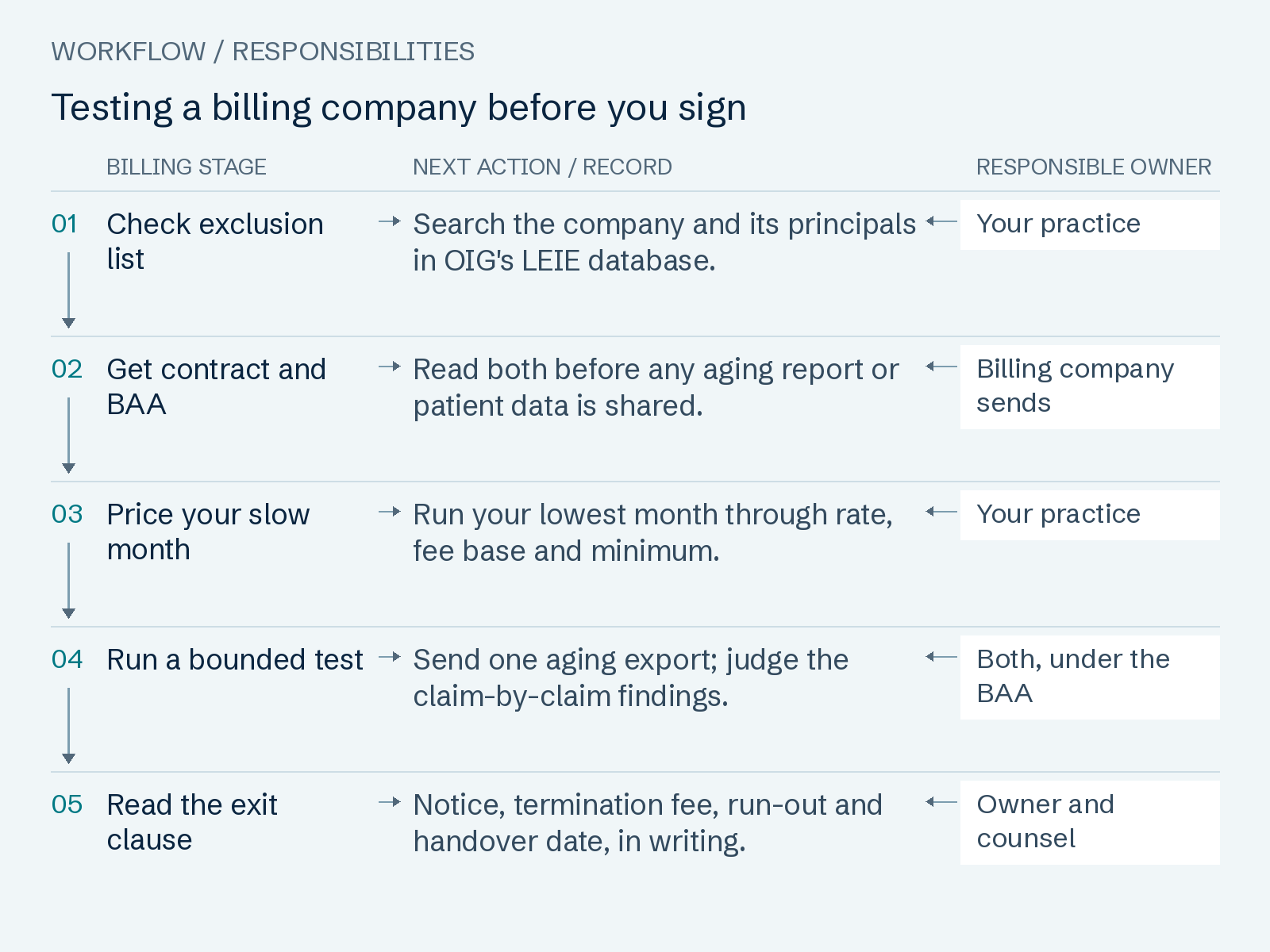
Read the workflow as text
- Check exclusion list — Search the company and its principals in OIG's LEIE database. Owner: Your practice.
- Get contract and BAA — Read both before any aging report or patient data is shared. Owner: Billing company sends.
- Price your slow month — Run your lowest month through rate, fee base and minimum. Owner: Your practice.
- Run a bounded test — Send one aging export; judge the claim-by-claim findings. Owner: Both, under the BAA.
- Read the exit clause — Notice, termination fee, run-out and handover date, in writing. Owner: Owner and counsel.
Terms to demand: deadline guarantees, exit rights, data handover
Every benefit above rests on a clause. Ask for each item in this checklist in writing before you sign, and treat a refusal as information about the company.
Deadline guarantees
A deadline guarantee says what the company pays when a claim it holds misses a filing, corrected-claim or appeal deadline. Read the conditions: how many days before the deadline the company must receive a complete claim, how the payout is calculated, whether it is capped, and whether the money arrives automatically or only after a dispute.
Exit rights
Exit rights decide whether a bad fit costs you a month or a year. Ask for the notice period, any termination fee, whether the company keeps working claims it submitted after you leave (the run-out), and what it charges on payments that post after your exit date. Federal privacy rules also require your business associate agreement to let you end the contract if the company violates a material term (45 CFR 164.504(e)(2)(iii)).
Data handover
At termination, a business associate must return or destroy the patient information it holds, if feasible, and keep no copies (45 CFR 164.504(e)(2)(ii)(J)). Destruction alone leaves you without your claim history, so name the return: what the handover file contains, its format, and the business day it arrives.
| Term | What to get in writing | Why it matters to your practice |
|---|---|---|
| Deadline guarantee | What is paid when a held claim misses a deadline, how it is calculated, any cap | Turns deadline risk into the company's cost |
| Turnaround times | Days to submit a claim and to work a denial, with a credit when missed | A promise without a remedy is a sales line |
| Payments | Every payer pays into your practice's own bank account | Medicare pays a billing agent only when its pay is not tied to amounts billed or collected |
| Fee base | Exactly which payments the percentage is taken on | The same rate costs more on a wider base |
| Coding | No code change without your clinician's sign-off | Keeps a percentage fee from steering codes |
| Notice and termination fee | Notice period in days and the fee, if any, for leaving | Decides how fast you can leave a bad fit |
| Run-out | Who works submitted claims after exit, and the price | Claims in flight still need follow-up |
| Handover file | Contents, format and delivery day | Your next biller starts from this file |
| Business associate agreement | Signed before any data moves; subcontractors bound to the same terms | Required before patient data is shared |
| Overpayments | How fast the company tells you when it finds one | Medicare's 60-day refund clock is yours |
Fees to watch: patient-payment percentages, minimums, statement fees
The headline rate is one line of the invoice. These fees decide what you actually pay, and a quote that leaves them out cannot be compared with one that lists them.
- A percentage of patient payments. A fee on total collections includes copays and balances your front desk collects. Illustrative example, not client data: at 7%, a practice with $60,000 of insurance payments and $6,000 of patient payments a month pays $4,200 on an insurance-only base and $4,620 on total collections, a $420 difference each month.
- Monthly minimums. A minimum replaces the percentage whenever the percentage falls below it. Price your slowest month of the last year against it.
- Statement fees. Mailed patient statements may be billed per piece. Ask the price and who decides how many go out.
- Setup and onboarding fees. A one-time charge before any claim goes out.
- Old A/R rates. Some companies price claims from before your start date at a separate, higher rate. Ask which claims count as old.
- Termination fees and post-exit charges. A fee for leaving, or a percentage on payments that post after you leave.
- Pass-through costs. Clearinghouse, software and payer application fees, and whether the company marks them up.
Our fees on the same list: 0% of patient payments and $0 setup. Invoices 1–3: only percentage fees on that month's insurance payments, plus any statements or add-ons you order; the $400 minimum starts with invoice 4. Percentage fees and mailed statements are capped at 9.0% of that month's insurance payments; the $400 minimum still applies from invoice 4. Mailed statements are $0.95 each. Contract: Month to month. Leave with 30 days' written notice. No termination fee. For inherited claims, A/R Recovery: For inherited claims 90+ days past the date of service: 15% of the insurance payments that post after we work them, and $0 on claims that never pay. Fee only on insurance payments posting after our logged action; patient payments 0%; full-service clients stay under the 9.0% fee cap. Compare these against other published rates in our medical billing cost breakdown.
When outsourcing is the wrong call
Outsourcing is not the right answer for every practice. Keep billing in-house, or wait, in these situations:
- Your insurance payments sit well above the break-even, and you already employ an experienced biller with a trained backup. Payroll may cost less for the same work, provided absences are covered.
- Most of your revenue is private pay. A fee on insurance payments will be small, but a monthly minimum may be larger than the work it buys. Weigh insurance against private pay first.
- You cannot give system access or sign off encounters promptly. No billing company can submit a claim it does not have, and turnaround guarantees, ours included, start from complete charge data.
- The only proposals you hold lock you in. A long term, a termination fee and no handover date are worse than a stretched in-house team, because you cannot correct the choice.
- The problem starts in the clinic. Unsigned notes or wrong insurance captured at check-in stay your staff's work; outsourcing the claims will not fix them.
A practice with one or two clinicians and modest payments is the opposite case: at $30,000 of monthly insurance payments, the grid above puts even an 8% fee well below one clerk's loaded cost. See how billing for solo and small practices is priced and scoped.
How to test a billing company before signing
A proposal tells you what a company says. These five checks show what it does, and none costs you more than a few hours.
- Check the exclusion list. Search the company and its principals in OIG's List of Excluded Individuals/Entities. OIG states that "anyone who hires an individual or entity on the LEIE may be subject to civil monetary penalties."
- Read the contract and business associate agreement before sending data. HIPAA lets you share patient information with a business associate only after it gives satisfactory assurance that it will safeguard it (45 CFR 164.502(e)). An aging report is patient information.
- Price your slowest month. Run it through the rate, the fee base, the minimum and every listed extra. If the company cannot produce that invoice on paper, the quote is incomplete.
- Run a bounded test. Send one claim-level aging export under a signed agreement and judge the claim-by-claim findings that come back. Ours is The Free A/R Deadline Map: A claim-by-claim list of every unpaid insurance claim over 90 days in the aging report you send: payer, amount, the deadline it faces, the denial reason and the next action, sorted by deadline. Clock starts with your claim-level aging export and signed BAA; above 10 requests in a week, we confirm your date within 1 business day.
- Read the exit clause last, and slowly. Notice, termination fee, run-out, handover contents and date, each in writing. Then ask for two references from practices of your size and specialty.
Put the answers from several companies side by side using our questions for any billing company, or start with the medical billing outsourcing companies compared on published terms. If you decide to switch, here is how to move billing companies without losing claims.
What our medical billing outsourcing puts in writing
We publish the terms this guide tells you to demand, so you can hold us to the same checklist.
On-Our-Watch Guarantee: If a claim misses a filing, corrected-claim or appeal deadline while it is on our watch, we pay you what it would have paid. Claims we get complete 10+ business days before the deadline; contracted rate less any copay you collected, paid automatically within 30 days of final denial; capped $10,000/month; your holds excluded. It applies on the terms above.
Clock-or-Credit Guarantee: From go-live, every new claim goes out within 1 business day of complete charge data, and every denial is worked within 2 business days of posting — or $25 comes off your invoice for each late one. Mon–Fri ET business days by your system's timestamps; worked: resubmitted, appealed or returned with the fix; auto-credited; capped at monthly fee; clearinghouse outages excluded. It applies on the terms above.
Clean-Exit Terms: Leave with 30 days' notice and no termination fee. Want a run-out? We keep working the claims we submitted for 90 days at your plan rate. Decline it and we charge nothing on payments that post after you leave. Notice by email; optional run-out covers claims we submitted before your exit date, at your plan rate; handover file within 10 business days of exit. The handover file holds: Every open claim with its status and next action, the denial log, payer correspondence and credentialing files, in CSV and PDF.
Every payment goes straight to your practice's own bank account. We never receive, deposit or endorse your payments; we invoice you once a month. We check every code against your clinician's documentation and never change a code without the clinician's sign-off.
Rates run 5.0% to 8.5% of insurance payments, set by specialty and practice size. See the full rate card.
Common questions
- What are the benefits of outsourcing medical billing?
- A cost that follows your insurance payments instead of a fixed salary, claims that keep going out when a biller leaves, deadlines and denials worked on a stated clock, staff time back, a monthly report, and no hiring when the seat empties. Each holds only when the contract backs it; see the seven benefits and their terms.
- What are the disadvantages of outsourcing medical billing?
- At high payment volume a percentage can cost more than a biller; you see the work through reports rather than in person; patient data leaves your practice; a percentage fee can reward higher codes; and overpayment refunds stay your responsibility. Contracts with long notice, termination fees or no handover add lock-in. The pros and cons table pairs each with its fix.
- Is outsourcing cheaper than hiring a biller?
- It depends on your monthly insurance payments. In our illustrative example, one billing clerk at the BLS May 2025 median wage, grossed up so benefits are 30% of total compensation, costs about $5,774 a month; an 8% fee matches that at $72,175 of monthly insurance payments and a 6% fee at $96,233. Below that, the fee costs less; above it, payroll may, if you also cover absences.
- What terms should a billing contract include?
- A deadline guarantee with its payout rule, turnaround times with credits, payments into your own bank account, a defined fee base, clinician sign-off on code changes, the notice period and any termination fee, run-out terms, a handover file with contents and a delivery date, and a signed business associate agreement covering subcontractors. The contract terms checklist explains each.
- How much does it cost to outsource medical billing?
- Most companies charge a percentage, so ask what it is taken on, plus minimums, setup, statement and old-A/R fees. Ours is 5.0% to 8.5% of insurance payments by specialty and practice size, 0% of patient payments and $0 setup. Invoices 1–3: only percentage fees on that month's insurance payments, plus any statements or add-ons you order; the $400 minimum starts with invoice 4. The rate card lists every rate.
- Can a small clinic outsource medical billing?
- Yes. With one biller there is no backup, and a percentage fee falls in a slow month; both matter most at small volume. Check the monthly minimum against your slowest month first. Our small-practice billing service covers practices of one to fifteen clinicians.
- Should I outsource medical billing?
- Consider it if one person runs all your billing, denials sit unworked, or claims are nearing their filing limits. Keep it in-house if your payments sit well above the break-even and you have a trained backup. Either way, test any company with the five checks before signing.
Sources and review
Page revised November 4, 2026 · Review contact: Hyder Shah (inquiries@claimpillar.com). Wage and benefit shares come from two different national BLS populations; the loaded cost and break-even figures are our illustrative arithmetic, not observed practice costs. Every source was retrieved on November 4, 2026.
- BLS Occupational Outlook Handbook: Financial Clerks (billing and posting clerks median wage, May 2025), retrieved 2026-11-04
- BLS Employer Costs for Employee Compensation, June 2026 (released September 9, 2026), retrieved 2026-11-04
- eCFR: 42 CFR 424.73, payment to an agent (Medicare), retrieved 2026-11-04
- eCFR: 42 CFR 424.80, payment to a billing agent for suppliers (Medicare), retrieved 2026-11-04
- eCFR: 42 CFR 424.44, time limits for filing Medicare claims, retrieved 2026-11-04
- eCFR: 42 CFR 401.305, reporting and returning Medicare overpayments, retrieved 2026-11-04
- eCFR: 45 CFR 164.502(e), disclosures to business associates, retrieved 2026-11-04
- eCFR: 45 CFR 164.504(e), business associate contract terms, retrieved 2026-11-04
- HHS-OIG: Compliance Program Guidance for Third-Party Medical Billing Companies (1998), retrieved 2026-11-04
- HHS-OIG: List of Excluded Individuals/Entities (LEIE), retrieved 2026-11-04
- Cigna Healthcare: submit claims and timely filing for providers, retrieved 2026-11-04