IPA meaning in healthcare
IPA stands for independent practice association. Outside healthcare the same letters mean India pale ale or the International Phonetic Alphabet, but on a payer contract or a credentialing form an IPA is a network of independent clinicians.
The clearest legal definition is in the federal HMO Act. Under 42 U.S.C. 300e-1(5), an individual practice association is a partnership, corporation, association or other legal entity that has a services arrangement with licensed professionals, a majority of whom are licensed to practice medicine or osteopathy. Under that arrangement the members provide their services under a compensation arrangement the entity sets, and share records, equipment and staff where feasible. The statute says "individual"; the FTC and New York's mental health agency say "independent". Both name the same structure.
What stays yours when you join
Each member keeps its own practice, tax ID, office and patients. What the IPA changes is how you reach some health plans: for the contracts the IPA holds, the IPA's agreement, not your own direct contract, sets your rate and the route your claims take.
How an independent practice association works
An IPA contracts with health plans for its members, then pays or routes payment to those members under its own compensation arrangement. The contracts come in two broad forms.
- Fee-for-service contracts. The plan pays per service at rates set in the contract. The FTC has acted against IPAs that negotiated these rates jointly without real integration; in its 2009 Alta Bates Medical Group settlement, the FTC described a 600-physician IPA that had orchestrated collective negotiations for fee-for-service contracts while its physicians had not clinically or financially integrated their practices.
- Capitated contracts. The plan pays the IPA a fixed amount per enrolled member, and the IPA carries the risk of what care costs. The same FTC order did not affect Alta Bates's capitated contracting.
Capitated IPAs and state rules
States regulate IPAs that take on risk. California, for example, defines a risk-bearing organization as a physician-controlled group that contracts with a health plan, receives capitated or fixed periodic payment, and is responsible for processing and paying claims made by providers. In that model your claim goes to the IPA, and the IPA pays you.
| IPA contract type | How the plan pays | Who carries the cost of care | Where your claim goes | What to read |
|---|---|---|---|---|
| Fee-for-service | Per service, at the contract's rates | The plan | Set by the agreement: the plan or the IPA | The rate schedule and the claim-routing clause |
| Capitated | A fixed amount per enrolled member, paid to the IPA | The IPA | To the IPA, which processes and pays it (California's risk-bearing model) | The compensation arrangement and the IPA's payment schedule |
IPA vs ACO vs MSO vs group practice
These four terms appear in the same conversations, often in the same pitch to an independent practice, but they answer different questions: who you contract through, who you are accountable with, who runs your back office and who owns the practice.
An ACO (accountable care organization) is defined in Medicare's rules at 42 CFR 425.20 as a legal entity with its own taxpayer identification number, formed by eligible ACO participants. The list of eligible participants in 42 CFR 425.102 includes "networks of individual practices of ACO professionals", so an IPA can form or join one. CMS says an ACO that gives high-quality care and spends wisely may share in the savings it achieves for Medicare.
An MSO (management services organization) is, in the Milbank Memorial Fund's description, an entity that provides non-clinical services such as billing, human resources, payer contracting and IT support to physician practices and other health care providers. The same brief notes that corporate-backed MSOs can use full ownership or contractual control, so read who controls what before you sign one.
| Structure | What it is | Your practice stays independent? | Who it contracts with | How the money moves |
|---|---|---|---|---|
| IPA (independent practice association) | A legal entity with a services arrangement with independent clinicians | Yes: own practice, tax ID and patients | Health plans, on behalf of its members | Plan pays the IPA (per service or capitated); IPA pays members under its compensation arrangement |
| ACO (accountable care organization) | A Medicare Shared Savings Program entity with its own TIN, formed by eligible participants | Yes, if it joins as a participant | CMS, for an assigned Medicare fee-for-service population | May share in the savings it achieves for Medicare |
| MSO (management services organization) | A company that sells non-clinical services to practices | Depends on the deal: clinical care stays with the practice, but some MSO deals add ownership or contractual control | The practices it serves | The practice pays the MSO for its services |
| Group practice | One practice with clinicians under one entity | No: one combined practice | Plans, directly, under the group's own contracts | Plan pays the group; the group pays its clinicians |
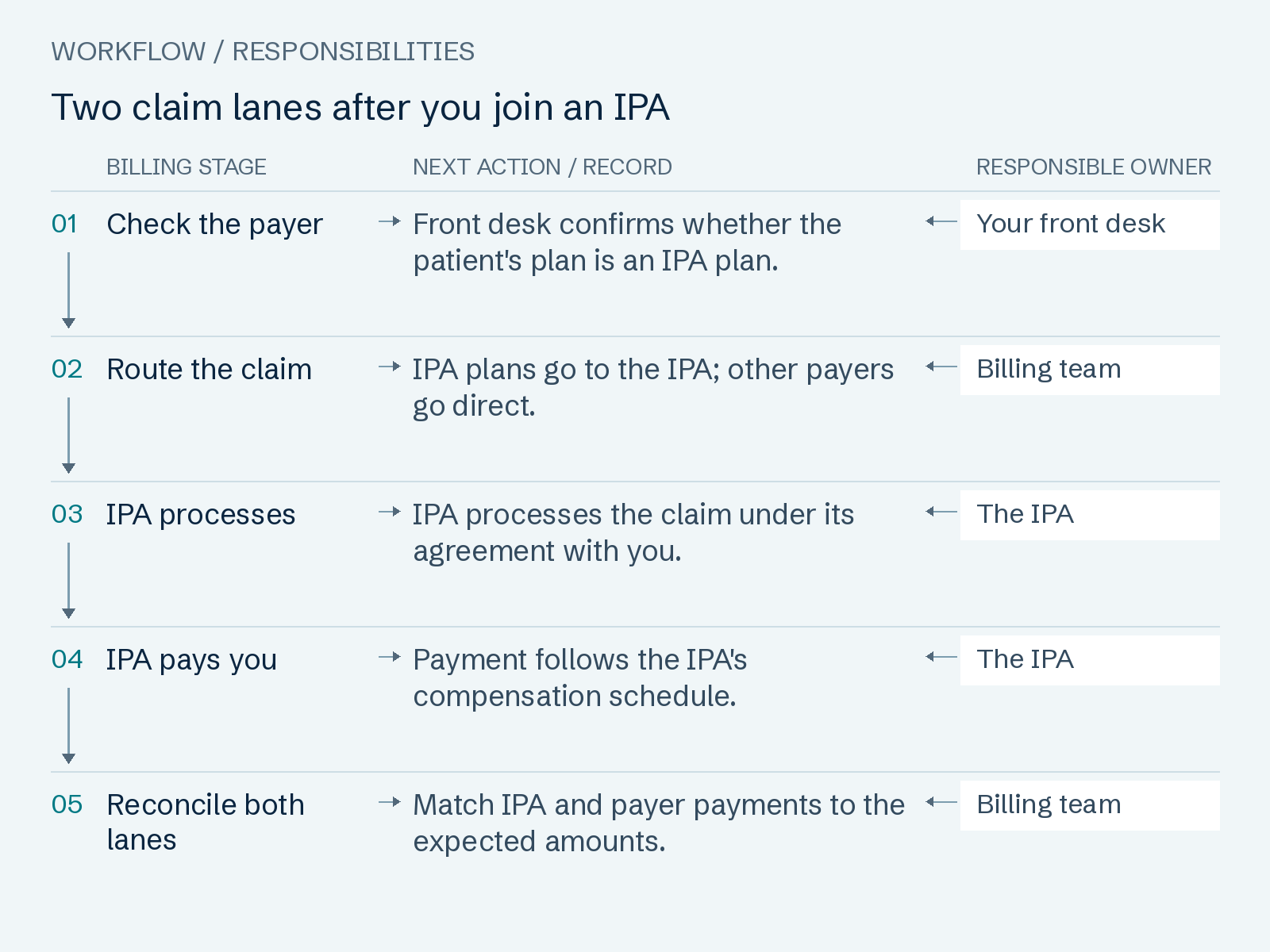
Read the workflow as text
- Check the payer — Front desk confirms whether the patient's plan is an IPA plan. Owner: Your front desk.
- Route the claim — IPA plans go to the IPA; other payers go direct. Owner: Billing team.
- IPA processes — IPA processes the claim under its agreement with you. Owner: The IPA.
- IPA pays you — Payment follows the IPA's compensation schedule. Owner: The IPA.
- Reconcile both lanes — Match IPA and payer payments to the expected amounts. Owner: Billing team.
Behavioral health IPAs and therapy networks
Therapists and other behavioral health clinicians can belong to IPAs. The federal definition in 42 U.S.C. 300e-1(5) names psychology and any other licensed health profession alongside medicine, though under that definition a majority of members must be physicians. State programs have gone further and built networks of behavioral health providers.
New York is the clearest example. The state Office of Mental Health says it and OASAS created Behavioral Health Care Collaboratives to help providers take part in value-based payment, funded selected networks in 2017, and describes the newer behavioral health IPAs as provider networks that use data to improve value and quality of care.
What it means for a therapy practice
Whether a particular IPA admits solo therapists, group practices or only agencies is set by its own membership rules, so ask for them in writing. If you join, the IPA's plans may carry their own claim rules alongside the ones in our mental health billing services workflow.
Pros and cons for independent practices
An IPA trades some control over your payer contracts for the reach of a network. Weigh both sides against the plans your patients actually carry.
Possible advantages
- Access to plan contracts the IPA already holds, without negotiating each one alone.
- A route into value-based and capitated arrangements a solo practice could not take on by itself.
- Shared records, equipment or staff where the IPA offers them, which the federal definition contemplates.
Possible drawbacks
- Your rate for IPA plans is set by the IPA's compensation arrangement, not by you.
- In a capitated model, money reaches you only after the IPA processes your claim, so your cash timing follows its payment schedule.
- Antitrust exposure belongs to the network. The FTC withdrew its 1996 health care antitrust policy statements in July 2023, along with its 2011 statement on ACOs, and now evaluates health care conduct case by case. An IPA that negotiates fees jointly without real clinical or financial integration is the pattern the FTC challenged at Alta Bates.
This page explains terms; it is not legal advice. Have a healthcare attorney review any IPA agreement before you sign it.
Billing inside an IPA: contracts, capitation and fee-for-service
Joining an IPA splits your payer mix into two lanes, and your billing has to run both.
- Plans the IPA contracts with. Follow the IPA's claim route. Under a capitated contract like California's risk-bearing model, you submit to the IPA and the IPA pays you; under a fee-for-service contract, the agreement says whether you bill the plan or the IPA.
- Every other payer. Medicare, Medicaid and commercial plans outside the IPA keep paying you under your own enrollment and contracts, exactly as before.
- Reconciliation. Check IPA payments against the compensation schedule in your agreement, the same way you would check a payer's remittance against its fee schedule.
Enrollment still matters
The IPA's contract does not replace your own payer enrollment with plans outside it. Each new clinician still needs insurance credentialing with those plans, and with the IPA under whatever process its agreement sets. For the payers outside the IPA, our revenue cycle management services cover claim submission, payment posting and denials for independent practices.
Questions to ask before joining
Use this checklist with the IPA's agreement in hand, for therapists and physicians alike. Get every answer in writing.
- Membership. Which license types does the IPA admit, and does it take solo clinicians or only groups and agencies?
- Plans. Which health plans does the IPA contract with, and what share of your current patients carry them?
- Contract type. Is each plan contract capitated or fee-for-service, and who carries the financial risk?
- Compensation. How does the IPA pay members, on what schedule, and what withholds or fees come out first?
- Claim route. For each IPA plan, do claims go to the plan or to the IPA, and in what format?
- Exclusivity. Can you keep or sign direct contracts with the same plans?
- Credentialing. Who credentials new clinicians with the IPA, and how long does it take?
- Integration. What clinical or financial integration does the IPA have, and has counsel reviewed how it negotiates rates?
- Exit. How much notice do you give to leave, and what happens to claims in process?
Before you sign, check that your own claims are clean. The Free A/R Deadline Map lists every unpaid insurance claim over 90 days in the aging report you send, sorted by the deadline it faces. Clock starts with your claim-level aging export and signed BAA; above 10 requests in a week, we confirm your date within 1 business day. If you would rather hand off your billing with payers outside the IPA, see our medical billing services for small practices and the rates on our pricing page.
Common questions
- What does IPA stand for in healthcare?
- IPA stands for independent practice association. Federal law calls it an individual practice association, in 42 U.S.C. 300e-1(5). Both terms mean the same thing: a network of independent clinicians that contracts with health plans.
- What is an IPA in healthcare?
- An IPA is a legal entity that holds a services arrangement with independent clinicians and contracts with health plans on their behalf. Members keep their own practices, but for the IPA's plans the IPA sets their compensation and may process and pay their claims.
- Is an IPA the same as an ACO?
- No. An ACO is a Medicare Shared Savings Program entity with its own tax ID, accountable for an assigned group of Medicare patients and able to share in savings. An IPA contracts with health plans for its members. Medicare's rules let a network of individual practices form an ACO, so one can lead to the other.
- Can therapists join an IPA?
- They can. The federal definition includes psychology and other licensed professions, and New York's Office of Mental Health describes behavioral health IPAs as provider networks built for value-based payment. Each IPA sets its own membership rules, so ask whether it admits solo therapists or only groups and agencies.
- Do IPA members still need their own billing?
- Yes. The IPA covers only the plans it contracts with; every other payer still pays you under your own enrollment. Even for IPA plans, someone has to submit claims to the right place and reconcile what the IPA pays against your agreement.
- Is it legal for an IPA to negotiate rates for its members?
- It depends on how the IPA is structured, which is a question for a healthcare attorney. The FTC has challenged IPAs that negotiated fee-for-service rates jointly without clinical or financial integration, and since July 2023 it reviews health care conduct case by case rather than under its withdrawn 1996 policy statements.
Sources and review
Page revised November 5, 2026 · Review contact: Hyder Shah (inquiries@claimpillar.com). The workflow checklists are editorial recommendations; payer requirements depend on the program and current policy.
- 42 U.S.C. 300e-1: definitions, including individual practice association (Cornell LII, retrieved 2026-11-05)
- FTC settles price-fixing charges against San Francisco Bay Area doctors group (Alta Bates Medical Group, FTC, June 4, 2009, retrieved 2026-11-05)
- Federal Trade Commission withdraws health care enforcement policy statements (FTC, July 14, 2023, retrieved 2026-11-05)
- 42 CFR 425.20: Shared Savings Program definitions (eCFR, retrieved 2026-11-05)
- 42 CFR 425.102: eligible providers and suppliers (eCFR, retrieved 2026-11-05)
- About the Medicare Shared Savings Program (CMS, retrieved 2026-11-05)
- The corporate backdoor to medicine: how MSOs are reshaping physician practices (Milbank Memorial Fund, April 28, 2025, retrieved 2026-11-05)
- Behavioral health provider networks and value-based payment initiatives (NY Office of Mental Health, retrieved 2026-11-05)
- California Health and Safety Code section 1375.4: risk-bearing organizations (retrieved 2026-11-05)